EMMA the Musical Cast Party - Live!
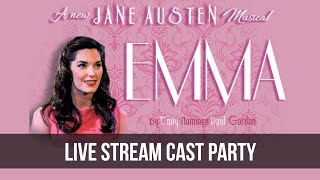
Kelly Barrett hosts a live cast party for EMMA the Musical, filmed in just 10-12 days with a 1960s setting chosen for budget reasons. The cast and directors discuss adapting stage performance for close-up camera work, the challenges of shooting without a live audience, and how streaming musicals could reach viewers everywhere.
Chapters
All right, and 3, 2— Welcome everybody joining us. I see the attendee list is popping up as we go. Very nice numbers. All right, well, we're going to wait about 10 more seconds for it to pop up.
I'm ready now. Sorry about that. I'm here.
All right, well, we're up to 120, which is the magic number for a Zoom after-party. I have, with my great pleasure, like to turn this over to our illustrious host and star of the musical that hopefully you all just saw, Emma Kelly. You are live.
Hi everybody, this is so exciting. Thank you for coming to our after-party. I know we just finished watching. For me, it's like so amazing to to see everybody again because we only had like 11 days together to rehearse this and film this. So it's been amazing to relive this experience and also hard. I find it very hard to watch myself. So it was a love-hate relationship with that whole process, but it was amazing and I loved watching it. I would like to throw this to the cast, go around. We sort of are in our little cubicle holes right now, but I'd like to go around and everybody say who you are and who you played. And how do we do this? Let's start. I'll say your name and then you unmute yourself and tell us who you played and if you had done this production before and if so, how this one was different for you. That's how we're going to start off. How did you have to recraft it for the camera? So let's start with Adam. Can you hear me, Adam?
Yeah.
So I'm—
Hi.
Hi, good to see you. So I'm doing this exciting thing on Zoom where I get to hold down the spacebar and unmute myself.
I've learned some—
exciting thing. So I'm Adam Levine, and I played Mr. Robert Martin. I played this role back when it was done at the Old Globe with a few other folks, and in Brian Herndon's background there, I'm the one to the left of his head. There he is with a little hat. Yeah, so as far as how this was different, so obviously the Globe wasn't a, wasn't a huge space But certainly Mr. Robert Martin, at least the way that I kind of do him, is a little— he's a little bit smaller of a character, at least the way that I kind of play him. So it was interesting to be able to take that living in a bit smaller space in a big theater as opposed to on camera and just trying to find the balance between being too small and not knowing exactly where, what, 'Cause we shot multiple cameras from different lengths and just kind of trying to balance that and trying to hopefully find a good balance between being funny for this big an audience and being funny for this big of an audience. I don't know, hopefully it worked.
That's awesome. I loved your performance. I just, like the moment where she wants to talk to you for the first time and you're like, uh, uh, uh, We just died laughing, everyone in the room. You just stopped us cold. It's so funny. Your comedy is so nuanced, perfect for the camera. And so anyway, I just wanted to let you know that I thought Robert Martin was an amazing character and your portrayal was beautiful.
You're sweet.
It was pretty much me talking to every girl in high school. That was— OK, so let's go to Sharon next. Jane Fairfax. Hi, Sharon.
Hi.
Tell us, how was this process for you? Had you done the role before? And just any thoughts you have.
Yeah, I did the role once before at TheaterWorks with a smattering of these people: Tim and Danny and Coco, Lauren, but we call her Coco, she'll tell you that later, and Brian. And so half the cast was new for me, which was fun. Will, who I got to play opposite with, which is such, such a joy. And I mean, the biggest difference is when you're working in a theater, you get weeks to rehearse. And this one, you were just sort of thrown into the fire and it's like, hi, nice to meet you. Let's do, let's do this scene. So it's fun. You have to have trust in your scene partners and trust in the material and trust in our directors. And just sort of go for broke, you know?
Totally. Yeah. So that's really cool. Did you have to like— do you feel like you had to adjust anything specifically for camera based on your last performance on the stage?
Yeah, of course. You know, like as Adam said, when you're 20 feet away from the audience, you have— you have to open your eyes bigger or project louder. And when there's a camera right here and a microphone, you know, right here, you have the freedom to make a small character like Jane, who's got secrets and is naturally a more quiet human, you have the ability to make her more in her natural state, which was fun.
I love that you said the freedom to make her smaller, because that's how I felt too. I felt like I can pull you into even more thoughts than having to like, you know, to the back row. So it did. It felt freer in a way. So that's— I love the way you worded that. Yeah. And I want to go now to Coco, because there's something specific that you changed for this version, right? Lauren, who plays Coco. Hi. Hi. First of all, if you have anything to say, because I know you played the role before, but there's something specific that you changed?
There is? Did I tell somebody that secret?
I don't know. I have a little thing here that it was like maybe a wig story?
Oh, well, it was a small wig story. They wanted some story. I didn't know how that related. I just got a text. Yes, my wig. Well, changing the period of time that we set this in is a big portion of— actually changed me, I think, in a lot of ways. Those costumes changed the way that I presented Miss Bates. But I didn't have this short of hair as I currently have, my COVID chic haircut.
But—
I love that haircut.
Thanks.
I may actually keep it.
I wore my hair short, but it just didn't feel right of the era, so I wanted to wear some more hair. And when it was time for the fitting, I came with this wig. A friend of mine who was a very close friend of Nell Carter's had left me a bunch of her wigs when she passed away, and I had in this shelf all these Nell Carter-labeled wigs, and I thought, oh, I should pull those out and see if any of them would work. And I got to wear Nell Carter's wig in this movie, which I think is kind of—
Oh!
Tim didn't know, it's making his mind blow.
I love it!
Well then, let's go to Tim. Tim, I know you've done this production before. Who do you play? A small role, I can't remember. It's a small role. Yeah, you are Mr. Knightley.
Mr. Knightley.
So yeah, you did this before. How many times have you done this production?
I mean, it depends on if you're talking about— I mean, 4 times, but 5 or 6 depending on different times that we've done it for presentations and things like that. Um, but I mean, so there was a, a camaraderie that was already there from a lot of people that was great for the town of Highbury. But for me, I mean, not to make you— got to totally gush, but it was really cool for me because it was a— it was like such a lesson of like falling in love for the first time because it was just— it's you because you're Emma. So it was like, what are we doing? Let's not worry about what we've done before. I wasn't thinking about other stuff. We had new costumes and new— and, and two directors that are amazing with Tim and Kenton. And it was just like, it was, it was really just like kind of being in the piece instead of having to just show it. And you were so, so amazing and were willing to try and do anything to see if it would work. And in the end, it's just you and me. In the end, it's the couples looking at each other and loving each other in this community. And that's what I love about the piece. So thank you.
Absolutely. Well, thank you. And I feel like, because this was new to me, it's my very first go, and I felt like I already knew all of you in a weird way. So it's so funny that you guys have done it so many times that I felt like I had been a part of it because you made me just feel like I had been there all along. So thank you. Yeah. I want to throw it to Dani Marcus because speaking of people who have done it a lot, I think she's done about 43 versions of it. Am I right? I'm sorry? Are Harriet, Dani Marcus? Hi, babe. Hi, love. It's so good to see you. Your performance again was just— and Timothy, everybody's so amazing. Like, you're just so sweet. Every time you come on, I just go, oh. I just love her. I love your portrayal of her. Talk to us about what it's like to do her over the years and how it's changed for this medium.
Oh, God. I, you know, just watching this tonight, I feel like having a little bit of distance from the show in the last 2 years, I guess, you forget. I mean, I know how much I love the show, but watching it tonight, I kept turning to my boyfriend saying, God, I love the show. I love it so much. I really, I really do. And I, I, yeah, it's been a huge part of my life.
It's—
there's major milestones that I can point to, um, like, oh, you know, when I was here, that's when this happened in my life, and when I was here, and, you know, this person was getting married when I was in Arizona, and this person was getting married when I was at the Old Globe, and, you know, I mark things by Emma Productions. So it's really, it's like a big part of my life. Um, yeah, as far as the The film stream, I was thinking about this the other day. So in the theater, when you gotta do an 8-show week, you get so used to really showing up in each moment, you know, fully emotionally because you have to do it. You have to be able to repeat it. You have to do it 2 shows in 1 day, even if it's like a really emotional moment, a really physically taxing moment. But I remember there was this day when we were filming this really long sequence And I had to be sort of like happy and joyous in the beginning of the sequence and like sobbing at the end of the sequence. And it took hours and we kept, you know, restarting and going back to the top. And then I would make myself— I'd go to my emotional place, I'd make myself cry, and then I'd restart and I'd have to glue on my eyelashes again. And you turned to me at one point and you said, "Dani, save it for your close-up." You were like, that sounds like me. You're like, we're an hour away from your close-up, save it.
Like, girl, don't burn it all right now. But God love you, you did it every time. You didn't need to save it. Your well was just full. You pulled, you pulled from that for hours. You were amazing that day.
But seriously, I took that and I was like, saving that.
Yeah, you got to cheat where you can cheat, you know. No, I'm just kidding. You're, you're—
I know better now. Thank you.
That's awesome. I totally forgot about that. But yeah, that's exactly something I would say. I really, really quickly just want to go over to the chat and respond to some of these people. Laura Berkowitz, it is wonderful to see your faces. And Janine Talbot is throwing love to Paul Gordon. Superb songs and lyrics in this production. Everyone seemed perfectly cast. Thank you. Sense of humor really comes out in the songs and production. I agree. We have Alice who said she was lucky enough to see this at the Old Globe in San Diego. Loved it then, loved it now. Hopefully somebody can talk about the changes in the period and costume and set dressing and what the motivation to change the time periods was. So we're going to go to that, Alice, in just one second. I want to stay with this one second. I want to go to Rich right now. Richard, how are you? What was it like to do your comic scenes without having an audience present? That's what we want to talk about. You're muted. If you want to unmute or hold down your spacebar, we'll be able to hear you better.
There you go.
Hey, Rich. Hi, Dad. So do you want to tell us about doing comedy and like what it's like without a live audience? Because guys, we didn't have— for everybody watching, we didn't have a live audience, you know. We're doing this on a stage and—
The first day or two that we— we had like 2 days of rehearsal and then we had to do this run-through of everything. It was like I've done every production of the show except the original one and I don't know where I am or what to do. It was like kind of the actor's nightmare.
It really was perfect for your character because he doesn't know where he is either.
Thank God for Coco, because I was saying, I constantly was saying, where do I go? What do I— is this where I come in? It was, um, I'm so pleased with the production now, but at the time, even when we were doing it when you do a show for so many years and you do it always in front of an audience, to come in and do a show in a theater without, uh, some kind of response, it's like so bizarre. I just kept— I don't know how to land this comic line anymore, you know, but it comes out fine. Thank you, Coco.
You were hilarious. Yeah, I felt the same way. And just like, for me, the camera was my audience, and obviously it's giving me nothing but just a black hole. But learning to like make it your best friend and just trust that whatever the choice is, that, that our directors Kent and Tim are there and they're going to tell us try it another way. And it's just, it took a lot of trust, but you nailed it. He was hilarious. And oftentimes he didn't know where he was, and I think that added to the comedy. So I think it was working on your favor. Next, I'm going to go to Will Reynolds. Hi, Will! Hi!
Oh my gosh, it is such a joy to see everybody's face. Oh my goodness, it's just—
You too, brother. And you had done this production before as well.
So yeah, maybe Brian can show in the topiary grove. Yeah, yeah, yeah. So I was in the Old Globe gang. For sure. And also I think we did a presentation in New York as well, I know. But this was such, you know, what's on my mind about it is that, you know, the difference from stage to film acting is a thing, but it's so rare to ever be in the same role and the same, do the same show in one medium where you have to, where it's the stagecraft and making sure the audience is getting what they need to get in that venue is a very different like recipe, but to get to do that in the same role, same piece in both venues is like such a rare gift. And I think we, it was an adjustment for sure, but I felt such a, it was so great to just relax into the character and not have to, so much of it is just kind of, and with all of Jane Austen, I think why it's so attractive to so many people for so long is because it is so intimate, you know, and it is so eye to eye and just like slight touches and just like, did he look at me? Did she look at me? You know, and so we could really just do that and not worry about the back of the house catching it, you know. So it was such a relief to just get to talk and listen and rely on the camera to tell the story and just be ourselves in it. So yeah, and I must say props to Kelly Barrett for literally never leaving the stage for this entire pro— the entire 11 days. I mean, long, long days, all, you know, never leaving the stage of the show as well. And the amount of material, the amount of singing, I I couldn't believe what you were doing. And so if I didn't tell you then, I'm telling you now.
Thank you. You're so sweet. Likewise, your version of Home always gives me goosebumps. And it was just a joy to work with you, brother. It was just such a joy. You brought so much light and kindness into the process.
Thanks so much.
And talent. Yeah, for sure. So next, I want to go to Caitlin for a second because you were— you had worked with Paul Gordon before, very familiar with his work. And I think you have a story about meeting Brian. But I would love to hear— I would love to hear how that happened.
Nothing huge.
Tell us who you played. I mean, you did play the mother who we never see with the hat. You see that much. We need to all give her props here because she's the unsung hero of a lot of those scenes. OK, to you, Caitlin.
Yeah, Somi Pak, one of our two talented costumers, said it looked like I was a lamp. So I thought that was very funny, and I can't unsee that.
Laura, I was just like, is that a cat? It was so funny.
Yeah, but the first time I met Brian, I just remember him like calling me by my character in the book's first name, which is like not mentioned in the show. And I was like, oh, he does his homework? Yes, we're gonna be, we're gonna be in good hands. That was great. And the first day that we filmed, that was the dancing scene, right?
Yeah, the same that were in this rehearsal stage. Yeah.
Yeah, that was wonderful. And I mean, you're gonna hear this echoed a million times, Kelly, but like, damn, like, what? It was such a lovely learning experience to get to watch you work. This girl works hard. And to hear everybody sing again, it was so good.
Yeah, you were exquisite as well, and it was my joy. Thank you for that. You're so sweet. Thank you. Um, so you— okay, so you met Brian. Let's start with Brian. Brian's in his topiary maze situation. Tell us about your backdrop. I need to know why you chose this.
It's the set from the Old Globe production, and, uh, I knew that.
I was just teeing you up.
All right. Uh, and I figured nobody needs to see the, the mess that is the desk behind me, so, you know, you cover up. You learn some things.
I'm just glad you're not disappearing into it like so many people do when they, like, they don't have a head and then it's just topiary words. Okay, so tell us about— tell us about your character. You'd done the production before. What was this like for you?
It was so much fun. One of the things that I love about getting to do so many different versions of this show is watching it evolve over the years and songs that have disappeared and songs that have come back and songs that have changed. We didn't sing Relations for, you know, 5 or 6 years, and then it came back. So the lyrics to Heartfield have changed every single time we've done it. So, you know, that was for me a little bit of, wait, what are we doing this time?
Okay, I got it.
Then we can go on. But I have— I cherish the fact that I've gotten to witness the show evolve because, as Danny said, it's a show I love so much. Get to watch it grow up in a way has been a real joy.
Awesome. I think we have one other cast member that we haven't spoken to, and it's Don. Oh, and Pamela. Sorry, I'm gonna go to Don first and then Pamela. Hi, Don! You're pointing like this, but on my screen it could be anyone. You're muted, Don. You're muted.
The right one.
There's the right one.
There you are.
There it is.
Hi, how are you?
How are you doing? I'm doing well. I'm doing well. I'm in Chicago trying to live through this, and and keep as happy as I can. But thinking about things like this is just amazing. I got to play the fly on the wall. I was Mr. Weston, just to watch you all do what you do so well.
And that was the joy of it. Well, you could have been with them. That is very true.
Yeah, but I was just there to absorb what you all were doing. And to have people who've done this role over and over, then matching with people who had never done it before. And to be in a live theater where it should be there with people, should have had human beings there, but didn't. It just had such a great— reverence to the piece, to the integrity of the designers, to what Paul was trying to create, and the purity of the lyric and the notes chosen. It was— and watch us be directed through it so gently. It was so fun to just watch the people do their brilliant work and then to know people get to see it anytime they want to now.
It's crazy!
I know, that's what's so cool about it. I'd seen it before, and then I can see it again, and I can watch again tomorrow if I want to. I mean, I can't. I won't. But, you know, I could. And that's amazing. Oh yeah, yeah. Just imagine just me in the house watching myself all day. I just want to cut over. Somebody said, Steph, you were lovely, complimentary to the performance, and thank you. You've been a wonderful fan my whole life, and I love you, girl. Saw it 3 times, Chicago Shakespeare. Missed the period costumes, but the show proves that Emma is timeless. So that's really cool that you thought it worked in any time. Thank you, Betsy, for your compliment. And someone said, I saw Lucky Enough to See It in the Old Globe. Oh, I already said that one. Oh, well said that Austen writes intimate scenes that lend themselves to close-up viewing. That's from Laurie Davis. That's something that Will touched on. And it's really cool because we see a lot of Jane Austen movies. And so we get those close-up interactions, but we've never been able to see the hybrid of it musicalized and intimate. So I agree with Will and I agree with you, Laurie. I want to throw it to Pamela. Hi, Pamela. How are you holding up in this pandemic? Pamela and Tim Kashani are married. Tim was one of our directors. Pamela is one of our stars. What was this like for you? How long have you been working on Emma? How long have you been with the project?
I jumped in just like you, Kelly. I jumped in at the last second with Don, who was my life preserver. I couldn't have asked for a more dapper figure to play Mr. Weston. And we had a lot of fun doing that together. But yeah, it was like being on a moving sidewalk. I was waiting for my chance to go on. And then when I was on, I was watching everyone else and finding the levels by observing and quietly sort of taking a back seat, but also finding my presence when it was needed and trying to be a support to you mostly because I feel like Mrs. Weston is your best friend. And is your sort of your mother figure, that your mother passed away when you were young. I've become this for you. And it was interesting to me that that sort of, I felt, happened in real life. When we were in the dressing room, I just so happened to be sitting near you, and I remember you asked me a couple of questions. Sometimes I was helping you run lines because you had so much to do.
You were such a wonderful support. Oh my goodness.
Well, it was— it came naturally to me to love you, honestly. You're just so special, and frankly, you're a savant. I don't know how you did what you did, but I truly enjoyed being that support for your character, and I love this show. I also, like Danny, I was enjoying it again, having had a little distance. From watching it, and I feel proud of it. And it's also so nice to see all of you again.
Likewise, thank you for your energy and your support, and everybody backstage. It was such an amazing group haul of just support and love, and like sometimes like, ah, we don't have time, you know, there are those moments. I certainly diva'd out a couple of times where I was like, I can't remember, I have one more thing, um, but it all came together in the end, and you were such a like calm, even, like just keeping us all from going crazy energy.
And yeah, just keep breathing, that's all.
Just keep, just keep swimming. Yes. Um, Tim was our fearless, one of our fearless directors. It's Tim and Kent Nicholson, they co-directed. Kent sort of did the staged part of it, and Tim was in charge of the, of being behind the camera and making sure that he was getting the shots. And I just want to throw it to you, Tim, and talk about like what— I know that you come from the film world. Was this crazy different from anything you had done before, and any insights that you have?
I started directing on stage and then moved into the film world, so luckily having both—
Oh, good. Oh, good.
—made a huge, huge difference for us. But yes and no. We— because we had shot Memphis and American in Paris already. The big difference, though, is people were actually chatting during the movie saying, how long did you run this in New York? How long did they get to rehearse? And nobody would believe that you had 2 and a half days of rehearsal. But it is very filmic where each scene we would set and we would shoot and we would shoot multiple ways. And then we'd move on to another scene. So for those watching, that's why there's title cards. We never ran this show in order. It was shot more filmic. Probably the most interesting thing for me from the film side is we initially shot it more Broadway where we were putting the cameras out in the audience and looking at it from a 3-camera, 4-camera type shoot. But the— we would then always go up on stage and put it right in your face. And that was in the editing room. Paul and I spent more time together than we did with our significant others looking at the, the language between how much do we lean into film versus how much do we lean in to theater, and the first cut was very, very theater-ish, but by the end, we felt like we had a nice balance for certain moments. In fact, the one shot near the end when you're coming to your epiphany moment, and I remember telling you, okay, we're just gonna shoot the whole number. We won't use the whole thing. We'll cut it up. And then we watched it in the editing bay, and it was just so beautiful not to cut it up. So I guess I lied to you on stage, but I didn't mean to lie to you, so I apologize. But it truly was a triangle.
You gotta be ready for anything.
I wanna turn this over to Kent and Paul, 'cause people ask how we were able to do it, and it was between Kent, myself, Alice Brooks, our cinematographer, who huge shout out to, because we luckily had worked together before. And we just had a second language going on where the minute we'd cut, she's working on lights, I'm working on cameras, Kent's running up on stage. We're dividing and conquering. So when people say, how did you do it? It's cliché in some ways, but Kent, I hope you agree that it would never have happened if we didn't trust each other immensely.
Yeah, that's true. It was 2 weeks of, or 10 days, whatever it ended up being, I don't even remember, of a blur of just trying to get everything right as fast as we possibly could. And then all those— the thing I remember the most is the beautiful moments where we would all, you, Alice, and I in the back, would all look at each other and be like, okay, we got it. And then we'd rush to move on to the next thing, you know. And there was a kind of simpatico energy amongst the three of us really, really remarkably quickly about how how this should, you should come together. And I feel like we learned fast. And also, you know, just reiterating what everybody else has said, like it couldn't have been done if people, if everybody, the cast was so game to just do it and try it. And, you know, we staged the thing in 2 days. I still, I was watching it tonight just going, Oh right, we staged that like in 30 seconds.
Like mere seconds before filming it, we're like, do it like this.
Yeah, totally, totally. It was crazy. I can't believe the amount of work that you did, Kelly. I mean, it's just, just in watching it through, uh, everybody's saying it, but it's, it's true that you never leave the stage, and that's, it's, it's remarkable.
Thank you. It's a role you dream about for sure. And I love that kind of stuff to just like, bye family, I'll see you in 2 weeks. I'm doing this thing that's sort of like, I know we're all sort of like that, you know, the flow when you get in. But I have to say, like, thank God we broke it up because I could not have done it top to bottom in 2 days for sure. I mean, there were definitely moments where I'm like, memorize, memorize, memorize, talk, talk, talk, you know? So thank God we broke it up the way that we did. But yeah, and Tim, to what you were saying about the shots, I noticed something too. Today, maybe that I didn't notice the first time. It's the humiliation number where you're like on stage with her in this very like— it almost felt like Doug Liman in The Bourne Identity, like guerrilla-style shooting, just like on stage in her thoughts. The lights are going through. I don't know. And so I really liked the balance that you struck. I thought it was cool.
Oh, thank you. Well, I'm glad you didn't notice until now because that's what you always try to do is hide the shots so that the emotion is doing it. And I mean, also huge shoutouts to the entire team. I mean, Ben was lighting, his fingers were going so fast when Alice would say something and Darrow was changing that set faster than can be believed. But yeah, I mean, hair, makeup, you name it. And it's kind of the, it was truly a beautiful blend of theater and film because people had come from different backgrounds And when we threw it on you, in fact, when we came home after the day that Richard was talking about, where we just stumbled through, Pamela said, "The cast has turned on you," because it's just been a nightmare.
"Has turned on you." Yeah, the—
and I said, "You know what, though?" I said, "We gotta strike a bit of reality because now we're gonna settle down a little bit." and we needed that visually 'cause we didn't know yet how we were gonna tell this story 'cause normally you have camera tests and all this time to do. So it was, I guess, a little bit selfish from the end-up visual. So I now fully apologize to the entire cast, sort of.
Well, I have to add to that, Tim, though, that in fact, there was no baseline for the staging actually until we could see it in that form. So from, I know it was hell on the cast, from my perspective too, I suddenly knew how it all fit together and how to do some of the little trickier moments where you're in one place and then suddenly you're in somebody's head and then suddenly you're, you know, the Mr. Robert Martin scene goes from a party right onto a city street and we didn't, I had no idea how a lot of that stuff was going to work until we were able to sort of see it together and that I think was essential to to putting the building blocks of the whole thing together as well. Although it was— I do remember it was very rough. Well, we need to hear from Paul.
I was gonna say, speaking of putting it all together, Paul Gordon. Hi! This is the composer, the writer. I mean, come on. Hey guys, it's great to see you. I love this show. I just— I love watching it again, and I just— you can write a melody and a lyric, and I just want to hear from you. And like, people on the chat have questions. Why, you know, what made you think of the 1960s and, and resetting it in that? And like, what was it like to compose it? So I'm turning it over to you.
Well, sure, thanks. And I just want to echo what everybody else was saying, Kelly. Just amazingly how you, how you just jumped into this so quickly and just did such an amazing job to carry the show in the way that you did. So thank you for that. Um, I guess the, the interesting question is, is why was it set in 1960? And part of that was just budgetary. You know, we knew going in that we could not afford to make Regency costumes. So we were really just kind of brainstorming on what do we want it to look like if we can't do that. And my first sort of idea of doing the show was to do it with slides instead of a set, which was a very short-lived idea. But while I was trying to find images, I came across these mid-century modern images and I was immediately struck and I went, could it work in this period? And I just started to think about it and I love this period, I love the clothes, and I just, you know, went through my script and realized the only word that we needed to change in the entire script to put it into the '60s was to change the word carriage to car. Which we did, and everything else worked. You know, the social mores of the time and the language, it just all fit together so beautifully. And if we couldn't be true to the Regency period, I just felt like we made the right choice with mid-century modern.
And Paul, can you comment a little bit? I know you've told me this, but when you, Ali, and I were working on the cut, where Ali Rice, our editor, created the first cut and then we were all collaborating and turning it into the final film. As an author, because you said this to me, what's it like getting to be that part of the process too?
I mean, that to me is just incredible. I mean, I love doing live theater, of course, but once a show is up, I sort of don't have that much to do anymore. You know, my job is sort of done and I turn it over to others. And in this, since it was just really a full collaboration with all of us. In the end, when I sort of got to be in the editing room and, and sort of got a chance to fill in some of the music, which we did in post, because we recorded obviously all live singing to as little tracks as we could, just a piano, just enough to get the sound and to fill it in later. So that was incredibly satisfying to me as, as a composer and as a writer. To sort of, you know, we all like to be in control artistically, and I felt like, you know, in the editing room at the end, Tim and I and Ali and the team, you know, we were really able to put those final touches on it in a way that was really exciting to me as an artist.
That's awesome. I loved, like, I loved that change, and the costumes were great, and we want to shout out to everybody who helped with the production. Do we have Does everybody hear? I don't know if we do. I know that Danny and I both agreed that we wanted to say something about Somi Pak, who did our makeup. She was not only an incredible makeup artist, but— and Caitlin, wait, you're doing this. What's this mean? Something wrong with my shirt?
Oh no, Somi did costumes. And Somi did costumes?
Oh my god. Oh my god, Somi did costumes. Do you know why I said that? Because I think she helped me with my eyeliner at one point. She did. She did everything.
She did everything.
And she has the best makeup in the entire world. Yeah. She was just like— her presence, her attitude, her— and her jack-of-all-trades-ness. Of course she did the costume. Sorry, Somi. You did everything. That's why I got mixed up. But that's what she does.
I had to text her during the show tonight because it was during the portrait scene. And I was wearing this off-the-shoulder thing with this tied sweater over my shoulders. And the skirt— that was impossible to put on, and I was like, Somi, you made it look seamless, and it took, you know, like, it took like 40 minutes to get into this costume and make it look, you know, like it was supposed to look, and she just was always there with every detail. These are the unsung heroes of these productions, and I love Somi. Somi, if you're watching, we love you.
And Kara, and Brad Haas, and Laura. I mean, holy moly. We were so lucky to have all these amazing people on board helping us and, you know, making the production what it was. It took a village. So to everyone, we're sending you love. If you can't be here, hopefully you're tuned in. We had a question on the, on the chat for Sharon. It says here, but I'd love to hear Sharon talk about doing Eleanor Dashwood, Jane Bennet, and Jane Fairfax, and how's the baby?
The baby's good. He was screaming bloody murder earlier and I was texting my husband surreptitiously underneath my—
like, is it okay? He's fine.
Um, yeah, I'm, uh, I'm, I'm your Jane, Jane Austen, Jane Austen gal. Uh, I feel so lucky to have played, to have played all these women. What was the question?
They just wanted to hear about what it was like to do Eleanor Dashwood and Jane Bennet and like your so steeped in that world. How did you, how did you become the Jane Austen girl?
I figure when I write my biography, it'll be My Life in a Corset. So many period pieces. I guess like I've sort of got this one Austen archetype cornered. I've got the market cornered for the stoic, for the stoic Austen. But it's really fun because each woman is different. You're not quite sure who Jane Fairfax is in Emma. Is she a friend? Is she a foe? She's so mysterious. Whereas with Elinor, she's got the world on her shoulders and she's really trying to save her family, and her burden is, is great. And with Jane Bennet, she's just so good. She's just such a good soul. I think all the women are good, but Jane Bennet is gentle in a way maybe that the other women aren't. So it's fun to explore. It forces you to really explore nuance when your characters are similar or of the same vein. You have to find the nuance and find out what makes each woman different. Yeah, thanks for asking.
Thank you. And we want to let people know before you log off that you get 50% 50% off if you're with us in this cast party right now if you want to purchase Emma the Musical. If you use the code EMMA PARTY online. So you, you can't rent it for 50% off, but you can own it forever 50% off if you're here right now. Use the code EMMA PARTY. Somebody said they live in Hawaii. It's next to impossible to get to New York and other places. So thank you for making this available to stream online. And you're welcome. And I want to actually— this is a question I wanted to pose to the group. What do you guys think of this new model of streaming musicals? I mean, I think some people are very much purists about theater and don't— aren't necessarily into the crossover art form, but we've seen it now done in this way. What do you think this means for the future of theater? Are you for it? Any thoughts you have, anybody, just raise your hand and— go ahead, Tim.
I think, I mean, Come on, right now, right now, if somebody has a project that they want to do, that they want to get seen or have— get some interest in musical theater, in theater in general, this is a great way to do it. This is a great way to do it. You can still do some projects even while you're social distancing and get them seen and understood. You just have to be more creative about how you present them. So I think right now it's, it's absolutely brilliant.
Right, like how could we all know we would be in quarantine right now and Paul Gordon would have thought up to do this for us? And just— let's put it forward.
Yeah, I mean, I just, I just think that the question from Hawaii was perfect. I live in Hawaii and I don't have a chance to see shows that are in New York or other places. And I think that's one of the main benefits of streaming and this model is that we get to share our work with people all over the world. I mean, when we streamed Pride and Prejudice 2 weeks ago, we had 160,000 people watch it from 14 different countries. And that's more people than have watched one of my regional shows maybe in a decade. So the idea of sharing our work, the idea that it lasts forever, and the other important structural difference financially is that the artists participate forever. You know, as theater artists, everybody is used to, especially actors and musicians and designers, They're used to doing the show, they're getting paid while they're doing it, the show ends, and then they have to look for another source. And this way, we want to create a revenue model where artists and designers and actors and musicians can actually potentially earn a living through their craft and have something going on forever. So I think there's so many advantages of it, but it's not ever meant to replace live theatre. Live theatre is special and important, but this is an opportunity, I think, to supplement it in a new way and create a new income stream for everyone.
And it's not just a park and bark, you're not just shooting it from the house, you're incorporating a new creative way of showing the musical, and I think that's what I love about streaming musicals opposed to just— nothing against other filmed productions, but we are getting a new creative interpretation rather than that.
That's correct. We sort of call it a hybrid between a stage show and a film. And I think all of us right now in everything that we're doing in terms of, you know, during this crisis is we're creating little new art forms. We're trying different ways of telling stories through character and music that is engaging to an audience. And maybe we're discovering that high-tech and incredible set pieces aren't always necessary to tell a good story and have people connect. And I think that's what's important in this new medium. Well said.
Just to let everybody know, the 50% off is if you go to streamingmusicals.com, you can share the code "EmmaParty" with your friends. It's normally $19.99, but it'll be $9.99 for you. And I think, Kent, you had something to say about this question about the theatre being streamed.
Yeah, it's interesting. I think First of all, I'm noticing a lot of people in the chats responding very positively to this idea that they can't come to New York. And I've heard that a lot for years, you know. And I think as somebody whose job has been the development and producing and production of new musicals for a long time now, my journey with Emma begins back in the TheaterWorks days, in fact. That, you know, this is what I've been doing a lot during my quarantine is being invited by playwrights to watch their readings and Zooms and streaming online stuff instead of going to the theater, which is what I would normally do. And this hybrid version, I didn't realize it until tonight, is really the closest thing I've seen to feeling like I was in the theater. And it's partially the intimacy of the camera work combined with the theater staging. And so that makes it different. And I know Tim started sort of experimenting with this when he was working on some Broadway shows, Memphis and American in Paris are two of them, where when they filmed them for the archives and for B-roll, this is how we did it. And I'm realizing now that I'm sort of stuck watching two-dimensional things that this version of this hybrid version of it is extraordinarily successful at creating that feeling of sitting and watching a show in a way that I have been missing. And so I think that bodes well for all the people in Hawaii and Greece and all the other places I've seen coming up on the chats saying, but I live here and I can't get to New York. And so thank you for showing this. And I think Hopefully we can figure out a way to get this as more of a standard medium for the form.
I felt that way too, and I was thinking, is it just because I was a part of it? Is it just because, you know, I have a soft spot for this particular show that it felt different than watching the TV shows I've been watching or the movies? It felt more alive, and I had a more visceral response to it. And I'm so glad you said that because now I know it's not just that. I think it it is more three-dimensional.
Yeah, the camera work really helps. It gives you that sort of intimacy feeling and connection, I think, to the actors' performances. You get a lot more nuance than you would if you were in a show, but actors are geniuses at sort of projecting to that back wall when they need to or containing it for the film when they don't. But we're not, as Paul mentioned, we're not trying to recreate the realism of film and TV. Right. And I think that becomes a part of it too. So it's still a different kind of storytelling. And that's what makes it feel that way. It was fascinating to me because I, having seen it before, but now missing theater and also seeing these other attempts at it or seeing the archival productions of shows where they're really just one-camera shoots. It was, it was very noticeable to me because I'm really immersed in that world right now.
We had a question from before, favorite parts of the production and/or lines. Does anybody want to talk about stuff they loved? Ah, yes, Rich. Wait, Rich, you got to hold down your spacebar or you're muted, bud. I would be a mis— if I didn't say I don't like change. Because I don't like change. I don't like change, I think is what he's saying. It's my favorite line in the show, really. And that's not working out so well for you now. It's sort of my whole 15 years with Emma. That's a great line. Anybody else? Walnut? Walnut? That's good.
We did save the walnut. I'm going to give it to Brad Haack. He'll, if he's watching, he'll understand exactly why. That's awesome.
Somebody asked a question here. What did they say? How did you decide that Emma, how did you decide that I'm going to interact with the camera or the audience. I can't remember how we made that decision. I can't remember if it was something we— I did and we kept going with it.
Well, it was always the intention to— when the narration— that it would— for at least it was always for me that it would be direct to camera. Like, I just thought of Ferris Bueller, you know? I just thought of the Ferris Bueller movie and how in the first moments of that movie he speaks directly to the camera. And you're in a different world. And I just feel like for a musical, that device would work well, and I think it really did. And of course, you played her so well to the camera.
It also allowed us to, like, do many things because it's my version of what's— it's in my head, you know? I feel like we were able to do things that we couldn't have done otherwise. Yeah.
Yeah, Kelly, we— you and I did talk about that a little bit, uh, in terms of the mechanics of it. We put the X on it because you couldn't see where the camera was because of the way the lights were. "There were times when we just can't find it." And I remember very early on you being very specific about saying, "Okay, so how do we do this so that we keep maintaining it?" And so that we created a device out of it to honor what in theater was breaking the fourth wall. But how did that work in relationship to the camera? Because that was Paul's intent all along.
And what's amazing with it is I could not have a line to camera, give a little wink in an unspoken line and you know you're still with us, which you can't do on the stage really, 'cause no one's gonna catch it. Yeah.
That's the amazing thing is that you actually can go close for these moments. We saw your wink and we saw these little subtleties that we would not see on stage because the camera can choose where to go and we can choose where you look at, but also because there's a theatricality to what we're doing. It sort of makes it— that's what I think makes it the hybrid, that we are doing these theatrical conventions in a cinematic way.
And we discussed so much of this and— oh, sorry, Kelly, I didn't mean to interrupt, but we discussed so much of this in the pre-production and you don't really know if it's gonna work or not. But I will say, when you came in to audition, I was— we had a camera up there But we were also testing different views on it. And that, even during the audition, I said to Paul, this is gonna work. 'Cause this was his idea. We tested it. And then the other thing we did for you, 'cause we have some funny outtakes of you doing something. And one of them was like, which, where am I looking? And from that point on, we said, Nate is your personal camera that you always know that you follow Nate. 'cause he was so good at getting in and staying out of your way. But you needed that comfort to not have to be thinking, where do I look or where do I go? And—
Oh yeah, I remember at one point it'd be very like, I was so confused. I was like, what camera? What moment? I couldn't see anything. But you know what I will say, what was really cool is the camera was my confidant, my friend, it was in on my secrets. And then it sort of turned on me when I had an aha. About my own "I'm falling in love" moment. And so I feel like it allowed the audience to be a character in the play of like, how much is Emma gonna share and then how much is she sort of avoiding her own mirror, which is the audience, of what's happening in her inner life. So whether it was a happy accident or completely thought out on Paul Gordon's part, it really, I think, was a lovely way to switch it at the end without having to overplay it or anything like that. On an unrelated note, how's everybody doing in this quarantine? Just want to check in. I should have asked that first, but truly, is everybody okay? Is everybody healthy in these boxes? Okay, good. Everybody got a dog or a cat to pet?
But I have a baby and I'm going to sign off and say thank you so much for watching. And to the cast and creatives, it's so good to see you all.
Everybody stay safe. You were beautiful. You were beautiful. I always call her Sharon. I did that again, didn't I? Everybody else okay? There's a kitty. Pamela, is this your kitty? Are you and Tim in different rooms? Please tell me you're quarantined together.
We are quarantined together with our 2 cats and our 17-year-old son. And this is Hakata. Oh, that baby!
That's a big kitty. This is Cosmo.
This is my puppy Cosmo.
Oh, what kind of dog is that?
He's a lab shepherd mix. Oh, there is a face!
What a cutie! My dog's pooping somewhere that she shouldn't. She does. Um, I'm just gonna look if we have any other questions here. Did you watch the newest Emma film and what was your opinion of it? Was a question someone had. I haven't seen much. Yeah, I haven't seen the new one. I had accidentally seen stuff before this, before we filmed this, but not enough to like— I knew Clueless, which wasn't going to inform this production much at all. Um, but I was glad that I didn't have like movie stuck in my head over again. And apparently people want to know, is this for 48 hours or indefinitely? You have 48 hours to use the code, and once you use the code, you own the movie forever. That's what Streaming Musicals is, guys. No one can take it from you. The curtain never goes down. The best thing to come out of this pandemic is that many cultural institutions are putting tours, plays, classes, and other events online. I agree, Maria. I agree. It's been amazing. Show us the dog. She's not here. Sorry, someone's asking to see— I would assume Josie. She's an Instagram sensation. She has far more fans than I do, and she's downstairs pooping on something. For Brian, what was your favorite clergyman to play? Jane Austen seems to not like them. It's true.
I think she had some bad experiences in her life. I answered it in the, in the chat earlier, but While I enjoy Mr. Collins and how much he relishes getting to do some really not nice things, Mr. Elton was my first smarmy Anglican, and I will always have a soft spot in my heart for him. So, and getting to watch this version again, I mean, maybe it's just that I've justified all my choices, but I really feel bad for him in so many ways. Me too.
Poor guy.
So bad for him. People are asking about the other productions. I don't think we were specific. We talked about a production in San Diego, but does anybody, Paul or anybody else, want to talk about the productions that have happened? And I know Robert Kelly, we should talk about who has directed.
Yeah, I mean, I guess I want to say that, you know, it was actually Kent was the person that I, that was reaching out to me at first with Emma. And we got it into their New Works Festival. And, you know, the amazing people that we worked with, you know, all the companies that we've had and all the great actors. And, you know, it's amazing to have a chance to develop a show over 12 years regionally because you do these little tweaks. I mean, it was in pretty good shape its first few years, but having the opportunity to have multiple productions productions allows one to keep going back and tweak and change. And you want to be careful not to throw the baby out with the bathwater and to, like, cut your best song because you don't like it that day. But overall, it's been kind of an amazing experience to slowly work on the show over the years. But I think finally it's done.
There was another question about people being nervous. Was anybody nervous for this particular medium? I know a lot of us actors have done, have experience with film and TV. Rich was nervous. But whether or not you've had that experience, this is a pretty intimate production. Those cameras were really close. Somebody actually asked, how did you get the cameras that close? Were you in danger at any point? But anyway, was anybody nervous or did anybody, you know, find themselves, I don't know, outside of their body a little bit and going, "Oh God, I'm judging my performance right now," just because you were thrown into something that was so new? No, everyone's a consummate professional.
Well, I think there was always the— yes, for sure, but then there was always just the parachute pull of like, "We can do it again, and we can do it again, we can do it again," until Tim told us we couldn't do it again and we had to keep going.
I remember that day and putting up quite a stink. I think I pulled my second diva card that day.
I was like, "I need another take." But just knowing that like, that we could always do it again, like there was just that, that took the nerves away. And that there wasn't, there was a completely, we were looking out at an empty house, was sort of like surreal and also kind of beautiful in its own way. That was like, there's no one here but us and this is for us. And it ultimately is for now, who knows how many people, but it really just felt like we were just doing this for ourselves and these little cameras that were around.
And because I was in sort of a coma, I can't remember, did we shoot it in chronological order? No, no, no, we didn't.
Okay, not remotely. Not even close. We shot it, we shot it in, uh, in set order, right? Right. So every location had a different— right. And so we, we went, okay, we're gonna shoot all of the study scenes today, we're gonna shoot all of the parlor scenes today, we're gonna shoot the wedding scenes today. So they were, they were always all done. And then there were a few little oddball things like the fantasy sequences and, you know, stuff like that. But the very first— and it's interesting watching it again because the very first scene we did was the ball scene. And in some ways it was the most elaborate and biggest. It had the full cast. It had, you know, a lot of— a lot more of the bells and whistles in it. And I sort of look back on it going, wow, we learned so much through the shooting of the rest of it. I, I love how that shot, that looks, because it's so much from Harriet's point of view, and the camera work in it is really great. But I, I would be curious what would have happened if we'd have done that one last. But it, it was fun. Yeah.
And I remember continuity now that you say that, because I just remember it being like, no, my curl was going that way when we were in the parlor scene, because it was the next day and we didn't finish. It was like we had to like redo it that way. And like, yeah, continuity. That's another thing you don't ever have to worry about in theater is like matching it. Hey, Shelley, I wanted to let—
Oh, sorry, didn't mean to. We're about ready to wrap up here. Oh, good. Okay. The other premiere is going for the West Coast folk right now. So I'll let you thank everybody and then we're gonna turn it over to, once you're done, over to Tom Pollum.
Oh, awesome. Thank you guys. Thank you for coming. To all my castmates, it was amazing to see you. I hope you're quarantined well. Stay safe. Stay home until they tell you that you can't, and then stay home longer. Yeah, yeah. And much love to everyone.
Love, love, much love everyone. Love you all. Be safe. See you next time.
Bye. Don't know exactly what move to make, what to take, what to leave behind. It's new. This feeling I've never felt before, and I like how I feel being here with you. Love you guys.
Love you. Talk to you soon.
Good to see you. Should we stay or do we leave? What's happening now?
It is time to close this Zoom, everybody.
All right, bye. Bye, everybody. Bye, Kelly. We'll talk soon. Bye, guys. Bye, Tim. Love you all. Bye. Love you.
More from Tim










TikTok Mental Health Awareness Month Video from The Magicians' Society of Manhattan | TA Spring 2022
