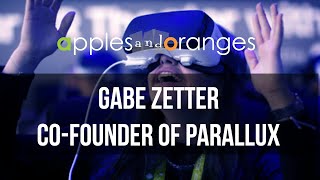
In this interview, Tim Kashani talks with Gabe Zetter, co‑founder and COO of Parallux, about his journey from a childhood love of storytelling to becoming a leader in immersive media. Zetter describes his early fascination with writing, cartoons, and plays, and recounts his first VR experience watching the Oculus Rift piece Dear Angelica, which sparked his awe for immersive narratives. He explains how his work at the Future of Storytelling organization served as a boot‑camp for learning the XR ecosystem, leading to his involvement with the CAVE project and the eventual founding of Parallux to productize that technology. Zetter highlights Parallux’s mission to create systems and software that make immersive content accessible to mass audiences, addressing challenges of technical fluency and scalability. He discusses the industry’s convergence—advances in hardware, decreasing costs, and the blurring line between AR and VR—foreseeing a future where immersive experiences are commonplace. Zetter shares excitement about adapting classic stories such as Frankenstein, Grimm fairy tales, and popular franchises into XR formats. Finally, he offers advice to newcomers, emphasizing curiosity, storytelling passion, and the importance of making immersive media approachable.
Chapters
What do you get when you have a Broadway professional and a camera crew? Long story short, you get a lot of cool info when you get Showbiz U Luminaries. All right, we'll start simple. Spell your name for us.
Gabe Zetter.
And your official title?
My official title is co-founder and COO of Parallax Inc.
You've got an interesting background in how you ended up in this world of XR. Tell us about one of the first experiences you had as a child that said, I like stories.
Well, I still consider myself a writer, and I've wanted to be a writer since I was able to write. And I read voraciously. I loved cartoons. I loved plays. Songs, anything that kind of gave you that visceral feeling of experiencing a story. And so when I graduated from college, I got involved in traditional media and telling stories through television and learned a lot in that world, and then was exposed to emerging technologies and immersive stories and was blown away even further by the possibilities of kind of a new medium that hadn't been explored, rules hadn't been written for it, and that's kind of— I might have jumped a question ahead, but how I ended up here is using emerging technologies to tell immersive stories in ways that haven't been explored before.
What was that experience like the first time you put on a device? What was the device? What was the experience?
Yeah, no, I remember it well. I was at Microsoft actually, helping them put on a storytelling summit with my former employer, The Future of Storytelling. And it's funny because I was helping produce an immersive storytelling event, and I actually hadn't really experienced VR before. And so my first real experience was a piece called Dear Angelica, which was created with the Quill system, and it was on an Oculus Rift, and it was really animation kind of brought to life through this new virtual form that I, I had heard a lot about, but I hadn't quite been affected by storytelling in that way before. And get rid of all the technology and, and the headsets and everything, and Dear Angelica is just a beautiful piece about love and memory and loss. And so to be able to feel all of that in a new format that I had never experienced before— we don't often do things that we haven't experienced before anymore. And I think that's why people have a genuine kind of sense of wonder when they do virtual and augmented reality. And it's something that we see a lot in kids, but with adults, it's, it's very rare. And so I felt that myself, and I kind of get a thrill when I see other people experiencing that as well.
I remember that piece that I had played with a lot of different stories and tools in AR and VR, and that was a watershed moment for me where I went, I understand now. And then my son did it, my wife did it, and it started to tip. Yeah, realized that we are just getting into what this medium can become.
Yeah.
You got the bug and saw that this was cool. How then did that lead you to what you're doing today?
Well, I was working at the Future of Storytelling, and I had an amazing opportunity to kind of be in the space where all these amazing storytellers were coming and bringing their new immersive stories, and companies were just learning about AR and VR in a really real way and experimenting with how they could integrate those products in their own lines of business and how they could tell the stories of their business using new technologies. And so I learned for 2 years about the people who were doing it and the technologies they were using and the places they were being shown. And I feel like I, I was kind of a boot camp almost for the immersive space. And then when my girlfriend actually was doing the motion capture acting for a new immersive piece. I went to meet that team who was doing the project, and that's how I met Sebastian and Chris. And one thing led to another, and they had great success with that piece, which was called CAVE. And they decided to kind of split off from the research lab project that they were working on and actually productize that technology into a real product and start a company out of it. And that's when I joined the team to help make that a reality.
And it's been a wild ride since you joined.
It's been crazy. I have not anticipated it, but it has been an incredibly fun and fulfilling and wild ride.
What are you seeing when you're talking to people? Give me the spectrum of what people feel about this content and where you feel you can make a difference in the future of it?
Yeah, well, I think that beyond anything else, people are just interested in it and they want to learn more. And what's fun and fascinating is that the conversations we have can range in technical fluency. And so explaining to a PhD what we're doing is very different than explaining to my aunt what we're doing. But regardless, everybody is interested in it. And I think that a big challenge has been making this technology and the experiences you see through the technology accessible to a larger number of people. And I think that's really where Parallax comes in, is creating systems and software that allows for the delivery of immersive content to mass audiences so that we can really tap into the economies of scale of the entertainment industry and have technology not be the limiting factor in people learning and experiencing and creating on these new, uh, mediums.
Do you feel like we are, we are actually converging? Because it's something in the industry that everybody's been watching closely.
Yeah, I think we are getting there. I think that if anybody tells you they know exactly when or how it's gonna happen, they're lying. But that we're definitely heading in that direction and that there's been tremendous strides made in hardware development and with that, amazing pieces of content that are getting more and more exposure to the general public. And we're going to reach a point soon where the technology is accessible, it's less expensive, and there isn't such a distinction even between VR and AR. There's immersive experiences and there are tools that allow you to access them and they're not prohibitive, and that's going to be a really cool world to live in.
What are some of the stories you're looking forward to in the future? Like, what— just as a consumer, what are some pieces that you want to see?
Yeah, well, kind of all of my favorite stories. So that's, that's how our most recent piece, Mary and the Monster, was created, was we love Frankenstein. Frankenstein was the first real piece of science fiction, and it's been told for 200 years as books, as poems, as TV shows, as movies, as plays. And so being able to play a role in telling the story of Frankenstein's origins in an immersive medium, in VR and in AR, that was really cool to us. So I'm really excited to see the stories that we're familiar with, the Grimm fairy tales, the Harry Potters, the Star Wars, all start to come to life in a way that people have never seen them before.
Great. Anything you want to say in closing out to anybody that's thinking about this as a career, following in your footsteps?
Yeah, absolutely. I would say just do it. Just learn as much as you possibly can. And don't feel as though you have to be affixed to a certain path or go from A to Z. Just start doing what really interests you. And talk to people and learn what's out there and let one thing lead to another and let yourself be interested and act on those interests.