2 Simple Drills For Better Skiing: Improve Upper Body Stability and Stylish Turns
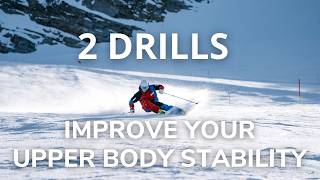
Tom Gellie teaches two drills using poles to stabilize your upper body and improve turns. Hold poles level in front of you, then behind your elbows, to force your lower body to work harder and reveal hidden movement patterns. Rosie and Mark both notice better alignment and less effort on the outside ski.
Chapters
Hey skiers, today I want to help you with your upper body stability, which will ultimately lead to you being more stylish in your skiing. I'm going to show you a few drills that are going to help with this. I'm going to set it up to be a little bit more like a self-exploratory discovery type lesson.
I could feel myself having to lift it up, which on the first run I didn't have.
I want you to really tune in when you try these exercises and be able to answer the questions that I ask you.
I just feel much more aligned with the ski.
This way you're going to be far more involved in the learning process instead of me just telling you this is how you fix it. Far more powerful if it's done through your exploration. I'll explain a little bit later in the video why this is such an important thing to work on, this upper body stability, as well as why I think style is also something you should kind of care about in your skiing. The first drill is really simple. Take your poles, put them out in front, hold your palms on top, and all I want you to do with this task is try and keep your poles still and level in the same spot the whole time. And as you're doing that, just see what you've got to feel, what muscles have you got to engage to make that happen. It may not be easy at first, that's great. I want you to try 3 runs of doing this before we really intervene, so Your task: keep the poles level and still out in front, as steady as you can, and just make linked turns at whatever ability you're at. So if you can carve, try carving. If you're not quite there yet, just make a basic parallel turn. Okay, here we go with the first drill.
So to keep things simple, just try and keep those poles as level as possible, like you're balancing a snowball like I showed earlier. And what I'm hoping you'll discover is how active your arms and upper body need to be in order to keep those poles level and still. It's not just a matter of holding them dead still because your body is inclining and changing position constantly throughout a turn, and therefore your upper body has to constantly be readjusting to keep the poles level. If you find you're a bit overstimulated and there's a lot going on in your brain, just slow things down a little. It needs to be at the speed where you can focus on where both hands are, what the poles are doing, if you're able to balance a snowball or a drink on your poles and not tip inside or outside to the turn. Now, I don't want to overwhelm you, but there's one more important cue and task with this drill, and that is to keep your ski poles square with your skis, or square to the direction of travel, not just facing arbitrarily down the mountain. Later on in this video, you'll meet two skiers who just discover how important this is to their alignment and balance on their skis, so look out for that coming up. But for now, poles level and square to the direction of your travel.
The next little exploration task is to now try and do the same drill but change the rhythm. See if you can make a shorter turn while still maintaining stable hands, poles right here the whole time. Let's see how we go. Awesome. So the thing I just noticed, for me, when I work on that, uh, keeping the poles really steady the whole time, is my mind also goes down to how much more active my feet need to be. So this is known as a constraint. I'm constraining or stopping one part of my body from moving and it's forcing other things to happen. Because what you're possibly doing in your skiing is you don't realize how much movement of your arms, your upper body, your poles is kind of taking up, picking up the slack of things that could be done down here with your ankles, feet, and your ski boots. So the whole idea, block something in a way like your arms and upper body, keep them in one place, So something else has to raise its level of performance and pick up the slack. So the question I want you to ask yourself after you come down after that run is, was I able to complete the task? Could I keep the poles in the same place the whole time? And if not, what did I have to do? What did you have to do in order to change it? Another question you could ask is, was it easier on one side? Was one side easy to keep the poles level on the other side it was harder, and what did it feel like to try and change that? That new feeling, that recognition of what is actually going on, is the most powerful thing. You must have that. The only person that can change your skiing is you. Coaches like myself can guide you there, but really the power is in your hands. Now it's really important that you take at least 3 runs of doing this before asking anyone else for some feedback, or being really critical of yourself. You have to give yourself time to figure it out. So I've done 1, I'm going to do 3 more before I really reassess how well I'm achieving that task. Okay team, you've done 3 runs of the poles out in front, getting some new feelings, some new sensations. You can park that for now, come back to that one later. Next, we're going to put our poles in a different position, so we're going to constrain our arms, put them in another place that's going to make us have to readjust our balance, readjust the whole movement pattern. The whole idea is shake the system up a little bit, which is then going to make your brain start paying way more attention. So here we have the next drill: poles tucked under elbows behind our body like this.
So the task is pretty much the same— try and keep the poles fairly level and fairly square with the direction of travel. Having the poles behind your back is just going to mix things up a little bit, so it's great to constantly keep challenging the system. Of course, if The other one is still challenging you, stick with that, but once you start becoming a little okay with it, it's time to move on and keep the brain engaged.
So you've taken a run with the poles behind your back, remember, keep asking yourself, keep noticing feelings, noticing sounds, are you kind of later with your edging, are you skidding more, can you change that while still keeping the arms in this position, what things are different How do you solve that problem? That's what you're going to do, and that's how you're going to become a better skier. Okay, so same task, poles behind my back, but I'm just going to change the kind of turns I'm doing. So I'm going to make a shorter turn on this slope here, see if I can keep things tidy. What have I got to do to make this still work? So that's feeling easy, I need to change it faster. Slightly different rhythm. Shorter, longer, longer. Mix it up. See if I can jump to my new edges. That's really fun. Got another one I can try and do it with my inside ski lifted. I can try and do it on one ski. Oh, definitely got to change my balance. My arms are behind me. Get forward a little bit more. Try the other foot. Whoa, nearly caught that one! This is the side I got to work. Oh, that was fun. I tell you what, being an Aussie that lives at sea level and skiing at 3,000 meters plus on the Hintertux Glacier, you can feel that that thinner air is harder work. So what did you notice with that particular constraint? It pulls differently. I certainly noticed I got to change movements, uh, down low. I've got to change where my hips are my upper body because I haven't got the weight of my arms kind of being out in front, they're behind me here, so I have to figure out how do I get my balance back in, in the right place on my foot. What did you discover? Was there an asymmetry? A better left turn? A better right turn? Yeah, let us know in the comments below. Well, I have some willing students here to give one of the drills a go.
Yes, some real-life students to help you relate to what you might be going through when you try this next time you're on snow. All I did was I gave him the rundown of holding the poles out in front and trying to keep them level the whole time. I didn't mention anything about keeping the poles square to the direction of travel, and you'll see that come up very soon with one of the students in particular.
Could you notice if there was— were you able to keep the poles level?
Somewhat level, but I definitely— my left turn, I was struggling more to keep it like flat.
Okay. Yeah, okay. Did you try and level it, or was it more that run you were just noticing it more?
I was noticing it and trying to correct for it, but I'm gonna try better on the next part.
Yeah, cool. I want— I would want to give you like 3 goes, 3 runs of this before, and we'll check back in.
Cool.
Because you did that pretty well, you had the level part right. The different task I want for you is I want you to try and keep your poles level but keep them in line with your skis.
So don't face the poles down the I showed Mark this video so he could see exactly what I meant by not facing the poles to the outside or down the mountain the whole time. It's more this one side, so if you've got video, it's very helpful to spot if you're doing something like this too.
Yeah, just allow the poles to face wherever your ski tips are going.
Yeah.
That's where—
yeah. Oh, see if you can tell which side is better. So here's the self-reflection part. How did you go?
I mean, it felt pretty locked in.
Okay.
I felt like my skis were— I had no trouble delivering pressure outside ski. I felt very stacked.
What about the task of where the poles exactly were? How did— could you—
I felt like I was probably 70% there.
I'd kind of agree. Yep, cool. So next one, it's really easy to focus on like the, the outcomes as well in the snow, the feeling. Yeah, so see if you can really see what happens when you try and get like 100% nailing in a turn where those, where those poles are. Totally different position. Rosie, for you, how did you—
that was better.
Oh, why?
Because, well, I personally managed to not keep facing down the hill. Yeah, I think I managed to foil my skis a bit more and Well, this side is still— I'm correcting it much more than the right.
Ah, nice, you can feel the difference.
Yeah, I could feel myself having to lift it up, which on the first run I didn't have.
Yes, way better terrain for it, right, because you weren't worried about people, grippy snow, and that's a good message for other people, right? You'd say do a run like this when you try a new drill.
Exactly, because I actually, I was like, oh, okay, that's not level anymore.
Perfect.
So Famous Chinese proverb, "I want to teach you to fish, I don't want to give you the fish." So you just learned to correct and feel yourself through the task. Yeah, so all right, let's keep laughing it, but you guys have got it. Great drill to work on, yeah, a new part of feeling in your skiing, so have fun with it.
It was great feedback to know that Rosie and Mark could feel when they weren't quite achieving the task correctly, and to see them practicing right here, making adjustments on the fly, really learning how to change their own skiing without further help from me. And look how stoked Rosie is, that's awesome. As Mark continued to practice, he really got a new sense of alignment over his skis, and he actually got the best Ski IQ from Carv he scored on this whole entire trip. So awesome job. I asked him later on what it really felt like when he got this drill right.
So you just said, Tom, that was different.
Super different.
Okay, in what way?
I can—
I just just the second half of the turn, just not try—
like, I just feel much more aligned with the ski, and I'm just like, I'm not doing any effort to stand on the outside. Like, it's easy.
Awesome. There we go.
Now, a quick note on rotational alignment. We could get into the weeds really with this one, but really I'm more about natural alignment of the body and not over-twisting things, getting things out of place. So just allowing the body to stay square with the skis, you'll nearly always end up with a natural amount of lower body separation, upper body separation. Mark just happened to be overdoing it from some of the training he'd had in the past. So cool to see him, like, right here, completely change his alignment and have a completely new feeling of what he feels like on his skis. So I hope something like this happens for you. I'd also like to be clear that I don't believe perfect technique has both hands completely level, like the snowball level idea. This is just a drill and a task to try and get you to focus on the fact that keeping them quieter and more or less closer to that level point can really help you upskill a lot of parts of your skiing. When you start developing higher edge angles like this, you'll notice my inside hand is lower than my outside one. This is a natural kind of position thing, so please take it with a grain of salt. It's just a drill and you exaggerate it to help upskill and learn new feelings.
And I also just got my new best SkiIQ on this run, which was, uh, it's 152, which is not like massively high, but this is quite a flat run.
Yeah, nice. Now I mentioned something about style. Now because I'm not a ski racer, I don't have to be at the bottom faster than everyone else. I can enjoy my turns. I actually really prioritize style. I like working on it. A bit like, uh, dancers don't just move around, you know, whatever. I really look up to stylish dancers of all types— breakdancers, tango dancers, ballroom dancers— and I think you can put that kind of style into your own skiing. And by working on constraining the upper body and arms, like teaching it to be a lot more quiet, I feel like that upgrades your legs, and then it allows you to have a bit more freedom of expression with your arms and upper body. Arms and upper body is huge for style. I mean, the legs controlling the skis can't really change that much, you can choose where you go, but your arms, you can place them higher, lower, forward, back, and really add that and bring your own unique flair to your skiing. Okay, so you've done your 3 runs of 2 different types of upper body arm stability drills. You've figured out some new feelings, perhaps something that's an asymmetrical movement on one side. You might now want to go off and just work away, chip away at that, and start improving it. One of the main points I want to get across to you today is by using a constraint or a task like locking out the arms and upper body, you can help your brain and body tune into what's going on elsewhere in the body. You can break movement patterns. That's how you break habits, you've got to change something. I really want to emphasize that once this starts feeling easy, I want you to change a variable. So try it going faster, try it with a different turn shape, try it on some off-piste, not so good snow. Mix it up so you constantly keep having to figure out a problem. Problem solving throughout the day is going to make you just enjoy the start of the day to the end of day skiing, so extending how much enjoyment you get out of skiing, and ultimately it's going to make you a far more rounded skier. Now if you've enjoyed this content, you've enjoyed the way I teach skiing, then please consider subscribing to the Big Picture Skiing YouTube channel. And even furthermore, I put all the best videos on my learning platform, which also has an app for Android and iPhone. Thanks so much for tuning in. I hope this improves your skiing and makes you enjoy every single day you're out on the slips. All right, I'm going to take another run. Let's go.
More from Tom



Most skiers overlook how they use their poles. Try these five pointers next time you’re skiing.







