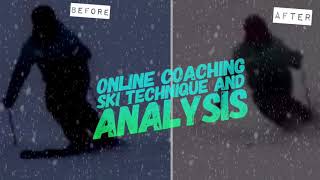
Ski coach Tom Gellie shows a client's short-turn technique transform in one week through remote coaching. The skier fixed a shallow edge angle and awkward hip position by rolling his ankles and knees inward, achieving the angulation and pressure needed to grip and launch through turns, all without in-person sessions.
Chapters
In this video analysis, I'm going to show you the change one of my clients has made over the space of one week to his short turns. So this guy is training for his Level 4 CSIA, and training for the Level 4 exam is no joke. It's a serious jump in the ability to manage your skills on skis. You've really got to refine things and show a very, very high level of skiing as well as a very high level of understanding skiing. So the top video is from him a week ago, and then this is what he sent me this morning. And so what we worked on is mostly to do with his weaker turn, which is in this direction. Direction. And so if you look at the top video first, how he initiates this turn, there's a lot of sliding going on, as well as a couple of things I want you to notice. Apart from kind of the more awkward-looking posture, his skis, the angle that they're actually sitting at, would probably be represented by a line like that., and where his center of mass is would probably be represented like that. Now if you take this angle right in the middle here, that is greater than a right angle. Now what does that mean? Well, that means that that ski edge is not going to grip no matter how much balance you apply to it, willpower, whatever you want. No matter how sharp you make those skis, they're not going to grip. If we look at the change he's made at this part of the turn below, you can see how he's initiated this turn is through rolling his ankles, knees. He's allowed his hips to actually move inside the turn, whereas it almost looks like he's actually pushed his hips outside the turn here while still keeping his ribcage in. And that's resulted in the flat ski up on this one. But on this side, you can see the skis are still traveling out on an arc before they're going to come around, and that's allowed him to get far greater edge angles earlier in the turn, which is what you really need for Level 4. So if we take it a little further, here as he starts to actually really apply the edge into the snow, because some people get confused. You don't have to have grip going on at the top of the turn, you just need the skis to be guided on the edge so that the moment, like right here, you can see the snow starts to spray, the skis and the body position is correct. So what's resulted in this phase of the turn, just after the fall line, is he's got a far better angulated position on his skis here versus he's still inclined, so that would be in the lateral plane. Second, he's ended up having to rotate his upper body, whereas here he's far squarer down the fall line. This rotation has probably come about because this ski on the outside here is not gripping, it's not holding. So his body is rotating to actually keep him in balance. If it didn't rotate, he'd probably fall flat on his face. And then we have a look at the completion phase here. It's so different. Far more anticipated, ready for the same moves on the other turn on this bottom picture, whereas he's still kind of facing this way. And then if we look in the fore and aft plane, the flexion in the joints he's far more flexed in this bottom picture as opposed to being more upright in the top one. And part of that is not because he's decided to, I'm going to flex my joints, it's because there's actually some pressure built up through turn forces earlier because he's had some early edge angle setup, he's positioned his center of mass inside with angulation. So when the ski grips, there's actually a large amount of force built up. Whereas this top one, a lot of the force has been leaked through him trying to catch his balance and also the ski skidding, and all that energy just goes into the snow spray. So there's no point in him actually needing to really flex through the transition in this top turn because there's not much force, but you can see even in the bottom one, he kind of gets almost launched through the turn, so he could manage this pressure a little better, but he's forced to flex a lot more through this part of the turn because of the movements he's made. So it's a great change in this guy's skiing in just one week and just through a couple of, I mean, I didn't even get to see him on snow. I'm in Australia, he's in Whistler, and We just worked in his, basically his living room, and me telling him, you know, that's the movement, that's movement, here's me doing it, and then him repeating it and me saying, no, that's not it, no, that's not it, that's better, that's better, and then sending him photos back and forth showing him progress. And then he just went out in the week and practiced, and kudos to him because that is a huge change, and I'd say that is looking more like level 4 skiing. So if you're interested in any of this kind of advanced coaching, I mostly work with ski instructors or advanced skiers, but happy to work with anyone. Please contact me at functionalbody.com.au or find me on Facebook under Tom Gellie and get in touch because, yeah, if you feel like you've, you're missing some analysis on your skiing. I'd love to see if what I do can help you out. Thanks for tuning in. Bye.