Dynamic Carving in 3 days | How To Ski Progression For Carving
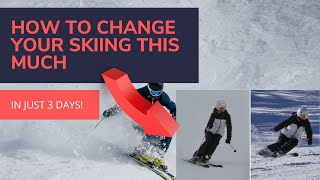
Ski coach Tom Gellie teaches beginner Emma to carve in three days using edge-rolling drills and hip positioning. He shifts her from unweighting at the top of the ski to staying low and inside the ski, creating wider, smoother turns. Tom says changing how you think about carving drives rapid improvement.
Chapters
So this is Emma.
Just how far could you take your skiing? In 3 days only? Well, what you're about to see is Emma, and Emma was a bit of a challenge for me in terms of, she wasn't challenging, the challenge was I wanted to see if I could develop her carving skiing like to a really different level in just 3 days' time, which is not much, okay. So this video, I'd never met Emma before, never skied with her, and so I wanted to start with a complete blank canvas, someone I'd never met. And, uh, and so I just watched her skiing, which you, you'll, you'll see in a second. And then with 3 days, I gave her the information, the exercises, the insights that I have around what I think will make the biggest difference in those 3 days to get her skiing better. And if you see the before and after in this intro section coming up, you'll see that she improved like I've never seen anyone improve before. So, to me, this proves the concept that if you give people the right information, the right feelings, and the right direction and scope to practice that, you can really blow out of the water, like, how fast you can change and improve. Most people don't make this sort of change within even a season. So, there are some things like Emma's quite athletic, so that's on her side. We had some nice snow conditions, so that was on our side. And, and yeah, so all those things helped. But what you're about to see is the first of 6 steps, so the 3 days broken into, into halves. And you'll see me give the first little piece of information and things to work on that completely changes the way Emma thinks about carving. So I hope you enjoy this video, and at the end I'll be back to talk about the 5 following videos that help Emma get to this point of really laying it over. And you know, you see the joy on her face at the end. It is well worth it. The feelings that she gets and the rush, adrenaline, from being able to do that is really cool. So Let's jump into the first of this dynamic carving in 3 days video series.
Emma is the weekend guinea pig at Perisher. I've actually never ever seen her skiing in my life. We're about to see her ski for the first time, both you and I. I'm going to video it, and I'm going to look at what's going to be the best thing to focus on to get your skiing improved and that change. So let's do it.
Let's do it.
What do you think about doing to make a turn start?
The first thing I think about is to, is, is to try and unweight and roll my ankles.
Okay, unweight and roll your ankles. Okay, cool. The first thing I want you to focus on is the feeling of the ski and the feeling of the ski changing edges and cutting into the snow. Okay, and it would be your outside foot So in this case, for the next turn, would be your right foot. So I'm going to move back. How would you roll onto that edge, like, kind of now?
Emma now shows me how she would position herself and roll the skis over on to gain early edge at the start of the turn. This is a really great exercise for yourself to try, and if you're an instructor, your students to try. And you want to use the poles as a balance point. So you'll see I get her to put weight on the poles, to lean on them, and help her gain the feeling of the position of her body where it needs to be in order to roll the edges over easily. I now show Emma what she's doing so she can see what it looks like. So I'm saying, you look like you're you've got a lot of strain on your ankles and knees in this position, and you're really trying to push your hips up and forward. I say this is in contrast to me just almost relaxing. See, I've got my hip almost leaned on my pole here, just chilled in this position. Now movement of my legs is very relaxed and easy. That's what I want you to try.
So get in the mimosa drinking position, just kind of like Yep. Does that at all feel different? I think you got to like not stretch yourself out, literally like you're leaning against the wall. Lean against the pole. Yeah, don't stretch yourself out. Don't stretch. Just don't stand up. Just— yeah, lean across, lean across. Yeah, yeah. And then let the legs kind of roll over. Yeah, okay. Yes, do not go up. So your usual thought of unweighting— that's better, that's better. Even be more down, more down. Yeah, there. Yeah. And now unroll the knees in that position and roll them again. So like, so go on edge, off edge a bit, but still stay leaning on the poles. Stay with your hips leaned there. Now just move your knees in and out. There we go. There we go. That freedom. So the freedom you feel in your legs there, can you see it's only possible when you're leaning and you're inclined? Yeah. So you kind of, it's going to take a bit of time, but you're trying to get in that position. So it's very effortless. You're not straining on your body to make that movement. Yes.
That's a straight down.
Yes. Yeah. So we'll try the other side just to feel it out. Hey, now you're getting it. Now can you— yeah. And can you feel like it's not a strain on your body? Yes. Yes, it's a roll. Yes, that's it. That's it. Relax into it. Let the legs move in and out. Rotate in and out. There we go. There we go, there we go. So we're going to take that for a ski.
So let's watch Emma as she tries to implement the stationary exercise into her skiing. So remember, she's trying to feel the ski cut at the top of the turn. She's doing that by being more inclined and not coming up. The legs are relaxed, and she starts to get it now.
Awesome. Okay, so what's the feedback?
So this is far more effortless. There's, uh, you're staying down and it's really— there's more of a sensation of your ankles and your knees, you know, rolling and grabbing the edge.
Yes, yes.
And but you're actually keeping weight in, you know, much more than unweighting. Yeah, I'm not weighting up and weighting down.
Yes, you're keeping it level. Yes, so what's the newest sensation for you? Just not unweighting and a rolling sensation? Yeah, yeah, okay. And we should say, you came— you grew up skiing like on straight skis? Yes. Okay, yeah, so this is good for those people that— yeah, yeah, on these sort of skis you don't really, uh, need to do that at all. They've got built-in turning. Now We'll do another run, but I was interested, did the exercise, the static exercise we did, did that help you give the feeling of what you're after?
Yeah, yeah, it really gave more the feeling of, you know, that your knees and ankles are rolling without your upper body actually unweighting first. So this could happen.
Yes, yes, yeah, perfect. Let's go practice. Really secure position for the poles. I leave my body weight, like upper body weight— it's actually probably more upper body weight— leaning against the poles. And you want to get used to this sensation. What you're doing is you're controlling your shins with your hip, like the pelvis. Your pelvis is moving in and out. If your pelvis here, on more edge, backing off the edge. One more edge, backing off. I don't need to go any further than this. This starts straining. This is perfect. I feel like my shins line up with about where I'm leaning on the pole. Can you kind of see that?
Yeah, yeah, yeah.
There's like a line they lean up against.
You've got a lot of, a lot of angle in your ankles.
Now see, they comfortably go further. Yeah. Yep. If my bum gets back over here, see, it starts wanting to reverse. Yeah. Yep. Even if I'm just here, so my pelvis is inside of my skis or over the top of this ski. Now I want to feel a freedom of this, so my my femurs, these leg bones, are free to rotate inside the hip socket. That eventually gets down to the feet. Let's have a go for you again. Yeah, that's it. So keep the pelvis low. There we go. And then look at your kneecaps and, yeah, move them outwards. That's it. Inwards. There we go. There we go. Now you're keeping your pelvis in the same spot. Yes. What's the difference? What were you doing before that's different to now?
Before I was coming out too far with the pelvis.
Yeah. Okay, cool.
You can't move it anymore.
No. Straight. Yes.
And now I'm like more centered in with my pelvis here.
Yeah, and see, now you're just as flexible as me. You commented, you said, "Oh, you're really flexible, Tom." You've actually probably got just as much, if not more, than me. Yeah.
Yeah, okay.
Yeah, yeah. Yeah.
It's becoming actually more flexier too.
Yes. There's not actually a muscular effort. No. Your body is just able to do that because of this inclined position. Yeah. If you did this with your pelvis straight, you've got no flexion at all. No, you're blocked. Yep. And some people would say, don't have your body rotate. Like, see your zipper jacket is facing like diagonally down the hill. No, allow it to. Don't face it down the hill. Just put your pelvis in the spot that you felt was cut. There. Yes. So it's important not to lose, like some people would say, like some instructors would say, turn like, no, no, the other way. They would say that way, counter. Yeah, yeah. And you feel that's not right either. Can you feel there's this— yes, sweet spot.
Okay, so a bit of feedback.
I mean, not much practice time, we need lots more, but already I'm interested in what you feel in here. And the interesting thing I thought was you said you felt more inside the skis as opposed to on top of the skis, correct? Yeah, yep. Yeah, okay, cool. And that second time you didn't feel as much of that early gripping, but you felt the more the lower position all the time. Yeah, that was kind of like tick, that was better. So now you need to get it a little bit of both.
Yeah, a combination of feeling the the lower position and also the tipping though as well. Yeah, because in the second one I was really staying on top of my skis.
Yes, and that's why you weren't getting the grip part as much. Yeah, yeah, okay, so you've got to combine the two. And it really, it is actually, I can say it's nothing more than like practice and your brain and body learning like how much tipping is too much, how much is enough, because the terrain and so snow always changes, and so you just learn to like feel, oh, I can get away with leaning this much, I can get away with— right. But you really always— for me, I'm trying to find— I'm trying to do it almost as much as I possibly can, okay, because then I can use the like the ski going on the edge to turn me as opposed to being flat on top like and twisting the ski.
Yeah, so why don't we exaggerate it.
Yep.
And see what happens.
Yeah, yeah, because you'll probably get caught a bit on the inside ski and, and whoa, fall over. Yeah, but you need to find, you need to find that extreme. Yeah. To then go, that's too far.
Let's do it.
Okay, so let's do it. So Emma said she's going to take a bit more of a chance on this run, in her words. So feeling a bit more toppling. That was a nice one. That was a nice one. That was nice. There we go, now she's taken the chance. Here we go, Elvis inside the turn.
Better?
Better? Yeah. What was— did you— did the chance pay off?
Yeah, it was, it was— I was more, um, toppling over my skis toward the other direction, and it gave the skis a quicker, quicker biting on the edge.
Yeah.
And turning around quicker.
Yeah. And did you feel that similar sensation of the static exercise of little bit of, you know, being able to roll the thighs over.
Yeah, yeah, yeah, absolutely. And less effort, it came around much more by itself.
Nice.
More in symmetry. But I can do better.
Yeah, let's go practice. A little bit of intervention here before you practice next one. You're getting this idea of the hips and pelvis being like falling inside first to help you get early edge and I should say, for you at this moment, you're not trying to lock the ski into a pure carve, just trying to get it on an edge to give you some more, like, a better platform. It's not like slipping away from you, or it's not like changing direction really quick. Give you a bit of a platform here. See, like, I can kind of press against this The ski doesn't move, only my body moves around, as opposed to my body not moving and the ski moving. You don't want that. Yeah, you want your body to move around and the ski to be stable.
Yep.
You're gonna get to here and you're just after a rounder kind of shape. Be patient, you don't have to go for lots early, go for gradually in here.— and the turn will progress a bit. Now you'll be able to move a little bit more. The turn will progress a bit more. Now you'll be able to take it a bit further. Don't try and get to that point up here so soon. You've got heaps of time. So gradual dropping in of the pelvis to be able to move the knees. There we go. Okay, how was that one? Man, that was smoother.
Yes, like when your pelvis— it's a whole different feeling. I felt the Okay, this comes forward, you know, more on the—
more down the hill. Yes, I'll just get this angle. It's not just forward. Do that again. You went diagonal. Yes, yes, yes, yes. So the run before, were you just rushing that a bit? Were you kind of just get the position and then see what happens instead of continually kind of getting your pelvis to move, to walk more.
Yeah, to get the ankle weight down the mountain. Yes, yeah. Coming into the inside more.
Yeah, coming to the inside more. Yeah, yeah, yeah, yeah, perfect, awesome. Yeah, you could see a bigger difference. You made some interesting comments just before, and I'm kind of going to summarize it. Like, I would say you were skiing, your goal, or you thought good skiing was to stay on on top of your skis, like on top of your skis. That's why you angulate, that's why you, you know, you're saying, you know, just remember lessons teaching you to pinch in the waist and you never let your hips go inside of your skis. So the newest feeling and sensation for you is the sensation of really being inside of your skis. Yeah. And then the transition, you're not going up and whatever, you're just going directly there. Don't take the scenic route, go—
Yeah, I never understood really what being inside your ski meant before.
Yes, yeah, and you said, like, it's important to say this, like, many instructors are always saying stay on top of your skis, stay on top, stay over your skis, stay over your skis. Yeah, and people literally— this is for the instructors watching— people take things very literal unless they, you know, unless you give them super detailed explanation. So you say that and people will be doing that even though you're maybe at a point where you're trying to carve more and get higher edge angles. Absolutely. If in the back of your mind early on you learnt to stay on top of the skis, you know, you will stay on top of the skis.
Yeah, that's what you're being asked to do. Yeah, but the sensation of being inside your ski and putting your hip down the mountain and inside your ski is entirely different.
Yes. So, to help you not steer the skis, just edge on the start of the turn, I'm saying to you, try not to be over-countered, or don't listen to all the people that told you to face down the hill. Why? If I face down the hill, my body wants to untwist as soon as I give it a chance. Watch this. Right, it wants to untwist. If I keep my torso more square, now as I go across, it just ends up rolling. Not here, be here, facing more in the direction of the ski. There we go. So feedback after the run. Focused on, like I would say, or you called it the angle being not being calmer, not as aggressive, like facing down the hill, uh, how to, how to feel, um, you know, much, much smoother and, uh, much easier skiing.
Yeah, so yeah, much, uh, more smooth skiing.
Yeah, you said that didn't rush around. No. Yeah, no, the, the skis, uh, came around with your body Yes, yeah, yeah, like if you, you end up too countered, they call that kind of countered or separated. As soon as you kind of let the skis go flat or sort of unpressure them a little bit, they want to untwist and line up with wherever you're facing. Yeah, and if at the moment we're trying to get you to just get onto the edges first before anything happens, we need to calm that angle of attack down. So the skis don't want to unwind and twist. Unravel too much. Yeah, exactly. Yeah, yeah. But that's like short turns, that's why you do it, because if you hold that position strong and you topple in, they unwind like a tea towel unwinding, and you get this free energy return to twist, and it shortens the radius quicker for you. So yeah, but for the moment we're cutting that out. Absolutely.
This is a more smoother, wider turn, bigger turn. So, uh, the skis are coming around smoother when you're not so angular, uh, you know, turned down the ramp.
Yeah.
All right, how about that? Emma did a great job, and you can see some changes already within like less than an hour of skiing. And what I want to point out here that's really important is the fact that the first thing was we changed the way Emma thought about skiing, and I truly believe this is so fundamental. You've got to change the way you think about your skiing in order to change your skiing.. So, when you have a different thought, then your intentions and movements are all directed very differently or towards that goal, that different intention, what you're trying to do. So, that's so important, and through the next 5 videos, we keep finding these changes in the way Emma used to think about skiing, and then how she changes, and the results Well, at the end of the video you'll see the results speak for themselves. Okay, so if you enjoyed this video, the rest of the series is available at my website, bigpictureskiing.com, and you can do a free trial to just check it out to see if it's something that you're into. But that's really where I put a lot of my serious efforts and thoughts and all my future kind of work is on there, along with another coach, Sam Robertson, an ex-world championship ski racer, like a very inspiring, amazing guy. So together, our goal is to help skiers all around the world improve just like Emma. And through getting these insights into seeing how other people like yourself improve and finding the same mistakes they make, and then ways to change it through, again, changing your thinking about what you're doing, we can hopefully help you. And I think this is really important. I'm not trying to reinvent how skiing is done. It is just all about perspective and thinking about things differently. And so I think that's really important to point out. I'm not like, you know, I see good skiing just like every other person from different nation. Sees good skiing, but the way I describe how it's done, the way Sam describes how it's done, is the differentiating factor. And so I'd love to share that with you if you'd like to check out bigpictureskiing.com and see, you know, nearly 80 hours now building every month of new content, new videos, just trying to help everyone improve all aspects— moguls, short turns, carving, everything. Anyway, that's enough about that. Thanks for tuning in and watching the video, and hope to see you at Big Picture Skiing.
Thanks.
More from Tom



Most skiers overlook how they use their poles. Try these five pointers next time you’re skiing.







