Experimenting with your own ski boots and is BOA here to stay? Podcast with Brent Amsbury
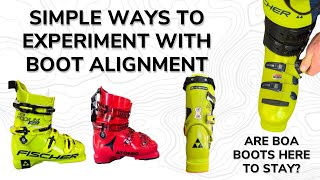
Brent Amsbury, an experienced boot fitter, walks through how to fine-tune ski boots yourself using foam shims and canting wedges. Most skiers in their on-snow tests preferred their original stance, but the new BOA lower-shell system got positive feedback from instructors and some racers for its wrap-around feel and micro-adjustments.
Chapters
If you're really into your skiing, then you should probably be doing some simple testing of how your ski boots are set up. And this doesn't have to be rocket science. Brent Armsbury today, who's been a guest on the show a number of times, very reputable boot fitter, gives a couple of pointers around using spoilers, the things that go in the back of the boot to fill in some space, in different places to help you decide and figure out if there is a more ideal setup for your ski boots. So that's in today's show, as well as Brent talks with me about the BOA system. So this is a new style of tightening the lower shell on ski boots, and it's sort of come out this season. He gives his opinion on what it feels like and whether it's going to be something we see in future boots as we look forward. If you're a listener to this show, you know I love talking about equipment, and getting the boots set up right I think is a really important piece. So there are a couple of good little takeaways in here that I hope you enjoy. And on that note, if you're interested in discovering some more around my thoughts on boot setup, there's actually a free boot fit guide you can download and view on the Big Picture Skiing website. It's under the resources tab. Check it out, it's 23 pages full of pictures and useful things to figure out if you could adjust your boots to be in a better position. Let's get started and into the show today with Brent Armsbury. So where have you just come back from?
Uh, I just came back from Big Sky, Montana, and I do a PSI event up there every year, um, as a guest clinician. And, uh, the, the topic of my, my clinics is called, uh, recognizing misalignment. And so I take attendees, other instructors, and we go out on snow and we, I use canting strips and I use, I take spoilers and pieces of foam and I take these instructors and I put them in positions that they're not used to or positions to empathize with their students of how they might come to a lesson misaligned. And so by changing their, their positions, they can feel what it's like to be over-canted, under-canted, under-flexed, over-flexed. And this year I decided I wanted everybody in the class to ski basically out of the position that they've been skiing in for, for a period of time. And I want to emphasize that when you take like a 2-degree spoiler, and you put it back behind the calf, what's gonna change, right? I didn't expect, and I wasn't expecting everybody to provide a negative response. I just wanted to see what happens when you take 8 to 10 people, kind of random, right? And you change their body position and their knee flexion and their ankle joint flexion 2 degrees, right? Approximately 2 degrees. And it was really, really interesting what happened and what results happened. And it was quite one of the most interesting comments about the reaction to their position was, oh yeah, I've seen these. They're in the— they came in the box with my boots. I don't know what they are. And I was like, okay, well, now we're going to learn, right? We're going to learn right away. What these will do and whether you might benefit or you might not benefit. But does it put you closer or further away from your center of balance? And what good things might you glean from it? What reactions did you feel? And what kind of, what other benefits or not benefits or just overall just the results? Of what happened. And it was really interesting. And so the results were that many in the group, of course, didn't really like to be flexed that much farther forward, right? They, they had more, they had forward flexion. They felt like, hey, I have got a good, pretty balanced stance. I stand nice and upright. And the spoiler was kind of like, oh, it's got now too much pressure on the front of the cuff and it makes me ski like I'm skiing with a light switch, right? It's either pressure or no pressure. It was harder to modulate. But about 30% of the group went, wait a minute, I liked it.
Yeah, this is cool.
I had more forefoot pressure. Um, I had more contact with the tongue. I liked the way it was shaping the turn better. Um, it gave me some access to movements I hadn't had access to before. And so it was really interesting to get reactions about when you make change in your stance, you know, what kind of results do you get? And just the being openness to making change, right? The comment about, I don't even know what these are for, means, hey, you should be open to trying to find the peak of your balance in your stance. Just because, and I explain this to all the students and to the attendees, like ski boots are not plug and play. They look like plug and play. The manufacturers want them to be plug and play, but in the end, they're not truly plug and play until, and you don't really get the maximum out of them until you start playing with some of the mechanics of the boot.
Yes. Yeah.
Yeah.
Interesting. And it's so true. Just the spectrum of every, everyone's just different. And, and yeah, you're not gonna get the result of like putting spoilers in is better?
No, I mean, most boot fitters, we take 'em out, right? We tend to take 'em out when you come in and try the boot on because it makes the upper cuff feel more tight. It might put you in a more awkward stance right away. Generally, it just makes the upper cuff too tight. Most people think they're just spacers, right? They're just used to take up slack behind your calf. But they do a lot more than that. And they, they can definitely be a tuning tool to find where you benefit from forefoot pressure, shin pressure, slightly more closed-down ankle, more access to, to rotary movements in, in specific situations in terrain or different types of skis that you ski on. You'll notice when you change forward lean in the boot, you'll get a, you'll get a different reaction, you'll get a different response. And in some cases it's very beneficial based on the type of ski you're skiing on, the type of terrain. And, and many cases it'll be like, nope, I don't think I like that. There's too much going on here. It's not really benefiting me.
Yeah. Yeah. Interesting.
Yeah.
And so did, did you find similar stuff with putting cant, canting under?
Yeah, absolutely.
Uh, there was, that's, that's like a changing from the sole of the boot, whether it tips out or tips inwards. And you were just doing it not permanently, just with basically like a wedge, right?
Building little cant strips. And we would take volunteers from the group that are willing to try to be over-canted and under-canted, and then the rest of the group is watching what it does to their skiing, right? Do we see more tip initiation at the top of the turn? Do we see less tip initiation? Do we see the knees kind of pressing together or pulling apart? Or do we see chattering? We definitely, every time you change somebody's canting, you get a result, right? You, you see a difference between the way they were skiing one run ago to the, through the run they were skiing now. And we had an instance where we had a, a participant where, uh, they were for sure somewhat knock-kneed and we saw that right away. And people in the group were like, oh, well you should really try this and see what happens. And by putting, adding canting, positive canting, um, it was very interesting for this person because they went, wow. That's, that's edging I've hadn't, I didn't have before. Mm-hmm. Holy moly. I just, I just got these boots and I wasn't, I wasn't measured and I, and we didn't even measure this person. We just said, here you go. And immediately they started skiing better. They had more edge control and they were fascinated with just the addition of a couple degrees of canting. And on one side it was too much and the other side it was just perfect. And but it opened that person's eyes. They went, wow, okay, what do I need to do to get these boots corrected? I feel way better than I've been feeling all weekend on my edges. So yeah, it's, it's really fun, right? You go out and it's just a random group of people, right? You don't know who you're going to meet and what kind of equipment they have. So when you start playing with it, for, for better or for worse. Um, eyes, you know, people wake up, they— their eyes open up and they go, whoa, okay, that's great.
Yeah, yeah. I remember I brought a bunch to New Zealand one year with the Rookie Academy and did the same thing with my, my group, and, and everyone was, uh, willing, and we just skied with, you know, 1, 2, up to 3 degrees in different directions, tried it tipping us in, tried to step it out, and, and yeah, it's amazing the difference. Have I, have I talked to you about my thoughts on canting lately?
No, I don't think so. We haven't seen each other for a while. Yeah.
Can I, can I share with you what—
please.
Yeah. Okay. So I really think— I don't think canting is necessary is, is my current standpoint. And I think where it has worked and has helped is when the cuff alignment in the boot, and the way it's internally fitting doesn't have enough range to move for that person's leg, whether they have a bowed tibia, straight tibia, more mass on the medial side of their calf or the outer side. And so the canting helps tip the whole entire boot, and so then gets the cuff matching the leg better. And I can— and I'm basing that, and I'm going to be fully honest here, basing this on a lot of anecdotal evidence of my own boot setup and then students and clients I've worked with to get the same thing. So with my own, used to ski with 2.5 degrees tipping me out on my right foot, and I couldn't ski. I used to ski with a really knock-knee position and just really difficult to get grip until I did that in a pair of Dalbello boots and then got some Fischer Vacuums and then the cuffs, the whole boot vacuumed to my leg and I didn't touch the canting. Went out and had the same feeling but without touching the sole angle laterally. And, uh, that was a real eye-opener. And to this day now, I don't have any canting whatsoever on, on either boot. And then two, two people— so Jason Simpson, who's working with me as an online coach this year, He used to have 2.5 degrees and 1.5, same outwards, uh, tipping thing. This year he needs none. He's just adjusted everything through the cuff adjustment, switching boot brands. Because I don't know, I don't know if you would agree, it seems like Fischer tend to be more lateral, or they have more range with— like, I don't know. Anyway, it seems to work with people with quite that bowed tibia fibula shape. And, uh, yeah, and same thing, he's, he's got the same results but without canting. Um, and so, and my premise is, it's like, okay, well, if you're working with the ski which is flat and tipping it, you generally want the, that sole to not be tilted either way. An experiment where you just stand bare feet or in shoes, whatever, and you stand on a slanted surface inward or outward changes exactly like where you put your hip, where your knee goes, everything else. And if we've grown up for, you know, 40 years old now, 40 years learning to balance on different parts of my foot the way I want to balance, I know if I want pressure on the inside edge of my foot or the outside or centered and how my leg lines up to do that. Um, I don't want the boot to be interrupting it. Thoughts on that? And you can completely disagree with me.
Well, I don't think you want to— I don't believe you want to pigeonhole canting as unnecessary, right? Um, canting is for sure a trial and error, um, dynamic test procedure. You can measure it in a store or you measure it in a static environment, but eventually those numbers don't always add up. But I just had a client where we measured her canting and said, well, I would like you to try 2 degrees on this side and 1 degree on this side tilting you out. And she had previously had canting in the same similar way, but new boot, new liner, new footbed, very different from what she had been skiing before. So went from a World Cup race boot with a lot of big angles, you know, with more aggressive angles to more of a freeride technical on-trail boot with a lower cuff zip fit liner, never had a zip fit, right? Didn't have the, the, the, the, the support of a zip fit. Everything was different. And because she had previously said she needed canting, we measured and we said, okay, this is approximately what we think. And then she went out and tried it and it was completely inconclusive. She's like, her partner played with tape and they spent a whole day and at the end they just took all the tape off and then went, No, I don't think this is good. This is working. You're actually not skiing better, you're skiing worse. And they came back and like, okay, what do we do? And I said, you go with what felt good. Yeah. Okay. If you've got video and your partner has a good eye and you, you spent all day and the conclusion was that didn't help at all, then you don't need it. Correct. Okay. Yeah. You just don't need it. That, you know, the cuff was adjusted, the, the boot's a completely different setup. You just don't need it. And I, and I responded with like, if you want to add canting later, we can still do it. There's still the ability to add wedges and there's ways to modify boots where you can add canting later. But for me, I always need canting. But does it change? Absolutely. I never take a boot for granted, meaning that every boot has to be like, oh, if I use this many degrees before in this direction, that it's always going to be the same from boot to boot. No, it's not. It, it will be— every boot needs to be treated as its own creature.
See, that's my point. See, there's something in there. If, if canting was truly for adjusting for that person's knee position, it would be the same. But if a boot changes in the internal shape and the shaft and where it contacts, all these points changes. Then yeah, anyway, all, all I'm saying is I've gone down this road and nearly always when someone's had a canting thing, it's maybe been the shell check has been fine, but then you put it on. And I know you did this amazing job with one, one of my clients before, you adjusted the liner as, as well as the, the cuff because he had quite big calves. And his friend was just like blown away with the differences he's getting. He was like blown away because his leg now wasn't dealing with liner and shell kind of pushing him and distorting his, his shape.
So, right, yeah, it's easy to reach for canting when you really should be looking at other things first, right? How are you matching anatomically, matching the shell? What— how are you matching the footbed. How's your, you know, what's your foot position inside the boot? Yeah, I, I've known a guy from Austria, you know, he was, he worked with Fischer for a while and he skied. I mean, I looked at him and he was like really knock-kneed and he was skiing a Fischer Vacuum boot. And I asked him, hey, do you, what's your thoughts on canting for yourself? He goes, I don't need it. And, and I go, have you ever tried it? He goes, oh yeah, fitters have told me I'm really knock-kneed, but it doesn't work for me.
And I went, this is skiing the guy, not on snow. You just like looked at him and it's like, yeah, he looked like, yeah, yeah, yeah.
But then I went, went skiing with him and it was like, no, he doesn't need canting.
Right?
Yeah, yeah, yeah. If, if you get kind of too ingrained in it, then you say, oh yeah, you're knock-kneed, you must have canting. But when you go out there on snow, Yeah. He could, he could put the ski way up on edge. He could do everything that needed to be done. There was no loss of performance. And he just said, oh, my cuffs were just basically with the vacuum boot. The, the boot matches my leg angle really well. So I really don't need it. And it doesn't work for me because my hip sockets can't accept it. I can't be rotated out there without generating tension. Yeah. And with that tension, that means I'm, really not going in the right direction. I should, you know, with canting you should feel more planted and more balanced and not forced. Totally.
So I, I, I've seen definitely cases for canting in racing scenes to accommodate like the type of, uh, discipline downhill versus slalom and the type of snow to, to kind of play with either more leverage or less leverage. To give a kind of a, a tuned kind of feel like a race car, but not, not done for an alignment thing, more for kind of the style of skiing and the type of snow.
True. Yeah, I mean, there's, there's many times where coaches will reach for canting when they see their athlete not being able to get the angles that they're looking for, um, knowing that that could potentially make them faster. So yeah, canting can be an important tool, but it's not the end-all be-all. I mean, there's, there's so many more steps that need to be attended to and recognized before.
Yeah. In that process before, right?
Yeah. Before you start playing with, with canting. And I'm a firm believer that you gotta get your fore-aft in tune before you start throwing canting into the picture because fore and aft plays so much into that balance that, uh, you can chase canting for a whole season when it was all about the fact that the ramp angle on your binding was too much, your ramp angle in your boot was too much, your anatomy didn't fit the boot properly, right? And so you're so far out of balance and then it's like, oh no, your canting's off. Well, No, everything else is off first.
Yeah.
And then you get rid of all that, you, you, you, you get it all neutralized, you get it finally balanced, and then you look at the canting and go, didn't need it.
Yeah. Hey Brent, now I know that the main reason we got in touch is, is Boa is new this season. Boa lower sections, the way— so if this is the first time you're hearing it, it's the way you tighten up the lower shell on the ski boot. Now can be done with a dial and a basically wire. You've been getting people into these boots. I put my foot in, in that actual boot there nearly, uh, nearly 9 months ago, and it felt— but I could definitely feel something. I'll let you explain what you're hearing and, and maybe address some of the common problems. But, but first of all, yeah, what are people saying that have actually skied in these boots from your end?
Well, I, I first have to kind of give you my opinion because I'm skiing in it, right? Okay. So one, uh, when it first comes out, a bit of a skeptic, right? I mean, it's not the most— when you look at it, it's this big tumor hanging off your boot, right?
It's growing on me. It's growing on me.
I must say, first time I was like, yeah, but yeah, aesthetically you just go, uh, you really have to put your foot in it and then play with it. And when I first tested Boa, I was in a boot that was— they only make certain test sizes. So it was a 26.5 and technically I'm a 25.5, so I can ski a 26.5. So I went out and I, I put it on and I skied it for a whole day and It, at first I was like, okay, I'm not quite sure what's going on here. But as the day progressed and I was able to fine tune the Boa, I started becoming a little more attracted to it. The first thing that I noticed right away was more foot feel, right? It's more foot feel. The, the, the way a Boa closes the boot, it's not like this, right? The standard 4-buckle boot kind of the ceiling kind of clamps you down. Yeah, the Boa kind of does this. Everything is kind of coming around your foot more.
Yeah, it's not a down top pressure, it's more like you put like a, like a strap you'd put around your roof racks or something around it, and then you kind of cinch it so it pulls in.
Yeah, it feels like the whole boot kind of comes around as opposed to coming down. Yeah, that in turn doesn't ever make the boot feel like it's particularly Tight. I never felt like the boot was like tight and I, I would keep adding tightness to it to the point where I was like, the boot isn't comfortable anymore. So what's going on? So I just back it off a little bit, find the sort of the happy place. But even with the new boot, the 25.5 I have with the ZipFit liner, it's still, even though it's the right size, it doesn't have that super clampy, roof kind of clamping my foot down in the boot. And in turn, you immediately start feeling like you're skiing more with the bottoms of your feet because it just allows for that. That's the way you make the boot work. Now, people with higher insteps, with higher arch shapes, they immediately don't feel like the roof's collapsing over their foot. It doesn't take too many turns of the dial and the boot feels like it's snug over the top of the foot. I don't have that type of foot. So I take a few more dials, but even then when it feels like it's snug, it feels more transparent. The closure feels more transparent around the foot. It almost feels like the boot isn't even there, but it's not loose. Yep. Okay. There's no, there's no movement. It's not that the foot's flopping around, it just doesn't feel like it's there. Yeah. And so intrinsic little small foot movements seem to come easier. They seem to come a little more natural. And I never found myself popping the boa at the bottom of the run, like classically buckle the boot, feel the clamp, it's all around your foot, run, and then bend over, unbuckle to release the clamp, right?
Get on the lift and yep.
Never, never.
So then do you like—
I never, I never undid my boa.
So do you like, what's the verdict? Do you like, are you liking the boots?
Yeah. I think I like it. Yeah. Yeah. I think I like it. I think that, that, okay. So I think that those, we saw at Beaver Creek, we saw Vincent Kriekmeyer take a downhill run on a pair of Boa boots. He has a pair of prototype Boa race boots. And he— it's not just one boa, it's double boa, upper boa, lower boa, and had him and Alexis Pintarot have a pair that they're playing around with. They're the, the guys at HEAD, the racers for HEAD that have been somewhat attracted to it and they're playing with it and they like the foot feel. It's kind of the concept of the boot. Is the way they ski. They like to ski with more foot feel. Not every racer wants that type of foot feel. They, everybody's a little different, but they seem to be on the very foot feel side. Interesting. Yeah. And so they have been, yeah.
A duck. How it's on the top.
It's closing as well.
Yeah.
Yeah. And so the word is that they're play, they're, they're testing it. And they're trying to see if the boot makes them faster. I mean, that's the end result of any racer is does it shave time off? Now, will we see him race this season? Probably not on a Boa boot, but for a concept to come out like this, that it really— for racers to be attracted to a concept like this so quickly when they're probably the most conservative group you know, true, tried, tested is the most important for them. And for certain racers at this level to start being attracted and getting involved with it, I think says a lot by the potential of the concept.
And so what are you finding? You're the general, you know, cuz you deal with a lot of, a lot of people in Park City and Salt Lake City area there, just everyday skiers. What's the feedback you're getting?
The feedback from the, I have some instructors who have purchased the boots already and they really like it. So I would, I'll take their feedback. I mean, in terms of the general public, I'm not gonna take their feedback other than it's comfortable, that it's easy to use, it's comfortable, it's better for that high instep, more difficult foot to fit. But from, from instructors who spend 100+ days out on the hill, who spend a lot of time in their boots, their feedback is already more— is for me quite valuable. They like the way it skis, they like the way it feels, it's working for them, and they'll continue to give me feedback throughout the season. But so far for them, they like the way it closes. They like the way not just over the instep, but how it pulls the heel further back into the pocket without a, without a painful result.
They're probably, I mean, have any of them never had a zip fit as well?
Both had not had a zip fit. Then they're both in the Fisher versions with the zip fit.
Yeah.
Okay. Neither have had a zip fit before. I think maybe one did, but it wasn't a daily driver zip fit for them.
Yeah, interesting.
Yeah.
Okay, cool. Yeah. So that, yeah, the, the, the main things, I guess, at the, the general spectrum public end is, is the fit is, is quite uniform around that area. There, there's sort of not so much unbuckling and buckling tighter going on. You, you dial it, you can kind of leave it, which is pretty handy.
Yeah. And it's, I think it's more than handy. I think it gives you a different feel. For a way a boot operates. Sure, there's people who are going to be like, nope, not interested. That's fine. Right? The 4-buckle boot, it's not going away anytime soon. 3-piece cabrio boots, they're not going away anytime soon. Okay. Boa boots, they're here. They're not going to go away anytime soon. I mean, manufacturers have already announced that there's more models coming out next year. There's going to be 6 or 7 brands with Boa boots instead of 4. So Boa is going to— is happening and it's going to continue to happen. Now, how far does it go? Does it go up the chain into World Cup racing? Yet to be decided. Does it move laterally towards rentals and broader ranges. Yeah, there's some announcements possibly for that, but we're not quite sure. It, it's still trying to find its own way. But in terms of negativity, no, there's really— there's no need to try to be negative about it. It's just because you're, you're reacting without really any evidence, without testing yourself. Yeah. Exactly.
Yeah, yeah, yeah. Cool. That's awesome. I really want to get my hands on a pair, or my feet in a pair actually, and try it out. So, um, get, get my own sort of views on it. But yeah, yeah, thank you.
Sure, no problem.
Yeah, yeah, awesome to, to catch up, cover some Boa stuff, look at some boot setup sort of discussions, and, and some actual experimenting on snow. I I think a great— I'm going to say I think that would be a cool takeaway from this, would be if you don't know what it's like with or without a spoiler, go put that spoiler, the thing that goes in the back of your boot, in and see if it helps or makes things, uh, worse.
Sure. And you can even put them— you can even put them on the front, right? You don't just have to put them behind your calf. You can actually put them in front of your tongue. Yeah, right. And make you stand up a little taller. And I've got, I've got instructors that do that. They, they put them on the front tongue. They, they feel like they sag too much forward. This nice hard plastic fits right around that tongue. They Velcro it on, put the booster strap or the power strap over it, and they're like, wow, way better. So, I mean, if you don't know what these are for, you, you can find a lot of uses for them. You can even use them for cup alignment, right? You wedge them on the sides. So, yeah, it's a multi-use tool. So if there's a pair sitting in the box somewhere, uh, it makes a, a really handy-dandy, um, alignment, balance, and, uh, self-test, self-test tool.
Yeah, yeah. And I think this time of year, I know, I mean, West Coast— if you're in Europe, you're having a great time, generally the snow— but West Coast is a bit slow to get started. Perfect time, especially that snow, harder snow, very honest. You're gonna feel if things are better or worse very quickly. And I think that's a cool, cool thing to do. Do you— yeah, what happens when you when you put that little shim different parts in your leg, you might discover that there's a better position, a better fit in that top part that works for you.
Yeah, it— right now when you don't have powder to ski and the, the mountain isn't fully open, if you're bored, if you like, you're only taking 3 or 4 runs because you're just doing the same old strip, why not play around with your, your setup a little bit? And try to find— maybe you can get a little closer to the, to the pinnacle of your balance point. Maybe you're not quite there yet and you just don't know it.
So absolutely. Yeah, excellent, Brent. Cool. Always valuable chatting with you. Thanks very much. I hope you have a great Christmas.
You too.
Out there listening, hope you have a great Christmas and a Happy New Year.
Thank you. All the best.
More from Tom



Most skiers overlook how they use their poles. Try these five pointers next time you’re skiing.







