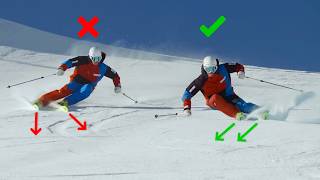
Tom Gellie shows how to fix tip splay, where your inside ski skids and splays outward during carving. The fix: lift your inside ski and practice engaging your ankle, arch, and inner thigh to level it and match your outside ski's edge angle, creating parallel tracks instead of a reverse snowplow.
Chapters
Have you ever watched really good skiers first thing in the morning and noticed the tracks they leave are two pure lines when they're carving? The outside ski and the inside ski both cut a really nice groove in the snow. Have you ever looked at your tracks, particularly your inside ski? I see so many intermediate-advanced skiers with a skidding inside ski. So today I'd love to give you one thing to think about, and it's very simple, to help you work on your inside ski performance and inside ski alignment, and the difference it will make in your skiing will be far smoother, more stable, and far easier to increase edge angles and your performance. So here's the first step. I think too many people do not slow down enough to work on their skiing. So I'm on a really nice kind of cat track area on the way from one lift over to another. There's not too many people around at the moment. I can work on this at a slower, slower pace. So your first step, you're going to stand on your downhill ski or your outside ski, and you're going to lift up your inside ski. Lift it up and be really passive, okay, so I'm not really doing anything with my foot and ankle. If you do nothing but just take it off the snow, you will find the tip of the ski probably wants to hang down, the foot is flat, and there's not much tension in the ankle.
This is an example of a skier with an inactive inside foot and ski. Notice at this part of the turn, the skis are going in different directions. This is tip splay or a reverse snowplow. So the inside ski doesn't have enough activation through the foot to keep it parallel with the outside one, and it's turning more than the outside.
The task is, what have you got to do to make the ski level with the other one? So I've got to engage my ankle, okay, so now the tip and the tail are the same height. I don't want the tip higher than the tail, I want it the same. Next, I want to now simulate a little bit of edge angle, so I'm going to put my poles here, lean on them, put my outside ski at like 20 degrees edge angle. I'm going to do the same thing, lift it up, be passive. What have I got to do to level it? Now what have I got to do to to match the edge angles, make them the same. I feel like I need to engage the arch of this foot. I feel like I need to engage the inner thigh of this leg. I've got a lot more tension going on just to hold it here. Some people may also find when they lift it up, they get tip splay, so the ski's rotated one way or another. So depending on who you are and your individual history, you're going to have to work out what's my natural thing, what have I got to do to correct it to keep it in line with the outside ski. So you take that, you check the other side, edge angle, lift it up, be passive, notice where does it want to go when you don't do anything, what have you got to do to level out the ski, keep it right next to the other one, and have the same amount of edge angle. Those feelings, you've got to lock that in your body. Now I'm just going to use this really gentle terrain to see if I can do that in an edge roll. So that inside foot is my awareness from the top of the turn. All the way through, I have to have, I have to have a very active inside ankle and foot. So I could even take a slight amount of pressure off of it, ever so slightly, to simulate the exercise.
So this is about finding just how much you need to do it. It's not too much, but it's not too little. There's this activeness, as I keep saying, of the inside foot, even though it doesn't have much pressure on it, in order to keep the edge angle similar, the rotation alignment the same, and give your skis a clean edged track coming from both the outside and the inside ski.
That's my one tip for you to be aware of. So find out what your inside foot and ankle does When you're passive, simulates edge angle, lift it up, there's passive. How much activity do I need? Because I, I really feel I've got to flex that inside ankle. I think a lot of people are passive and relaxed, the ski rotates, you get this tip splay, and you're not— you do not get similar edge angles. And then therefore, both skis carving nice grooves in the snow to help you ski better in all conditions. I'm Tom Gellie from Big Picture Skiing, I hope you enjoyed this. There's way more tips, hundreds of videos on my website and app for Apple and Android, so check it out to become a better skier.
Now I think this drill and skill practice could help all intermediate skiers out there, I see this common problem all the time. So work on this drill in your spare time, on the way to the lift, like I'm doing right here, and I think you're going to really notice it pays off, especially as the conditions get tougher. Now like I mentioned, there are hundreds more videos on how to ski better, become the best skier you can be, and I truly believe age is no limit. So why wait? Big Picture Skiing is all about maximizing time off snow so you can get the most out of that precious time on snow. So in the famous words of Warren Miller, "If you don't do it this year, you'll be one year older when you do."