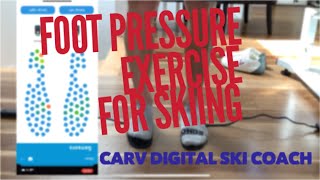
Tom Gellie uses Carv smart insoles to show how foot pressure affects skiing. His right foot grips edges better than his left, which loses grip in turns. Simple indoor drills that train pressure distribution make on-snow performance more reliable.
Chapters
Today I'm going to explain an exercise you can do if you've got a set of Carv insoles. So these Carv insoles are a digital ski coach, and how the technology works is basically on your phone you get a readout that shows you where pressure is distributed underneath your foot. This is really important for skiing because where pressure is just distributed under your foot directly translates into the ski and therefore the ski edge, and will either help you grip in a turn, steer a turn, yeah, direct, direct your energy into the ski, into the snow, and make something happen. So I've got a bit of an exercise you can do which is actually not even on snow. So I'm going to start screen recording so you can see what I see on my phone. But if you take your Carv insoles and say you're just standing inside your shells, you take your liners out, stand on your shells and your ski boots like this, you can then see a direct sort of bit of digital feedback of where pressure is under my feet. Okay, so the first thing I'm going to use it for before I go skiing I go on a ski holiday or something, is how is my balance first left to right. And straight away I can kind of see that the ball of my right foot seems to distribute pressure across the whole of the, the ball of the foot, the front of the tripod, more evenly compared to the left. Like, the left is sort of— you can see the green dots don't light up as much, so I've got more pressure in my left heel. Than in my forefoot. Okay, so that would be something I could work on, just bringing some more awareness into the front of my left forefoot. The next thing, more skiing related, is if I'm going to go out and the first movement I do to tip the skis on edge and get pressure distributed to the inside edge to make the ski grip, I can compare how well I do that right versus left. Okay, so right seems to be able to get, with less effort, the inside edge of the foot to light up more easily than the left. You can see it's kind of showing up greens and oranges. And pressure is force distributed over an area. So on my right foot, I'm allowing the weight of my body which doesn't change, to be concentrated over a smaller area along the inside edge. And this is going to help with grip, directing the pressure directly to the edge, the force directly to the edge. And on my left foot, I have a harder time, and I can tell you in my ski turns this is true, I have a harder time getting pressure right to the inside edge. So sometimes my left foot, if anything, the left ski is going to lose grip. So I can use this device as feedback to work on, well, how do I get these dots to light up in the heel, in the forefoot, the same as on the right, this left one. So you can see I'm having a harder time trying to get them to light up. So the first thing I think about is, well, first try and get the pressure over a smaller area. So almost take pressure away from other places in my foot. And then think about weight in my upper body, where it's distributed. So here I obviously allow my weight to really drop down into that foot on the inside edge. This side, there we go, lighting up a little bit better in the forefoot. And then in the heel. And the interesting thing is I recorded a video just recently which will come out soon about fore and aft balance using your Carv device to help give you feedback on that. But fore and aft pressure and balance really tells you whether the ski is going to grip at the end of the turn. So, so I need pressure on the inside of my heel at the end of every turn in order to make that tail not wash out. And my left turns my left foot turning to the right tends to wash out more than my right. And the data here doesn't lie. You can see, like, here, easy to get pressure to the inside of the heel. Left foot, more of a struggle. I have to play around with it more in order to get the same readout to show up. So the whole point of this, if you've got a carve instead of carve insoles, is to start working on feeling through your feet more and building awareness of how can you get the same pressure distribution through the feet to help make your skis work. Because if you can't do it indoors without turning, without people on a slope, without, you know, all these other distractions, then it's going to be a lot harder when you get out on snow. So work on it in a very simple, safe environment. Here we go, like indoors. Teach your brain to connect to these parts of your feet, how the rest of your body works to get that happening better. And, um, yeah, I think it's quite cool that, uh, you can utilize this off snow to help, help train your body. And, and so when you get out skiing, you're more instantly connected with your feet, which connects you to your skis and makes you perform better on the snow. Hope you guys enjoyed that video. Hope you can utilize this little bit of an exercise to help you, uh, ski better.