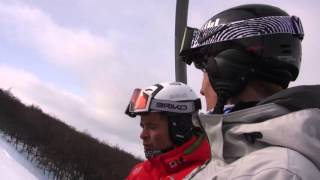
In this informal chairlift interview at Cerro Castor, ski instructor and athlete Fred Lepine discusses his personal training approach ahead of Interski. He explains a shift from a compression‑focused style to a "suspension" technique that engages all joints, allowing better adaptation to varying snow conditions. To develop this, he practices very slowly on flat or gentle slopes, deliberately altering his motor patterns, and uses video analysis to compare his perception and feeling with visual performance. He emphasizes the importance of matching internal sensations with external feedback to ensure effective technique, even when the movement feels uncomfortable. The conversation highlights practical drills, mental awareness, and the role of feedback in ski coaching.
Chapters
Okay, so we're on the chairlift in Cerro Castor and I've managed to ride up with Fred, good friend Fred, and I just wanted to ask him a couple of questions. So Freddy, welcome to Cerro Castor on the chair. Very interested in hearing what you have been working on personally in your own skiing, you know, I guess the lead-up to Interski.
Yep. Well, when I'm working in my ski, I try to use all joints. It looks like if I'm in suspension. In the past, I was too compression, so I don't use properly all joints. At this moment, if I'm very suspension, I can use all joints. I can adapt different situations on the snow and the condition. That's what I want to do.
Okay, excellent. And we chatted a bit before, but you said, what were some ways you worked on getting your body to be more in this suspension?
What I do, what I do and what I did in the past, and I try to change my motor pattern, so I ski very slowly in the flat heel, flat slope, and the goal is to, to be efficient, to move very slowly, and to use all joints. So if I was too early and I was too quick, I did some mistakes. So I tried to use a lot of slow, very easy, and I use a lot of video to watch what, what is my element and my movement. Yes.
So would you say, are you, are you a feeling person? Like when you go out on the slope and do practice changing a motor pattern, do you, are you searching for feelings in the joints? Are you using like a drill, an exercise? What method do you like personally?
It's very interesting because what I want is to match my perception with my feeling, with what I see. So if I have a good perception, a good feeling, when I'm alone, I can know if I'm in a good way. So it's very important to see what I do, what is the feeling when I did this. And sometimes I'm not very comfortable, I'm not comfortable, but what is the performance is very well. So it is very important to match the feeling The position and the performance.
Yes, yeah, nice, I like that, good. Yeah, great, well, look forward to going for a bit of a ski with you, and we're about to join the Koreans doing a short-term clinic, so it should be fun.