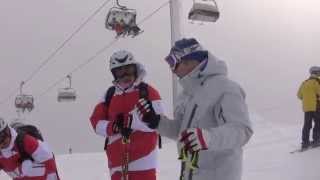
A ski coach explains how stance must change with terrain and speed. He breaks down the relationship between a skier's center of mass and base of support, showing how the lower body generates turning force while the upper body balances. He uses a five-stage development model to map how skiers progress from learning basics to creating their own variations.
Chapters
turn or a short radius turn or, uh, in the bumps or in the steeps. All of those situations will create, uh, slightly different forces. And as a result, if the forces coming at you are coming at you at a slightly different trajectory, then your form on the skis is going to be slightly different to deal with those forces. Okay, so let me just go for a walk. Within our stance, there's stances that are very strong, probably ones where the hips are right over top of the feet. And then there's stances that are very mobile. I don't think this is actually a very mobile stance. It's probably something a little more proportionate, bending in all the joints allows us to be more mobile in here. It does probably take away a bit of strength. You know, you don't see a guy coming through a super G turn at 100 kilometers an hour with proportionate bends in the legs, right? You see the guy in a very strong position. But in Super-G, the function is about strength in long turns compared to— I don't know about you guys, but I watch, uh, like a slalom racer in between the gates, very often their legs are parallel, their thighs are parallel with the snow because they have to bend to control the pressure, and they want to have that so they can manipulate, in my opinion, they want to ski like that so that they can manipulate the base of support, the skis, with the lower joints. So again, just looking functionally, even if it's ski racing, that's why we believe our stance changes a little bit depending on what you want to get out of it. My overall stance probably will look to you, and it probably is, might look a little bit back of center. One of the things you see in Whistler a lot is you're constantly in soft snow, heavy powder. So again, functionally there, you have a lot of attributes on the snow that are slowing your feet down all the time. So again, the line between your feet and your center of mass in order to stay balanced has to be a little bit more on this trajectory compared to doing GS turns on ice where the mass might be right over top of the center of mass, or the mass over top of the base, because there's very little resistance to the ski as you're doing an arc turn through GS. But if the bottom of the pole is the base of support and the top of my pole is my center of mass, I'll always need to manipulate the base of support to balance my center of mass. And what I do is I try to manipulate my base to direct my mass or to control my mass in whatever kind of turn I want to end up doing. What we try to stay away from is this is our stance. Well, it depends on what's coming through the skis, on how you're going to stand to line up with your feet, with your mass, okay, all the time. So center of mass, base of support is something that's been around in Canada. I don't know when it came out, but it was in the '70s, I think, and it was called movement in motion. And that is probably one of the most fundamental aspects of our technique. Okay, manipulate the base of support to direct and control the mass. If I'm gonna go ski bumps up to here and I stand like this, I'm gonna die, right? Like, I'm gonna die. So I gotta, you know, Scott, it's kind of weird. I would rather talk about balance. I want to see stand in a way where my mass is supported and I balance through my feet. As I'm coming up to a big powder bump, which I hope maybe we can ski, you know, I'm gonna have to take my feet and place them there because I know they're going to slow down to balance against that, that bump. If I come into a big bump like this, hey there, right? So it's kind of where I'd like to play with terrain and try to show you guys a little bit of the different, different functions, and as a result, how the form changes slightly because of those functions. Guys, too much talking, let's go skate! An ability to turn with the lower body. We firmly believe that the turning effort comes from the lower body, okay? It comes from manipulating the base of support, and then the upper body adjusts just to maintain balance and is really just there for the ride. Where we balance on the bottom of our feet, not on this part of the boot. And I think that kind of the proof actually is just— so what's your name again? Tom. Tom. Just watching Tom come down there because I did that on a boot that has no ability to leverage. Right, because he's on telemark. But because he's forced to balance, you know, I kind of think right, right under the arch there, right in the middle, he can actually perform that quite well. So we talk about light pressure on the, on the front of the boot, but never pressing, because if we press, we're probably going to get ahead of center, and then no longer is the base supporting the mass. Okay, when you get ahead of center, quite often we also lose our rotational alignment, we can quite often get ahead of our lower body. So that ability to turn the legs is something that we focus on a lot. So really it's just center of the foot all the time. I think that's where we probably are a little different. We don't play fore-aft. I'm just watching you guys ski. I think you guys play with going more forward and doing the turn. We tend to stay More in the middle of the ski all the time. Pretty relaxed skiing, huh? Yep. Having a good day? Yep, you betcha. Excellent. We're about to do some real skiing now, eh? Oh yeah. Um, we got our technique, you know, basically we, we, uh, work with our base of support, balance our center of mass, turn our legs. You know, a little bit of separation, work some angulation. You know, it's kind of our technique. I think probably the more challenging side of it is how the hell do you teach that to other people, right? Like, what's the— what's our method? And one of the things that's new or newish in the last 5 or 6 years we've been working on is called the Skier Development Model, and it's basically something we stole, um, from the National Sport Association Association in Canada, and it just describes how anybody learns any new skill. And their theory is that you go through 5 stages called initiation. So that would be the first time you're ever exposed to the new skill. Okay? Acquisition is you can do it, but— and an easy one might be, say, pole plant. You can do it, but you constantly have to be reminded. Consolidation would be the student, you can now turn your back on the student and they can continue to do it without direction, but only in a pretty closed environment. There can't be any extra things thrown at them. So if they were doing, they could maybe do a pull plant short turns on a groomed run, but you'd bring them here and introduce another aspect respect, like bumps, and they probably lose that aspect of their skiing because it's not ingrained far enough. Then, so initiation, acquisition, consolidation, refinement, meaning that you can throw curveballs at them like bumps, like steeps, like powder, and they keep the skill, they keep it at that level. Okay, and the final one called create variation, where the, the Student will actually almost create their own moves to deal with situations. Keep up down here, let's go! Ande nicht schnell, die haut's da rum!