Help in Skiing Powder and Crud
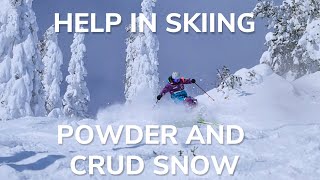
Tom Gellie teaches two techniques for skiing powder and crud: building a strong platform on your outside ski at the end of each turn, then using that to float briefly at the top of the next turn. He demonstrates with drills like rhythmic bouncing and bump-trampoline exercises, emphasizing pole plant timing.
Chapters
I have two concepts that will help you ski powder snow and chopped up crud snow with greater ease. The first concept is to create a strong platform at the end of every turn. The second concept is to utilize that to create a float phase at the top of every turn. The reason you need the platform at the end of every turn is because the snow surface in powder and crud snow is inconsistent in comparison to a groomed run, which most people are used to. Wider skis for sure help in deeper and heavier snow, however these concepts I'm going to share will work whether you have wide skis or narrow skis. The tricky thing with powder and crud snow is the consistency is often very variable. A snowstorm one day might be dry and fluffy, and the next it might be wet and heavy. We often can't tell what is under the surface of that snow. Good skiers are really just predicting and making a guess as to what is there and committing to it. This is why I want to help you with the focus on how to create a good end of turn platform so you can go in with confidence with every turn. And if we nail this part, then we'll be floating through the top of the next turn. And this is important because in deeper, heavier snow there's more resistance, so being out of that snow a little bit is going to make it easier to change edges and redirect where we want to go. It is also probably the most fun moment in the turn, so you really want to capitalize and enjoy that part. So let's get started on this first concept of creating a platform at the end of the turn. This first step requires finding some flat terrain, or at least traversing across some crud and powder. Your goal is to try and bounce in a rhythmical fashion, and the bouncing is you compressing the powder or crud snow down into a platform, and this gives you something to get both skis in the air from. It's perhaps a little bit like jumping in sand, where the surface is not that compact and firm and you have to sort of press down into it in order to get both feet out of the sand. There's nothing too technical here except perhaps a good athletic stance. The real goal is just mileage and a felt sense of finding that platform under the snow when you can't usually see it and maybe you can't predict it. You're teaching your body to search for this feeling before You shift weight before you do anything else so you can then get into the air and make the next move for the next turn. The common problem I see is people make a movement before they sense the platform, before they really bear down into it and try and leave the ground for the next turn. They're too rushed, they're used to the groomed terrain, and they just move or shift their weight without this platform in their mind and this felt sense for it first. If this skier had just practiced some straight-line bouncing on some flat terrain, they probably would have also found their feet would have naturally come together because that position is much easier to get the bounce happening. Another exercise not requiring powder is to get between two bumps. This essentially creates a trampoline with your skis that you can practice bouncing up and down with. I'm a big believer in teaching with feelings, and this bouncing exercise between two bumps probably gives the best bang for your buck without having to find powder snow. Now I really want to emphasize that as a beginner or someone that is not used to skiing powder and crud, you're doing these exercises to get mileage of the feelings that an advanced and expert skier has. This is what you're trying to do, you're trying to build mileage in feelings of a platform that you are not used to yet. The next step after straight line bouncing is to actually work more in a little bit of a turn. Now the main thing here with the bouncing is you actually want to be more outside foot dominant. That platform you create that you release pressure off of and you get airborne and you float really comes from an outside foot heavier pressure, then the inside foot helps bounce you from side to side. Very similar to what I'm showing here on the beach. So when I finish a turn, I'm looking for my platform to be my outside or downhill foot, and I get my upper body over the top of it. I load it up, and then I help use the inside foot to launch me and float into the next turn. Watch how Sébastien Michel makes very similar movements, getting over the outside ski, creating a platform right through the end, just as I do jumping in the sand. Watch this turn closely to see better. Watch in the next turn how I focus on the platform of the downhill foot, just like the sand jumping, and I try and get both feet light to start the next turn. This is opposed to a weight shift, which a lot of people focus on at that point in the turn. Like this skier, to me it looks like they are focused on weight shift for from one foot to another. Imagine now if this skier did the bouncing exercise, getting the feeling of creating a platform and releasing both skis in the air. This skier would have a totally different run down that beautiful powder field. Along with our feet, the pole plant becomes the final element we need to create a platform strongly at the end of every turn. Aim to make your pole plant timed with when you want to leave the platform of the downhill foot at the end of every turn. A good pole plant helps support your platform, enabling both feet to get out of the snow and change edges and start the new turn through crud or heavier snow with greater ease. Pole plants like these ones made by The Skier in Red do not help add to the platform at the end of the turn. This pole plant is too early, before the skier has created a platform. Remember, it is something that helps add to your platform that you've started with your feet first. This will enable everything to move into the next turn more as one unit. I think this angle is really helpful to see how I time the pole plant to add to my platform at the end of every turn. Notice it's not a blocking pole plant. It is one that helps support me as I move across my skis and commit to the next turn. So try and remember, your pole plant is an addition to the feet, but the feet must come first. The poles just help add more support on top. A great way to practice this is doing more of a traverse or a loopy turn where you can focus on the timing of this pole plant along with what you've worked on with getting both feet to create a platform to help you create float at the start of the next turn. Check out this float phase from Josh Duncan-Smith. So awesome. If you can get everything right up until this stage, you're going to find the float phase not very hard at all. Remember how I said these concepts work regardless of ski width? Narrow ones here or wide, they'll both work. And the concept is easy, just try and keep both skis light and move them together as one unit. Don't be in a rush to pressure that outside ski. Enjoy the free-falling sensation. Even in the crud, the longer you can stay light, the more maneuverable your feet and skis are, and the easier it is to maneuver the top of the turn and get your direction set up. Now, as far as practicing goes, really it's about awareness in the top of the turn. You're looking for a floating sensation of both feet. You're looking for less pressure up in the top of the turn, and remember to capitalize on that This light moment allows you to maneuver your feet both laterally and in a direction change. I personally keep tension between my legs so that both legs move together as one in that float phase. Now I've tried to cover two important concepts that should help your powder skiing and crud skiing. However, with that being said, I've worked for almost two decades on my own skiing, trying to refine all different aspects. My most powerful piece of advice is to get video of yourself to see what fundamental skills are lacking and what you could really be working on. And if you don't know where to start, that's where I can help. Big Picture Skiing has the most extensive video library on the internet with drills, exercises, focus points for all turn types that will help you build these fundamental skills and make you a better skier. There's a link in the description below giving you access to 5 pieces of free content. Why not check it out? So in summary, in powder and crud, you want to work on creating a strong platform. This platform is more dominant with your downhill foot. A well-timed pole plant will help with these first two steps to finally give you a great float phase, which is the most fun part in powder and crud skiing. Thanks for watching. Don't forget to subscribe and leave a comment if you enjoyed this video.
More from Tom



Most skiers overlook how they use their poles. Try these five pointers next time you’re skiing.







