How do elite skiers get forward in the moguls?
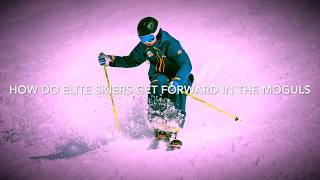
Tom Gellie breaks down why upper-body lean and ankle flexion fail in moguls, then shows the move that works: pushing your forefoot down while driving your hips forward. This shifts your weight over the balls of your feet without losing contact with the snow, the signature technique of elite mogul skiers.
Chapters
Different ways that I see people trying to get their weight, their mass forward to help them start the next mogul turn. So first way, they think that moving their upper body down or their chest forward in isolation is going to get their weight forward. As you can see in here, I don't really get a shift in my center of mass very far forward because really, um, it's sort of just changed the angle right here to this angle, and there hasn't actually been that much weight shifted forward of my base of support. So we'll go on to the next movement. Second method, people try and keep flexing their ankles further. Couple of problems with this, your ski boots are quite stiff and you kind of run into some problems here. Two, same thing, can you see there's more of my bum just going down and squatting lower as opposed to really getting that far forward? Okay, to start my next turn. Move on to number 3. Ooh, let me just draw this in. Watch the line of the hips go down, down this way. Ideally, we wanna be traveling this way. Next one, we look at extending the hips. Alone. Problem with this, as you go over the bump, if you've absorbed and you're trying to travel down the hill like this, you are with this movement alone going to end up with your hips going up. And if the timing is right, yeah, it's okay, but you're probably going to come off the snow and extend and lose contact early on the other side, so you're going to be pushing off the ground. So there's another one.
People are probably trying to do.
Then let's have a look at probably how I interpret, anyway, try and make my forward movement to get hip extension and into the face of the next mogul, which is hips forward and like a contraction of the calves. So the movement of my hips forward really is totally linked with my ankle joint right here. And so I get the tips down and my hips are forward, and now you can see that my weight is very much balanced right over the balls of my feet. So it's definitely moved forward, and all I need to do is go a tad further and I'd be falling over. You don't even need to go that far in the motos, just gotta get the tips down and get forward again. So then the final one, if you just took, uh, so this is the good way. Notice also hips traveling very much in line with the bench. This way. And the final way, if I just don't have calf contraction, so I leave the plantar flexion or pushing the forefoot down, then I end up with this movement, which is I get my weight in front of or over the balls of my feet, tips go down, but I've ended up dropping my mass down too much instead of taking it more forward and down the slope. So there's different ways that I see people moving to get forward at the start of a turn in moguls. So play around with all the different ways and see if you can figure out which one you use to get forward, and then see if you can play around with the way that I particularly happen to view really good mogul skiers moving forward, which is pushing the forefoot down as the hips come forward, and with that combo you get this kind of a look.
So this analysis is just one particular lens, one particular viewpoint at looking at how a top-level mogul skier, in my mind, makes an extension movement to get his mass forward or keep it flowing down the hill with a good snow-ski-snow contact. So if we stop at the position where the guy has absorbed, the reason he's absorbed at this point, or is in this fully compressed position, is because the bumps are down the hill like this. He doesn't want to be going down the hill with his center of mass bouncing around the place. He wants his center of mass to travel down in a relatively straight line. So he's gotta keep his hips doing that, and if you watch in the video here, you could just see that his hips take a very direct line down the hill, but his knees and feet really do a lot of moving to absorb and swallow the terrain. So let's have a look how he gets from here back to an extended position. Well, basically, how does he keep his hips moving straight down the hill fluidly without coming up too much. Part of it is, uh, plantarflexing the foot down the slope, getting these shins driving forward. At that same time, as the hips come forward, you'll notice the upper body goes back. So the shin angle here is still relative But notice how he's come much more upright here as the hips get pushed forward. And then a moment later, it all starts coming matched up again. You'll see right here, this is looking more similar. Again, matching back and shin right here in the fully flexed position. Here, Really, you can see that driving forward shin, tips down, which is coming from the forefoot pushing down, and the hips coming forward. And there's that upper body at a very more upright angle. So this is just my viewpoint on how an elite level skier is keeping their hips moving straight down the hill, which is just them basically syncing up how their foot and ankle works, keeping tension there, not just flexing the ankle but actually driving the forefoot down as the hips drive forward. It's not just a hips forward movement alone, it's not just pushing the balls of the feet down alone, the two combined to keep the center of mass or the hips flowing down the hill in a straight line. So here we have Michael Kingsbury Numerous gold medal Olympic mogul skiing champion from Canada. Uh, fully flexed position here, fairly, uh, matching spine-shin angles. Watch as he goes over, as he pushes the balls of the feet down, the shins and the knees drive forward along with the hips. And that ends up changing this relationship of shin and upper body. So driving forward, driving forward, this has to kind of come back to compensate for that and allow him to be in this position where now we've got nice lined up back and shin again ready to absorb, absorb. Both angles stay relatively congruent., but then the forward movement, the movement to get the hips forward and keep the hips moving in this nice smooth pattern down the slope, he's gotta really put tension in the calf to push the ball of the foot down, and at that same moment he is driving his hips forward. It's not one Without the other, it's both at the same time. Let's look at another elite skier and how they make, uh, movements with their feet and hips synchronized to really keep their center of mass What you could kind of imagine is the hips moving down the fall line in a smooth trajectory. So there's the kind of the smooth line of the slope, and notice how his hips stay on that, yet there's no way you can trace his knees staying along that line. Even his kind of upper body changes along that line, but the centre of mass definitely follows it more. So incredible flexibility here. I would be super envious to be able to have that much range. But let's have a look at how he gets from this tucked up compressed position out of it. So there's the hips opening, driving over the balls of the feet like I demonstrated in the kitchen. Now we've looked at shin angles, upper body angle. Not aligned anymore very much. Upper body upright, shins driving forward, and that's coming from the hips pushing forward and the balls of the feet pushing down. So shins and back aligned again, hips want to keep traveling down the hill, but they don't want to go up here. If you don't make a move with your ankles, then you are going to go up at this point, and that's not going to be helpful for the next bump. You're going to be traveling too much in the air. But if you can drive the hips forward to push on the balls of the feet, and at that same time work the ankle joint here to push down, then you end up with the hips traveling in a straight line down the hill. Nice one, right there. Hip extension with great foot movement. Even does it in the air back up here. Watch this. Boom, boom. Super nice skiing. So here I've tried to line up as best I could a dry land kitchen exercise to just teach myself the kind of coordination of ankle and hip moving forward, or getting the hips moving straight, not up, not down. And it looks pretty similar to Mikael Kingsbury on snow. Obviously you've got to apologize and accept that, you know, he's skiing, I'm not skiing, he's got ski boots on, he's moving down on snow, lots of differences. But hopefully you can just pick and see the similarities here in how his hips travel straight down the fall line, how his foot ends up more plantar flexed, hip joints open, there's a change and a very big difference in shin angle to upper body angle, shin angle to upper body angle throughout the movement to help get those hips moving forward and keeping them moving down in a straight line.
More from Tom



Most skiers overlook how they use their poles. Try these five pointers next time you’re skiing.







