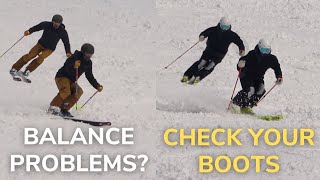
Tom Gellie shows how heel lifts and stiff boot cuffs force skiers backward, killing balance. He fixed a skier named Paul by removing the heel lift and trimming the cuff, which improved Paul's balance metrics by 15-20% instantly without any technique changes.
Chapters
Probably one of the most common problems people have in their skiing early on is getting forward, or they're told you're not flexing your ankles, you've got to get forward more, got to get forward more. This can be a technical issue, however, a lot of people don't check their equipment, the ski boots in particular, because this can often be a low-hanging fruit reason why you're struggling, okay, and it's a really easy fix if you know how. So let me give you an example. In Japan this season. This guy was on my camp, Paul, and Paul is a good skier. He skis in Colorado, wanted to improve. One thing he was really frustrated with was forward balance, balance over his foot, and we could see it in video, see it in his stance. He recognized it and he's just, yeah, sort of at his wit's end a little bit. On this camp I could see it too, and I said, hey, I think we need to check your boots. After a couple of days of skiing, we had time in the evening and we We took the liners out, checked a bunch of things. Found 2 things that were definitely, I think, contributing. You'll hear the result after of what he felt. So number 1, inside there were heel lifts, things to jack up his heel. He said he didn't know why they were in there. The boot fitter who fitted his boots a few years ago put them in. He thought he had a reason in the first place, and often it is to try and help people get forward. But actually, on heel lifts and ramp angle, which is lifting the heel end up more, often you make people lean back more because the way the body reacts— we're not like a mannequin doll where if you lift it up everything tilts forward. Just think about when you walk down a slope. When you walk down a slope, you actually like have to lean back relative to the slope to stay balanced in gravity. And if you're walking up a slope— I'm on stairs at the moment, but if it was no stairs, my heel would pretty much not be touching the ground at all, be leaning forward into the ground. So ramp, heel, high heel can do that. So we took those out, and next thing we did was we checked his ability to flex the boot. And the boot wasn't super stiff one, definitely with like the right one for him, but the design of it, the plastic right at the front where the booster strap comes around was very high, really high, higher than my 150 Raceflex boots. So I said, hey, I've had experience chopping this down and people finding they can flex the boot and get in a better position. That also includes my wife with her new boots. Anyway, so he said, permission to cut my— that top down. Cool, did it. Two things done. We went to sleep. Kind of anticipating what was going to happen the next day. Get out there, after a couple of runs, warm-up runs, I bump into him. Hey, how's it all going? He goes, Tom, for the first time ever, I feel my whole foot is flat on the boot. I can feel the front and the back when I want to. Before, I realized I just couldn't feel anything. I felt like I was more stuck on my heel. That, I really believe, was the heel lifts. He said, also, I feel in the powdery snow— we had some good snow in Japan— I can balance better because my ankle can kind of flex. The boot actually flexes a little bit better. So that change in the cuff height for him was a real, uh, real winner. Could be more athletic, wasn't completely locked and stiff. His carve scores reflected it, 15 to 20% higher in all the balance metrics compared to like the whole couple of seasons before, like immediately. First run, no technique change, just the boots and equipment change. So this, uh, brings to my point of this video: it's not always technique that is the issue holding you back. Your ski boots in particular are so important to get right, and I've got a free boot fit guide in the description below you can check out. Put a lot of time in, all the experience I've had figuring out sort of these problems. And as well as on the Big Picture Skiing website, the video library, there's a whole equipment section and mostly boots though, with little sort of DIY things or helping you to go, you know, know when to go and tell a boot fitter the problem and they can go help you. So yeah, a couple of things you want to definitely check out. Boots have to be really dialed in and right, so go check out that free boot fit guide and don't just always blame yourself. Especially like, like, because of your ankle, like, it's not that hard to flex your ankle. Most everyone can do it. Even my wife, she has really poor ankle flexibility. She can't squat all the way down without her heels coming up. And I would say she's on like the very limited end because we've got her boot set up right, no heel lifts, the cuff was adjusted. It's still like a stiff high-end ladies boot, but the cuff can flex well. She has plenty of ankle flex, so it's not just a strength thing, not a mobility thing. A lot of people see that and they go, oh, I've got to stretch my calves, and not what I've necessarily seen. Often it's the boot, stiff plastic thing, and the way it's wrapping around your leg and the angles of that boot that's getting in the way. Hope this was helpful. Share with other people if you think this might be something for them. Thanks for watching. If you enjoy this content, consider subscribing. Okay, see you next time.