How To Actually Use Your Eyes When Carving
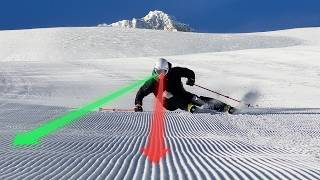
Tom Gellie shows how looking two turn phases ahead transforms your carving. Pick a spot two-thirds through the next turn and rotate your head there before your skis tip. Cameraman Siamak immediately got tidier turns and higher edge angles.
Chapters
I've got one of the simplest yet most effective tips for all your skiing, and it's got to do with where you look into your turns. It's so important, it's crucial in so many other sports— mountain biking, motorcycling, surfing— they all know the importance of looking into your turns.
However, I see this as one of the biggest oversights in the way skiing is taught worldwide.
So today I want to explain to you some simple exercises help you get the feelings of looking into your turns so you can actually create higher edge angles, smoother linking, and better prediction of what's coming up through your turn. So by the end of this video, the main thing you're going to realize is you're going to need to look roughly 2 turn phases ahead into the turn. So I'm trying to give you an amount of how much, as opposed to just looking down the hill or where you are going. The reason you want to be looking about 2 turn phases ahead is because it's going to help you get your body moving ahead of your feet at the top of the turn, and then visual information like if the terrain is dropping away, if there's a rut, if there's a person, if the snow gets icier, that sort of stuff, you're going to be able to pick that up. Your brain recognizes terrain information and it will adjust accordingly. The other really important thing about looking into your turn and what it will do is when I incline or move into the turn laterally to build edge angles, if I do it while looking at you like this, it feels very sort of unbalanced, like I'm losing balance as I incline. If I look into the turn and incline like this, The difference is I feel more that I'm just moving forward because forward is where my eyes are looking. So if I'm moving where my eyes are looking, it doesn't feel as out of balance. It's a simple thing, look where you're going to go, and now I'm going to give you a couple of tips on how to start working on this.
The first tip centers around timing of when you deliberately look into that next turn. So that timing starts in the transition, and I want you to look 2 phases ahead, which means you're going to look just past the apex or just past the middle of your next turn. And don't be just general in looking here. I want you to try and pick a spot on the snow, almost predict the shape of the turn you want to make, look at that spot in the transition, and then try and ski through that target. So if you're doing this well, you should really feel your neck and head actually rotate more than the rest of your body, and particularly more than your skis. Notice how my head turns quite a fair way before my skis start to tip and turn. This is important and will give you that feeling of early edging and early entrance into the turn. Notice how it doesn't matter what level of ski performance you're at, even these basic parallel turns, the looking into the turn before the skis turn really helps me predict what's coming up and to shape the turn much better. Adding this key technique into all my ski turns has probably made one of the biggest impacts on my overall skiing. It's also been one of the best things for my mountain biking and surfing as well. So the first thing to try is in the transition, look ahead of your skis, turn it before everything else, and roughly aim about two-thirds of the way through the turn. Pick a spot and try and ski through that target.
So now another even more exaggerated one, and I love exaggerated things because you need to get a new feeling. It's like telling someone, hey, have you ever tried chocolate? It's very hard to explain what chocolate tastes like unless you have it. So I give you an experience of really looking into a turn. It's like me giving you a taste of chocolate and you go, oh, I know what that's like. So here it is, I'm going to look right over my shoulder, over my shoulder, so I'm going beyond 45 degrees, right over my shoulder, I'm going to hold it there until I almost finish a turn. So I can even do this in a snowplough so I can practice at a slower speed, look over my shoulder, then turn, look over my shoulder, then turn, look over my shoulder, then turn, it's going to feel really quite odd. That's the whole idea. You exaggerate it. As long as you— if you exaggerate it enough, you're probably going to index back to about just the right amount. So the second one to try is exaggerating the feeling. You're just going to turn your head so you're looking right over the left and then the right shoulder. Now this is the cameraman Siamak. He's literally had only a couple of runs trying this out. What do you feel the effect is of looking into your turns?
Yeah, when I look into towards the turn where I need to look, the crossover going into the direction of the turn, it's just automatic. Also, it's smoother and there's better flow, and I'm on, on a higher edge.
Yeah, I would agree. I, I said to him, he looks tidier. A lot of mistakes, everything is tidied up, and like the turn shape and gradual pressure buildup, all those. So that's just simply coming out as it feels easier and smoother. Simple as that. And you felt it immediately, yes? This is not like, oh, work on it for a while and you get there. It's an immediate—
It was immediate, and the word tidy is really appropriate because there's all these skills that I think I have, it's just brought them all together.
Fantastic. You just realized you needed to look into the turn a lot more than you had been.
Totally, it was not 45 degrees, I was looking at the beginning of the turn versus the apex of the turn.
So maybe one turn phase ahead.
Yeah, instead of two.
So get out there, these are results you could be feeling yourself. Now the type of turn, size, so a long turn, short turn, there's sort of It's the same principle really, but in a short turn things happen so fast, I personally find it really helps my short turns if I keep moving my vision to where basically that after the apex moment is. If I keep going from there, looking to the after the apex or the middle to end point of the turn for the next one, that really helps me. In the moguls, if you ask any World Cup bump skier what they're working on, a lot of the time it'll be where they're looking. If you can read the terrain in front of you, you're going to be able to make decisions and react better. So in summary, look into your turns. You probably want to exaggerate it to begin with, so we talked about looking over each shoulder. You can do it in a snowplough, you can do it in a basic turn, and then build up the speed and edge angle as you get used to it. So a lot of people look in this direction where their skis are going, or maybe 10% into the turn, you're going to look far further down here. And you're just going to allow everything to be a little free and sort of follow like a spiral staircase, head leads the way, everything else is then going to follow. The general guideline I use is 2 turn phases ahead. So if I'm in the transition right here, I don't look at the initiation, I look further down towards the, like, after the apex. If I was at the middle of that next turn, I'm going to be looking at the initiation of the one after. It really is going to help your balance when you start making toppling and inclination movements. The reason again is if you do it this way, this feels very unbalanced, but if I face where I'm going, it just feels like I'm moving forward. You see it in all other sports. The best in the business, they look into their turns, the best surfers, the best mountain bikers, the best MotoGP riders, they all do it. So you start practicing it too, it's going to make a massive difference in your skiing. Now if you've enjoyed this content, I invite you to check out Big Picture Skiing. I create videos on every single topic imaginable in the ski world, from ski boot setup, ski selection, hand position, eyes of course. Angulation, carving, moguls, everything. I try and cover it all. Go over there, check it out, there's a free trial so you can do it risk-free. I guarantee you're going to learn something. Join the community, engage with the other members that are learning at a faster rate than anyone else on the internet. Good luck with your skiing, thanks for following Big Picture Skiing, and I'll see you out there on the slopes hopefully. See you later! Mm-hmm.
More from Tom



Most skiers overlook how they use their poles. Try these five pointers next time you’re skiing.







