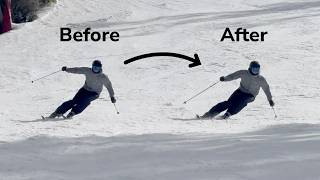
In this instructional video Tom Gellie demonstrates two straightforward hand‑position cues that dramatically improve carving on the first try. The first cue is to keep the palms facing down toward the snow, which enhances balance and creates a “safety net” feeling. The second cue is to keep the outside hand low and level through the turn, allowing the hand to follow the outside foot and maintain pressure on the outside ski. Tom shows the cues in action with two skiers, Matt and Jackson, highlighting the visual difference in ski bite, carve shape, and overall stability when the cues are applied. Learner feedback confirms a stronger sense of balance, reduced arm‑raising, and a more relaxed, fluid turn. Tom then explains his broader training philosophy: isolate individual skill pieces (hand position, ankle grip, etc.), practice them deliberately, and then integrate them into the “big picture” of skiing for smoother, more instinctive riding. The video ends with a call‑to‑action to explore his Big Picture Skiing platform for deeper coaching.
Chapters
Today we are looking at improving your carving. If you want your carve turns to perform better, then you need to spend some time on your upper body and hand position. I want to show you 2 powerful but simple cues that will make a noticeable impact on the very first run you try them. And to prove just how powerful these cues are, you will see 2 skiers try them out and notice the impact in just one run.
So it feels better. Yeah, he's better.
So after watching this video, I'm confident you will know how to improve your own skiing, making a step forward and never looking back. I'm Tom Gellie, I improve people's skiing, and I've helped thousands of skiers through my YouTube tutorials as well as my 5-star reviewed online platform, Big Picture Skiing. Keep watching to become a better skier.
Two things you can do with your hands. The first one has got to do with keeping your palms like facing down towards the snow. And the reason is, if I was going to walk across a tightrope walk, I wouldn't have my hands like this, okay? So my body is used to— everyone's body is used to— when you're looking for balance, you face your palms more down. Okay, so you grip your poles as you're skiing. You're just going to try and keep the palms down like this as you, yeah, develop your carving angles. The second thing to be aware of is your outside hand position. But through a carve turn, you're going to try and keep your outside hand consistently at the same height, even to the point of it getting lower and lower and lower to the snow through the turn, as opposed to getting higher Higher, higher. So something I got to work on for sure, especially on my left side. My arm likes to lift. As soon as I get it right, I can consistently keep my palm more down and the hand lowers through the turn, I keep my balance against the outside. I just feel way more secure. So have a look, see if, uh, see if you can see it. Try it yourself.
The first time you try this, I suggest going a little bit slower. This will allow you to be conscious and aware of where that outside hand is and if you can keep your palms facing more down. A good result to begin with is just even being aware or catching yourself with your hands raising up, where you probably didn't realize that was happening. I had a couple of instructor friends with me to try this out, and you can see the concentration on their face as they're trying to keep the palms facing more down, as well as keep that outside hand more at a consistent height and it not raising up throughout the turn. This is some footage of Matt earlier in the winter, and you can see that through the turn his arm kind of keeps going up and raises up and he's not able to keep great outside ski pressure helping that ski bend and grip in the snow. There's a lot of really good things going on in his skiing, but this is one thing that stood out and why I wanted to help him with his outside hand position. Just check out the difference already in half a run. His outside hand, instead of raising higher and higher throughout the turn, actually goes lower and lower. This one here is a great example, you can see it wants to go up, then he thinks, no, I've got to keep the palm down, and look at that outside ski bite, that ski bend, and that carve turn really come around nicely.
Can I ask you what that felt like? Because this is a big thing for you, right? Yeah, yeah, yeah, yeah.
I feel so much more stable going throughout the whole turn. Like, I used to throw my arm up really high and then I completely lose my outside ski. Keeping that kind of level hands with both hands the whole turn, I can really build that pressure through the whole turn on the outside ski.
Yeah, nice. Really happy, cuz the first tip I gave you was just about the hands, like the palms facing down. So even without the hands like being level and low to the snow, even that made a difference, right?
Yeah, yeah, absolutely.
Yeah, yeah.
And just having those hands down, it just feels like you've got like a— it feels like a bit of a safety net where I can really exactly feel with the snow, like I'm reaching down for it instead of having them here and stiff. Yes, yeah, more relaxed about getting a little bit lower.
Yeah, because you know, like with poles, like think about like surf, like sports like surfing, skateboarding, or like whatever, like you don't have to hang on to stuff, so you've got your hands kind of free. And so you kind of like, if you stack it, you feel like more safe. Yeah, so there's a definite safety feeling, isn't it? It's like just feels safer. So yeah, all right, time to get both combined. Let's give it a crack.
Here's Jackson practicing those palms facing a little more down throughout the turn. And that outside hand not raising up as the turn progresses. However, there's something going on that's blocking him a little bit, so we need to pause for a moment and help him out with something further.
Feel the difference between keeping the hand over the outside foot exactly as you go down. Can you feel at this point, if you keep the hand over the foot, you feel blocked?
Yeah, about here.
Yep. Now watch what happens. Keep the hand like lowering and level, but allow it to move in. Yes. And see how you can keep going. Yep, so go back up again. So the thing you got to watch out for, what stopped you like continue to move fluidly, is you tried to keep your hand over the outside foot. Yes, the whole time. It's down, level, and low. Bingo!
That's what you're looking for next time.
Yes, yeah, so it feels better. Yeah, he's better.
It just feels like I'm not trying to force everything as much. Like, I was having to do so much weird stuff to get like those high edge angles and that balance, and I don't know, it just felt a lot more relaxed —like simple.
Yeah, simple, that's the word.
Yeah, yeah, I felt like I had more time to return. Like, I don't know what it— just that simple movement kind of is the blend between everything else to help it all come in together for me at least.
Yeah, yeah, yeah, for me too. I just feel like, oh wow, even— did you feel turns even where you slide? Yeah, you feel way better in a slide with your hand there. Yeah, you can get it back again. Without it, it's, it's tricky. So the hands to accidentally go up there.
Yeah, yeah.
How many out of, say, that run there, how many do you feel like you got solid? So say there's like 12 turns, maybe 8. Yeah, yeah, yeah, pretty— yeah, over 50%. Yeah, sweet. So it's just a matter of practice, practice, practice, keep building, try and get 9. Um, yeah, let's, let's go get some laps in. Yeah, sweet.
Nice. Some really cool results from the boys there in literally one run. So the way I approach training skiing for myself and others like Matt and Jackson there is to look at what key skills are missing. So not necessarily how to make like a perfect turn from like 1, 2, 3, 4, 5, like this is how it's done, but instead like what happens when I have my outside hand lower through a turn? Like how does that affect balance and grip, my ability to feel like it can go faster? So I look at different elements like this in my skiing and other skiing, and I try and help them build these like pieces of the big picture of skiing. So once you put it all together, then you start realizing you flow. And like the guys felt like they were safer, it was simpler to ski, they're having more fun and making breakthroughs where, you know, you heard Matt say usually had to have all these different weird complex ideas whereas this was literally one or two simple things that actually packaged that all together. So what I've found is a really great way to approach ski improvement is to pick these skills and these different separate pieces, whether it's awareness of your hands or awareness of how the ankle joint helps grip or slip the ski, and you work on these things individually on their own so you can actually focus your attention on them Give them the time that they deserve to then realize the outcome, because then what starts to happen is it turns into a feeling, and that feeling is far easier to conjure up than, than the thought that it first started with. And then you can start skiing with more flow, less things going on in your mind, and you're just actually reacting to what you see ahead of you. You're predicting, oh, this is coming up, I'm going to need to, you know, make this decision, make this movement, have my skis here. And that's all, that's all going to be happening in the back of your mind automatically. But the way you get there is by working on these little pieces, the pieces of the big picture of skiing.
So quick tips with your hands that make a massive impact. Remember, first one, palms more facing down, okay? This also gives you more space for edge angles. Your poles are here, you're going to get a— you're going to run into them, you're probably going to lift your arm up to create space. So palms down, tightrope walker example, is like really good to like— okay, that's why, but we just naturally balance better like this. The boys said it, they felt, they felt safer. Okay, second one is you start being aware of that, the outside hand is just going to stay at a consistent height above the snow, possibly even getting lower, lower, lower, lower through the turn. Okay. And remember, a big breakthrough for them with progressive edging, so not getting stuck here, you don't keep your hand over the same spot. It's not this, it's consistent height above the snow as it moves. So see, I just, I feel like my hand is in line with my knee as I get big edge angles, not out here. Okay, give it a try, let us know if it works for you in the comments. Please like and subscribe. Even consider checking out my platform bigpictureskiing.com. I've got over hundreds of videos on every single thing you could think about that's going to help improve your skiing— moguls, carving, short turns, powder, everything. So go there if you're really the obsessed, deep-interested skier. Otherwise, keep checking out my YouTube channel. Thanks for watching. See ya!