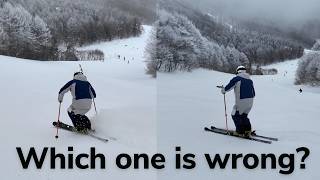
In this coaching monologue, Tom Gellie addresses the common dilemma of receiving contradictory advice about skiing technique. He argues against a binary right‑or‑wrong mindset and instead promotes building a versatile skill set by exploring the full spectrum of a technique—in this case, pole planting. Gellie describes a systematic approach where students experiment with pole plants that vary in angle, timing, and pressure across multiple runs, observing the outcomes rather than judging correctness. He connects this method to broader adaptability, explaining how different snow conditions, turn types, ski equipment, and fatigue levels demand different pole‑plant strategies. The talk also critiques the prevailing coaching culture that often prescribes a single “ideal” technique, using examples such as retraction (staying low) and mogul skiing to illustrate how exploring alternatives can reveal new options and enjoyment. Ultimately, Gellie encourages skiers to develop the freedom to choose the most effective technique for any moment, turning opposing feedback into a richer understanding of skiing dynamics.
Chapters
How do you make sense of seemingly opposing feedback? Someone says this is the right way to do something in skiing, someone else says no, that's wrong, you should do it this way. Well, let me see if I can give you another perspective that maybe changes your mind and doesn't think in right versus wrong, but thinks in terms of building versatility, adaptability, and a wider skill set. So I'm going to use an example of pole planting. So if you trust me as your coach, I say, hey, this is the one way you should pole plant. You know, the right technique is that you always pole plant at a 45-degree angle away from your toe piece of your binding. It's down the hill. You always do it when the edge has changed in that exact moment. Not sooner, not later, and you know, you put this much pressure on it, not too heavy, not too light, and you only tried to pole plant in this way. Okay, there's one way. What if I instead said we're not going to work on what's right or wrong in pole planting, we're going to explore the whole spectrum of pole planting. So the first thing we're going to do is we're going to try and make some runs, and every run we're going to change where we pole plant. It's not always going to be at 45°, it's going to be more towards the tips. Then the next run, it's actually more towards the tails behind us. We're going to try some pole plants where it's really heavy and hard. We're going to try some pole plants that are super light where we barely touch the snow. And your job as a student is to figure out what happens when I do these things. What changes? And, you know, don't judge them as right or wrong. Just judge them as what happens. Does it give you maybe an option that in a certain circumstance might be helpful? So that you can see, if you change from thinking about what is right or wrong, am I doing the right way or the wrong way, to, hey, I've pole planted every single way possible at every single different time in the turn possible— early, late, right in the middle. And I understand that actually there's certain points when I want to use a different pole plant, because if you watch good skiers that ski a variety of turns— this is really important if you want to become a true all-mountain skier and adaptable, ah, unless all you ski is the same kind of groomer pitch all the time, sure, you might find there's one more ideal technique. But if you ski different snow conditions, different pitches, different types of skis, you also get tired versus being energized, you're going to need to change and be okay with that change and knowing like, hey, I need some help unweighting, so I'm going to pole plant differently. I need some I need some help committing to the turn, I need some help pivoting faster, so I'm going to change where that is. So this whole concept of exploring the spectrum of a skill is the way I go about my coaching, but I do find it's difficult at times because the sort of the majority thinking around things is that there is one way to do it. Like, in the Tom Gellie system, we only, you know, transition low, or we only use hop turns, or things like that. And so I just find people get a little bit confused because they're like, but someone else said not to do that, they said to do this. My response is, there's no right or wrong. Don't think of it in terms of that, think about you've just found another skill set, another way to move that if you can't do it and you don't own that yet, probably a great idea that you go and work on it and figure out what it does. So that skill like retracting, being lower in a turn for example, like people get told, "Hey, you're popping up too much, there's too much pop-up in your turns, you're extending, stay lower." Instead of thinking that's wrong, you could actually go and explore what not popping up does. How does that change it? Because you'll find not every turn is that useful to always stay retracted and never rise. So, you know, for example, my own mogul skiing, I've spent a lot of time working on staying in contact with the snow, being really low, absorbing not really catching much air. But I see some great skiers, uh, and myself at times, like, catch air, and I'm like, you know what, I'm not as good at that, and I'm gonna go work on it because that's gonna bring some more freedom and some fun and some situations where actually that might be a better decision to make to transition my turns than absorbing and trying to stay low. So yeah, I'm really trying to broaden my own skiing and not get stuck in this is the one way to do it. So anyway, how do you reconcile seemingly opposing feedback? This is right, that's wrong, you need to do this because, because the other thing is wrong. Well, instead of thinking that way, instead think about outcomes, exploring the spectrum, and being like, hey, I need to be able to do the whole end of like the pole planting, the early one, the late one, the heavy pole plant, the light pole plant, because then when that situation arises, when I might need to use a different technique, not the prescribed perfect technique, I'm going to have the freedom to choose that. I'm going to choose it because it's the, the right decision based on that moment, the environment, the snow at that time. And yeah, freedom, full freedom in your skiing. Anyway, hopefully I hope this video was helpful. It's in response to a lot of people asking me questions about, you say this, but then you also say the opposite at times. Yeah, of course I do, because I want you to understand the full spectrum of skiing, not get stuck into one only ideal right technique, because it's rubbish. There's no such thing.