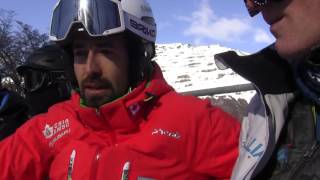
Jeff Marks, a ski instructor from Banff and new member of the CSIA demo team, spent three to four years preparing through intense physical conditioning: core strength, flexibility, hip mobility, and slackline work. He shifted his skiing toward greater grip in turns and better balance on the outside ski, emphasizing reactive agility to quickly regain balance after imbalance.
Chapters
Okay, so we're on the chair in Ishwarya, first day of the workshops, and I just happened to jump on the chair with Jeff Marks. Hey everybody. Hey. So Jeff is a member of the Canadian CSIA demo team, and I just wanted to ask him a couple of questions. But first we'll let him introduce himself, maybe a bit about how long he's been skiing for, and then I'm going to ask him a couple of personal questions. Alright, so your name and how long you've been skiing? Ski instructing for?
My name is Jeff Marks, I'm out of Banff, Alberta, and I've been ski instructing now for 20 years. This is the start of year number 21.
Excellent, and where are you based?
Based in Banff, Alberta, Canada.
And your position?
I work for the CSIA in, in the winter as Educational Development Coordinator for Western Canada, looking after administrative duties and a lot of on-snow work, as well as being a part of our technical committee and education committees. And I also I teach skiing at Lake Louise Ski Area.
Excellent. And is this your first, second term on the demo team?
First term.
First term? Excellent, excellent. And so then I'd like to ask you, what are you working on, what did you work on in your skiing to get on the demo team and I guess get your level of skiing high enough to be able to achieve that?
You know, for me, the last, I would say, 3 to 4 years have been a lot of actual physical training. Just getting myself in different and better shape than I've probably ever been in. And of course, as a lot of us do, dealing with some old injuries and things like that. And so I needed to do some strength training and flexibility and that kind of stuff. And it's— so that's sort of the core of it. That's where it all started. And then actually on a technical side, you know, grip, balance, performance, just trying to pull all those things up as I move forward.
Excellent. And then did you do that, like, a lot of your training, is it spent with another, like, another skier, a partner, or do you do a lot of, like, sort of self-evaluation? How do you, how do you kind of, I guess, progress and make sure you're on the right path?
Well, we're pretty lucky in the Banff area, and actually in a lot of Western Canada, we have access to, you know, a lot of The guys, girls that I would consider to be my mentors and trainers, a lot of them have been to Interski before multiple times, and so I'm in a pretty lucky situation where I do have access to that. But also, I think once you get to a stage where you, you know, you understand what it is you need to focus on and why and what the results are when it's correct versus incorrect, a lot of that training can be done on our own. Yes. And so we go out and we do that, and it's not just getting feedback from trainers, but getting around each other as demo team members, you know, just the guys and girls that I work with on a regular basis.
Yeah.
Talking about skiing, looking at skiing, skiing. Yeah, yeah, yeah. Yep.
Do you feel your skiing has changed then since, I guess, I guess making it a goal to be on the team and then going through the last few years of training, do you feel it's—
Yeah, absolutely, it's changed quite a bit.
Like if you were to look at a video of yourself skiing 4 years ago and now, what simply, what would you say is different? Like the transition, where you're getting grip, where you're getting pressure?
Sure, yeah, absolutely. I think, you know, where I get grip in the turn and where I'm able to actually direct the momentum that I can get from that. You know, being able to maintain grip and balance, you know, to the outside ski so that I can actually direct my momentum, you know, across the hill or down the hill or wherever I want to at that particular time. I think you'll see in a lot of our demos, that's sort of what we're trying to display is the ability to use grip and balance to and then a release that lets us go where we want to. As opposed to a hangover, if you will, from one turn to the next that sort of dictates how much ski performance we're going to get, what direction we're going to travel, how fast we're going to go, and those sort of aspects. So that's where a lot of my personal focus has been, and in the making of the team, the building of the team, our demonstrations We've tried to implement that and hopefully display it.
Yeah, yeah, cool, excellent. And you talked about the physical sort of mobility and strength stuff you worked on. Yeah. Can you give us a bit of an idea of what specifically, like, were you trying to get lateral movement in your hips, like strength in your back? Yeah, where does it come from?
Yeah, I would say just core strength so that I can, well, core strength and flexibility, like you said, just because, you know, the forces that we're, you know, you look at everybody on the demo slope and there's a lot of forces being generated and, you know, the snow is harder and so being able to technically move the way we want to be able to move to get something to happen, but then also be physically strong enough to be able to deal with pressure that results, deal with imbalance, things like that, you know, obviously it doesn't always work the way you want it to, but to be able to come back into, into a turn that you want or something that keeps you out of trouble or what have you. And then agility as well, so trying to, you know, get quicker and being able to get out of balance, back into balance as quickly as possible. Not in a technical fashion, but more in a reactive— just being able to move.
Yeah, yeah, yeah, yeah. I saw you guys did some training on a slackline.
Yeah, we've been doing some slackline training.
Yeah, that's good.
Yeah, I don't know, I don't know if it's training, but a little bit of, a little bit of goofing around and so on.
Yeah, cool, good stuff. All right, well, thanks very much, Jeff, for your, uh, time, and, uh, we'll hopefully maybe catch another chair ride and ask you a few more questions.