Jimmy Krupka - Skiing, Podcasting, Ski Equipment And Hustling
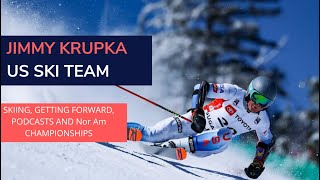
In this episode of the Big Picture Skiing podcast, US ski team racer Jimmy Krupka discusses his evolution as a skier, technical insights, training drills, equipment setup, coaching influences, and his competitive goals. He explains why the traditional emphasis on staying constantly forward in the boots is limiting and describes a more dynamic rocking motion that balances forward pressure with a later‑stage tail press to generate speed on intermediate terrain. He highlights two foundational drills—one‑ski balance runs and the up‑and‑over (through‑and‑over) drill—that improve edge control, balance, and early pressure. Jimmy shares his development path from early club skiing in New Hampshire to the Green Mountain Valley School and the US development team, emphasizing the role of supportive coaches and a “constraints‑based” training environment. He delves into boot fitting (canting, ramp angle, footbeds) and the nuanced process of selecting and testing speed skis, including base grinds, wax choices, and the lack of a universal scientific formula. The conversation touches on biomechanics, such as the debated advantage of bowed tibias, and acknowledges the wide range of body types that can succeed. Jimmy also talks about mental preparation, drawing inspiration from surfing, motocross, and backcountry jumps, and how his own podcast (Arc City) and Instagram presence serve both as a learning platform and a funding avenue. Finally, he outlines his upcoming NOR‑AM schedule, his aim to win the NOR‑AM title, and his predictions for top slalom and GS World Cup contenders.
Chapters
Yeah, growing up, coaches were always just like, you need to get more forward, you need to get more forward. And we do all these drills where you're just like moving your hips forward and leaning on the front of your boots and like getting your shoulders over your tips and all this stuff. And then as I kind of got older and was making, you know, more nuanced turns on harder slopes, it just wasn't clicking. And I realized that like, you can't be forward all the time. And that's actually a really slow way to ski. And so I'm like, I'm not saying you need to get off the front of your boots. Actually, you kind of have.
Hey skiers, welcome to another episode of the Big Picture Skiing podcast. On today's show, you're going to meet Jimmy Krupka. Now Jimmy is a member of the US ski team, and he's got his sights set on becoming North American champion this season. So watch closely, that'll be really interesting. I think this guy's definitely got it in him. I really love the way he thinks about skiing, he's definitely a thinker, but he's also very good at putting that aside and knowing that good skiing actually happens by kind of running on feel and on instinct. You'll hear some insights into what Jimmy thinks about ski boots and skis, there's some really interesting stuff, especially around the faster speed skis. You'll also hear Jimmy's main drills he thought really helped him become a very fundamentally solid ski racer at an early age, where he came from, his, uh, his history. It's really, really interesting. He's, he's a funny guy, so I think it's, uh, he's very easy to listen to, very articulate. And I hope you enjoy this episode. I think there's a ton in it. And afterwards, please follow him on Instagram at jimmy_hu_. He's got a very entertaining channel. A quick mention for my website, Big Picture Skiing, and soon to be an app for iOS and Android. It's where I put all my ideas, and my co-coach Sam puts his thoughts in there too, on skiing technique, equipment setup. We teach lessons on bumps, theory on racing, all sorts of stuff.
It's—
the goal is to be a one-stop shop, be one of the best resources out there for skiers to find out about how to improve their skiing. So if you haven't checked it out, bigpictureskying.com, and soon to be found on the Google Play and Apple App. Now without further ado, let's get in and hear from the guy you've been wanting to hear from, Jimmy Krupka.
Or Jimmy who? Jimmy, thanks very much for joining us on the Big Picture Skiing podcast. I'm going to hit you with, uh, my first question here. Why are you not the world's best slalom skier right now? What's, what's holding you back? Or are you just on this trajectory and we're just waiting to see you be world number one?
So there are days where I feel amazing and I feel like I could beat anyone, but that's not the truth. And I like to kind of stay grounded in reality. I've got a lot of work to do. Basically, my, my flat skiing feels almost as fast as anyone, like really, really flat stuff. I'm working on maintaining and generating speed on kind of moderate terrain where there can— a huge gap can open up between the best guys and the worst guys. So I'm just trying to figure out how to, you know, keep my skis on the ground and keep generating speed through that stuff.
Um, and that's really like my big, um, like that would be a main, like a main focus in this season is like you want to be able to see in like those kind of sections of a course you're better than, than you were last year. And yeah, yeah. And so, so to figure that out, do you Do you like using video? Like, do you watch people that you know are good at that and then compare to what your line and movements are? Or what do you— or do you just like to get out there and train that terrain and feel it? Like, what's your style?
I think the best way to get better at something is just to do it and, and just, um, keep an open mind and stay curious and just work really hard and get a lot of reps in. I think that's kind of my— been my sort of, um, formula for getting better. Um, obviously you got to look at video and you got to look at what the other guys are doing. Um, and more than anything, um, just look at what they're accomplishing with their skis, because it's easy to look at the best skiers in the world and go, oh, I'll just copy exactly what they're doing. I'll try to put my hands the way they're doing it. I'll try to do my knees the same way. And that's a really misleading thing to do because you don't, you don't ski like those guys. You have your own style. And, um, what they're accomplishing on the snow is all pretty similar to each other though.
Yeah. So how— so then have you got a little like simple cue now, a fear, feeling, you know, that you're getting that speed in that inter— like those sort of not flats but the intermediate kind of parts of the run? Yeah, how do you get yourself in the right position to, to do that? Or what's, or what's the mistake, you know, oh no, that, that's the thing that makes me slower. Like, do you know what that is?
Yeah. Um, I mean, what those guys, what the best in the world do really well is, um, they pick the ski up, or I say pick the ski up, it's actually the opposite. They press the ski into the snow early. So they're basically maybe it's maybe 1 foot before me, but their ski is pressed into the snow and arcing down into the apex, whereas maybe my ski is sliding a little bit and then hitting their arc and pressuring just before the apex. But, you know, the early pressure sort of thing is, is key. There's so much to it, though. I mean, if you really want to break it down, there's like you need to go deep. So you have to kind of have your skis pointed out so that they can snap back. Because if your skis are kind of just pointed down the hill the whole time, then they don't— they're not able to create that, that snap, like really bending the ski. They're not— they're also not able to— you're not able to cut off as much line if you're not going deep like that. So people love to talk about this concept of going deep.
Basically where your skis are pointed out the opposite way to where you want to go. Yes.
Almost at the top of the turn.
And then you kind of step back.
Yeah. And I love to geek out about this stuff as much as anyone. But at the end of the day, generally, like the way I'm trying to get better at this is just like, feel it out. Like, I feel— I just like, get— give the feedback. That turn felt good. Let me try to make more of those.
So is it almost like, like, I know whenever I try and— not to the level you or your, uh, teammates do it at, but I know when I try and do that, it's almost like you have to do anti-turning. Like, you have to tell yourself, just don't try and turn. Would you kind of— is that almost what you— because you, especially as it gets steeper, you want to be a bit of a wuss and you kind of want to, you know, like, feel a bit of the snow through a brushing, skidding, and it's like, don't do that. Just don't. Like, would you, would you agree?
It's really, yeah, it's really hard to force yourself to, you know, quote unquote, go deep in the turn. Because when you're going fast, you're on a pitch and you finish a turn. The first thing you want to do is, is kind of push the tails of your skis out. So you're kind of ready to come back the other direction.. And so trusting yourself, like that's a big word we use when we're working on this kind of thing is like trusting yourself to finish your turn and just kind of float down the fall line for a second and then push that ski into the ground. Um, keep still pointed out and then, uh, kind of bend the ski back into the fall line. Um, it's, it's hard to trust yourself to do that.
Yeah. Yeah, totally.
Okay.
So if we, we wind back like the clock on your life in a little bit, like what's, what's your background? Like how, how did you get into, you know, racing, uh, being on the US ski team?
Um, started skiing at 2. My parents were big skiers. Um, my middle name is Cannon after Cannon Mountain, um, which is, you know, New Hampshire. Um, and then they weren't racers really. My mom, you know, raced a couple races in high school, but they weren't really planning for me to race necessarily. Um, but I, uh, I don't know. I think it was like, I saw a poster of Bode Miller somewhere and I was like, what is he doing? And that's what I want to do. Um, my parents were like, oh, that's ski racing. I was like, put me in the club, put me in the, put me in the ski club right now. Um, so kind of from age like 5 or 6, I was totally hooked on the idea of ski racing and, and going to the World Cup circuit and being on the U.S. ski team. Um, and so flash forward, you know, 7th grade, we moved to Vermont so I could attend the ski academy in Waitsfield, uh, Green Mountain Valley School. Um, and then from there, when I graduated high school, I made the, you know, development team. Um, and I've kind of just slowly been working my way up there ever since.
As, as like, I, I'm a dad, I've got a 5-year-old. Like, do you have really good memories of going to a school that was just like a school that was focused on skiing?
Yes. I, I like, I loved my high school experience. There's a lot of people that like were like, oh, high school was tough. Um, I loved high school and because I got to ski every day. I mean, it's no surprise there.
Like literally during the winter, like every day, every single day.
Like so good. Well, except for Mondays. Mondays was a full class day. Um, it was like, class from, you know, 8 AM to 6 PM. Um, but then, you know, every other day class started after lunch and went to 6 PM, so you just skied all morning. Um, you know, those 4 weekdays, and obviously you'd ski on the weekends.
Did you find— were you the kind of, uh, person that— were you a bit of a naughty kid? Were you a— were you a good— like, you did all the stuff the coaches would say, or would you be off building jumps with your friends in the trees?
And, uh, it was kind of a mixture. It was like, I inherently, I was kind of a goody-two-shoes, and so I listened to what the coaches said, and I, and I like, like, you know, quote unquote, like, worked hard. Um, but I will say that like the, the, the rules I would break were, were safety rules. So it was like we would, we would build a jump where we weren't supposed to, or in the offseason, like, we'd we'd put up a slack line like 40 feet in the trees across some ravine behind the school. That was the stuff that would get me in trouble.
So then for like people that are maybe, you know, not the level of, of ski racing, but we wind back to like what helped you get there. I was asking just before the show, like, did you have some favorite ski drills that you felt were like really effective for you to get like fundamentals down?
Yes. Um, one of them, I remember there was a year I had a really tough season after, I think it was 9th grade, had a really tough, um, ski season. Um, wasn't putting in a ton of effort. I was eating microwave popcorn for breakfast. I was video games, like that kind of thing. And the results showed. And so like that summer in the prep period, I was like, okay, I've gotta buckle down. And I don't know what inspired me to do this, but someone had told me like one skiing is really good for you. So like literally every day during our, during the summer and fall at our prep camps, I like after training ended, I'd go out for like 5 to 10 extra runs on one ski. Um, and number one, it like builds strength obviously. And I was like on a pommel lift too. So I was on this like one leg the whole time dying. It was terrible. But like being able to balance on one ski and make turns is like, exponentially increases your abilities, I think.
Your skill. Yeah, all skills, right? Yeah, like every— yeah, the edging, a balance, like where you point the ski and steer it. Like, yeah, that's, that's interesting. You know, that's one of, um, Slopey's— Eric Slopey's go-to's. Yeah, early season, heaps of that. And same with my, uh, my sort of co-coach Sam, who he, he raced a couple of world championships and Super G. He grew up ski racing in Australia, and that was one of the things— in Australia we get a lot of like wind hold and bad days, and so the, the ski racing club was always on like the beginner hill on those days when all these kids are on one ski like crashing and practicing and going. But yeah, it's such a good like fundamental, isn't it? And, um, kind of takes away from always like just outside ski, outside ski, like you gotta learn to, to master like skiing the inside ski as well. Cause that's the hard part. Yeah.
You're, so you're developing not only that skill, but all those muscles that kind of hold you in place when you're on your inside ski. Cause sometimes you end up on your inside ski or whatever. Um, and also like it gives you instant feedback. Like the, the instant your hips are a little bit too far back, like you can't even hold it up and you fall. Where my fascination with being forward all the time started.
I think we talked about that before the show, but Yeah, do you want to, do you want to speak to that? Because I know in one of your, uh, just, just so people know, you have a podcast called Arc City and it's a really cool podcast and I recommend people listen to that. But in one of them you, uh, you were speaking with, uh, Sandra Pratt, yeah, about, about always being forward. Yeah, so do you want to speak to, I guess, you, when you discovered it's not always being forward and your thoughts on being forward.
Yeah, yeah, no, like, yeah, growing up, coaches were always just like, you need to get more forward, you need to get more forward. And we do all these drills where you're just like, moving your hips forward and leaning on the front of your boots and like getting your shoulders over your tips and all this stuff. And I did this one skiing stuff too. And I was like, the secret to skiing is being forward all the time. And then as I kind of got older, and was making, you know, more nuanced turns on harder slopes, um, it just wasn't clicking. And I realized that like you can't be forward all the time and that's actually a really slow way to ski. Um, and so I'm like, I'm not saying you need to get off the front of your boots. Actually, if you kind of have a little cock to your shins, if you're like at all times, that's good. But You can't be leaning over the front of your tips at all times. Um, there, there's kind of, um, there's a rocking motion. And, uh, yeah, we talked about this before the show where I was saying like the, the water skiing is a perfect way to look at it. Cuz you see a water skier and they kind of come into their turn, you know, middle of the ski, maybe forward even. And then as they round the buoy, they lean back like crazy. And so they're using their ski like tip to tail in this rocking motion. And that's the way, like, you know, to, you know, for all intents and purposes, that's the way that a GS turn, a slalom turn should be. It should be like you kind of start— you watch Marco Odermatt, best GS skier in the world right now. He is crazy forward at the front of the turn, at the top of the turn. And as he comes through the apex and completion of the turn, he's kind of rocking back on his tail a little bit. So his whole ski is bending tip to tail. It stays in contact with the snow. It's just a more natural and power-generating arc.
Did you figure that out through like chatting with friends, like feeling it yourself? Like what was the discovery?
Um, I think it was, it was just like training, training one day on, on tough conditions and my tails kept washing out. Um, we were on kind of like bally snow and, um, you need kind of more touch to your skiing, more nuance when you're on tough snow like that inconsistent snow. And like, I couldn't figure it out. And my coach and one of my teammates— this is what— this is why, like, a good teammate is great. He will point things out for you. He's like, dude, you're, you're way too far forward. Your tails are washing out because you're leaning on the front of your ski. And so your tail has no pressure in the snow. And that was like a huge aha moment for me. And I've been kind of, you know, I've kind of figured that out since.
Yeah, cool.
So you—
so you— so one of your favorite, like, or drills that you really felt helped level you up was the one ski. Would you say there are any other, like, good ones for fundamentals of good ski technique?
Yeah, the other one that I love is the, um, people call it the, uh, up and over drill. Some people don't like that, they call it the through and over. Basically what you're doing is you're crossing the hill, um, on your downhill ski with your uphill ski in the air. And then while you're still crossing the hill, you switch to your uphill ski, balance on it, and then make a turn while like just on that ski. So that uphill ski becomes your new downhill ski throughout that arc. Um, so it's almost like one-ski skiing, cuz you always have one foot in the air. Um, but what it does for you is it just like shows you how to be balanced on the outside ski because some people, um, or sometimes I'll just get in the habit of just not really being on the outside ski and it's possibly one of the most important things in skiing. I'll just go, okay, downhill ski, outside ski, and things start to clean themselves up. Um, but the beauty of this drill is that it also teaches you and also kind of primes you to get that pressure we were talking about, get that deep early pressure. Kind of, it's basically your uphill ski and then it turns into your downhill ski and you're pushing into the fall line. And, um, I love that drill.
Yeah, that would be— I, I say like, I'd say a great one to stop people doing a little pivot, right? Balance, move with the new arc with balance instead of Trying to like cut off or brush the top of the turn a little bit. Okay, nice. Would there be a third?
Um, I'm not sure. I mean, I, I think that, um, if it comes to— if you're working on technique, there's a million you can do. Um, it's always fun to get rid of your poles or to try to balance something in your hands just to keep that, keep that core and upper body disassociated from the lower body. But I'm also a huge believer in what people call constraint courses. So I had this, I think probably the best coach I've, I've had, um, Sasha Rurik, who used to coach the US team. Now he's in France at some academy. Um, but he would just set crazy courses. He'd set, you know, 15-meter super across-the-hill slaloms with stubbies in between. Um, he would set like 15 or like 12-meter straight down the hill slalom. So you're, you're going like Mach 10 in slalom, which is scary, but it's good for you. Like, he'd do all these different things so you don't have to think about your technique. You just have to survive the course and ski the course well. And if you ski the course well, you're improving your skiing.
Yeah, I love that. That constraints-based learning is, is really cool. I think in all sports—
I said Sasha was the best coach I've had. I've had a lot of good coaches, so if any of my coaches are listening, um, Sasha was the best coach for me that year. Like, I improved immensely that year. Um, but I just want to shout out my other coaches because I've had some really amazing coaches. Nice.
Would you say, like, it sounds like he, he really helped you get that concept, like, sort of like the environmental thing helping to push your skiing. Did any of the other coaches, like, can you think of anything else, like, even if it was like a different aspect, like, hey man, like, stop eating the popcorn, stop playing video games, like, get sleep, get Like, would you say there's things that other coaches instilled in you?
I mean, there's a guy, Worm, Jeremy Transue, um, at GMVS who like a really undervalued, um, aspect of coaching is just like caring for your athletes. And so this guy would, um, see me struggling in the course and he'd take me aside and go, we're going free skiing. The course isn't productive for you. Tell me what's going on, why are you frustrated? Start from the ground up, let's do this. And like, just having like someone do that was like, was amazing and saved me from going into a funk every once in a while.
And that was, that was big. Yeah, that's, that's really important, isn't it? Because those funks are sometimes hard to get out of. Oh yeah. Right. Like, so yeah. Okay, cool. Cool. Hey, onto like equipment. Do you do much— say you're given your new ski boots this season, what do you do? Do you do much to get them dialed in?
Ski boots are always just a fascinating thing to think about for me, and I try not to think about them too much. I think having confidence in your setup is like— it's— I think it's— you You can't win if you don't have confidence in your setup. So, um, that, um, hmm, trying to figure out what exactly to say because yeah, ski boots get complicated. Basically, you know, I always skied in the same boots and then on my first couple of years with the D team, they were like, hey, you know, an important part of being a ski racer is figuring out and tuning your setup. And so we're gonna do some canting, we're gonna see what, you you know, angle we should tilt your boots in or out. We gotta figure out what angle to tilt the cuffs of your boots in or out. Um, we gotta figure out the ramp angle, like how far your boots are tilted forward or back on the skis. And, um, it's a, it's a skill being able to test because there's so many variables in skiing and you can free ski on a pair of skis that feels awesome. And then you'll go in the course and it still feels awesome maybe, But, uh, you're a second slower than you were on your other setup. So there's like, there's, it's subjective, but also you try to like time so that it's objective and like you can get caught in these vortexes of, of, you know, testing stuff. Um, ultimately I came to a point where I was just like, not gonna think about it anymore. I'm just gonna ski on this pair of boots. If I need a little bit more grip, I'll put the boots, I'll tilt them out half a degree. If you tilt the boots out, it makes them more aggressive. It takes less, you know, knee angle for the ski to arc. Um, and sometimes it means I have more grip on ice. Um, so I've just settled on my boot setup and I, I, uh, to continue that confidence, I tested one thing I was thinking about. I was like, hey, maybe this would work. I tested it this summer. It was a disaster.
And so I was like, okay, what was it? What did you test?
Did you test in? Um, no, I tested, um, I put my, I put the bottom of the boots, tilted it back in and then canceled that out by tilting my cuffs out.
Out. Yeah.
Okay.
And what did you feel? I'll ask you first, what was the, what was the theory? And then what was the actual result?
The theory was like, in general, I'm a little knock-kneed. Um, and so we could get into a whole thing about people's bodies and who's built best for skiing. But some— there's a theory out there that people built best for skiing are those people that kind of have those bent tibias where if you see someone's leg bowed, like bowed.
Yeah, yeah. Like, yeah, yeah. Like the knees, they're not like, like a cowboy, but their lower leg is curved outwards. Like you can fit your fist between their calf muscles when their feet are together almost.
Yes, exactly. If they're too bowed, it's, it's a nightmare. Bow the right amount. Like you see a lot of skiers will have that kind of like bow to their legs. Um, so my— and the way just my hips and legs work, like, my knees end up a little bit more knock-kneed, especially when I'm skiing. When I'm not skiing that well, my knees are kind of together. And so I was like, hey, maybe I can artificially pull those knees out a bit by tilting the cuffs out. Um, that will make it more aggressive. To counteract that, I'll put the bottom of the boot in a bit. And it just, it just, it just felt wrong. Like, it just felt like my knee wasn't lining up with the boot the way I wanted it to. Um, I was way slower on the flats. I felt like there was something there on the steeps, but it was really inconsistent, so I, I kicked it to the curb.
Yeah. Okay. So what do you run now? Do you go a little bit out in the, in the canting on the sole?
Yeah, I smidge out and run half a degree out at the bottom, and that's it.
You got to do much internally to like get it a nice fit and Um, I've got a really nice, um, footbed—
shout out Matt Schiller— that I've been using for ages, and that thing is nice. It's nice to have a little arch support. Um, I was thinking about trying some foam liners. I've heard those are cool to kind of keep the foot, um, tighter in the boot, um, and just have a little more control, but I haven't tried that yet.
Yeah, but you don't need to like do massive grinding or punching.
No, I mean, I've got bone spurs like anyone else, so they'll— we'll grind out the— my heels will grind out my sixth toe, and that's kind of it. Yeah, cool. I don't actually— awesome.
It's just what they call it. Yeah, you know, I know. Yeah, yeah, that bone on the side. Yeah, I think if you're not getting that, that's—
this—
you're not skiing hard enough. Yeah, on skis, like, you're— so if we stick with equipment stuff, you're mentioning the there's quite a nuance like to, to speed skiing. Um, so like then getting on skis that are built like Super-G, downhill, downhill style. Yeah. What's what you, you were telling me a little bit about that when, um, like getting that right and how there's lots of stuff to play with.
Do you wanna, do you wanna talk to that? Um, no, it's, it's really fun to like, if, if you just go into, um, you know, I was at Copper Mountain training and almost every speed team in the world, um, for a good week or so before the Lake Louise World Cup is all training at Copper. And so the, the Copper East Village Lodge is completely taken over, um, by ski racers, um, you know, rented out. And the whole bottom floor is just the, the ski technicians' ski rooms. Um, and there's just lines and lines of skis in these rooms. You know, each speed skier probably comes to Colorado with like, I don't know, like 20 pairs of speed skis or something like that. Wow. And they're all, you know, some of them are different skis in that they turn differently and some of them are different skis in that their base grind is different or the base material is different. And so they've got different base grinds for, you know, wet snow will be a deeper base grind and dry snow will, you know, be shallower. They'll have, you know, different base materials that work on cold snow and warm snow. And so their job is to kind of figure out what ski they like. But a lot of these speed skiers will have like a ski that they're like, this is my Bormio ski and it feels awesome at Bormio, but it doesn't feel good anywhere else. And so there's this, like I was talking about earlier, like there's so many like objective ways, but also subjective ways to test this stuff. And it's, and it starts to get like, it's almost mystical at a certain point, you know, cuz you go into these rooms and you'll talk to these technicians and some of them will say the key to a fast speed ski is waxing it with the correct wax for the Bormio race 6 months ahead of time. So in June I'm waxing this ski HF like whatever, HF, whatever, whatever, you know, temperature. And sit, and if the wax just sits, and then other guys will tell you, hey, like, there's no such thing as wax sinking into a ski. Once it's on a ski, that's it. And, and it's really fun to talk to these guys because they're like, some guys will do a million wax cycles, some guys will do a million, you know, cycles where they ski, to ski in on the snow.
Um, so yeah, what you said, there's no like set science, like they know, hey, do this with this amount of time and, and that produces a fast ski.
It's, it's not like that at all. There's not that science, which I think is, is hilarious. Um, like they, they've done enough testing that they know like, okay, this base material or this grind or this wax is fast. Um, but I just feel like there's no way to really test the, like, letting a ski sit or not letting a ski sit or all this different stuff. Or like some people will say, once the ski is HF6, then it stays HF6. And no matter what you do, it's always gonna be a base of that. And some guys will say it doesn't matter. Some guys will even say the temperature, the wax temperature doesn't matter at all. Like I've heard, I've heard guys tell stories of like, you know, they had one pair of skis that was fast and it was fast everywhere. You could wax it with your grandmother's wax in the basement and it was gonna be fast.
And this is like hung on to that ski, one of the best in the world, kind of like, or like that level.
This is a ski that like wins World Cups.
Yeah. Wow. Just put candle wax on it and it still rips. Yeah, that's cool. That's fascinating, isn't it? Um, but you're, you, you're more slalom specific, is that right? Like, that's what you're—
is that correct to say that? Yes. Yeah, you know, I, I, I was actually, in the running for maybe starting Super G World Cups. I had a couple really good Super G races. Um, and, um, ever since I broke my leg skiing Super G, just haven't skied at a high level since.
I was asking you before, like changing, uh, tact here a bit, like, can you ski moguls? Yeah. Okay. Is that partly to do with where you grew up skiing?
Partly. I mean, I like the, in Vermont, I think there's a rich culture of mogul skiing. You know, you've got a lot of these small ski areas like Mad River Glen and Mad River will, will groom like 1 or 2 trails and the rest is just, you know, natural snow. And so it's all moguls. And my dad was a big fan of like Wayne Wong growing up and he was like, but he was like so stoked on moguls. And so naturally I was stoked on moguls and I would just, straight line them as fast as I could. And, um, you know, I have a ball doing it, and I think it's great for your slalom skiing. Yeah.
Do you— so do you still ski moguls, like, from time to time?
Yeah, from time to time. Good for the soul. Like, I, I remember last— having a tough series, and the series was over, and I just went out and ripped some moguls, and, um, it was just a blast.
Have, have you ever skied, like, proper mogul skis in the moguls? I haven't, no. What do you usually ski, your slalom ski or like a freeride sort of ski?
And whatever I've got, freeride skis on your feet, slalom ski. GS skis are fun because I feel like I'm, you know, I got the 195s on, it feels like I'm throwing it back to the old days.
Yeah, yeah. I, I just think it's interesting on that I've had one pair age to go, these like Rossignol mogul-specific skis, and it was amazing the difference Uh, like, it makes it much easier to ski like zipline moguls and way more fun, um, because a lot of the time, like, I'm skiing on a slalom ski for demonstrating as a coach and stuff, and those things, like, just the wide tip and tail, like, they're always trying to overturn you. And so it does force, like, a slightly different style, and it feels like it's much nicer to ski it on a GS ski. Because you're not getting that tip pulling as much, and the tip also hits the bump earlier. And kind of like, so, so you can really be forward and you get absorption through the, through the tip of the ski. Um, yeah, because I saw a guy the other day on Instagram who's a really good mogul skier, always skis on mogul skis, and then he was like, oh, this is me skiing moguls, a zipline, on a, on a slalom ski. And you could see he had to like, even he had to adapt differently and was, uh, was different on it. But anyway, it's fun to to try a real mogul ski in, in the bumps.
You'll have to give it a shot. Yeah, I should, I should try it out sometime. I should connect with one of the—
there's a couple national teamers who are from Vail, so I should connect with them. So where are you, where are you right now, and what's coming up in your, um, in your schedule?
So I'm in Vail right now. My parents both live in Vail, um, so it's, it's, it's nice. I'm here for the next 3 weeks, and I get to stay at home and hang out with my little brother. Um, little brothers actually, both are— one of them's home from college now. Um, but I'm here training at wherever I get training. So Copper, Vail, or Beaver Creek. Um, potentially gonna race a NORAM Super-G at Copper. Um, I would be on the 10th and then, um, Beaver Creek NORAM Tech Series, which is the 12th to the 15th of December. And that's kind of like, I'm going for the title this year in NorAms, just trying to win NorAms. And that's, so that's the start of the season for me.
And how many races does that include? So if you get that, what's, um, yeah, how many more races would you need to do to like be in the running to, to win it?
There's 8 slaloms, 8 GSs. Is that right? Yeah. 8 slaloms, 8 GSs. Um, it finishes at Whistler. In the end of March. Um, and I don't know, it depends from year to year. Like sometimes a ton of World Cup guys will ski NorAms, but then they'll maybe do one series and so they'll dilute the points. So then it won't take as many NorAm points to win a title. Or sometimes it's just the same group of guys skiing all the NorAms. And so you've gotta beat everyone every day kind of thing. Um, it kind of depends year to year.
Yeah. Okay. Yeah.
And the last race is when?
Whistler, end of March. End of March. Okay. Yeah. All right. Well, I look forward to that moment. I'm sure you'll make— you got to check out Jimmy's Instagram and please keep making those funny edits. He does good, takes the piss out of himself at times on how the season's going. So yeah, hopefully there'll be a good, a good one if you claim that title.
You guys, yeah, stay tuned, follow me. Have you got time for a couple more questions? Oh, absolutely.
Yeah, um, yeah, probably 20 more minutes. Yeah, perfect. Well, I, I— one thing that intrigued me, you were like, there's talk of like the perfect built ski racer, like what their anatomy is like, correct? So is that— that's something like people start discussing when you're at your level. Can you give us a bit of insight? Like, you talked about the kind of the bowed tibias. Yeah. Is there any other things? And then, and then why would that be an advantage?
Um, the bowed tibias are kind of an advantage because it, it just seems like they allow people to have Like you watch someone with really nice matched up knees in their turns. Um, and it just seems like those are the people. Um, and it seems like they have more leverage too with those, with those bowed tibias. Um, it's, it's a really out there theory, but we love talking about it. And, and this coach I had, this, this great coach had Sasha Rierich, he'll talk about it from time to time. Um, so that's important, but it's not, I think the fun thing about ski racing is that. There is no body type that isn't— well, I'll, I'll rephrase that, rephrase that statement. There's a huge range of body types that can win a World Cup where you see Ramon Zennhauser, who's 6'7", which I think is probably the upper limit. Like, I can't imagine Kevin Durant skiing, partly because not many 7-foot people ski, so they don't know how to create equipment for a 7-foot skier. You know, someone who's 5-foot-nothing is not going to win a men's World Cup just because I don't think they have enough mass on them. But you see, what's the Bulgarian guy's name? The super short guy. I mean, he's like 5— I want to say he's like 5'6". He's tiny. And I could see him winning a World Cup. Got this huge range of bodies that what it comes down to when you look at bodies is, um, the way you have to ski a course with your body type. So, you know, that Bulgarian guy, um, he's skiing slalom like it's GS. He's making these beautiful arc-to-arc turns. He has to go arc-to-arc cuz he doesn't have the mass or the leverage to not do that. Um, whereas Jerome Zennhauser, basically he just has to somehow keep all his body parts together And because his legs are so long and he, he has so much leverage on the ski that he needs very little edge angle to bend the ski. So he's kind of just sitting there, um, pushing it down the fall line, just trying to keep it all together.
Um, yeah. Have, have you, uh, like, have you seen him ski live? Um, ah, yes, I have. Yeah, and it's like really probably quite different to watch, like, like what you're explaining there.
Yeah, no, it's, it's crazy. And I like— it's amazing, you can just see the mass, like, it's just like how many kilos or pounds he is, but he's huge. You can, you can just feel that energy moving down the mountain. And when he hits the slalom gates, it's a, it's a thud. It's, you know, he's putting some energy behind it.
Yeah. Who's, who's your pick for like, uh the, like, the overall champion in slalom this year? Who do you think's— who do you think's— and GS, let's say those two, who, who are you putting?
Yeah, I just like to put a couple guys in the running. I think it's really hard to just pick one. I think Henrik Kristoffersen's always in the running just because he's such a competitor. I don't think he's necessarily the best slalom skier in the world, but he's a maniacal competitor, um, and he puts it down on race day. Um, I, I just don't know if Clement Noel, like, he just seems like he hasn't trended in the right direction. I see him winning some World Cups. I don't know if I see him winning the title. He's not super adaptable when it gets bumpy. Um, but when he is, when it's, I mean, he won the, he won the gold medal. Like when it's, when it's smooth, he just puts his feet together and, and cuts off so much line. Um, Lucas Broughton, I saw him training in New Zealand and I saw him training Somewhere else. And it was like he, he, in New Zealand, he was working, he was going really slowly. He was using, he was kind of, um, you could tell he was working on stuff. He wasn't trying to go fast. Um, but he was kind of, um, he was, you could see he was exaggerating a movement. He was really trying to keep a tall hip and like stand really tall. Um, and it looked like it could be pretty deadly slalom skiing. So. I think he'll be in the running and I think Oatly McGrath will be in the running. I did a great podcast with him recently. I'm gonna release it soon. And he's just got a good attitude too. Like he loves to go fast and has fun going fast and, and it seems like he carries a bit less pressure on him than some of these European guys that, that, you know, just get really intense and, and forget to have a little fun.
Yeah. Yeah. That's a good point. That's a really good point. And I probably said it before, but I really enjoyed the podcast that, uh, Sam and I did with one of the ex-Norwegian World Cup coaches. And just to hear about the culture in Norway, and that's the thing, it just sounds like, man, like if I was on a team, it sounds like a really cool team to be on. They all, yeah, have a great attitude. Um, and then you saying, yeah, like they do, like Lucas Bratton starting his own, like, fashion labels. Like, the dude is— he's like, he's going places, you know? Like, he's, he's motivated. Okay, cool. And what about in GS?
Who do you— who you, uh, GS? Oh, I, I just think Marco Odermatt is head and shoulders above everyone else right now. I don't see anyone coming close to him. Um, I like— I love to root— like, I think my guys Tommy Ford and River Radimus are going to be in there. I think they're going to be this possibly could be their best season yet. Um, um, they're on the up and coming, but I just don't see—
sorry guys, Marco Urmats just ripping right now. Like, and so is it just in— like, what do you think it is? He's just got a real feel for the, like, taking the line, like, right to the—
like, as direct but still being able to, you know, not scrub speed and he goes direct, which is like, that was like Bode Miller's like number one thing. He's like, if you're not going straight, you're like, you're not racing or whatever. Like you gotta go straight. So he definitely does that. He also just puts so much energy into the ski at the top of the turn. Like you watch him, he, he does, sometimes it'll be a double pole plant, but he kind of throws his body over the tip of his skis at the top of the turn. So He, like, you know, like I was talking about earlier, like, you know, he establishes that, that turn a little bit earlier than some people. And not only is he establishing it, um, early, but he, but his, so much weight is forward on his skis that it's just accelerating him into the fall line.
Um, that, that reminds me, you know, uh, the Sölden race, there was this clip. So they come outta the start and it's kind of fairly flat. And then there's the first, like, bit of a roller, and the camera is kind of like 45 degrees looking at it. I just remember seeing him, and he came through the frame of the camera just visibly faster, like, on that section than everyone else. Everyone else was like just carrying the speed. He looked like somehow he created speed through that. So that's what you're talking about.
And yeah, so keep the straight leg. I think people, people don't realize the importance of a straight leg, but the physics of it is basically if your, if your leg is almost locked out, then every ounce of, um, you know, energy that's going into whatever, your body or the ski, it is just completely translating.
Whereas if you're like, yeah, it's not going into the bending motion. And okay, that's interesting. I haven't thought about that with him. He just more times, like if you took every turn, he's got a straighter leg at more points of that, of that turn to kind of just keep his mass being directed around, around the arc. Yeah, that's interesting. Yeah, make— makes physics sense.
Totally sweet.
I think I've, uh, I'm, I'm there with the questions. I've really appreciated your, your time, Jimmy. I think there's been some really cool stuff we've talked about. If you want to do a little plug for yourself, like, how can people find out about you? And I reached out to you because I know you were saying, you know, I'm on the U.S. ski team but I'm unfunded, I need some help. So if people are listening and that, you know, that's something they're interested in doing, how can you, how can you sell yourself and how can they find out about you more?
Um, yeah, I appreciate the, the space for the plug. Um, yeah, if you— I mean, the best place to follow me is on Instagram at jimmy_hu_ Um, I post kind of silly videos that I make. Um, and I have, I have some fun on there and I'll, you know, I'll post my race results when, when those come through. Um, I just want you to stay tuned. Um, oh, also listen to the, listen to the podcast Arc City, uh, anywhere you find your podcasts. And I've got, I've got some, you know, mostly just World Cup skiers on there. Um, but, um, yeah, uh, check it out. And then just stay tuned because I'm working on a few things. I've got a head sponsor. I think it seems very promising and I'll probably announce that in January. But I'm always looking for support and I'm always kind of hustling. So I think I'm going to come out with some apparel for Arc City for the podcast and then maybe some personal apparel that you can buy and all those proceeds. Benefit me and help me fund my season. Because yeah, I'm training with this US ski team all year, but I've got no funding. So I'm paying for all the travel, all the lodging, you know, all the food, all the lane fees, the rental cars, all that stuff.
So it adds up a lot. Yeah. Hey, that was one thing I was going to ask you before we go. What have you learned from doing your own podcast?
Oh yeah. So much. It's incredible. You know, it's funny because I had this one coach, incredible coach by the way, but he hated the podcast for a little while. He like truly, truly, he's like, this is a distraction from skiing and I don't want you to be a journalist asking World Cup skiers about them. I want you to be beating them. And I think this puts you in a mindset where you're thinking they're a level above you. So it was an interesting, you know, interesting perspective. I didn't believe it.
And I think he's come around to it. Just secretly. You're secretly like learning, undermining them, like playing the like friendly. Hey, yeah. And then you're like, grab that idea, grab that idea.
And like, yeah, I mean, I was, I was, I was telling you, I have a, I have a secret about Boots that I'm not going to tell anyone in this podcast because I told you. So you've got the secret info, but I can't divulge that information yet because it feels like an advantage to me right now. But yeah, I like, you know, it's amazing. I get to talk to these people that win World Cups and do it at the highest level, like Darren Rouse and Lindsey Vonn and Mikaela. And there's so much to be learned. I couldn't tell you all of it. One thing that really stuck with me was when I talked to Darren Rouse. This was back when I worked for Ski Racing Media. Um, we did, uh, I used to do their podcast for them and I talked to Darren Ralves and he said one of his pre-race rituals was watching not ski racing, but big backcountry jumps, um, motocross and, uh, surfing and just like these, these 3 sports outside of ski racing that he loved to do. And he would watch that and just get stoked about like expressing himself about like finding that flow of moving down a wave or down dirt or down a mountain in like a fun way where you're just sending it. And he would center that feeling and then that would— you go to sleep with that and he'd race with that the next day. And that resonated with me so much. And I, you know, those are 3 sports that I also partake in. And so that was kind of something I incorporated into my ritual because it just made a lot of sense. And that was just something that I would never ever hear about unless I talked to Darren.
Yeah, I love that because the last guy interviewed, he's a surf coach. And, um, and I was like you, I love surfing, but I'm nowhere near as good at surfing as I am skiing, so I'm still learning it. But the things I've learned from surfing, I love trying to apply in, from surfing to skiing. Like, I love in surfing how much expression there is and, and, and, and that sort of stuff. And I think, you know, sometimes I just— yeah, that's cool about big mountain skiing when they like usually really surf and ride the mountain. So I'm trying to take some of those feelings of like where there's pressure and where there's no pressure and where there's, yeah, other things going on. And, and having that, that just— yeah, like you said, there's this feeling that builds up inside you that you know, and it And it puts you in that flow state where you really, you know, let more autopilot run. And we all run better if you've done the training on autopilot, you know. Yeah, that's nothing truer said. Yeah, yeah, awesome. Jimmy, thanks so much for your time. Uh, best of luck. I'll, I'll speak to you again when you are NORAM champion. And yeah, thanks for your time.
Yeah, thank you.
More from Tom



Most skiers overlook how they use their poles. Try these five pointers next time you’re skiing.







