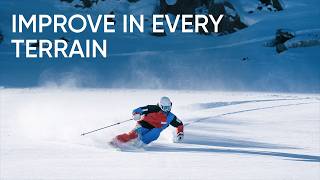
In this instructional video, Tom Gellie explains the concept of transition weight release – the moment between ski turns when the skier becomes weightless – and why mastering it improves control, speed, and enjoyment across all terrain. He introduces Carv’s boot‑mounted sensors that quantify vertical force during turns, showing graphs that compare an intermediate skier, his own data, and elite skier Markus Kasten, highlighting the larger vertical acceleration spikes that indicate effective unweighting. Tom demonstrates two drills: (1) the hop‑turn for intermediate‑to‑advanced skiers, which exaggerates the upward motion by jumping from one edge to the next, and (2) a real‑time audio‑feedback drill for advanced skiers that cues leg‑only unweighting via Carv’s spoken metrics. He walks through live Carv scores (e.g., 80 % vs. 100 % transition release) and shows how improving the metric translates to smoother, more “floaty” turns on difficult terrain, such as refrozen snow or moguls. The video concludes with practical advice: aim for 50‑70 % scores as a baseline, use the drills to raise the metric toward 100 %, and apply the weight‑release feeling to extend ski performance throughout the day.
Chapters
Do you feel like at the start of the day everything goes well when the groomers are perfectly nice and smooth, but then as the day goes on your skiing deteriorates? Perhaps because the terrain gets bumpier, there's clumps of snow. Well, if that's you, I've got something that's really going to help you improve and enjoy the entire day of skiing. Hi, my name is Tom Gellie. Today I'm going to help you with something that's going to help not only you ski all-terrain, it's going to help your style and make skiing really fun. This is Transition Weight Release. So today we're going to look at why transition weight release is so important in skiing. We're going to show you how Carv is now able to measure it and how you can use that data to improve. And I'm going to share an exercise for both intermediate and expert skiers that is going to level up your skiing. Let's get started. Transition weight release is the movement between turns where your skis become light, and it just makes it easier to move from one turn to the next. Let's go for a ski. I'm just going to show you at a really basic speed first. So as I finish a turn, I'm heavy, but I want to start a turn feeling light. So right through here, I want to feel weightless because then it's easy to turn a lot. Easy to edge. So I often see skiers around struggling in the transition because they're not really trying to be weightless. They're just keeping their weight on the snow. Why do you need to unweight your skis? It's really simple. Let me show you. When I'm floating in the air, I've got full freedom of movement in all dimensions of my skis, so I can choose to steer them more, I can edge them more, I can make a fore and aft adjustment. Really easily. When I'm down on the snow and the opposite is happening, I'm pressured, my options are far less, okay. Capitalizing on that moment of unweighted between turns is what we're trying to work on. At lower ends and slower speeds, it is more an active movement of extending the body. You'll feel an up motion in your entire body, but as you become better, as you start to use the terrain more, you're going faster, that goes away and you start to only really feel it through your legs. And then of course, there's every shade of grey in between. What's really exciting is Carv can now measure this transition weight release. And if we can measure it, we can go out and improve it because it's a hallmark of some of my favorite skiers like Markus and Ted. For those of you who don't know, Carv uses sensors clipped to your boots to measure your skiing. And to give you data and coaching to help you improve. We're going to speak to Alex from Carv, who is going to help us understand that data so we can see exactly what's going on during the transition of our turns.
Using Carv, we can actually measure the forces going on in your boots as you ski. In particular, we can measure the vertical component of force going through your skis and your boots during the turn. Okay. As people get better, we actually see a really clear trend in Carv's data, which corresponds with increased weightlessness as someone is finishing their turns. On the left-hand side of this graph is the start of the turn, then the middle, and then the end of the turn is on the right. Here we have an intermediate skier, your data, Tom, and Markus Casten's data. We can see from the graph that intermediates don't actually have very obvious or large spikes in their acceleration vertically, which basically means that they're not actually experiencing a very dynamic upwards or downwards movement through their feet. They're largely skiing in a very static position where their skis are in a steady state as they go through the turn. You are skiing much more dynamically. You actually have in particular a really exciting moment of unweighting at the transition right at the end of one turn and at the start of another. Your skis are unweighted and you can maneuver them into the next turn really easily. So I put Markus Kasten's data here as well, and he's so exciting to watch. And this is partly why we see an even bigger change in how his feet are experiencing vertical acceleration through the turn. Basically what this means is he's unweighting his feet very dynamically during transition, and I think in extreme cases he's actually going to be floating off the ground and totally weightless.
Yeah, totally what you see. So what you see in videos that makes it look really exciting is exactly the same here in the data.
Yeah, absolutely.
So if you're a carve user and you're looking at scores and you're seeing something in that 50 to 70 range, then that's a great sign that this will be a great thing to work on and you'll really feel a difference if you do. So this is Mark, he's a confident advanced skier, but as the conditions deteriorate in the afternoon, he's going to find it more difficult to ski well, and one of the things that will drop down will be this transition release. Let's go find something a bit tricky to compare how Carv is scoring our transitions. This will be fun. This is like refrozen, really hard stuff. It's going to make noise in my ears, but we're going to use it for science and to show you that this transition weight release is so important. First, we're going to send Mark down, then I'll ski and we can compare scores. A real problem with trickier terrain is most people skid exactly like they do on a perfectly prepared piste. But then you're going to show up most likely with your arms all over the place looking untidy. And so a simple way to fix that is be unweighted. You've got no interaction with the snow, you can be tidy in the air and interact with the snow for a shorter period of time. So I'm going to focus on feeling weightless between the turns. Not the crunchy part, the floaty part. I'm kind of still making it fun. Alrighty, let's have a look at your transition weight release. Okay, 80%. Yeah, so it's not, uh, totally not there. You have to have some kind of unweighting, or you're going to trip and fall, right? But yeah, it could be better. So in comparison, my balance metric on that one said it was 100% transition weight release. Let's go work on a few drills, see if we can improve that. So the drill for the intermediate to almost advanced skier is a hop turn. The task is to just jump from one set of edges to your new set of edges. You can turn your skis, make any sort of turn shape you want, it's up to you. A little bit steeper is better. I'm going to give you a demo of it right now. It's a great drill to exaggerate, and that's the point. I'm jumping more than I need to, to really get the feeling. Really important you get the whole ski off and even the tails, because your tail is what often catches. So I'm going to have a look at my carve scores after doing the hop turn drill. Click into balance and transition weight release, 100%. So you should try this one too and see what it shows up with your carve scores. Now let's get on the chair. I want to show you the more advanced one. So I'm actually going to put Carv into real-time audio feedback and choose the transition weight release as a metric I want to hear. It's not so much a drill, it's more of a concept. So really all you're trying to do is still be light between your turns, but instead of your whole body moving up and you're feeling this up motion like we practiced before, It's really only going to be from the legs down. So my feet are going to come up like this and change edges. Up, change edges over to the other side. I'm going to feel how effective that movement is in my ears as Carv talks to me. Okay Tom, let's ski. 93%. So soften my legs. Soften.
100%.
In the transition.
100%.
Yeah. 100%. Makes me go faster. I see a little bump there to help. 100%. 100%. 100%. Oh, that was fun. Really fun. And with the feedback in my ears, you kind of get a good idea of, yeah, 100%. So using a totally different movement pattern. It does feel really light between the turns, but compared to the slower, lower level, I feel like my body is trying to take a more direct path, so my legs just have to work like crazy. So if you feel like you don't do that with your legs, work on this drill concept idea. It's going to help you towards making turns like that down there. Now I wouldn't have this in my ear every time I ski, but for a drill, this is perfect. To get you the right feelings, then you're off to the races. There's a really good reason we all love powder skiing, it's this weightless feeling as you float down the mountain, but it doesn't always have to be in the powder. If you can master this transition move, you're going to enjoy the similar kind of feelings on the piste off-piste and in the moguls. So now your day is going to be extended, you're going to have fun skiing in rougher off-piste terrain, you're going to open up more parts of the mountain. And for you advanced skiers, I can remember back watching some of these awesome skiers ripping around and wanting to do the same thing and wondering what is going on. And when I figured out that a lot of it to do is this transition, being light with both of my feet there, a new whole world opened up. It was so fun in every type of terrain. So it's that simple. Get out this winter and start working on your transition. I hope you found this video really useful and it's going to help you improve your skiing this winter. I've certainly had a great time filming this content for you. If you have any questions, please leave them in the comments below and we'll do our best to answer. Otherwise, until next time, have a great day. Whoa, it's deep in there.