Matt Graham Olympic Mogul Skier On Elite level Bump Skiing
In this conversational interview, host Tom Gellie talks with Australian Olympic mogul skier Matt Graham about his elite bump‑skiing experience, training, equipment, and competition formats. The discussion covers boot evolution—from early kids' boots to Dalbello 3‑piece, Full Tilt, Krypton, and the Dalbello DRS 110—including homemade canting plates, 3D‑printed boot boards, and heel‑lift wedges that solved his knock‑knee and alignment issues. Matt explains altitude effects, off‑season camps in Finland, New Zealand, and Australian clubs, and the physical toll of high‑intensity mogul runs. Technique is broken down: line selection (wide vs narrow corridor), turn tempo (up to 190 tpm on tight courses), absorption versus “bottoming out,” knee and hip alignment, and the importance of staying centered over the fall line. He reviews Carv smart‑ski sensor testing, noting its evolving metrics for moguls (turn tempo, corridor width) and comparisons with elite North‑American competitors. The interview also delves into pole planting mechanics, arm positioning, and drills such as lifting the inside arm to improve weight transfer, contrasting older C‑turn style with modern still‑upper‑body technique, and the role of poles as a third point of contact. Matt discusses training without poles to enhance upper‑body stability, and emphasizes managing ski tip impact by focusing pressure near the binding rather than the tip. The conversation introduces the new dual moguls Olympic event, explaining its head‑to‑head format, judging criteria (turns, jumps, speed), and how scores are calculated relative to the opponent. Matt shares his Instagram handle, outlines the Australian mogul development pathway (AIS, clubs, mentors), his civil engineering background, sailing and trampoline experience, and offers coaching tips on narrowing corridor, improving absorption, and aligning the torso. He reflects on career milestones, injuries, mental preparation, and looks forward to competing in Milan‑Cortina.
Chapters
And now we go to Matt Graham from Australia. The men's mogul competition, Matt Graham of Australia. From Parrish, Matt Graham, he's ripping it. Strong skiing through the midsection.
Fastest time and then hit that whistle.
Matt Graham, 88.9, goes into the number 1 spot. Well, he can be pretty pleased too, a silver medal. I'm still thinking about the conversation I had with Olympic mogul skier Matt Graham. He really got me thinking about my own technique, and if you follow me, you know that I absolutely love bump skiing. I'm recording this intro from the streets of Salzburg on my way home because I got to meet Matt a couple of days ago. We got to ski on the Hintertux Glacier. I got to see him ski a proper mogul course at lightning bolt speed. Speeds. I mean, wait till you hear in the interview how fast a turn, like turns per minute, he makes, and the World Cup people make. It's just astonishing. It's well above what I actually thought was possible. Now in this interview, I think it's really fascinating, uh, find out that Matt really had some troubles with his boot setup for many, many years, and it took him a while to actually get the, the right setup that made him just feel efficient and not have to put as much effort in, and mistakes being caused through his boot alignment. Now we also get to chat about Carv because Matt tried Carv and in the MOGA course, there's some super interesting results from that one. And I think it really points to Carv getting more and more accurate with its measuring and comparing to, you know, what the best of the best do in their skiing. So as always, these podcast interviews, I try and bring deep insights things that help you learn, because that's what I want to get out of them. And I think you're going to really enjoy this one. Thanks so much, Matt, for your time, and good luck in the upcoming Olympics. Aussie, Aussie, Aussie!
Oi, oi, oi!
How are you finding the elevation? Because obviously Finland wouldn't— yeah, no one near— yeah, yeah. Do you, do you feel, even with all your off-season training, do you feel the effects Yeah, going up there, I've, I mean, I've done 4 days on snow now, and, um, the first day I felt all right.
I've come off the plane and, you know, the body was fresh, um, so I felt pretty good. Second day I started to have a bit of like day 2 blues. I mean, body started to get a little sore, noticed the altitude a bit more, and yeah, it definitely catches you out of breath a little bit more than you normally would expect. Um, but it's even just like the little things like bending over, put put it, doing up your boots, standing up, like you might give yourself a little bit more time for when you do that to when you drop in for your run than you normally would, just because you might have a bit of a head spin or something like that. But I mean, luckily we're living down— what is this, like 1300 meters down here in the valley? Yeah, and we're skiing up at 3000 meters. So yeah, we're only up there for a short period of time during the day. And, and more, we're skiing, it's short bursts. Yeah, 20, 20 to 25 seconds of high-intensity work. And if you're skiing well, you're not really exerting as much energy as you would if you're, you know, on the edge a little bit more.
Yeah.
So yeah, it changes run from run, really. Yeah.
Okay. Okay. Yeah, that's good to hear because yeah, I'm definitely feeling— yeah, I feel it. Well, I think there's two things: the effects of the altitude, and then even though, like, you— did you last ski about September?
So we were in Perisher until like middle September.
Yeah.
We had a couple of weeks off and then we actually went to the north of Finland at Levi where they had the, the FIS slalom event this weekend.
Yeah.
So we had an early season training there, training camp there on like a— it's a small sort of flat course. Okay. But it was more just to fill a gap between September and— Yeah, yeah, yeah. Keep the legs working, keep the legs working, be in the boots, sliding on the snow.
Yeah.
We weren't going there to sort of reinvent the wheel and learn anything new, really. It was more just to keep moving and stay in the boots.
Speaking of boots, like, we first properly met a few years back now.
Yeah, you might have been, what, 23? 2022, I think.
Yes. Yeah. And you were doing a bit of a talk and I did a bit of a talk and you mentioned that you had some success getting in a different style of boot. So maybe do you want to start with, like, where was the problem that made you, like, look into boot setup?
Yeah, I mean, I guess just to give you a bit of background on, on my, like, skiing career and, and how it evolved. I mean, when I was young and in Australia at the time— this is in the early to mid-2000s— some of the best skiers in the world were skiing on back then it was the Rikely, or it was transitioning into the Full Tilt, which is now the K2 3-piece boot. Um, and initially when I was a kid, I just had these tiny little like kids' Lang boots with some twin tips, and that's what I started mogul skiing on. Yeah. And from there, once I was big enough and old enough to get my first pair of mogul skis, it was like, here are my ID1 mogul skis, and we want to move into like a 3-piece boot. Yeah, that's what some of the best mogul skiers in the world are using. And so we just grabbed some, back then, some kids' Dalbello 3-piece boots. I think they're called the Rampage. And then from then on, this was probably in— I mean, I was probably like 10 years old. From then on, I'd only ever skied a 3-piece boot because that was sort of the belief at the time, that you're a bump skier, you ski in this freestyle boot.
It's got better ankle flexion.
Yeah, it's got this, this progressive flex. It's better for the bumps. That was sort of the mentality. And, um, over the years, that's just— I just learned to adapt to the, those boots and that equipment. And then, um, skied on those boots all the way through until the 2000 and just, uh, 2012. I got like Full Tilt rang me up and said, oh Matt, we want to give you some boots. So I've skied a couple years on Full Tilts and had two boots that were the same, but fit completely differently and skated completely differently. So I was like, that's weird.
Yeah.
So I preferred the Dalbello. So I went back to Dalbello and, and, um, they've been supporting me ever since that time. But at that point in time, I was in the Krypton.
Okay, should we get into like— I'm curious, you're already like, what was different that you didn't like that made you go back? Like, what did you feel?
It was just the boot, like, um First pair of Full Tilts I had were— they were great. Um, I liked them. They were— skied well in them. Funnily enough, I went from being in a 25.5 Dalbello Rampage, yeah, into a 26.5 in the Full Tilt. I couldn't fit into a 25.5. Okay. And so that first pair of 26.5s were good. And then the second year, got the next boot, um, 26.5, the same boot, Full Tilt Classic or whatever it was called. And And it was like the volume was— felt completely different. And I mean, the first time I put those boots on was like right as the season was starting. I mean, and it wasn't until I started skiing on them, I'm like, wow, these feel weird. I'm like, my heels are lifting. And this is a 2013, 2012, 2013 season, and I was just finished high school and I didn't know anything about boot tech or any of that. So just, I just had to learn to deal with it.
Yeah.
And, um, I mean, I went pretty well that year. I got— ended up with a 4th place at World Championships in boots that were like Too big. Way too big. And the fact that just those two boots, but were supposed to be the same, just fit completely different. I was like, nah, I'm not doing that. Full tilt's not for me. Yeah. So that's when I called up Dalbello and they, they were looking after my brother at the time. He was a mogul skier as well. Yeah. And so we had the contact there with Sport Trade in Australia. And from then until the Beijing Olympics, I was on the— what was the Krypton, which then changed into whatever it was after that. I can't remember. And, you know, I got my silver medal at the Olympics in 2018 on those boots. But back then I have really bowed legs. Mm-hmm. And so the three-piece boots are very straight. Yeah, too much cuff canting. I mean, you, you can cant them, but in my opinion, it really doesn't do anything.
Yeah.
And so to compensate for that, I would— I used to put like a shim or a wedge canting plate underneath my binding. Yeah, between the sandwich between the binding and the ski. And it was very homemade. I mean, okay, we got— my dad sort of called up a mate, got these things made at like different angles. Like, you know, started out, tried a 2-degree plate, 3-degree plate, and ended up on a 4-degree plate. Wow. But there was no science behind it. We just sort of assumed that you would need the same angle on each leg. Yeah. So I used to run like a 4-degree plate on both sides.
And if you didn't have that, like say you borrowed someone's skis, would you feel knock-kneed?
Oh, super knock-kneed. Yeah, that was why we changed it. So when I went to the first Olympics in Sochi 2013. Yeah, I was flat, um, just straight out of the box, ski mount, and straight out of the box boots. And at the time I could never really keep my legs together in the bumps. I'd always hit the moguls and I'd be like, my legs would want to just like pull apart.
Yes. Okay.
Especially when it got ruddy. And so because of that, obviously I was, you know, when we looked at the way I skied on the, the groomers and whatnot, I was always A little bit A-framed.
Yes.
Trying to find that, like, that edge. Yeah, I'd really have to dig the knee in. Yeah. And so to compensate, I was like, oh, we do these canted plate things. Yeah.
Um, and then so you did that, went to the Olympics, and that's— and then so with canted boots, your knees more aligned, metal, silver medal. Yeah, yeah.
But like just a little bit, 4 degrees on both sides.
Yeah. Okay, quite, quite extreme.
But I guess like it's amazing what your body can learn to compensate for and work with. So obviously I can make that work, but I was still very— at that point in time, I was very prone to making mistakes in the bumps. Like, for me in particular, I'd always— I struggled to get the angle on the left, whereas the right, I always felt like I would find the edge pretty early. And what happened after those Olympics, which really sort of made me— between PyeongChang and the Beijing Olympics, I went through a bit of a weird period. My form sort of slumped a bit. And Dalbello decided to re— they tried to reinvent the wheel with the Krypton boot and fully changed the mold of the boot. Okay. And when I went to that new mold, it was— I felt way off balance. Okay. From left to right. Yep. And then I just threw that quad, Olympic quad. I just dealt with it, was trying to figure it out. Um, and anyway, I went to Beijing Olympics, um, I didn't do well there. I mean, admittedly, I broke my collarbone 7 weeks beforehand and had a disrupted lead-up, but didn't do well. Sort of fell out of love with the sport. Was— felt like I was sort of beat my head against a brick wall, like, yeah, I couldn't get any better. What was going on? Felt off balance, didn't know what the answers were, what the solutions were. And so I started to look into more alpine race boot fitting, just both mostly on YouTube, like, yeah, I can't remember, a bunch of guys. And that— but I looked, I think Cantology was one of the the brands I looked into, and they made a bunch, like a YouTube series on alignment. So I did my own sort of research and, and on what was possible, because I was, I was also just fed up with, like, mounting my skis with the plates was a pain in the ass. Yeah, like we had to, we'd have to go out, find longer binding screws, sort of grind them to size so that would work, and mounting the things took Like, we mount— I mount my own skis, and to do it with the plates, it was like an hour, hour and a half per ski. Yeah. Whereas normally it takes 10 minutes.
And if you needed to have a ski broke or something over overseas, like, and you're stuck with the left and right ski.
Yeah. I don't like having a left and right ski. Yeah. Because if you've— in moguls, if you clank and smack an edge out, yeah, sometimes you just switch skis. Yeah, yeah.
That's a problem solved.
Problem sort of temporarily solved. Um, but but having a left and right, you're just stuck with that.
Yeah.
Anyway, so after Beijing, when I was doing all this research, um, I called up a few friends in Australia, particularly, do you know Sammy Kennedy-Sim?
Yep.
Ski cross athlete. I spoke to her a little bit about, um, Andy Burfield. I'd only maybe crossed paths with him a couple times prior to that.
Yeah.
Like before that, I would just do my own boot fitting. I'd go to like a ski shop and be like, hey, can you heat these up for me? And I'll chuck my foot in this wraparound liner and heat mold it, and that was it. Yeah. Um, once I started looking into, you know, more of the science behind the boot fit, I was like, okay, I need, I need some help, some proper help. That's when I started working with Andy Burford through Sammy's sort of connection, because he fitted her boots through her career. And that's when I started talking to him about, you know, canting. And, and for that first season in 2023 in Parrishaw I was on the Il Moro Del Bello, which is a 3-piece sort of freestyle boot. I think it's like a 120 flex, something like this. And anyway, we sort of made some makeshift canting, canting plates under the, under the boot. Yeah. And it worked.
Yeah.
All of a sudden we realized, you know, and it wasn't 4 degrees. I'm not 4 degrees on my left and 4 degrees on my right. I'm significantly less you know, and when I did it that way, significantly less on the left. I think in that boot I was 3.5 degrees on the left, and then I had like a 2-degree cant on the right.
Okay.
All of a sudden I was balanced. Yeah, I could stand on my left ski, feel that edge. And then, um, but the problem, the problem with canting those boots is when you, um, they're kind of like this, they have like a, the bottom piece which is like a, I don't know what material is, it's almost like a rubber or something. Yes, it's not solid like this. Yeah. And anyway, so when you pull that off, it's like it— this part of the boot is like, um, hollow.
Yes.
And so you can't really do much like grinding. Yeah. On the, the toe and heel because obviously it's going to get pretty thin and pretty sketchy.
Yes.
So we couldn't really come up with a good solution for that. And anyway, I was— we had a temporary thing going that was working, and so I just went on the Dalbello website, was thinking about like a 4-buckle boot, and I sent him this DRS 110 at the time, and I was like, what are your thoughts on this? Like, is it worth trying it?
Yep.
And then he happened to just have one in the shop. He literally— we went in, I went in, so this is sort of at the end, early September, after our competition season in Parrish had finished. And, um, we pulled them out of the box. He said, I'll just stand in them, I just want to see what they look like out of the box. And it was like instantly on the flat, I could stand way in a way more natural position. Yeah. So all of a sudden it was like, oh, it was like this lightbulb moment. I was like, we're way closer. We have a way closer starting point.
Yeah.
Than what I had in like a three-piece boot. And, and he was just like, he sort of did my alignment as like cammed in the cuffs to sort of match my shin angle. Yep. And he just said, take them for a ski. Yeah. See what you think. And anyway, as it was, I don't need a whole lot of cam. Yeah.
On these boots.
On these boots. Because you can manipulate so much more in the cuff, um, and, and just the whole—
the angles of it out of the box were more—
works a lot better.
Yeah, I wanna, I wanna jump in there because I think some people will— so they'll go through your process and you've got the canning plates and the boots, and they'll go, oh, I'm a 3-degree on the right, a 2 on the left. It's not net— like, that's just for that boot.
Yeah, even, I mean Yeah, this is my second pair of DRSs and they're slightly different to my last pair.
Aha. So these— and yes, it's same boot roughly, but the molds and stuff, slight differences. You might have even, you know, grown more muscle in different places.
Exactly.
And you've— it's not the same. And I just want to say that because I think some people go in and they go, yeah, I'm a 1 and a 3, can you put a 1 and 2 on? But really, every single pair of boots different. Different.
You should check. They come out of the same mold. But yeah, there's, there's always going to be little bits of differences. Like if you get a custom liner, I mean, that custom liner is not going to be the same every time.
That's right. Volume in the inner and outer part of it there. Yeah.
So that was something that was quite interesting. I even noticed after last season, my pair of boots, like between World Championships in March and when I skied in Perisher. Yeah, we did a lot of cycling. Yes, a lot of road cycling. Yeah, my calves got bigger. Yeah, all of a sudden, and then I felt like I needed— I couldn't find that inside as quick because all my calf bulk went to the outside.
Yeah, okay.
And so we had to make some adjustments throughout the season on my old boots, which, um, was sort of factored into this boot as well, which this boot's only, I don't know, maybe 15 days old. Okay, ski days.
What about the— because I know in mogul skiing Can you talk about what you feel is right? Like, do you want bottomless flex? Do you want support and certain stiffness to help with absorption? What's your feeling on that?
I mean, a lot of it is what you get used to. So obviously I spent so much time in a 3-piece boot and was used to that sort of flex pattern. Yeah, that spring-loaded sort of flex pattern. So when I went to this, it was it felt very different. Yeah. And I had to make some tweaks to make it, make it right. Like when I first put these on and just went and skied on the groomers, I could easily tell these things are unreal. Yeah, way more precise, reactive. Just felt unreal on the groomers. Yeah. And then after, you know, half a day on the groomers, I'll go skate some bumps at Perisher and, and my fore-aft was off. Yeah, we could tell my, my lateral out was way better. Yeah. We're like, all right, this is good.
Yeah.
But like all of a sudden my feet were getting away from me, and, and so I struggled to find that sort of forward position in the boot initially. Um, so then went home, made some extra tweaks, you know, with a ramp angle and stuff like that.
Yeah. Okay, so you, so you jacked up the ramp angle?
It just chucked a heel lift in the wedge. And, and was that pretty much it? Yep. Yep. Heel lift made a massive difference.
And you reckon, do you run like, how tight do you do your top buckles?
Yeah, pretty tight. Pretty tight.
Yeah.
I mean, this is 110.
It's pretty—
especially on a warm day, things—
yeah, it can flex pretty easily. Yeah. Yeah.
Okay. Yeah, flex in the boot's not the issue. I like— once I got used to this, I found it— the flex more enjoyable and better than like a three-piece.
Yeah. Okay.
Because the three-piece, like, when I think back on it, it's like the tongue is what's designed as like to give you like the rebound or the flex stiffness. So they're like, oh, we just, you know, you want to soften the boot, you get a softer tongue. Or whatnot. Yeah, that tongue is not a perfect spring. Yes. Yeah, because if you, if you take a tongue off a 3-piece boot and you start to flex it, the initial flex is really hard, but then once you start to move it, it's like it'll like fold through. And because it has that spring action, it's always pushing you back.
Yes. Okay. Which is not great when you want to just easily set yourself forward, right?
Like, not necessarily. No, it's great. Like, yeah, it's, it feels nice, you know, if you hit a frontside of the bump you can, and it can really take that, that sting out of it.
Yeah.
But then it wants to push you back.
Yeah, that's what I mean. Once you've got pushed back, so then you're cresting another bump. Yeah. So sometimes feel almost a bit like a bit more effort than you'd like to get back to. Yeah.
So it's a different feeling and obviously people get used to it. I mean, Mikael Kingsbury, he's skated on a full tilt his whole life, obviously pretty good. Yeah. Ikuma from Japan as well. He was on a full buckle boot for most of his career. The last 2 seasons he moved to a full tilt. Yeah, mostly because his coach forced him to do it, I think. Yeah. I mean, once I got used to this, I feel like you can sort of just lean on the front of the— yes, on the boot, and you can trust, trust it a lot more.
Yeah.
Whereas, um, on like a 3-piece, if, if you're on the run in the softer side, then, you know, you might hit a mogul and you feel like you can fall through it.
Yeah. Okay.
And that's— I think, um, it's a misconception in skiing that if you're you can't flex the boot, it's because your boot's too stiff. Yeah. Because in, like, in my opinion, like, if your boot's too soft, your reaction is to use your heel because you don't trust the cuff.
Yes.
You don't trust the cuff to sort of lean into it.
Yes. Yeah, interesting.
That's sort of my opinion anyway.
Now, it doesn't, it doesn't stop there with the boot mods and that sort of stuff. What is, what is this?
Yeah, so we've been, we're fortunate enough in Australia, I mean, we have a lot of support through like sporting bodies and organizations, and in particular Australian Institute of Sport. And so they like sort of help out all amateur sports, I guess, and Olympic sports with creating things that can make, you know, little difference makers. Yeah, little one percenters. And the stock— this is just a boot board.
Yeah.
And it's just— and it's basically just to replace the original boot board that was in there, which is like a a really hard, like, brittle material.
Yeah.
And, you know, you've smacked some bumps off on that thing, it just cracks and gets destroyed. Yep. And so this is also designed as like a bit of a shock absorber, so it's got a bit of, bit of give in it. Yeah. Um, and then we're able to sort of implement my heel lift that I like into that one piece, as opposed to having a flat boot board with a— yeah, secondary heel lift.
Yes. Okay. And that's 3D printed?
3D printed, yeah. So along with our canting plates as well. Yep. So this is basically scanned off the original, like, orange ones that come with the boots, and then they're able to make a model and, and just get it really precise. Yeah, get it altered to whatever degree you want. And it gives us an ability to go out and, like, trial a lot of different stuff. Yeah, it's just probably 15 screws that you can interchange pretty easily. Yeah. But my way I would always do it is, you know, I'd I'd go on the lower side of the cant. Yeah, I feel would be— let's say I wanted a 1-degree cant, I feel like a 1-degree is right. I'd maybe try like a 0.75.
Yeah, okay.
And then I go feel that and I'm like, all right, if I need a bit more, then you just add a bit of tape.
Yeah, okay.
Until you get it about right. Yep. And then you can sort of be like, okay, that's, you know, basic trigonometry. You can sort of figure out, yeah, what your angle is going to be. Yeah, until you get it right.
You've enjoyed this stuff, hey, because you started— your part of your studies is in engineering.
Yeah, so I did civil engineering and business at University of Newcastle. And so this year, sort of geekiness, I guess I like.
Yeah, you got into—
but it's also just putting my— I mean, I spent my whole bulk of my career being like, my effort areas were like, you know, like you gotta dig your teeth into it and work hard. Yeah. And, um, and this is just— this sort of stuff was about like just changing my focus a lot more, putting a lot more effort into my equipment and getting that right. Yeah. Um, because like I said, I felt like I was banging my head against a brick wall. I couldn't get— I couldn't progress anymore at the time, and I was almost falling into a bit of a slump. My results were sort of fading a bit. And, um, and since I changed, you know, I went from— in the 2022-23 season after Beijing, um, had one of my best— my— probably my best season on tour. I had 6 World Cup podiums, um, and I finished second overall in single moguls and then got a second and third place in the World Championships that year. So yeah, okay, that was one of, if probably not my best season.
Okay.
And literally changed, changed boots that offseason and it was pretty last minute. It wasn't till the end of Parrishaw we started to get it dialed in with the new boot.
Yeah, right.
So I didn't have a whole lot of time in the DRS before the season started.
Yeah.
And so consequently that year I was a little bit slow At the start, my results were a little lower than I would have liked, but then as the season went on, I got more used to the boot, more confident in everything, just kept getting better and better.
Yeah, I want to steer us towards technique a little bit. And so if I sort of started off saying, say we're talking beyond, like, someone can just get down a zipline course Are there some common, like, misconceptions there that, you know, you see, like, say, people like me on the internet giving advice, like, oh, this is how you do it, and that, or others, how you do it, that you go, actually, there's a point where that changes? Any of the things like that come to mind?
I mean, when I watch, yeah, the stuff on YouTube of more of like, I guess, like your instructor style of skiing or your alpine style of mogul skiing, it's, it's definitely a different line to what we would normally ski.
Okay, so talk us through that. Talk us through this different line.
So like, I guess like your line will probably be a bit more carvy, a bit wider.
Yep.
Then say like how I would look at it. Yep. Um, and as like a mogul skier growing up, like you'd sort of focus maybe more on a narrow corridor. Yeah. Um, as opposed to getting as wide and turning around the bump. But the way you do it establishes probably more control.
Okay.
So whereas we're sort of You need to let go of that control. You need to be willing to take on a lot more speed and a lot more impact to take that more narrow line down the mogul course.
So because I ski— we both skied that, that Hintertux bump line yesterday, and I felt so slow. And then, you know, you come blitzing down there, and I'm standing there looking down this pitch going, you know, come on, give it a bit. But my instincts are like, make me pivot and go up high and everything. How would you coach me? Say we're back up there to start getting tolerance to go a little faster. Yeah, yeah, exactly. Yeah, yeah. I mean, you probably want to go start on a little easier course, like, okay, so, so just take, take it so we're to a point where just, Tom, we need to get you on a course where you could just go hell for leather.
Yeah, and you can practice skiing that narrower line and taking a bit more speed through the bumps. Okay. Pick up your, I guess, your tempo, your, your cadence, I guess, because, yeah, the straighter you go or like the more down the fall line you ski, like the more absorption you have to use. If you ski a really wide line, I mean, it's the way the moguls sort of form up, like you almost don't even have to absorb. Yes. Yeah. It's almost like a big banked slalom course. Yeah. You go really wide.
Yes.
As you sort of narrow that up and ski more of a fall line. Yeah. You've got to take a lot more impact in your absorption. But I, yeah, I'd probably take you back to like trying to do an easier course where the moguls aren't so big. These bumps are quite big.
Yeah, aggressive.
Yeah. And, um, yeah, you try and like narrow you to, I guess, your corridor. Yeah, corridor down.
Yeah.
And, um, and try and take on a little bit more speed.
Yeah, yeah.
And you get to a point, I mean, especially in these moguls which are really large, you have to be willing to leave, leave the snow.
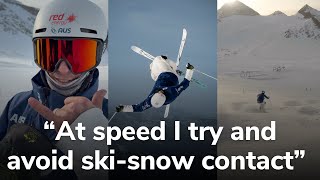
Yeah, because, okay, there's a good one, because I think in the instructing world they're always on about like contact, ski snow contact is control, get contact, get your tips down the back of the bump. So can you speak to where that's applicable and maybe it changes?
Yeah, I mean, I guess from a recreational point of view, it does establish a lot of control. And, um, but in the sport of mogul skiing, like, time is a big component. Yeah, it contributes 20% of our to 20% of our final score. But it also, you know, if you're skiing really slow, like, it also affects your turn scores. Yes. You can't get a really good turn score if you're going— if you're skiing slow and in control. So I guess to a point where you can't move your legs fast enough to keep that contact with the snow.
Yeah.
And so what generally happens, I mean, it's more of a natural thing than anything.
Yeah.
But basically you sort of just bridge the trough of the mogul.
Yeah.
Okay. So you're only skiing on You know, like the— if that's sort of your mogul, you're just skiing on like the top third.
Yeah.
Okay. You'll hit— you'll come into the mogul like this is the trough. Mm-hmm. And then you sort of absorb that top third or top half of it. Yeah. And then teeter over the top of the backside. Yes. And then it sort of releases to the next mogul, to the next one.
You're not going way down in because I watched you at Mount Buller at the A-bomb and I was like halfway down the side and I took a little video and I was looking back at it and it's like, he's not like— and the range of motion you're using, I was like, oh, he's not like going full ass to grass.
Like, yeah, that's a very easy course.
Okay, sure.
Very small moguls. Whereas here you got to use a lot of range. Okay.
But it's still not like the full— a lot when you're going fast, you're not depth. Like if you went in the, into the deep part, you're probably going to cause problems, aren't you? If you tried to get in there.
Yeah. I mean, at that speed, if you're going all the way down to the base of the mogul and then coming all the way back up, like the flex on your ski would just cause way too much pressure. Yeah. And you wouldn't be able to handle it.
Yeah. Okay. Are there points in your career you can remember, like maybe back as a teenager, where you had a breakthrough? So like maybe, you know, what my level, where I'm at, and it'd be like something that I could be looking for that I might discover and go, oh yes, that's going to open up a new world in, or some new feelings of confidence and I mean, it's hard to pinpoint it, I guess, just on the spot, but it's probably getting to that point when you go from skiing like full ski snow contact. Yes.
To trust in it and being able to bridge that trough a little bit.
Yeah. Okay.
Because all of a sudden, like, your tolerance for your— the speed that you can handle, which just goes way up, which is why when you watch— I mean, if you watch yourself ski versus me, like, I'm basically just going, yeah, I'm not resisting. I'm not trying to resist, resist a whole lot. Yeah. Okay. I'm trying to just basically fall down the mogul course.
Yes.
And, um, and when it does come to pulling speed back for the jump or whatever, do you reckon that's when you really need to lean on like your, your technical side and your absorption to really sort of pull things back?
But can you remem— was it a gradual process? Like you suddenly realized, oh, I'm bridging? Or do you— can you remember like a day in Parrish where like your coach is really pushing you, or conditions were perfect and a bit softer, and that's when you discovered it?
I mean, I assume it would have been a forgiving day, but yeah, I can't pinpoint it. It just would have happened over time and naturally as I, you know, would have got bigger and stronger and developed as, yeah, as an adolescent sort of boy at the time. Um, but I mean, at that point in time I was just a kid trying to chase the older, the older guys around. And they helped with, you know, at Parrish, we were fortunate enough to have like one of the hardest courses in the world there.
Yeah.
And back then we used to get a large portion of World Cup skiers and top-end World Cup skiers would come out, train, and compete in our national titles. And so I was like, as like a 10, 12-year-old, it was like eye-opening. And I was just, yeah, oh, that's how I want to do it. So that's, that's the mogul skiing that I've known.
That's probably, you know what, I just think that's probably something really, um, unique for Australia in moguls compared to racing because we bat well above our weight in moguls, but ski racing is harder. I think there's other things there. But the fact you grew up with all the best there. Yeah, all the best. I really come to Australia to train for alpine skiing.
Yeah, my sport's really cool in that respect. I mean, we're out here training in Hintertux and, you know, there's like US and Canadian club teams out there. And I mean, it's, it's pretty cool for them. I mean, I remember when I was a kid, And, you know, looking up to those big guys, like, I mean, in Australia, sort of trained alongside Dale Begg-Smith a lot in the mid-2000s when he was at the top of his game. Yeah. Olympic gold medals and. Yeah, all the rest.
Yeah.
So watching that guy just rip mogul runs was like, oh, that's unreal. Yeah. And I mean, I was fortunate enough at the time, obviously I was— the sport in Australia was much smaller back then. There was only a handful of families involved, really.
Yeah.
At that club level. And I guess I showed, you know, a reasonable— a reasonable amount of sort of determination and talent. And when I was like 13, Dale and his coach Steve Desovich, who was my long-term coach, um, he's from— they're both— he's from the US, Dale was from Canada but competed for Australia, um, that sort of took me under, under their wings. Yeah, I did a couple days, um, training and skiing with Dale where Steve Desovich would coach him and then, yeah, and then Dale would coach me.
Yeah, okay.
So he was, he was a big mentor through that like adolescent, uh, early days in my career. And even to this day we still sort of text each other a bit here and there.
Yeah, okay, okay. Being in the ski industry and I've got Archie who's 8, and you met him at the interschools, he's enjoying the, the—
I've seen him on the Instagram stories every now and then. Yeah, he looks like he's getting a lot better.
Yeah, he's getting better, he's enjoying it, but I get here to Hindertux and there are just hundreds of little race kids getting around and it seems like quite a— like it's a lot of effort. Can you help me understand, like, being an Australian, I've always kind of thought in my head, I reckon Archie, if you really want to do any kind of sport, I kind of want to nudge him towards moguls. Yeah. Your thoughts on that? Like, you've got a— you've got One little one.
Yeah, a little girl.
Yeah, little girl. Yeah. So, yeah. Any advice for things around Archie? And then, like, your thoughts? You're already like, no, my, my child is not going to compete because it's just crazy. And I know how my back feels. I don't want my daughter to feel—
Exactly.
Things like that.
I mean, the moguls have— we have a great history in Australia. I mean, my teammate Chikara Anthony, she's a reigning gold medalist from Beijing. I got a silver the Olympics before that, and then Dalberg-Smith was a gold— got a gold in 2006 and silver in 2010. So we've got a really strong history. And I mean, us as Australian mogul skiers, we owe it a lot to like the likes of Dalberg-Smith, who sort of pioneered that like Olympic pathway and Olympic sort of glory for mogul skiing because the way— the way assessment and stuff behind the system works is, yeah, like medals breeds sort of funding. Yeah, the teams. And so that sort of got the ball rolling and developed a really strong pathway in the moguls, moguls world in Australia. Yeah, I mean, from, from club level all the way through, there's a really good pathway there. Um, yeah, okay, which is what sort of I went through, and then obviously all my teammates did as well. Yeah, started at their local club. Um, you know, I was from Parrish. The two clubs are basically Parrish Winter Sports Club and Team Buller riders down in Mount Buller. Yeah. And when I grew up, the Mount Buller Club was sort of the dominant one. Yeah. From like, which had a bit of hangover through the '90s and 2000s. But then over time, once Parrish built our big course there, it's called Topper's Dream. Yep. Once that was built, it just sort of changed everything. And now the mogul scheme basically is at Parrish in Australia. Yeah.
Let me ask you this then. With, because I kind of want an answer here, or I'm searching for one. Are you, do you think, are you like a crazy kind of person? Like, are you the kind of kid when you were younger you would huck things when other people wouldn't? Are you a calculated kind of person? I guess I'm trying to like look for like traits, but so much different.
Yeah, I mean, I was pretty, uh, I'd say I was pretty reckless in a lot of ways. Okay, but it was It was probably more calculated than I probably gave myself credit for. Okay. Like everything I did was, you know, I, I wasn't doing something that I was scared of. Yeah. Okay. So obviously I believed in myself to do something, whether it was a trick on the snow or jumping off a roof into a pool. Like it was. Yeah, that was sort of who I was. Yeah. But I was just, I was pretty invested in just into the sport a lot. In the offseason, just in my backyard, especially leading up to winter in that autumn period in Australia, I'd spend an hour and a half, 2 hours bouncing on the trampoline in the backyard every day. Yeah. And trying to mimic different tricks and learn different tricks. And it was, it was all very homemade. And I think that's— it's created some issues in my jumping and acrobatic stuff on snow.
Oh, really?
Well, just because it's ingrained. Ingrained. And I didn't have— I didn't come from like a gymnastics background. That was sort of stuff I had to learn later on. Yes. Okay. But I, I'd say especially younger, when I was younger, I had like a pretty good aerial awareness, and, um, and that was just from doing stuff in the backyard, really. Yeah.
Like, are you good at other sports? As people get annoyed, like, oh, if we go play golf or we go surfing or something, do you find you're like fairly good at figuring out sports? Would you say that's—
I think I am to some extent, not as much as maybe others are. It's probably just led by my competitive drive to— especially if there's like a game involved.
Yeah, okay.
Like, I'm gonna work my ass off and try and win that game, whether it's, you know, a little soccer, soccer game or table tennis, ping pong, yeah, whatever it is. Um, yeah, so I think because of that, like, sort of competitiveness, I'd say I'd pick it up, pick different things up really well, reasonably well. Okay. Um, but I was sort of an avid sailor growing up because I'm, I'm from the Central Coast of New South Wales.
Yes.
And come from a sailing family. My mum and dad sail, their parents sailed, and we sailed out of the local sailing club at Gosford and, um, was actually a 4-time national champion in like a junior boat. Okay, right, like a small junior boat. And, uh, when I was 14, I basically got to the point where I had to make the decision if I was going to be a sailor or a skier.
Okay.
And before that, it was my dream was to do Sailing Olympics, skiing Olympics at the same sort of time.
Yeah. Okay.
But I think the dollars were getting too high and yeah, okay. I started to realize when I was like 13, 14 years old that it's going to be very hard to do that, to do both.
Yeah.
And I also, I was so competitive that I wanted to be the best at whatever it was.
Yeah.
And I couldn't be the best at both of those. Yeah. I may have been able to go to the Olympics for sailing if I really stuck it out. And skiing at the same time, but I probably would have been a participant at both of those events. Whereas I wanted to be the best skier in the world from when I was probably after my first overseas trip. Really? 2002. Yeah, that was sort of when I, uh, sort of had like a sort of clicked.
That's definitely a thing, isn't it? Like champions, Olympians, they often have a story of, I remember going, I want to win a medal. I want to be world champion. Yeah, that's a—
like, setting that, I think it's pretty common.
Yeah, very.
And for me, it was— we went on our first overseas family holiday to Silver Star. Yeah, BC. Yeah, uh, just for a couple weeks. And I mean, this is in 2000, very start of 2003, so I was going into grade 3 of school. Yeah, I think I was 7 or 8. Yeah, I would maybe just turned 8 years old. And just loved it. And, um, saw that like an Australian Winter Sports Club camp thing on, and, and that was when I'd already— I joined Winter Sports Club the year before that and got a bit of a taste of Moguls, Alpine, and a bit of like the train park. Um, but Moguls I was already sort of eyeing off at that point. I enjoyed it the most. And anyway, I got back from that Silver Style trip and literally flew in then one night, and then we had Sailing state titles the next day. I sailed with my brother at that point in time. Yeah, I went to sleep jet-lagged as hell. Woke up the next morning, my mum woke me up, and I remember just waking up and just being like, oh, Mum, I want to be the best skier in the world. And then she was just like, yeah, righto, Matt, we're gonna go win state titles. Yeah. And anyway, so me and my brother went and won the states, and then the rest is history. But it was, um, that was sort of— I never forget that moment. Yeah, it was just weird.
Amazing.
And at that time I didn't know I was getting moguls. Yeah, I used to want to be like a big mountain skier.
Yeah, okay.
When I was like that age, I used to watch like the ski movies at the time. Matchstick movies, Matchstick, New Line Cinema I think was called. And yeah, I watched a movie called The Seth Morrison Chronicles. Yeah. And I was like, he was awesome. Yeah, that's kind of what I wanted to do. Yeah, okay. Um, anyway, moguls was for me.
Now what about if, if someone's getting into moguls, does— do the skis make it easier? Do they make a difference, the skis you're on, compared to, say, the skis I tried to ski the bump course?
Yeah, yeah. So like, for those that don't know, um, mogul skis, they're much narrower than normal ski.
What are they underfoot?
61.
61? Yeah. Okay.
And then I'm not sure the tip and tail are— okay, 90 at the tip maybe, and yeah, maybe way now 70-something at the tail. Okay, so a lot narrower. I'm not sure what the radius is, to be honest. I don't need to know. I just scan the things. Yeah, they work for me. So yeah, so I'm— and to be honest, I haven't really skied moguls on this type of skis you're on, so I'd be interested to try one time and yeah, and see if I can rip bumps. I'm sure I would be able to, to a reasonable level. Um, but I imagine like a short, like slalom ski would be quite tricky because they'd be like super stiff. Um, Whereas my skis, they're like softer in the tip and then a little stiffer in the tail. Yeah. And that's basically— so soft tip helps, like if your tips do hit, ideally tips hit the bump first. Yeah. And that's sort of like that, um, gives it a bit of a shock absorb. Yeah. Effect. And then the stiffer tail is basically to help land jumps.
Oh yeah, so you don't wheelie out.
Yeah, so you have something to leverage off. I mean, And it does come into effect when you get— I mean, you get pretty backseat in the bumps.
Yeah, yeah, that gets soft.
And you can use that, use the cuff of your boot and the, uh, tail of the ski to try and pull yourself forward.
Yeah, yep. But yeah, narrower ski, straighter, you can keep those feet doing the same thing. You're not like— you're not stepping on your own skis.
Yeah, and you just— you can roll from edge to edge so quick.
Yes.
Yeah, you put them on and you'd be like, these things feel weird. Like, yeah, as soon as you roll, you're on edge. Like, um Yeah, I haven't skied on too many wider skis. I mean, I have a pair of, uh, I think they're Vocal Mantras at home. Yeah, um, they're like an all-mountain sort of carvy ski. Yeah, I've only skied on them a handful of times. These things feel like an effort to lean over, like, compared to like a mogul ski. Um, but once those things are on edge, they're unreal. Um, whereas mogul ski, like, you got to be a little careful, especially on the groomers, because it doesn't take much to boot out.
Yeah, I bet. I bet.
Yeah. Especially because we didn't have riser plates or anything. It's just—
Yeah, you're binding on ski and narrow. Yeah, right. So that's why you don't see you guys really nailing it over because you—
Well, there's two reasons to that. There's one because we do like way too many turns in the bumps and we're already— legs are cooked, so we don't want to do any more turns than we need to. But yeah, generally, like when we're not skiing in moguls, once we've warmed up, we're not doing many turns to get to the course off the chairlift. Couple of lazy carve turns down and yeah, get there. We're not working on our short, short turns or— Yeah, right.
Like, like big cars. Yes. Yeah.
Because I mean, that takes it out of you as well.
Yeah, definitely does.
A lot of leg fatigue. And then you go jump in the bumps and—
But you are looking for— you were saying you're like, you want to maybe when bump skiing comes down, you want to go and like, yeah, have a crack, get good at other parts of skiing.
Yeah, for sure. I mean, I think I'd be reasonable, but it would be definitely a shift to like really work on different turn techniques with a different style of ski, like a like a more carve groomer ski. Yeah, I like to try slalom. I'm just gonna slalom ski. Yeah, okay. And just to see how aggressive it is, I think I'd want maybe a soft— a stiffer boot. Yeah, probably, probably a 130, I think, at least. Um, but yeah, I'd be intrigued to give them a crack someday, and maybe you can teach me some stuff because—
yeah, yeah, it'd be, it'd be good. I'd like to.
Yeah, we do a bit of, um, like medium rate of just sort of turns Yeah, um, but our technique and what we're taught is probably a little different to what you would teach.
Yes.
Okay, like you, you probably— because the purpose would be more like, you know, sort of hip hinge, foot outside. Yeah, it's also— whereas we try and keep the knee a little bit more under the hip. Yeah, just a little more knee angulation.
Yeah, with it. Yeah, I remember seeing an old Steven Fearing like YouTube video about carving on, on like as a drill on mobile skis. Yeah. Yeah, yeah.
So we're sort of, you know, we want to be just basically— our turn is just rolling, rolling the femur.
Yeah, yeah, always there. Yeah.
And these kind of want your knees to be on your hips most of the time and just your foot out to the side. Okay.
You've approached equipment in the lead-up to this Olympics. You're obviously training physically really hard, probably trying to recover. Any other areas like in your technique when you watch video at the moment or tricks? Like, where's your next couple of percent, you reckon?
I mean, I think I've got the package I need to do really well. Yeah, push for that top step. It really comes down to putting it all together and connecting the dots from the start gate to the finish line. And that's, that's like when you get into that high-level mogul skiing, that's, that's like the art form of it. And the, and the, just the competitive pressure. Yeah. And just, I mean, everything's so like you're dancing on eggshells and on such a precipice of being in control and out of control. Yeah. And if you're too much in control, you're gonna be going too slow, so you're gonna be out of it anyway. And if you're on the out of control side, you'll be making mistakes, and all of a sudden your turn scores and your jumps will probably be affected. Um, so yeah, it's just really good being in tune with the course that I'm skiing and knowing where my limit is. Yeah. And then being able to execute like my run the best that I can do it. Yeah. Which is when that sort of mental sort of rehearsal and mental psychology side of things.
And this course, this course in Italy, do you know much about it?
Have you? Yeah, we, I mean, we skied it. We had the Olympic test event there in March last year. I liked it. Yeah, it's, it's on the steeper side, which is good.
Yeah. Not as steep as Toppers Dream.
Overall, it's probably similar, but maybe it's slightly steeper. Yeah. Um, but like Topper's Dream in Australia, it's like really long, super steep top section where it gets up to like 36 degrees.
Yeah.
But then the middle section is maybe 26, 25, 26. Whereas in Livigno in Italy, it's— it'll be like a constant 28 degrees.
Okay.
Yeah, the whole way down. Yeah. Which is kind of like the benchmark. 28 is like a steep World Cup, well, like world-class course. I mean, we go to World Cup and like you can ski on a 25-degree course. Yeah, it's really flat. Like this one in Hintertux is not overly steep, it's challenging in its own unique ways. Yeah, at the moment, um, but it's not by any means like a steep course.
Yes.
And so I think I prefer it when the course gets a little bit steeper. Yes, bumps develop a little bit more and they get a little bigger.
Like, do you find that that's— you're, you're okay with that? Other, other elements like this Hindertux one, is it rhythm change? Like, is that what catches a lot of people out? Like, to make a course, if it's not steep, what else makes it tricky?
Yeah, so like your jumps, the way the jumps can be built.
Yep.
And like your transition, the size of the jump, um, and then yeah, little things like rhythm changes within a section of moguls. Um, but also as the mogul course gets older over time and more and more people ski it, it gets like hacked up in random different ways.
Yeah.
Um, and gets less— like gets more imperfect, I guess.
Yeah, kind of more angled.
Yeah, less smooth, a little more rutted and a little more gnarly. And, and that's kind of what we have here in Hintertux, which is making it challenging.
Yeah.
Um, it's been— the course has been up for, uh, probably 4 or 5 weeks. And they've had hundreds of kids skiing on it. They had a comp there last weekend. So yeah, it's, it's pretty beat up, pretty beat up. But in that respect, it's good because if it wasn't like that, if this was like a perfect mogul course, it'd be too easy.
Yeah.
You want, you want the easier side.
Yeah.
We want that sort of like a bit of a challenge.
Yeah.
Going into the season. Yeah. Just to test everything a little bit more. Yeah. Put everything through the paces.
But speaking of testing, you tried— we gave you some Carv units yesterday to try out. What did you think of— think about it?
It was cool. I've seen it online mostly through like your channels and stuff and looked into it a little bit. But yeah, I wasn't sure what it would be like. And then I think I saw something recently, maybe you posted it about like how it's been adapted to moguls.
Yes.
A few days ago you might have posted something.
Yeah, because it used to just really like, even if you did moguls, it could tell you were in the moguls, but it would kind of judge you as though you're as a carve type skier. And now they're changing it, knowing that you don't have high edge angles, other metrics and metrics are actually more important.
Yeah. So it's cool to see like there's some cool features that we're able to look at, like turn tempo, different alignment things.
Yeah. Like the corridor.
The corridor.
Yeah. The width there. Yeah.
So that was, that was interesting and pretty cool to look at because you mentioned.
Yeah, we looked at because there was myself, the highest tempo I've seen myself get and I was definitely a little bit out of control, which is what I need to work on. It seems like it was like 116 turns per minute. And then your—
one of your faster runs, you had, I think, 169.
169 turns per minute, which isn't—
for us isn't crazy fast.
Yeah, what's the crazy fastest?
We hit like— it also depends, like your turn tempo depends a lot on the spacing of the bump. So our velocity or speed down the hill might not change that much. Yes. But if you have a course with a lot closer space and your turn tempo has to pick up.
Yeah.
So if you're on a tighter course, you'll be getting close to 200 turns a minute. Yeah. Wow. 190 is sort of our fast— fastest on like a normal course. Yeah. But these bumps, because these are big bumps and a bit more spaced out. Yes. 169 was I think for that run I was like, I was starting to feel like I was pushing the limit, but I was still well within my cut. Yeah, within my control zone.
Yeah. What I think is cool too, I don't know, maybe you get your opinion on it, but remember I said before, I said, oh, there's this guy on the leaderboard, and you said, oh yeah, he's a NORAM competitor. Yeah. And he had a certain score. And then yesterday you were probably thinking, well, if this thing's got any legitimacy, I should be able to beat this guy.
Yeah.
So was there— did you feel there was like, oh, that's kind of interesting, like there's got to be something, they're on the right track here?
Yeah, I mean, I guess there's probably still some— it seems like maybe it's the metrics at the moment lean towards mogul skiers, like, like competitive mogul skiers. They're getting really high scores. Yes. Because I think the top 2 were the, the 2 US NORAM level skiers.
Yeah.
So maybe they need to play with the metrics a bit to balance that out. They're working on it right now, but I was thinking about it because I guess It'd be hard to tell because obviously like you're in it like a very advanced like mogul skier in the, in the, in the, in the recreational.
Yeah, recreational. Exactly.
Yeah. But when you get to that competitive level, it's such a different— it's a different ballgame.
Totally different.
Whereas you're a very advanced technical carve skier and then again you go to Ted Ligety World Cup level. Yeah.
Boom.
Like he's, he's significantly better than you.
Yes.
You would say.
Yes. Way better.
But the metrics and the edge angles might not be that too dissimilar.
Correct. Yes.
Whereas our main differences in like mogul skiing would be like, you know, how wide our corridor is.
Yeah.
And turn tempo. Yeah. Which obviously is—
and able to do it steeper and steeper and still be able to.
So I'd be interested to try the Carv on different pitches.
Yeah. Courses.
Yeah. And see what sort of scores I'll get on, say, like a flatter, higher tempo course.
Yes. Yeah.
Because then, and then I'd, you know, if I go to an easy course and get a really high score, then obviously something's got to be— the metrics might need to be tweaked a little bit. Yeah, yeah. But yeah, it was unique, pretty cool. Yeah, experience.
Yeah, unreal. Yeah, because I think the interesting thing I'm thinking about is like the world of skiing zipline moguls is sort of small in terms of who skis bumps in, in places all around the world. So I'm sort of interested, yeah, to see where they take that because You know, if you ski this natural big small bump change, change, change, tempo is going to be much different. Yeah. And you do it with control and flow. If it's all on like fast tempo, 169 turns per minute, like that's not going to happen. Or there's going to be accidents on that.
Yeah. If you're on a super steep double black run with massive bumps, like you're not going to be doing that turn rate.
No.
Because you'll be killing yourself.
Yeah, yeah, yeah. But I guess it's that— yeah, yeah, it's just an interesting thing. But I think it's it's kind of cool that when you point a particular turn type into like the, the end of where it's like, right, you test it with gates and speed or down a mogul course.
Yeah, you know, I mean, what was interesting yesterday was, as opposed to comparing, you know, like the score I was able to achieve yesterday to, um, like top skiing and stuff, and people skiing on different courses, what was interesting yesterday was like, you know, I first did my I did my sort of first run at like a moderate to fast-ish pace, got my score, and I was like, all right, I can beat that. Yeah, I go again, try a bit harder, and I was able to beat it. Yeah, yeah, I can get above that again. And then, and so the fact that I was able to actually, yeah, intuitively trying to tack a run a little bit more and get a higher score. Yeah, and some aspects, those metrics are working the way they should. Yes, I guess it's the hard part is comparing, yeah, like a mogul score and a mogul run to someone ripping carvers on the groomer.
Yeah, but yeah, that's so true. I think it's cool, like, as a, as a coaching tool, you know, the fact you can go there without a video, you can kind of warm up, and then you can also, like, over time, as you ski all the different courses around with it and you start getting a sense of, like, what's going on with the score, maybe even if you see things like the parallel skis change or something, and maybe the boots you have, you've worn out the soles a bit, you need to make sure that the alignment's back and correct. Yeah, it sort of opens up some like interesting things there to track with data, like what's going on.
Yeah, yeah, it would be interesting to go to a different course and like say I was able to achieve a 160 here and then I go to Finland in a week's time, you know, like what does that course score relative to this? And then am I able to make— are my better runs like giving higher scores. Yeah, relative to that. Yeah, that's probably where I would look at it the most. Yeah, just comparing, trying to compare obviously apples to apples.
Yes. Um, yeah, exactly. Like, what if there's this sweet spot? Like, what if Hindertux is where you get the highest because certain things— yeah, you can charge it too steep and there's the bumps are close enough that you can do it, but other places might be actually technically harder, but because—
so your score might be naturally lower. Yes. But then you've got compare apples to apples.
Yes, yeah, yeah. Which I think is the, the thing I find tricky sometimes with it, with the carving, because someone might get this great score and then you're at a different resort where the snow's not as good or the terrain's different and then it's harder and you can't get what they're getting because they've just got this perfect mixture going on.
Yeah, the global leaderboard is pretty, it's pretty cool concept. Yeah, yeah, it's, I guess in that, in some aspects it's very, would be very hard to, uh get it completely correct and accurate.
But a bit of a spoiler, like, I'm— we can't say the score because they need to rejig things, but Matt pretty much blew the carve leaderboard thing like to the top. There was no one had ever scored this type of score before. You're the first one, which is cool because the, the team were like, we want people who are currently competing at the like top end to be testing it so we can actually get everything calibrated right. So yeah, I think it's a good, it's a good sign that you're not being beat, you know, you're flogging.
Yeah. I mean, I could see, I could see yesterday when I did, you know, my sort of more full pace run and then when you guys were like, what's the score? I told you and you were— yeah, that excitement was really cool to see. And then also, I guess, reflected like we said, like I was speaking about a couple of days ago, being like, you know, I should be able to beat like these are high-level North American Cup skiers, given I'm a World Cup skier. Yes. And if, you know, if I'm not beating them, then maybe the metrics are a little off. Yeah. Um, so I think I, I could see like, like on your guys' faces being like, okay, it's, you know, something's working in the right, in the right, right way there.
Yeah. And, um, yeah, unreal, mate. I wish I'd wrap it up. You probably need to get up and eat some dinner and do a bit more stretching.
And yeah, I'll take next day or two off, off, out of the boots. I think the weather's coming in, but it's been good. We've been trying to take this up for a while.
Yeah, we have. We have. It's awesome. We got to do it here and we actually got to this backdrop. Yeah, I know. Yeah, it's— we've got a pretty good life.
I mean, it's one of those things you got to, you got to soak it up while it's there, right? You got to soak it up and enjoy it. And as I'm getting towards later on in my career, I'm sort of appreciating these sort of moments a lot more. Yeah. And then maybe 10 years ago when you're just stuck in the grind and trying to get better and So if you're my coach, you've seen my skiing, give me 1 to 3 things you think I could do to improve.
And maybe because you said, Tom, you should come and do the A-bomb, and I was like, no way, I need a little bit of mogul-specific comp training.
So what I think for you, I'd want you to try and work on having that corridor a little bit more narrow.
Okay.
And so to do that, you'd probably want like less edging.
Yeah.
And, um, using your absorption and sort of steering a little bit more. Yeah. You'd probably be steering the ski over the backside to try and work on that narrow corridor. Yeah. Um, and there's things you can do on the, on the flats for that, working like a— as opposed to like doing like what you would call like short turns. We call them short turns, but yeah, short turns or short swing turns. Yes. It's much more narrow, like steered sort of style of turn.
Flatter, flatter ski.
Flatter. Yeah, flatter ski. Still the same sort of feelings and sensations that you would want to feel. Mm-hmm. But everything is much narrower underneath. Yeah. You're almost trying to think of like, you know, if there's a balance beam, like you're literally just right on the edge of that balance beam.
Yeah.
Okay. Doing that on the flats.
Okay. Corridor narrower and then.
Yeah. Then you'll be able to really start to work your absorption and going faster. Yeah, once you get into that, it'll be about making sure you move, move faster. Yeah. Okay. Which I'm sure you can, but it's like—
yeah, it's, uh, one thing I have, I have worked on that's really helped, um, is like with the absorption, really when I hit a bump, like not letting myself come down to it. It's all like trying to stay as tall and strong here, and the legs only come up not me go down to my legs. Is that a fair—
yeah, no, it's definitely a good point. Um, yeah, any tips to make that better? We sort of would, in our terminology, would be like, oh, you're like, you're sitting through absorption too much.
Yeah.
Um, and usually what happens when you do that, you'll, you'll bottom out too early.
Yeah.
Okay, you'll max out your range, but you've still got a bit more to climb.
Ah, and so how do I fix that?
And what happens there when, if you bottom out early you can't continue. You can't like sort of, I guess, like maintain forward momentum over the crest. You'll end up— your skis will release off the front side and you'll actually get a bit of air on there, probably put in the back seat. Um, how would you improve?
How do I improve that? Is it probably coming a little bit, the bridging?
A little bit. And also it's like, yeah, you really have to— like you're saying, it's, it's like the absorption has to be measured to some extent. Like the initial impacts where a lot of it is, but then like the absorption itself is a little bit measured, especially in big bumps.
So, so, uh, maybe if I put that in my own words, I've got to get used to like as I'm approaching a bump, I've kind of got to go, right, I can tell how much I'm going to need to absorb. Don't use all of that up too soon or I'm going to keep bottoming out. Like, yeah, because you're going to be instinctively playing with tension in your muscles, so you're absorbing but not— yeah, too fast that your hips—
yeah, but then it's a fine line because then if you're too stiff, then it gets jerky and it's unpleasant. Um, I mean, I think of like, as well, like, to the point, like, when you're trying to ski faster, um, your absorption sort of becomes like a natural thing. Like, a lot of people who, who aren't great mogul skiers or they get into mogul skis recreationally struggle with absorption. Because it's not something you do on the groomers, really.
No.
Um, but once you like start getting comfortable in the bombs, you start narrowing that corridor up and taking a more like a line that's more down the fall line, your body like would naturally and instinctively do it. Yeah, to some extent. It's like, I mean, if you think about if you were to jump off this little couch here onto the floor, you could do it pretty stiff-legged.
Yeah.
But if that couch was 2 meters off the ground you're naturally going to take that impact. Yes. And so being able to, I guess, have like the courage and the, and, and the will to push the speed a little bit, like your body was sort of naturally—
that's why step one's important first, right? Because then I'm going to be naturally finding that I'm going to have to change my absorption a bit more, whereas the speeds and line I'm taking, I can kind of get away with.
Yeah, you can get away with maybe being a little bit more conservative with it.
Yeah.
As much as you start to narrow the corridor a little bit and just pick up that tempo. Um, yeah, I think it would naturally happen. Okay, more than you would believe.
Okay, no, I believe it, I believe it. Yeah, and I think I'm a firm believer— well, just what you said there, like, just as soon as you start forcing something, your body can figure out it's like, that's too big of a drop to just— I have to do something because I don't want to be jarring my back.
Yeah, exactly.
Number 3, I was thinking This is something maybe you can speak to this, but like where you are in with your like rotational alignment, like I know separation down the hill is a big thing, but I've noticed when I watch really good mogul skiers, like often when, when they're coming over a bump, the next pole is like so ready and it almost like reaches and your body like kind of lines up a bit more straight with the skis. So things look like they absorb more in a straight line, not You know, when you see the classic twisted up, yeah, you do defensive, and that's, that's not great absorption. Whereas if you're aligned, your absorption feels better. Am I on the right track?
Kind of a little bit, especially like a modest pace. That would be like, you'd want to follow it a little bit. Um, but generally, like, your torso is, is— you want it to be anchored, just anchored down the fall line. You're just pretty much pointing down the fall line the whole, whole time. Yeah. And the rotation and the angulation comes from basically a little bit of like a foot eversion. And I guess the angulation you would see from the front is— it's in some ways it's like a— it's almost not real. I mean, you're like hitting the bump with like a big knee angulation. Yeah, because the force is too high.
Yeah.
But the angulation you see from the front is the fact that you're in a flex— hitting the bump in a flex position, and your hips might be turned a little bit. And so you're not actually— there's no knee angulation.
Yes, it's not this angle. It's visually kind of visually—
it's, it's like an illusion. Yeah, a bit of an illusion. Yeah, it gives you that. But where you can really work on, and when it gets fun, especially like big space bumps, like free bumps. Yeah, for us would be like in the transition, like from one absorption, you know, you finish that absorption right at the peak and then that weightless period as you crest over the bump, that's where you can really dive your knees in and get that angulation. But when you actually impact, you don't want any angle, right? Pre-aligned. Yeah, yeah, actually engineering thing, it's just simple I mean, if you do that, that's— yeah, you're going to have some knee problems.
But yeah, even back, right? It's just something's going to give there.
But generally, yeah, you've like your torso and everything's facing down the fall line. And if you do get into a position where you're like, we call this like countered.
Yeah.
Like if you're, if you're hitting a right side turn and your upper body's facing to the right.
Yeah.
You're a little bit countered to the turn.
Yeah.
What that generally results in on the next turn you're gonna be twisted.
Yeah, yeah. So yeah, in the mogul skiing, there is a point, probably at the more lower levels, where you— that separation kind of down the hill sort of is going to get you a little bit in trouble.
But if you're skiing a slow pace, nice wide sort of carvy line, there's a little bit of like following. Yeah, yeah, yeah. Okay. Yeah, otherwise you will get into that weird sort of—
okay, I gotta ask the bonus fourth question then about poles, because I haven't talked pole plant stuff. And the thing I look at with my poles pole planning that I kind of don't like often when things go fast is, is not the one that's planning, it's the other one. How do I— how do you—
I think that's forgotten about. Yeah. Yeah.
Like, and then it's like so slow and it's like going all— yeah.
I mean, we generally like, like in Australia, like our sort of arm and body position is sort of like elbows up.
Yeah.
And arms sort of forearms pretty much aiming straight downhill, maybe a little bit in.
Yeah.
Okay. Basically like relaxed shoulders.
Yeah, yeah, yeah.
You don't really want to be like hunched up. Yeah, sort of relaxed shoulders. And like, it's really just like a, a prep and release.
Yeah. Um, but then do you think like, is there like— you've planned it—
what you can try as well is like when you're out skiing bumps next time. Yeah, it's sort of like when you finish, say, a right turn and you transition to the left, like raise this arm a little bit and let it release under.
Yeah, instead of probably the opposite, which is letting it drop a little bit too much.
And it's something that helps people, like if people are struggling to like transfer the weight to the outside ski. Yeah, you would do that as like a bit of a drill, you know, you, you lift that inside arm.
Yes.
So get everything over on that outside ski and vice versa.
I actually noticed that in some, like maybe, uh, I don't know, maybe it's state level kind of competitive skiers, you maybe they've learned that you can, you really see this deliberate Yeah, thing that I guess as you get better—
a little old school, that technique. Okay, it used to be called like the C-turn. Okay, people like really—
well, yeah, yeah.
Um, going down the hill, especially like a bottom section, there was an American guy who used to love it, Toby Dawson. He was a big C-turn guy. Yeah, okay, just be like whipping his feet out to the side and his upper body sort of been on the counter.
Yeah, okay.
And it's cool, it always looked pretty cool. Yeah. And, um, but in modern day moguls nowadays, it's like upper body, head completely still, arms as still as possible. Okay, okay.
And I think that's the one I'm gonna— I'm gonna take that. I think I'm gonna try a bit of— yeah, try that like inside, inside, just inside.
Just, just lift it just a little bit.
Yeah, just a little bit.
But yeah, you kind of want that release arm to not like drop or— yeah, do anything. And then often as well, people, people's pull plan arm when they pull plant will go pull plan out wide.
Yes, yes. Um, you're the one who wants to be— you want to be like lined up, right?
Yeah, yeah, just sort of lined up. And literally, basically, the tempo would be like you hit the bump, you impact the bump, still prepped, you're absorbing at the top of the absorption as you crest the bump. Yeah, it just sort of falls in the snow.
Like, do you ever train like no pole plant or like no poles? Is that a good—
I mean, probably not as much as I should, but that's something when I was a kid we did a little bit at the club level. Yeah. Skating with no poles, um, and especially if we're on like a ski-specific camp, okay, sections, you know, you might have your poles, sort of hold them together just in like a— yeah, in your arms.
Yes. Yeah.
Um, and that way, you know, you're trying to keep that upper body still stable whilst the legs do all the work. Yeah. But it is— it's a challenge.
Yeah.
Especially if you're skating like a— go top to bottom with no poles on the World Cup courses.
Yes.
Hard.
Yeah.
Your ends of your hands end up just just going around. Yeah, like that pole plan is like the third point of contact with the ground. It makes a big difference.
Yeah, yeah, massive.
I mean, even skiing groomers, doing big carve turns with no poles is a little awkward. Feels a little bit awkward sometimes. Yeah, yeah, until you get like used to it. This is much the same.
Yeah, yeah, unreal. Okay, I got some work to do.
Yeah, I'm looking forward to seeing—
I'll keep you outside.
Maybe lift it a little bit. Yeah, yeah, if you start seeing that, that's a little bit bridging, a little bit faster.
Yeah, yeah, that's probably the two things. Yeah, a little— yeah, all those things.
I'm gonna, I'm gonna take that to heart and yeah, yeah, it's one of those things as well, like, um, when I think about like hitting the mogul, um, especially when this tempo gets up, you don't really want to like bury a tip into a mogul. Yeah, at a high speed, because when you hit that mogul, like, that tip is going to flex so much because the mogul's sticking up at you. Yeah, especially if it's a big sharp bump. Yeah, and it just causes all sorts of like errors, errors and pressure spikes and stuff. So it's almost like you're, uh, like if this is the mogul, your tip might just miss it, glance it, glance it, and then the front part of the ski will still hit first.
Yes.
Um, and then that still gives you that like trampoline sort of shock absorber effect without diving the tip in.
Yeah, yeah, giving you the kind of knock-off balance.
Yeah, yeah, especially in a mogul course when it gets rutted and it's pretty aggressive. If it's nice and slipped, yeah, you can dive it. Yeah.
Okay.
And it sort of works through the fluff. But yeah, okay.
And so to simplify that, just not the tip of the ski, try and think about that bit in front of the binding.
Yeah, pretty much the midfoot and, you know, a foot in front of the toe post.
Yeah, okay, great.
That's sort of where that like initial sort of impact is and is taken. Yeah. And then as you hit the bump, that impact sort of comes. Often you'll hit the mogul like your foot will be slightly in front of you.
Yeah.
Or like it would look like it would be if you face frame it. Yeah, um, but then when you hit it, that mogul always slowly pushes it back. Yeah, okay, okay. Sort of like a, a little bit like a—
yeah, like you're walking, your foot comes down and your body passes over.
It's a little bit the same.
Yeah, okay. So hey, if people want to follow you and see how you're going for the Olympics, what's your Instagram handle?
Yeah, so my Instagram handle is MattGraham_Moguls. And I'll be competing in Milano Cortina in the single moguls and the dual moguls, which is introduced to these Olympics for the first time, which would be pretty cool.
And so the dual's new? Yeah. Oh, cool.
Historically, the single moguls has been the Olympic discipline. Yep. And then for these Olympics, for the first time, the dual moguls is in, which is pretty insane. Very fun to watch racing.
Yeah.
Side by side. Yeah. It gets pretty crazy.
Oh, can I ask one question there? Can you still win and you're not as fast as a person? Yes.
Okay, so it is judged on, on the same, in the same sort of way. Yeah, it's judged on how well you skate the bumps, the tricks you do, and your speed. Yeah, but as opposed to just being judged by what you've done, um, based on like a criteria, you're more or less just judged against the person next to you.
Yeah. Okay.
So the speed is a calculated thing.
Yes.
Okay. So if you know, if you beat someone by like half a second versus if you beat them by a second, like that, the score difference is sort of calculated. And then same with the turns. Like you're like, you know, the person on the left is a bit messier than the person on the right. The turns go to the guy on the right. Right.
Yeah. Okay.
Okay. So it's a little bit more— it's a little bit easier for The judges, uh, in some, in some aspects, yeah, it is. I mean, they're probably a little bit— they have less to think about. Yeah, but it's also hard in that you're trying to watch two people.
True.
Yeah, doing jumps, figure out what jumps they're doing, who did it better. Yeah, in that, in that aspect, it's quite difficult. Yeah, you're not so much judging— I don't believe they're judging a whole lot of turn technique or stuff like that in dual moguls. They're more or less just looking for mistakes. And yeah, if anyone's making mistakes, then— or obvious mistakes, then—
and the other one, then they're kind of like, right, we can—
yeah, you can go with that.
Um, that's going to be cool to watch.
It'll be cool. And it's— yeah, it's much easier for the, uh, the armchair experts at home. Yeah, because it's like a knockout thing. Every— it's all done in one day. Yeah, it's just like a seeded bracket and it's just last man standing, basically.
Yeah, sweet.
There'll be some thrills and spills, I'd say, and in the dual moguls.
Yeah, excellent, mate. Good luck. Go Aussie!
Thank you. Thanks for having me.
Yeah, no problems. All right, and, uh, yeah, thanks for your time, and thanks for watching, everyone. We'll see you next time.
See you.
Well, I love that conversation with Matty. I hope you did too. I'm really inspired to work on my mogul skiing after this chat. I love always having new sort of goals and things to think about in my own skiing to sort of keep pushing it forward and keeping things challenging. If you're the kind of person that also enjoys this and wants to improve their skiing, from carving, short turns, moguls, all-mountain skiing, I invite you to check out Big Picture Skiing. This is where I put all my efforts as a coach to be able to help people like you, because I can't ski with everyone, but this is my chance to be your coach and help you improve. So join the hundreds of skiers that are really enjoying Big Picture Skiing, making great improvements, and I hope you have a great ski season this year. All the best, see you on the next podcast.
More from Tom



Most skiers overlook how they use their poles. Try these five pointers next time you’re skiing.







