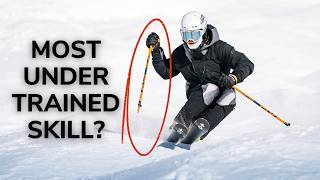
Tom Gellie and an instructor break down a pole-plant technique for moguls and short turns. Position the basket near your binding so the plant happens late, driven by wrist rotation with hands in a triangle. Practice stationary reps first, then add weight shifts and real terrain to build rhythm and balance.
Chapters
So the next thing for working on moguls and short turns is what I'm going to call the pole set. So that's having your pole basket in a ready position way earlier than you think. So essentially, when you start a new turn, so I've gone from, say, weight on left foot to weight on my right foot. Notice as soon as I'm switching the weight, I'm also switching which basket is ahead. Ahead to ahead. So it feels a little bit like running, except you only want to make the movement as much as possible. From the wrist. So I'm not breaking my rule of the triangle hands. Everything's staying consistent. The other thing is when you're setting it up, I'm not trying to really pole plant out there. The pole touch actually ends up being back right next to my binding, but this just sets you up in more of an aggressive position. Like my arm, my whole outside half of my body is really engaged, but then I am touching next to my boots or toe piece here. Touching there.
The way I think about this is by being patient. I get my pole set ready, but I don't touch the snow until the last minute possible. What this will do will actually improve your balance because you're really waiting until that critical moment, that last second where you really need the help of the pole plant, and when you plant it, it's right next to your body So this actually encourages you to use your feet and whole body and pole plant together.
Okay, so in terms of the progression, I just want you to start out making sure you do 10 to 12 on the spot. And if you can get someone to video you from this angle and compare to what I'm doing, check that out. Okay, you might be seeing arm reaching, you might see letting go of the pinky finger. All things that are in Pole Use 101. Make sure you check that, that out too. But right here, stationary. And then if you've got a slope that's a bit of a pitch, like I don't want to straight line this, I'm not going to turn, I'm just going to go straight so I'm feeling like I'm moving. Then we go 1, 2, 1, 2. So no pole top touch yet, just a weight shift in a plow so I can actually think about what is going on and consciously catch myself if I'm reaching, reaching, reaching. Next step, you're going to start putting in the pole touch. So pole set, touch near the binding, pole set, touch to the binding, pole set. If you add in a little bit of a turn, it's just sort of stimulating the whole pattern of movements. That you're going to be doing in the moguls. Then you can challenge yourself with a little faster. So 1, 2, 1, 2, 1, 2, 1, 2. Have a look from behind now. Good. Now I can add the pole pole touch, pole touch. So notice as I come around the side of you here, it's almost like the pole touch is not a forward where I get a jab back, it's actually as the basket comes in a backwards direction. All the time trying to not lose my triangle hands position. So you can even go now straight if it's a really flat section. Practice, practice. Have a look from the back how there's a little bit of a weight shift, and then I can start adding some little turns. Pulse, set, and touch. Pole set, pole touch, pole set, pole touch, set, pole touch, pole set, pole touch. Utilize every bit of terrain like here that you'd usually maybe straight line back, cat tracks, all those places to ingrain this habit. Because once you get into the trees, the moguls, short turns, it gets steeper. You need to rely on what you've felt in all these times to come have the capacity to do it because you need it to be felt. Not thought about. It'll take a while, but keep working at it. So if you've been watching carefully, you'll notice I've only focused on the outside arm, okay? Wrist motion, pole set. But if you watch, I have this coordinated forward-back. So the inside pole, after the pole touch, I do kind of bring it back. I don't want it back here like this, looking for Wi-Fi, da da da da da. I want it just back a little bit behind me there, ready. Okay? So this just helps feel like you've got a rhythm going. Feels more whole body integrated. Okay? So the next thing is, pole set, and just allow the inner arm to come back, and don't drop it. The biggest key, watch this, Most people will make a pole plant, drop the arm, drop the arm, and then they're picking it up, planting it. So it's dropped, picking it up, planting it. We go back to the triangle hands tip, which you must work on first. Notice if anything, my inside arm feels like I lift it, lift it, lift it, lift it. Have a look at this from the back. So I don't want to be dropping, dropping, dropping, dropping. Consistent. Okay, so work on your triangle hands and now bring in the pole set and touch. And then next, spend some time working your inside hand as well. There's not arm motion really present, like a little bit for sure, but it's really— I'm trying to control as much as I can from the wrists, so I'm constantly in this stable position. If you've got this steady position where it's not too low, not up high at your shoulders, but down here, and you're working from it, you'll feel more balanced. Did this with a guy, the guys on the camp just this week. Massive change. They even said one of the guys went to the terrain park. He's like, I held my hands in that spot the whole time. I'm less scared on jumps. Have your hands here, work on making the pole plant from this position, not reaching. Okay, you'll feel a huge difference, I promise you. All right, get out there and practice next time.