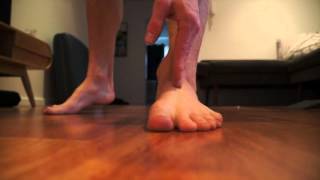
In this instructional monologue, Tom Gellie explains foot pronation— the natural movement of the foot after heel strike that allows the foot to become a flexible, adaptive structure. He describes the anatomy of the foot, the role of pronation in absorbing terrain, and how proper pronation reduces strain on the rest of the body. Gellie then connects this biomechanics to skiing, emphasizing that a smooth, effortless pronation at the very start of a turn shifts weight onto the inside edge of the ski, triggers muscle activation, and improves edge grip. He contrasts natural pronation with over‑pronation or actively rolling the foot, warning that forcing the movement or extending it too long hampers balance and can cause knee/hip strain. The video outlines the timing (pronation only at turn initiation, followed by supination) and provides practical drills— such as moving from a supinated position to a pronated one on a wedge—to help skiers feel the correct movement and develop the habit of letting the foot lengthen naturally. The overall message is to let the foot “relax” into pronation at turn start, use it as a trigger for the rest of the body, and avoid prolonged pronation for smoother, more controlled skiing.
Chapters
Okay, so I wanted to talk a little bit about foot pronation, the importance of good pronation, and perhaps its place and timing in a skater. So starting off with what is foot pronation. Foot pronation is essentially the movements that your foot goes through, each foot goes through, when it strikes the ground when you're walking. So after heel strike, your foot, whole foot hits the ground, and it's at this point your foot turns into a mobile, adaptive, suspending structure. So before we kind of covered the whole planet in concrete and flat footpaths and everything, we used to walk around on uneven surfaces. So we had to have a body that could deal with all these changing surfaces, that could adapt to all the different undulating surfaces and everything that we encountered— sticks, logs, rocks, everything. So, all the bones in our feet, the 26 bones in our feet, are designed to articulate and move. But they're probably designed to open and move the most at this pronation phase. Because it's this point we are basically shifting our weight from one foot onto the other. Okay, from left to right, right to left. So the foot needs to turn into this mobile, adaptive structure. Okay. If all those bones move and allow, allow themselves to open up and the foot to kind of conform to the ground, it means the rest of your body has the chance to not work as hard. It can help with the balancing of your body at that point. Whereas if your foot is really rigid, you're locking out up to 33 joints in your feet of potential movement and adaptation that the rest of your body is going to have to make up for. So pronation is a really important movement in, in every sport you do, walking, everything. It's one thing I've worked on that's helped usually with all sorts of things, different sports, pistol squats, gym stuff. So really cool. Okay, so why would it be important in skiing, and when would it happen? So when your foot pronates well, the sensation and feeling you'll get is of the arch making a lengthening movement. So you're not actually rolling the foot. Just gonna move the camera. Into a different spot so you can perhaps see. So it's not this movement here, right, which would be an overpronation movement, okay. There's just a movement of allowing the whole foot all the way across the front here and my heel to still stay in contact with the ground, but my arch to go arch from sort of being raised to lengthened. You should be able to see that in the shot there. The arch lowering, all these muscles kind of lengthening, the big toe actually kind of moving forward slightly. So that's what pronation, good pronation feels like. Secondly, the weight goes from being sort of centered to being predominantly more lined up on the inside of your arch where these bigger bones are. So right where the ski edge is, okay, along here. So if you allow your foot to pronate really effortlessly, and like I said, let pronation— there's no muscles that actually pronate the foot. Good pronation is just a letting go. It's letting gravity and the joints articulate so that the foot moves in this way. Okay, as opposed to trying to pronate the foot and roll it over. So if you allow your foot to make this pronation movement at the very start of your turn, you are going to set yourself up a lot more successfully at the start of the turn. Because it sets off like a triggering effect of a whole lot of different muscles in your body to start firing and start working. Because if your foot is rigid, those muscles are not quite sure already really what they're supposed to be doing. So when I start a ski turn really well, the timing of it, if I've finished I turn to the left, I'd be more on the outside of my left foot here, and I'm about to pronate it. So, more from the outside, go from there. And it's more a series of letting that foot flatten, and my weight stack over the top of this foot. The foot lengthen, and everything settle down on the inside part of my arch right here. And I can feel weight and pressure go right up to the ball of my foot, where a lot of the time we're telling students to apply pressure. If you just let your foot do this movement, the weight wants to drive there naturally. So that's another good bonus thing about pronation. So, timing of it, just as you're starting to change the edge, as you're moving off this, the old edges here, onto the new ones, that's how you want to start getting grip. Is through this pronation phase. Okay? Difference being, if you try, perhaps too early or too hard, in actively pronating the foot over, like this, if I just try and balance on that foot right now, in this pronated position, you'll see me wavering about a little bit, which is a lot harder to do. So there's a lot of effort involved to do this. So, it's not exactly the most efficient and easy way to start a turn. So, if you can at least teach your body how to do it more effortlessly, then from here, perhaps you can start adding more aggressive edge movements. But there's definitely a patience element of starting the turn and allowing the foot to at least settle with its weight shifted from the old outside foot to the new outside foot onto this pronated position. So try that for yourself, the difference feeling of balancing on this foot, where you're allowing the foot to lengthen and the weight to just naturally drop here, and you actively trying to pronate it over and lift the outside foot up. Okay. You can even try it, if I've got these wedges here to simulate me being on edge angle, over here in this position, my hips move inside. If I try and continue to pronate my foot, so long after that initiation, but we're right in the middle of the turn, if I keep trying to pronate this foot at this point and move in, it doesn't feel quite as good as just letting my foot settle and rest in the position where it sort of had started from with the pronation. So pronation doesn't last for that long. Just as in walking, you, your foot strikes the ground, pronates, as it takes your body weight onto here, and then from here on in, your foot actually starts to supinate. So the bones all start pulling up together to help create a rigid lever that helps move you forward. So that pronation phase doesn't last that long, in my opinion, in skiing. Just at the start. From then on in, you don't really want to continue to try and pronate your foot, because you're going to end up rotating this knee and leg inside, jamming up the hip on the inside here, and blocking your ability to really move smoothly inside the turn. From here, I don't feel like there's much in the way of muscles helping to control my mass being moved inside the turn. So if they're not— nothing's helping me be controlled moving inside, nothing's going to help me really come out of it very easily. Whereas from here, I can actually feel some length come in from the rest of my body in some of the other videos I've talked about, which would help me bring my body back to center again. So, to recap, pronation, different types of pronation, and just letting your body relax and the bones lengthen, everything adjust, and more of a letting go type movement, okay. To help trigger response in the rest of your body to start getting ready and fire up for the next movement. Give it a try, starting your turns with that sensation as opposed to an active rolling over. And I guess one thing you could try to just feel the difference here is an exercise of coming around, if I'm finishing this turn, to the left. I'm going to put my foot in a supinated position, or weight on the outside, pinky toe side of my foot. Put my weight there, allow my body to rest on top of this leg and this foot, and let the foot pronate. So just get used to going from this position to being balanced over the top of this foot in a relaxed manner. So from here, into pronation. Because some of you will be saying, hey, my feet are already in that squashed flat position. And yes, that is also a problem. Because it sucks if you're already in pronation, because your body doesn't experience moving into that position and get a triggering, a loading of the muscles. So you'd want to be working on some slightly different stuff, but at least if you can feel going from a supinated position to a pronated position, your body is getting the stimulus of going from one position to another. So you could try that both sides, just getting a feel. You'll probably feel that one side is easier or pronates much more naturally than the other. But just get used to the feeling of that movement. Allowing your body to balance on top of a pronating, adapting foot that allows your weight to naturally just start moving to the inside of your foot, where the inside of the edge is, which is going to help you set up for the rest of the turn. Remember though, pronation doesn't last for that long, it just helps you set up. From then on in, don't try and keep pronating the foot. There's some other things which I might talk about in further for the videos just there. Anyway, good luck with it, and feel free to give me any feedback. Thanks.