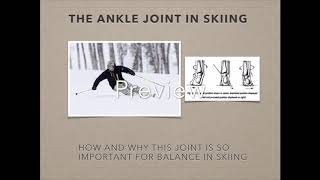
Tom Gellie explains how the subtalar joint converts lower leg rotation into lateral foot motion, shifting your center of pressure toward the ski edge for deeper carving. Ski width affects how close your pressure point sits to the edge, and foot-knee alignment determines edge direction. Footbeds and binding setup either help or hurt your ability to use this joint effectively.
Chapters
Welcome to the lecture on the ankle joint in skiing. In this lecture, the goals are going to be to learn about mostly the subtalar joint in the ankle. So this may be new for some of you, which will be great because knowing how to utilize this joint will really open up a whole new world of, uh, ski maneuvers and ability for you to control the edge.
So we're going to learn about how this joint moves, how to assess this joint both indoors and on snow, why it's an important joint to use in skiing, and then look at equipment factors that could possibly get in the way or even possibly help you get the most out of this joint.
The joint converts rotational movements of the lower body or the lower leg into lateral rotational movements of of the foot, you will force more of the center of pressure from here to this point, which is going to be closer to the edge that you're actually trying to get to penetrate and hold on the snow.
Narrower the ski, the closer this point of, um, center of pressure is to the edge, so there's less torque trying to flatten the ski over snow, changes in terrain, speed, turn shape.
They all give you—
the more places you can separate from, the easier time you are going to be able to readjust your balance. This guy on the right, he's probably in a slightly supinated position with his foot, which actually pushes his knee outwards, whereas Paul has his knee inwards, which helps him direct this center of mass of his to this part of the ski edge.
He now can start to use the subtalar joint to direct the force right into the edge, and you'll see the ski goes from being into a, being a drift to cutting harder, harder, harder, and carve on a check.
So a good footbed will not block this motion, but it'll set you up with that talus, the top of the subtalar joint bone, right in the middle.