Sasha Rearick - Find your skiing solutions through exploration and playing with the environment
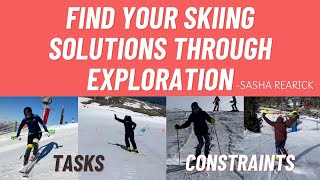
Former US World Cup coach Sascha Rearick explains how to teach skiers through constraints and exploration instead of prescribing technique. He uses drills like the Avers drill and reverse bicycle to force athletes to discover their own solutions, shaped by terrain and environment rather than one right way to move.
Chapters
Hey, do you guys want to know who I interviewed on my podcast this week?
Yeah.
Okay, well, I interviewed Sascha Rierich again, and he's a former World Cup coach of the US ski team. He now works with a company called Apex 2100. They coach races. Um, yes, super interesting conversation. You want to know what we covered? Yeah, what did you talk about? Okay, well, one of the really interesting things is Sascha is right into this, uh, it's called ecological-based learning approach, and it includes stuff we've talked about before, which is constraints-based learning. So anytime you ski around a race course, there's a constraint because you have to go around the gates, you can't just go wherever you want. So we talk about that and how he uses a lot of these principles to help coach athletes, and he really believes it's like the way— principles that are in this kind of thinking, definitely the way forward. So I think you guys would both benefit in your skiing, like I've tried to put into my own coaching. Yeah, it takes some effort to rethink some things and not just tell people how to do it, but give them a task and the task teaches them how to do it. So yeah, that's really interesting. And then I would say the last thing that's really cool is, do you find sometimes people get confused by counter separation, when to separate? Yeah, I feel like these— some of these terms throw people off big time. Yeah, totally. So we try and we get into that discussion. We talk about separation and Sasha's kind of definition of it, as well as anticipation, timing of when that is like that term is used, counter. And there's some really helpful stuff in there. So I think the goal is there from both of us to try and help people have better clarity on terms used because, yeah, it can be confusing.
Yeah, yeah, yeah.
We're gonna go take a run at Threadbow here, but you guys should listen to this podcast coming up and enjoy it. Thanks a lot, Sasha. You're tuning in with us from New Zealand. You just arrived. I wanted to touch base with you again after our last interview where we talked about constraints-based learning a lot, and I've certainly found it really helpful in my own skiing. Um, today I thought we should discuss this, but, but sitting above constraints-based learning is this thing theory of like the ecological approach to learning.
Yeah.
So if people are brand new to this, what, how would you describe that and where, like where did this term ecological approach come from? Okay.
Well, thanks Tom. Thanks for having me again. Yes, we're here in New Zealand. We're training in Wanaka using Kidrona and Troublecomb. And I think it, you know, we can use this as an example as this is there's a lot of different terrain down here and a lot of different snow conditions we'll experience over the month, month and a half that we're here. And the ecological approach, where the actual term comes from, I don't know. That's probably some PhD.
Doesn't matter.
In a PhD in the university world. But what's clear is we as humans develop the way we move and the way we act and the way we react based on the environment that we've grown up in. And what I, what I've noticed is, you know, just having been able to work with athletes around the world, highest level athletes from around the world, you know, people that are absolutely gung-ho and love the sport and kids that are, you know, kids that are still trying to emerge into whatever level of sport they're depending on where they come from, they have certain strengths and weaknesses in their own skiing. So this again tells me that the environment you grow up in is so critical to your own movement development and how you, you know, get down the mountain. So I really believe strongly in this. In the past 5, 6 years, I've been really coaching more and more in this way, talking more and more in this way. And, and it's, you know, you know, how do you constrain the athlete to, uh, that the athlete has to find new, new movement patterns to improve their skiing? Um, and, and how do you as a coach give them certain tasks that are gonna help them improve the skiing? So let's take a step back. For example, let's just talk about Colorado versus New England skiers. New England skiers are very good at active weight transfer. They go from outside ski to outside ski very well. They have an active weight transfer. Colorado skiers, they can carve really clean turns on a passive weight transfer, very passive. They just roll up both skis left, right, because the snow's so grippy that you don't need to actively weight transfer. So when I'm working with athletes that have grown up in the East, they have other skills that they'll need where the Colorado athletes, I really have to work on active weight transfer. And that's not because of the coaching, the cueing. This is just the environment that they've been in. So as a coach, as a teacher, we have to say, okay, these are the, all the different environments or all the different tasks or all the different ways that constrain somebody to help them learn new skills, new fundamentals, or ingrain better fundamentals in their own way. So the classic model of teaching is move your body in a certain way, move your shoulders this way, move your foot this way, flex your ankle this way. The ecological approach says, I'm gonna put you into a certain environment and I want you to execute this task and you're gonna give feedback whether the task is being executed well or not. You may give some hints and some cueing, but you're gonna try to let the athlete find the solution. But as the teacher or as the coach, you know that by doing that task, it's gonna get them to do X. And then typically what I'm trying to do, all I'm trying to do is get you in a better athletic stance. Yeah. A better athletic stance, a balanced athletic stance is defined as I can move in any way, anytime I want. So I can increase the edge angle, I can change the turn, I can stay with the arc, I can release the arc, I can jump at any moment. The athlete's really balanced in a really good stance. They can do this.
So now rewinding back.
Find us. Yeah. Go for it.
I was gonna say, rewinding back, why did you start taking this interest 5 years ago? What was the trigger?
5, 6 years ago, I went from being the World Cup coach for 10 years, head of, head of, head of the World Cup, the US team, to going back and working in development. And I got the opportunity to work with a bunch of different people that were kind of revisiting the motor learning, motor, motor learning, motor development science.. And then I went like, okay, I have all these ideas of what's, what, what's needed at the World Cup, but how do you get there? So I kind of revisited, you know, the education, what's out there. And it's clear the science out there has, has really caught up to this and is showing that that's the way to go. So I, that was the first stimulus. Second stimulus was I needed to help teach a lot of coaches and a lot of athletes from a lot of different parts of the country. In these camps and sitting there and giving feedback to one athlete at a time is not time effectiveness. So I could go, okay, how can I, how can I, you know, have large camps with coaches that I don't know, with athletes that I don't know, but achieve some kind of outcomes that are, that I think are important. And so I, I merged those two together and I said, oh, this is working really well. How do we continue this? And then at the same time, I look back on, you know, a lot of the good experiences I've seen from my past in the World Cup or burden, you know, through the Europa Cup and thinking about also watching other coaches that coach really well. They've used a lot of this stuff. So I don't think anything I'm doing is new. It's just kind of taking parts of, you know, old methodology from the '50s, the '60s, the '70s, the '80s and '90s, and just saying, hey, let's put this together and, and, uh,, help athletes find their way, their unique way to make the most effective, efficient turn. The next part of it is also the other part of this is you learn in this method, you're much more fluid in your movements. So when the pressure is on or when you have to adapt, you're not cognitively thinking about how to do it. It's subconscious. So when the pressure is on in competition, it flows much freer. Or when it's all of a sudden the pressure's on and you're in a steep chute and you gotta remember, you know, stand on the outside ski, keep your shoulder up, pull plant downhill. Like all those things will, should come out of your subconscious much freer. Yes.
Yeah. And I guess that's probably where this, this term came from, ecological approach is it's looking at the evolution of humans, how we learned to do things was through our interaction of the environment. I like the example of the East Coast skier versus the Colorado West Coast skier and just seeing patterns there. Are there any other patterns you would say, maybe even not East versus West, but even Europe, you know, based on the environment, um, rolling terrain, steeper versus flatter, like, do you find that skiers that grow up on more mellow kind of runs are good at generating speed and the obvious, you know, people who are on the steeps are always better at controlling.
Yeah. I would say that like athletes from Tahoe, from the Squaw Valley area, Tahoe, Tahoe, or excuse me. You know, those areas are, I've seen and I've coached a lot of great athletes from that area. Those athletes are phenomenal at handling terrain. Keeping the skis on the snow, having the courage to go down the mountain. They're really, really good at that. They're good natural skiers, but they don't build up a lot of energy in the turn. They don't build up a lot of power in the turn. So they don't have a lot of upper and lower body separation. They don't have a lot of, you know, let's say call that real powerful clean turn. That's not their strength, but they are able to keep the skis going down the hill with courage. They are able to move with the terrain. They're able to read the terrain really, really well. They, they ski in this very stacked position, which is a very safe position, very, very solid position. So if it's really bumpy and rough and gnarly, they, they're, they're no problem. They can go. And I think that that's partly is, is, you know, in the West there in the Far West, you get so much different snow. And when you are training gates, it's huge ruts and you're surviving. You're not trying to, you know, power up the turn as much as possible. Where, you know, take an East Coast skier, you know, from, from Northern Vermont or Central Vermont, and those same skills they don't have, but they do know how to load up the ski. So, I mean, I think that's another example that many coaches can relate to, having worked with athletes from around the world.
Yeah. It, um, do you remember back to one of the principles of this ecological thing, this, this idea that, you know, we're trying— you're trying to take this approach of not giving people like movements, like this is how you flex your ankle, make sure you flex to the outside ski, hands here. Do you remember in that book that we both checked out, the How You Learn to Move, the Bernstein's Hammer? Example? Because I think that's how he starts off. Like, there's no perfect— like, repeat the same perfect movement over and over again.
Yeah, so he's talking about degrees of freedom. Yeah, yeah. So if he— it doesn't matter what sport you're talking about. Like, you take the most elite pitcher, or, you know, Federer's tennis serve, and you were to, you know, plot the wrist movement, the elbow movement, the shoulder movement. Every one of those serves is going to be different. And the more freedom you have to adapt and to adapt to the situation that you're in, the more free you are and the more higher performance. So the higher performers have greater degrees of motion, degrees of freedom of motion. The lower performers are always much more cyclical pattern. So it's much more, you know, a learned pattern. But if you just take it from pitchers, tennis players, which is a pretty repeatable environment, and you go, okay, the better ones are more free. And what do we do as teachers? We're trying to constrain that so that they're not free. Huh. That doesn't add up. Let's find ways to let them be free. Yes, there's some fundamentals. There's some patterns that are probably more important. But let's create this freedom of movement.
Yeah.
Because that's what he was getting at with the hammer, which was even more constrained environment, simplified environment.
Because he had this theory that, you know, he wanted to test, he got all the best blacksmiths and, you know, is the theory that all the best blacksmiths use the same repeatable, like, best technique? And he found no, that it's all different.
And then they—
and then, so then you're looking at this degrees of freedom problem. And, and then the, the, the researcher guy also looks at other sports in this book and how they don't. And, and even the example, I don't know if you remember, they've got these like fancy machines that can hold on to your arms if you're a golfer and almost like force you into making a swing like Tiger Woods, and showing that it doesn't really transfer that well. So even if you get like hold of someone and you like, this is how Mikaela Shiffrin skis, and I'm going to push your hip this where you're, um, it doesn't end up actually helping them, uh, in the long run. As you said, when you get to a real life situation and there's pressure on and it's not the same conditions that you trained in, now you're stuffed.
Yeah. And I think that's, that's, uh, that's why I keep going back to this is help the athlete find their own solution. You know, they're gonna find a unique solution.
Um, so have you had a chance to—
but I think we have to, we have, we have to have an understanding that there's certain fundamentals that we want. So like in blacksmithing, the hammer has to contact cleanly. You can't skip. Yeah. It's like there's a certain part of the hammer that, that's doing the work. You have to make sure that that's making the contact. So in our sport, skiing, it's either the edge, the edge on the tip, the edge in the middle of the ski, the edge of the tail, or the glide, the sliding, you know, those, those things.
So I guess, have you been able to reconcile like how much— because once you learn about this, you tend to want to take— you're like, okay, well, everything should be learned through me not telling the person exactly how to do it, how, you know, so external cues, that sort of stuff. If you found a good framework or way of thinking about covering like the basics fundamentals where you kind of do need to teach people a little bit of stuff? Like, is there, is there like a percentage mix or how do you go about it?
Yeah, I can't, I can't do a percentage mix, but I do chunk the sport apart. So I'll challenge them in a certain way and say, okay, now all of a sudden I'll see that they're very challenged because they're— one part of that chunking mechanism is not working. And then I will realize that, oh, they've found a solution to get the ski on edge without using that possibility at all. So they haven't learned that. So I'll go in and learn that. So for example, what we see a lot of times from athletes from Tahoe, they're very stacked. They use hip angulation, but they have no ankle pronation and internal femur rotation. Just because if you really did that on the, on the snow there, you, you know, you would just, you get jitters. So I'll go back and really teach that motion. How do you get the ski on edge without using the pelvis, without using the, the upper body?
Just outta curiosity, was that what you were doing? You just posted an Instagram video, a girl on one ski kind of in javelin position. Edging, side slip, edging, side slip, edging.
Yeah. Yeah. That was in that frame line. Exactly. Okay. We were looking at a couple other things. That was more like a testing to see where she was gonna break down. Okay. Um, to see where, where, where the motion would break down to see which chunk we had to work on. Um, but that, that's in that line. So, but we'll go back to that when, when we come to tasks. So the task there was javelin. I want you to slide and then set the edge crisply, set the edge crisp, and that the, the, the poles on your pelvis can't move. So I know by that environment, she has to internally, she has to pronate her foot and internally rotate her femur. So I know that, but I'm not talking to her about that. Yeah. And I can see like, okay, she's able to do that., but the position's not great with her upper body. So I can cue her externally with just picking the tail of the ski up. And by picking the tail of the ski up, that's, in order for her to do that, she has to move her upper body into a proper position, which that proper position being a fundamental to me is that, yes, you know, you're not rotated in, leaning in.
Yes. So I guess really, I mean, like, most the time, even like you chunk things down, you break it down like that, the solution that you're trying to get them to find can nearly always be done through a task, a constraints-based sort of situation, as opposed to move your upper body more forward of the outside ski.
Yes.
To try— and that's what you've really worked on and that's what you're advocating for. And yeah, that's, yeah, very cool. So why don't we talk about then, under this ecological approach, there are, there's, there are things like constraints. So we'll talk about that. There are things like tasks, uh, there's one that where he talks about, uh, you know, the opposite, like doing the, going the wrong way. Yeah, yeah, yeah, yeah, yeah, which I think is a really cool one. And then I'm not sure if— I did that one today. Okay, cool. I'd love to hear that example. Not sure if there are any other ones. Let's go with those. So the opposite constraints and tasks, wherever you want to start.
So constraint would be is, you know, you can— I was doing it just then. There's a catwalk coming out of Condron, a long catwalk back to the lift. And you have the wall on one side, like a snow fence. And on the other side you have a cliff. Yeah. You know, the rock face. And I'm like, okay, I want you to pretend that you're bouncing off the wall. Okay. So those are the constraints. You're gonna ski all the way to the wall and you're gonna bounce off the wall. And then, so that was like the constrained environment. So there, all of a sudden we're setting a certain radius, a certain tempo, and then I go half that. So make it half as much. So that's, that's a, a real basic constraint. You know, setting gates is a constraint. I can set 'em 27 meters apart. I can set 'em 27 meters apart straight versus very turny. And if I said very turny, the solution's gonna be different than if I said very, very straight. I can say, I want you to straddle the stubby versus I want you to not touch the stubby, or I want you to put the inside knee on the stubby. Those 3 environments, those, that's the task. The, the constraint would be How far you set the gates, how much turn set you set the gates. And then the task might be, what are you doing inside that? Are you holding your hands across your chest? Are you picking up the tip of the ski? You pick up the tail of the ski. Are you putting your hands on your hips? Those would be a task. Yes.
Or are you traveling the stub ends? Almost like rules of the game.
In a way. Rules of the game. Exactly. Yeah. Like how can I manipulate the rules of the game to change the environment? So that's kind of constraint and task. When you're freeskiing, we give lots of tasks, you know, lift the inside ski, drag your pole, lift the pole above your head, put the poles above your head, put the poles behind your back. Those would be tasks. We do it all the time. We don't necessarily think Oh, this is ecological approach, but we are doing it.
We're all doing it.
Yes. Yes. Um, the opposite one is, uh, someone sits back and skiing, they're clearly in the back seat. You have them sit back even more. Yeah. Um, and it works really, it works really well. Yeah. Um, you have them lean in, you have them on their inside ski too much. You have them, I want you to make the turn totally on your inside ski. Yeah. And, and all of a sudden they go, wow, that feels really weird. Okay, well, I'll try to do the opposite of that. And then all of a sudden they're like, oh, I found a new solution. I found a new feeling. So the one today was, um, we set really, really, really turny. And we had athletes that are, you know, 20 years old to 16 years old. And I was like, man, the only way to really ski this, so it's going to feel any kind of good, is you have to ski this like Stenmark. And they're all looking at me like, Stenmark, who, what, how did he ski? And you know, Stenmark had this huge skate, V-skate, you know, reaching for the sky, but he put a lot of energy in the ski. And they're just still looking at me like, and I'm showing them and I'm demonstrating, which I never do. And I'm like, they're still looking at me like, I'm like, all right, imagine if you had a straight, straight, straight course. And all of a sudden you skied extremely active, what would you do? And they're all like, oh, you'd fly out of the course. So you'd fly out of the course. So here's the opposite effect. Now it's really turning. Imagine if you didn't turn, if you weren't active, what's going to happen? Oh, you'd get stuck. You'd feel like you're stuck. All right. We tried those two different approaches and different courses with the straight course and different courses to try to extremes everyone in. To get people to be really, really active today, it's tough unless you put them on. This is where you can change the rules of the game by changing the equipment. So you can run, you know, slalom with Super G skis. All of a sudden you've changed the tech, you've changed the constraint is you don't have sidecut anymore. You don't have the ski possible to bend, so you have to do something else to make it work.
Yeah.
Did—
what were some of the things that those athletes— did you get some like verbal or like interesting things like, oh, like how did you know as a coach, like confirmation? Were there anything you got from today doing that in terms of—
yeah, because they feel it. They'll feel like, oh, I can get through there smooth and I'm not having to do 1,000 steps or things like that. Yeah. They know it. They, you know, the athletes I work with feel, they feel really well. Yeah. They can feel, oh, I'm doing this good. That felt good. Yeah. Most of the time they understand, you know, what the feeling's good. Some of the lower level athletes be like, oh, that feels really good. And they'll be putting pressure against the fall line. Below the fault line. And that's where we'll have to teach 'em what that means. But for the most part, they have a pretty good sense of feels, especially when you get in the extremes. Yeah. Um, when it's, and that's why I like to set in the extremes, it's very straight, very turny, is because you've given them that much more ability to feel what's good, what's bad without having to give any feedback.
Uh-huh. The other week, that they'd set up this small mogul course on the beginner run at Threadbo. So, so green, easy area for this school competition. And then they left it up there, and one of the mogul coaches the following day set up little mini flags really high up on the mogul. So not down the trough, really high up and quite far, like, past the trough. And then these kids The task was they had to get around the flag, so they had to kind of almost go across the trough, up the side of the mogul, turn way, way, way later than they are used to, and then go again. And it was really difficult. And I looked at it and I went, I think the coaches maybe set this wrong, um, you know, because I skied it and I did it okay but not great. But then this mogul coach comes back up and he's been on like a representative level. And he went down and totally schooled me and just nailed it. And there was something else he did in between that I wasn't doing. So he was coming around this flag, and then he would almost jump the trough. So project himself forward, hips would be up, land, and then a quick little turn. So there was a different sort of thing going on. And I watched and I went, okay, gave him a bit of a clue, went at it again, and, and found something completely new in the way a new feeling, a new line, new tactics, just through that simple thing. It was just so brilliant. Like, I wish there was more of those, like, almost stations at a ski resort just for the general skier, you know, like, like a Rubik's Cube problem. Like, here's a little mini course. You don't have to have a black run. You don't have to have great snow. I just wish there were more obstacles, more terrain things to play with, because I think people would just I think one, places like on the East Coast in Australia, we don't get always the best snow. You'd have way more fun no matter what the conditions are like, and people just learn, would learn more.
Absolutely. Any comments to that? Yeah, absolutely. I mean, I love it. I love it. I mean, that's what he is doing. He is like, okay, here's your normal pattern. You know, a lot of times we have a coach at Apex who calls it, as soon as they're figured it out, he changes the task or he changes the environment. To, so he unorganizes them or he disorganizes them. Yeah. So it's, and then they have to find a new solution. So he does it about 2 or 3 times during a training session. He'll do 2, 3 runs. Okay. They start to get organized. Boom. He changes it. And like sometimes they can organize themselves in a run and he'll change it right again. And he's just constantly trying to disorganize them. And by disorganizing them, they're finding new solutions for that problem and they're becoming way better skiers. Yeah. And I think that's what, that's what that coach was doing. It's like, okay, you always do this. What happens if I ask you to do this? Yeah. I go find a new solution. And sometimes the solution's too hard and you need that little bit of like, see someone else do it. Oh, it is possible. Yes. Or, you know, you need some encouragement or sometimes you need to take a step back from it. Like today, like today we, we had, uh, we put all of a sudden The task was too hard. It was Aver's drill on the right footers. You had to, you had to ski the stubby normal, but the left footers, you had to straddle them. Is that it? And you had to do it all Aver's drill.
And of course people are blowing fuses.
And I didn't— I blew fuses. I was like, well, that was too far. But then we just took one of those out, put the poles back in the hands and did it. And they were able to do it really, really well. The other is like, okay, we probably just took it too far. There's this constant balance where you're trying to— when you're doing this approach, is going just enough outside of the comfort so that they're stimulated. That's motivational. It's like, oh my God, okay, I can't quite do it, but I know I can get there. As soon as you get there, the boredom will start to seek in.
Change it again. Hey, just a really quick word from me. If you've enjoyed this episode of the Big Picture Skiing Podcast or any of the other episodes I've put out, could I ask a small favor of you? Could you please subscribe or follow on whatever channel you're listening on, whether it's YouTube, Spotify, or Apple. That really helps support the show and helps me bring on great new guests like Sascha so I can share that information with you. All right, thanks very much for helping me out. Let's get back to the show.
If you look at the terrain park at a ski area, you know, and you see what's going on in the terrain park, you've got little hits, you got little things, and then they're, they're, they're coming up with their own task. I want to jump off of this onto it backwards, land and come off of it forwards. You know, what are they doing? They're playing in that sense.
Have you read The Rise of Superman, the book The Rise of Superman? Yes. What's the fastest— the most progressive rate in all sports is extreme sports. And look at all the mountain biking, just more bits of terrain. The environment is being played with and the people go and experiment with it. Someone goes and, you know, does something differently that no one's ever seen before. And suddenly people can now see the possibilities. And yeah, I really wish that just ski resorts, after visiting Japan and seeing this, this resort in, in Fukushima where they had these, all these mogul kind of training areas. So it's like a mogul training kind of park for adults. So you didn't have to take air or anything, but waves, like just waves without the that sort of stuff, easy mogul runs, stuff like that to, to play around with, just gave people way more opportunities to, to find and discover these new things. It's, uh, yeah, it's my push at the moment. I'm like, if I could talk to all the ski resorts in the world, I'd be asking them to put in like adult terrain park areas because, you know, I think the whole skiing population would have a, have a blast, uh, using them.
And learn to ski. Yeah. Absolutely.
Absolutely.
Yep. And then just giving, you know, just giving some, giving some ideas of like what you can do in it because, you know, yes, that's right. I think that's where, where the traditional skier or the traditional ski instructor is not trying to be creative in those environments. We're said, this is how you do it. Do this, do this, do this. Where if we could just say, hey, use this environment, And what are you trying to challenge? You're trying to challenge movement left to right, balance. Can they jump? Can they, can they keep the skis in the snow through it? You know, and just give 'em, give 'em some cues of how to use it.
I think it would be good. I would say, you know, one thing I, I noticed that was interesting with like the coaches coaching these athletes through this little constraints mogul course is most of them didn't want to do it. Because they're embarrassed and it was out of their comfort zone. I haven't felt— I was like, do I want to do this? All these people watching. Uh, but then I'm so glad I gave it a go. And, you know, I knew this other guy, Will, who's a fantastic mogul skier, was watching, and he was better at it, but I had to just put my ego aside. And, and I'm so glad I did because a learning opportunity was opened up. Um, do you find that's a, an issue with your athletes too, is just helping them overcome embarrassment?
Yes. I think we do have a perfectionist mentality or perfectionist society now that's troublesome for learning. And I often talk about really good training's messy, it's ugly. You're gonna make lots of mistakes. And if you're not making lots of mistakes, it's not good training. So That's right. And yeah, I think there's so many people think they have to be perfect and that no, there is in elite level sports, there's no perfect. You're always trying to get better. You're seeking perfection, but you'll never get to perfection. So put that aside, embrace the struggle, love the struggle. And what I do found though, like, is this, I think it's much more common in today's society. But I do found whether it's working with Americans or French or internationals, just talking about it in that same context we just did there, people improve really fast and they say, oh, it's okay to fail. And I'm like, no, you know, create this environment which it's cool, it's good. You're going to fall down, you're going to struggle, you're going to mess up. Don't worry about it. Let's go move forward. And It's just constantly reinforcing that, um, and the terminology. If you make a mistake, no big deal. Let's go, let's get back up and go again. Yeah, this is how we learn.
So good training, great training is really messy. That's one of the best things I think I've embraced in the last year and a half is, is don't worry how silly I might look doing things. Like, it's how I'm gonna push my skiing now.
I mean, I learned this from people that learn lots of languages and they're so good at learning languages. The number one skill that they've learned is that they have to make mistakes when they speak. And so they just go like, I'm going to make a lot of mistakes because every time I make the mistakes, that's a little bit of learning. And that's how they go from like zero being able to speak anything to like just Speaking. It's just they get that in their mindset is I'm gonna have to make a lot of mistakes. So let's just speak, get those mistakes going because that's where I learn. And I thought that's really cool. And that, you know, that holds so much of us, all of us, holds us back so much.
Yes, totally, totally. Now, you brought up a comment I posted a video about a learning experience I had with an Austrian ski instructor, uh, nearly a decade ago, where his advice to me was to rotate into the turn, rotate in the start of the turn. And it was sort of going against current beliefs at the time about what I should do with separation, upper lower body separation. But luckily I tried it, had this really nice result. And you made a comment that, you know, anticipation is a word that is perhaps, you know, used in Europe but not really used, uh, in North America and elsewhere. And so people don't understand where this maybe upper body rotation or this idea of rotating into the turn is actually a useful thing. Um, do you— I thought let's use this opportunity to discuss upper lower body separation and your thoughts on this is like a skill, a concept in skiing.
Yeah, I mean, I think that the most important thing to do for, to have this discussion is, is, is to find a little bit of vocabulary. So upper lower body separation is the legs turning one way and the upper body, everything above the pelvis turns the other way. The pelvis is our fulcrum and our legs are turning one way and our upper body's turning the other way. That is upper lower body separation. It's not angulation. It's not hip angulation that we have to understand. Hip angulation is hip angulation. It's an angle. It's the abduction of the femur.
I kind of call that lateral separation as opposed to like—
Yeah, I just, I don't even use the word lateral separation. Just to just call it, that's hip angulation. That's hip angulation. Simple. And upper, upper, lower, I mean, the Norwegians even have a word that's called spine rotation or spine flexion. It's this upper body. And really when we, when we have upper lower body separation really good, the legs are going one way and the upper body is flexed and it's actually flexing towards the outside. That only is necessary at the moment of the turn, the force. So let's review the phases of the turn. We have the initiation of the turn, turning phase, and completion. And in ski racing, I've been using more like building, the building of tension, the turn, and the release. The only time you need upper low by separation, or you want it, is at the turn phase. It's just so that the forces can align and you can make the most amount of force in the turn or release the forces or whatever you need to do. So you watch a running back, doesn't matter if it's rugby or American football or basketball, the athlete's cutting, there's that separation. The inside shoulder is in line over the outside. So that's biomechanics, that's physics. So you need that for a quick turn, a powerful turn. So that's where the separation is. Yes. Now, when we build tension or we build tension in the turn, we take angle. To get the skis on angle. If all of a sudden I have upper lower body separation at that moment, my upper body is facing the outside of the turn, I'm no longer in balance. Anticipation is when the upper body is facing more down the hill.
Then the skis.
Above. Then the skis. Yeah. And one would be like, oh, that's rotation. Well, if it was in the middle of the turn, that's when it would be rotation. But because it's in the initiation of the turn or the building of tension or moment, it's anticipation. If I rotate at the bottom of the turn, if my shoulders are facing inside my skis or my skis, I'm following my skis and it's not the appropriate time, that would be rotation. So if I'm making glide turns, you asked about which skiers, you know, if you ski on flat long terrain athletes that used to grow up in Breckenridge, Colorado, we're, we're great at this. I mean, it's so flat, so long, long runs. You make long super G turns. You're really, really good at glide turns. You ski with your skis and your shoulders and everything facing your skis. And that's how you make fast turns when it's glidey.. But if you try to do that on steep, you don't make the turns. The turns end up being very glidey and you don't make it around the gates or you don't make it to where you wanna go. Yeah.
So that's where the difference is. Yeah. I think that the example you gave, uh, just back on the, you know, phase specific, like sort of in that turn turning phase, how if you look outside the sport of skiing, when do you see this similar position show up naturally without coaching people again on it is like the cutting from right to left to dodge a player. It's sort of how the human body organizes itself when there's this sort of like change in, in direction. Momentum is redirected, it assumes this position. So top of the turn, you're not trying to redirect yourself, your momentum at that point. So you shouldn't be looking to replicate a position that is a natural position from like a collision redirection moment. So I think that's a— this is just, I guess, a simple way to see it outside of skiing and how it can kind of fit. And fits back to this idea of like, people learn these things by like putting themselves in a situation where you've got to get from left side of the, of the run to the right side fast without losing your speed and these positions show up.
Yeah. And people, but like, you know, when people say, oh no, counter is bad. Yes. Counter at the top of the turn. And if you counter the hip, the pelvis, if the pelvis is countered and in a moment that's not necessary, yes, it's, it's bad. But there's times where if you're skiing a steep chute, And you don't have any counter, you're in trouble. You're not going to, you're going to be in trouble. You know, so there's times and place for it, but like, it's just upper body and lower body separations is the pelvis stays relatively neutral. Yeah. I'm back to the turn. The pelvis is neutral. We're in a neutral stance.
And then as I build the turn, the upper body faces the outside, the lower legs going. Yeah, something interesting I've noticed, uh, I'll just say, just with Archie, who's 6, uh, he doesn't listen to me very much because I'm his dad. When we go skiing, I try and tell him, but he doesn't like to. So he's obviously watching and just skiing. But this year, he's strong enough, he's sort of more parallel, making short turns on like this fairly steep blue run in, in Thredbo. And I'm just noticing he shows these things of like separation and position just through without me telling him these things. And why I'm saying this is it brings up the point, do you think a lot of the time when you're given athletes who've made it pretty far, they're right, okay, I want to really try and push my sport, I'm going to go join Apex, do some heavy, you know, really serious training. There's a lot of time what you're dealing with is you're changing what people have been told they should do in their formative years, like, this is what you have to do, we want to see angulation because you're leaning in. Like, is that— do you want to speak to any—
do you feel that is, is part of a, a reason for when you're not— you— yeah, yeah, we see all kinds of, you know, we call, you know, bad habits or ingrained habits. And how they've ingrained is either by watching people or the That was the, the, the norm of the club or the best, the best skier in the club did that. Um, you know, or that was taught, you know, so we're trying to uningrain bad habits, which is always really hard. And if you cognitively try to uningrain bad habits, it's like you can spend the next 3 years trying to do that. And it doesn't work. So what do you have to do is teach them new, better habits.
So that's where constraint-based methods really work really well. So say you're given the— given this athlete that's come across and they are an early separation person, it's at the wrong time when we're looking at maybe this anticipated position. Do you have a way that you'd like to help those people discover that?
Top of the tongue? Yeah, I use, I use one drill which I call the Avers drill. Um, it's where you drive the outside arm forward all the way into the apex of the turn. And then right at the apex, you switch hands really dynamically. Um, I posted some stuff, uh, about 2 months ago about that with AJ doing, AJ Guinness doing a bunch of it and then some other kids doing that as well. And you can see that, that kind of motion and short swing turns and long turns. Um, so that's a, that's a drill that I use quite a lot to You try to break that or try to teach a new habit. Um, you know, just coming neutral, having to cross your arm or your inside arm reaches for your outside shoulder and your outside arm reaches out or forward, switching a pull from inside hand to outside hand. Um, just giving them some other task that they have to do in the transition, kind of makes them find a new solution and just drop the inside hip back and inside to start the turn. Yeah. Um, it takes a lot of time. Uh, and what I found is by giving them these new tasks and new environments, a lot of one-ski skiing, you make progress. Um, but it takes time. I mean, I remember River Radimus, um, still like when I watch him ski and when his glide turns, geez, I still see it. You know, I still see it. They love to just, you know, drop that hip in. And, and I remember going skiing with him the whole day, like an entire day trying to get it out. And I went like, holy, is this, is ingrained deep in his, in his myelin, you know, his myelin sheathing. And you know, then, then having brought, you know, ski instructor, really good high-end ski instructors, coordinative ski instructors, you know, give him a whole lot of other tasks and see it improve a little bit. Different coaches work with him and step by step by step it's improved. And now he's one of the best GS skiers in the world. But you know, he, that ability to do that allows him to ski really turny GS really well. 'Cause he's got that, you know, in his bag that that's his strength. But it also, you know, it cause, causes him challenges in other ways. So, but it takes time.
It takes a lot of time. Okay. Then finally, the, the release part, if we're talking about what you're looking for through that phase and, and then sticking with rotational, with separation drills you use and, and, and what you're looking for that, that is like a good outcome at that part of the turn.
Yeah, I mean, I think the, the challenges is like you want to release the ski so you don't continue to turn up the hill., but you want to stay with the ski long enough to get however you want to get across the hill. Right.
Yeah.
So the release, like it doesn't, so you have to, you know, there's this like release without continuing. So you stay with the ski without continuing to turn. Yeah. Up the hill, which is a hard concept to get, but once you understand it's like, oh yeah, I can stay with the ski, but I don't continue to turn. I'm just, traversing. Yeah.
So if you're in a good balanced position, you can go inside ski or outside ski.
You can go two skis. Yeah, whatever you want. You can go to the, or if you, you can go just the tail of the ski. So if all of a sudden I need a little bit more radius, I can just use the tail of the ski to get a little more radius. So again, it's that balance up on the position. So we do want to continue to see a little bit upper lower body separation, um, that the athlete's in balance. Um, what task I use all the time, and this is what I call the reverse bicycle drill. It's where you pick up the tip, your tip of your outside ski at the end of the turn. Yeah. And then you leave the tail on the ski. Reverse it. So yeah. And then hold it up in the air until you start your new turn and then you place it down kind of around the apex and it's like pedaling a bike backwards. So your inside leg short, I'm picking up my outside leg, my outside leg comes shorter, my inside leg comes longer. Yep, nice.
Do you use any— what, uh, with— do you play with, uh, like this, you know, how much to turn up the heel? Anything you can draw on from experience where you've played with that? I suppose with gates it's just— but do you put anything like— do you use stubbies, uh, die on the snow, that sort of stuff, to teach people like, hey, this, this is what I mean by turning up the hill more. See, this course is set so you like—
that's the feeling. And this course, usually it's the opposite. So usually it's release, it's more about releasing. I put the brushes and I have the athletes keep below the brushes.
Most people are scared. They're trying too much. Yeah, that would be me.
That would definitely be me. Yeah. And then athletes, then what happens is athletes make mistakes. So they think they gotta turn more bar above the gate, more above the gate, but it's really, they gotta change their depth of the turn. That's a whole nother topic. Yeah. Another thing. Yeah. For, for, for another, but I, but, but yes, you can use, I mean, that's, that's the beautiful thing of ski racing to learn skiing is that you're constantly changing the environment, turning your straighter and that those are constraints and that forms the skier skills. Excellent. Yeah. So on the release side, if they're in balance, you know, when you're just free skiing, you know, from that, I really like that reverse bicycle drill. I've done it with all kinds of athletes, you know, and ski instructors and, you know, little kids, little kids. You'd be like, can you lift the tip up at the end of the turn? And they're, you know, they can play with it. I mean, little, little kids can do it. And all of a sudden, because you've giving them a task, lift the tip up at the end of this turn, which is contrary to what everybody else says. No, lift your inside ski. I'm saying, oh, lift your outside ski. And in order to do it, you have to be in balance. Yeah. And they'll find a way to get in balance. And as soon as they're doing it really well, you do it on GS skis or you do it on steeper terrain or you do it with no poles or you do it with your hands on your chest, which are your hands on your hips and And, you know, you can do this with like everything I do with like World Cup skiers. You can do it with 6-year-olds, 5-year-olds. Um, no problem. Um, and then as soon as they start to do that, as soon as they start to do that, then you can say, okay, now I want you to start the turn on the inside ski. It's like a white pass turn. Yeah.
Yeah. You know, like a white pass turn.
Yeah.
Hey, how, how is, uh, how are your kids going with their skiing?
They're doing good. Tasman is first year FIS and Giacomo's just turned 7. And yeah, we're having fun skiing. Kind of like they enjoy it. My son and my daughter, she's playing ice hockey. Zali's playing ice hockey and ski racing is the second sport. She goes, I love training, staying around for 2, for, 2 runs a race all day doesn't seem to be that much fun. I'd rather play ice hockey. I'm like, good on you.
Uh, yeah. So, but yeah, it's fun. Great. Sasha, thank you so much again for joining in and sharing your ideas on coaching with the rest of the world. We really appreciate getting a look into your mind and, and how you do things. All the best with this New Zealand season.
And, uh, yeah, all the, all the coaching you're going to do. Thanks, Tom. Enjoy, enjoy Threadbow. And, and, uh, I look forward to hopefully one day get to go actually rip some ideas around and learn from you about the mogul side, because I do know that moguls is an amazing environment to really learn how to ski.
Um, so I'd love to, I'd love to share on the hill one day with you.
Yeah, ditto. Me too. Awesome. Thanks a lot.
Awesome.
Thank you so much.
More from Tom



Most skiers overlook how they use their poles. Try these five pointers next time you’re skiing.







