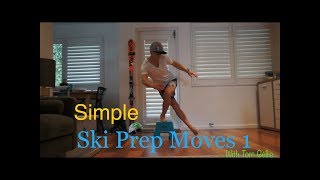
Tom Gellie, a ski instructor and body-alignment specialist, demonstrates a single-leg balance drill called the clock reach. You stand on one foot and reach in different directions while keeping three points of contact, bending through your ankle, knee, and hip. The exercise strengthens proprioception in the hips, knees, and ankles to prevent falls on changing terrain.
Chapters
Hi guys, this is Tom Gellie, and I'm a professional ski instructor as well as a body alignment specialist. I'm about to go away on a ski trip to Canada in 3 weeks' time, and I just wanted to share with you a couple of different exercises or bits of training I do to help prepare my body. And I do this for a number of reasons. So, one, I want to prepare the joints and muscles that are going to be kind of working the most in a sport like skiing. So that's definitely my hips, knees, and ankles. I also want to build proprioceptive awareness of my balance, because in a sport such as skiing, you're always being thrown in and out of balance. Your, you know, your surface you're sliding on is always changing, whether it's You know, getting faster or slower, or rougher, smoother, up, down. It's always changing. So I want to build my body's proprioceptive awareness, especially after being around in Sydney, walking around on the flat all the time. So, there are a couple of my main reasons. So, the first one I'm going to just share with you is just a single leg balance drill. And I'm going to start with my left foot. And a couple of key points with this exercise. See if you can keep 3 points of contact on the ground. So behind the ball, the ball of the foot, behind the big toe, the little ball of the foot, and the heel. So those 3 points, see if you can keep them constant the whole time. And we're going to move, firstly, my other foot to some different directions around along the floor to challenge where my body moves, and then therefore my center of mass moving, and then how my joints react and my muscles react to those positions. So, yeah, because say we're skiing along and you hit a bump and you get thrown this way, which would be kind of similar to me reaching my foot out in an opposite direction, my upper body would get thrown this way.. I want my body to be ready and prepared to manage that. So without further ado, here I go on my, on my left foot. I'm going to start with a clock. So I'm going to start at 12 o'clock straight ahead. You'll notice the difference. If I don't bend this leg and I reach forward, I'll get a certain distance. Okay, so without bending, that's how far I can reach my foot. Okay, if I bend more, I can get further. So from there, way out to here. So the more you bend your joints, ankle, knee, and hip, the more you'll be able to challenge your base of support. So 12 o'clock, 1 o'clock, 2, 3, 4, 5, 6, 7, 8. If you want, see if you can go for 9, clock across here, and then work your way back. 5, 4, 3, 2, 1, 12. Always come back, sort of reset, so you have to challenge yourself again. So this time, second time round, I want you to be aware, same foot, of what the rest of your body's doing, okay? Because if you're reaching out to 3 o'clock and you're throwing your arms up or your head forward or whatever, you're teaching your body to coordinate those joint movements with this rebalancing move. So the way you want to rebalance if you lose your balance this way is, if you want to do this, by all means go ahead and do that as you reach out. But if you want to compose yourself skiing, keep this relaxed and loose. It doesn't have to be rigid. It's a difference. I don't want to stop my body from moving completely, but I want to keep it relaxed so I can come back really easily. So this time around, I want you to focus on your head. And keeping it relaxed as you go around all the points of the clock. So just notice if you need to do anything strange with your head, or can you keep it quite still? Okay, working back, and I can already start feeling my muscles really working. Pretty hard on this second time, all the way around the clock. Okay, so we're going to switch sides. There's likely going to be a difference between one leg and another due to injuries or just favoring certain legs. We're going to go to 3 o'clock. We already know now about that if we add strange movements to this exercise, it's fine. It just means our body is picking up on using those to help rebalance, as opposed to perhaps we want our hips and all the muscles around the knee and the ankle and the hips to be bringing us back into balance. So, just really depends what you want your body to be trained to do. Okay, so twice around each side, different points of the clock, and you can scan different body parts. So perhaps the next time around, you could watch your hands, and do you grip with them? Do you grip with your shoulders, your armpits? Do you hold your breath? All these different things you want to try and work your way into being as relaxed But composed as possible as you hit every possible dimension, which is going to build not only your proprioception from hitting a bump. And I know my leg's out here, but this is just simulating a change of position and mass. So if I did get bumped off on the snow, I'm going to know my body's going to be prepared and more ready for getting myself back to center again. Less likely to freak out, fall over, and injure myself. So, we're going to go into something more challenging now. So, do this as you feel comfortable, but we can do the same exercise now on a step to bring more eccentric challenge to the leg, the single leg. And I really like unilateral single leg training because if you add really good balance of one leg to really good balance of a second leg independently, then the two of them combined together are going to be far better at bringing you back to center than if you just work, say, in your usual squat pattern. This is far more challenging for the balance, vestibular system, proprioceptive system, and your muscles. So adding a box, still trying to hit the ground. So depending on your level of physical strength and readiness, lower one, you don't have to reach and bend so much down. I'm still trying to get to the edges of my balance zone. Great thing about this is you can do this anywhere inside your house, at the gym, in the park, whoa, all sorts of different places. This time back right now, I'm focusing on nice, relaxed, quiet hands. I will say, right at this point, to go back to thinking about this foot you're balancing on, that it's relaxed as well and has got 3 points of contact. Tripod is a stable structure to stand on. Okay, so there you go. Really simple exercise, one of the ones I use to help prepare myself for my upcoming ski trip. I'm going to do a few more just to give everyone a bit of a glimpse of how I myself like to prepare and train myself for sports like skiing. And yeah, so keep an eye out for that. Just wanted to give a shout out to my good friends Projected Productions. These guys produce fantastic ski instructional videos. They've got 2 out already. You can find them on Vimeo On Demand and search Projected Productions. They're just about to bring out a third technical video, instructional video, so check them out. Highly recommend them. Amazing skiers on the video, some really great tips that, you know, the more info, the more sort of stuff you get that can prepare you for your ski trip, the better. So anyway, thanks for tuning in. I'm Tom Gellie, functionalbody.com.au. See you next time.