Ski Mobility With Dr Kelly Starrett and Tom Gellie
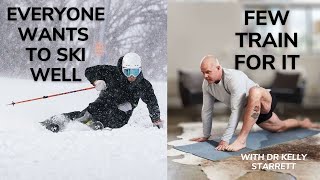
Dr. Kelly Starrett explains why skiers need systematic preparation beyond just hitting the slopes: proper sleep, protein, aerobic conditioning, and strength work that mimics ski movements like single-leg squats and kettlebell swings. He calls 8,000 steps, 8 hours of sleep, and adequate protein the non-negotiable foundation before any technical training.
Chapters
Everyone can go ski one day, but how are you on day 2 or 3 or 4? You know, people start to fall off. Ah, bro, I need a half day off. I'm gonna, you know, I'm like, bro, we're in Japan. Like, we're, you know, it's, it's day 4 of the helicopter ski trip and like, you're tired today? Did you eat breakfast? No. Like, show me what you ate for lunch. Like, it cannot include a Monster Energy and a beer.
Today's episode of the Big Picture Skiing Podcast is a really special one. I'm joined by Dr. Kelly Starrett. Now Kelly has spent decades helping people to move better, recover faster, and stay mobile for life. Now if you've been following me for a while, you know I'm big on mobility and getting your body prepped and ready. It's not just about strength, it's about being able to spend long days on the hill in variable conditions, recover fast so you can do the sport that you love for longer. In this chat, Kelly and I discuss what it really means to prepare your body for skiing. Not just a few stretches in the morning, but an ongoing practice of movement, recovery, and awareness. He uses this great analogy. He says, imagine you approach getting ready for skiing like you approached— you were going into a fight or a boxing match. You'd be far more prepared earlier. You'd eat well, sleep well, and you'd respect what your body is about to go through. And I love this perspective because think about it, you go at high speeds and you have these long levers strapped to your feet. There are high forces that go on when we go out and we go skiing. So if you want to ski better and ski for longer, then this conversation is a great reminder of why you need to put body prep and mobility at the top of your list of things to do, especially even now before ski season really kicks off. I think you'll really enjoy Kelly's practical approach to how to move well, recover well, and be more prepared for a day on the slopes. So let's get stuck into this conversation with Kelly Starrett. Hey Kelly, so the first time time I discovered you, a friend Riley was talking about this book, Becoming a Supple Leopard, and we were both sort of in the gym quite a lot, skiing hard back-to-back seasons, and we're reading this thing, and I, I found it, and I went, oh, I've got to try this stuff. This is probably what I'm, I'm missing out on. So how did you get into being this mobility person in the first place?
Because stretching is so cool, because everyone wants to talk about stretching. Look, you, you, you fell victim to the, the leopard virus. That's really what it is. And it's interesting because you really are the kind of case study for why this kind of conversation took off, is that a lot of us were engaged in very high-level sport. I grew up racing FIS. I paddled on the US canoe and kayak team. My wife is a, you know, was a rower at Berkeley. She's a 2-time world champion. Like, we met at the world championships, always about performance. And at the time, no conversation was about looking at position and our lack of position or restoration position as a limiting factor to our performance. It was just do more work. And if you get stronger, yeah, get stronger. And if you, you know, we tell people like, obviously I work the competition, which is just, you You know, bollocks now. And, and what we saw was athletes were looking for a way to take care of themselves that didn't involve waiting around to something was catastrophically, you know, on fire before they were like, hey, let me activate this emergency medical system. And then simultaneously, you know, that you'd go see a physio and she didn't ski, she didn't— she wasn't training with you, she didn't understand your lifestyle, um, how you ate, what your injury history— really, there's so much context. And the place to really discover that would just get— we found out was the gym where we had a live running diagnostic test all the time going with the athletes we were working with. Is that your movement changed over the course of this season? You got beat up after epic days. How do we recover those positions? How do we begin to explore minimums? And really the dangerous idea here was that we said, hey, it's your responsibility to take care of your body's positions and to make sure that you have as much movement choice as you can. And, it's interesting to see if we just take, for example, how typically people prepare for skiing. You pull those skis out of the trunk, you're like, "Oh, it's hard to put your boots on because you're so stiff." And then, you're like, "Well, no, I won't make any hard turns on the first run and I hope that the rest of it comes together." And man, I'll tell you that there was just a lot of slack to be taken out of the system in terms of enhancing recovery, restoring position. And ultimately, what we found is that when we used strength conditioning as a formal diagnostic language, we could return and restore people to having a lot more power and native ranges, which meant you could get into the shapes and techniques that everyone was trying to do. There's not an accident that we start slarving. I mean, slarving for me is like, I'm like, "Oh, yeah, you want to see what happened to people's range of motion?" And we just let them slarve around. And of course, it's a valid technique, But you know what I'm saying is that if you can only slarve and you can't rail and you can't put your foot in the snow and, and you, you can't hook up, then what we start to see is the techniques change. And we see the same thing with gravel bikes and everything else. It's just that, you know, what we're trying to do is end up making the machines fit the body. And no one was thinking about making the body fit the machine.
And I think I want to emphasize, you keep using the word like shapes and positions. Because I think that was what probably really grabbed us as skiers. Because as you get better, you do your instructing levels, you start honing your eye to these angles where the body is at different points in the turn, and it's not all in the same spot that it's twisting, it's tilting, it's winding up, it's unwinding, right? And so I think we went, oh, here's like an approach we can take off snow to help fix that stuff. So I'd say that like, that is a key point that I was like, I need to get into this because no one was telling me about that. Like, you do your levels or you do a lesson, the instructor— I mean, it's a bit different today, people know more, but like, the instructor wouldn't go, your, your hips are tight. They'd just go, you're rotating, you're skidding, stop skidding.
Oh, doing that, you're like, well, if I'm supposed to dissociate my upper body from my lower body, you don't have any internal rotation of the hip, what are we talking about? You know, and I mean, how many times? So again, I grew up in southern Germany. Our school got out at noon on Wednesday. We ski. That's my favorite sport. There's no other sport where you can hook up the G-forces that you can find on skis. It's just, it's crazy. And, you know, what we started to see was, you know, early on, you know, so imagine me going to the André Arnold's, you know, he was a World Cup champion ski racing camp in Austria and sold it on like 12. And, you know, having to unbuckle my boots and be aware of foot pressure. And, you know, and we're diagramming, you know, foot pressure in the turn, and it's very technical conversations. And those were my first sort of entrees into the technicality of sport and how we were thinking about, you know, very complex feelings as it related to being able to make a turn or do something. And, you know, though, that interoception of being able to— an athlete feel what she's supposed to feel, where is my weight supposed to be is so important to understanding this, because if you can't access that position, you can't even feel what we're talking about. And no one's looking at it. Basically, we're like, we take this body and we're like, well, I hope you like purple skis because that's what we've got you on. Right. And there's so many complex interchanges between boot and ski and snow and speed and body. I mean, it's really a miracle when you even today, when I see someone hooking up and railing turns, if I, you know, if I watch them like obsessively and when I get to the line, I'm like, man, nice turns, man. And like, you really— it's so unusual to see someone put all those pieces together. And my Instagram feed is just, you know, Austrians in one-piece ski suits, you know, railing, you know. And it's really just— it's so fun to see how the ski technology and boot technology— I'm in a plug boot again after racing for a billion years and I'm like back in a plug boot. It's warm and it has fur and a cappuccino machine I don't need to unbuckle. What's happened in the world? So the ski equipment is so good and now we're fitter and stronger than ever, but we need to make sure we're keeping an eye on minimums and being able to look at rotation of the hip. Or every time I go in to get fit for boots and someone's like, they're like, man, your ankles are amazing. And I'm like, really? My ankles are normal. I just have normal ankles. They're not amazing ankles. But go hang out with a boot fitter and you can see what I'm talking about. That boot fitter is like, oh my God, these feet that you're showing up with, Like they're weak, they're shut down, they're collapsed, they're your bunions. You have these gross things and we're trying to make this high-performance experience. Boot fitters are the closest things we have to magicians today to try to get people to feel what's happening with their body. It's a remarkable time and place. And where should we begin to untangle that in the formal movement language of the gym?
You mentioned feet a lot there, and I think that is a really important one. And I got two things I was, I've been meaning to ask you. One, the second time I got into like a discussion about, oh, there's this guy Kelly and have you read the book Becoming a Supple Leopard was when I went and studied structural integration, rolfing. This guy Colin and I were chatting and he mentioned that you perhaps were, were you, were you rolfed? Did you go see someone that did that stuff? Like, how did you get into the fascial stuff? Cause this was back in. Like 2013, I want to say. And fascia was kind of not really, you know, every now everyone's like fascia, fascia, fascia. That even that period's kind of passed. But how did you find about like fascia and were you involved in structural integration at all?
So my wife is in the background and she just laughed out loud because my girlfriend in college was a rolfer. Ah, graduated. And then lo and behold, I spent a lot of time at the Rolf Institute in Boulder, went through some 10 series, and then read Ida Rolf's book. And to your point, when we started thinking about the movement system, I was like, of course, of course we're talking about fascia. And what at the time in the late 1900s, which is when this was happening, when I was discovering fascia for the first time, no one was looking at strength and conditioning seriously. No one was thinking about joint mechanics. So fascia was this really interesting piece where we could see that we could put a lot of information into the body. We could think about how patterns worked. And I mean, the body has a chirality. It has a spin. It's really important we understand how to create rotation. It's important to understand that there are positions that allow us to be more stable. You know, when you are cranking, you know, a big turn, you know, your knee is more stable when there's an external rotation force in the leg and knee becomes less stable when there's an internal rotation force on the leg. So if you're cranking, like say that you're making a really hard turn to the left, that downhill ski, that knee is becoming more stable. And then that uphill ski, that leg is actually unwinding to allow you to have that position. And understanding that is a miracle of skiing, but also simultaneously, you know, you almost can understand why the Austrians are like, no, lift the foot up into the stem, Christy. Yeah. And because they were like, you know, we didn't know, like, how, how do I express that much rotation in the hip? How do I make sure that my body can end up in some of these positions and shapes. And, if you're not thinking about the body as a system of systems, what did you drink and eat before you went skiing? How stoked and warm and hot were you before you put your stuff on? How did you sleep last night? Oh, you thought I was going to talk about your body. Yeah. Then, we can talk about, do you have the skills and the proprioception and the available range of motion to be able to do these things? I mean, there's a reason that everyone immediately in the line grabs their ski poles and folds forward on the skis to try to take some of the extension load out of the pelvis. And, there's a reason why we see so much lumbar disease in our skiers. We're cranking that pelvis over to solve that movement problem of having the knees canted forward in the boots. And, especially if you're particularly short in the front of the hip anyway, which most people are, we're going to see just at the end of the day, your back aches after skiing moguls and it doesn't have to.
Mm-hmm. So then you, so you had a rolfer, like you, so you must have had a lot of sessions. Can you help the listener understand, like, the changes? Because I think what was, for me especially, was my body can change. That was like a, that was a mind-blowing thing to me. I did rolfing, and then also after like discovering some of the mobility stuff, which now made a lot more sense, like this feels like the similar kind of instant almost changes you get from rolfing. But can you explain, like, was there a moment you were like, you maybe had session 4 and you're like, holy cow, my legs go like up to my ears and out to the sides? Was there a story that, that stands out in, in like after a session?
Remember having a session and walking and feeling like my butt went up to my neck? Like, I was like, oh, my glutes work really well right now. I think that the key to understanding all this is that you are going to have to appreciate the system. And a lot of times are— if you thought about, you know, when we think about fascia or connective tissue of the body in relationship to movement, it's easier to think, hey, we should be layers of warm silk sliding over steel springs. That's how our body is intended to work. Tissues are supposed to slide and glide, and there's a ton of dynamic movement that happens within this system. And oftentimes, for example, we don't roll the quads like up and down along the trying to find the pinnation or, you know, like the rectus femoris. We don't roll up and down the rectus femoris. We go side to side because what we're really interested in is how are these tissues interacting in the global system in the neighborhood? So I have a house, a quadricep head. How's it relating to the rest of the quadricep heads? That's the rest of my house and my parking lot or my garage. And then now how's that interacting with my street and how's that interacting with my town? And how do those things come into the system? Oftentimes we see that, you know, through poor hydration and poor movement and old injury and trauma, the body sort of gets sticky. And it's not the only way that we can lose function, but if those networks aren't sliding and gliding, and I'll give you an example, cuz it doesn't have to be just trauma and like you're a smoker, right? You know, there's a reason like why people go to Japan and sit in the onsen afterwards and they feel great. Like you're getting blood flow, those tissues are sliding and gliding again. You just like, your skiing is better and better and you, you eat a bunch of fish and rice and you don't go out. And there's a whole bunch of things that go along with that. But you know, part of what we're, we're seeing here is if you train really hard, the first thing that your body does is actually lay down connect a bigger connective tissue framework. So your body says, okay, we, we're gonna need bigger quads here, right? We, we've You've, you've set the signal that your quads are insufficient for the job and now they're going to grow. And that's what exercise is really about, right? If we look at ultimately even a day of skiing, it's about adaptation. And then my body is adapting to this, to this sport or this activity in some way or other. And oftentimes that connective tissue system is the first system that gets laid down. So the muscular, musculature framework gets bigger, the connective tissue system container gets bigger.. And if you don't keep an eye on that, it's easy to get stiff fast. And those tissues can suddenly not slide and glide very well, and they can become congested or just stiff because, you know, you, you did a ton of squats and then a ton of moguls, and then you sat around, you know, playing on the Xbox. And so what we discovered was when we started thinking, look, if fascial therapy had solved all the problems, and it solves a lot of problems, we would have just focused on fascial therapy the rest of our lives. If seeing a chiro had solved all the problems, that would have solved all the problems. I'm an Australian-trained manual therapist. I'm a Maitland-trained therapist, and we are heavy joint first, but we really do think in terms of systems approaches. And so, if I can restore your sliding surfaces, that might unlock a lot of movement. If I go after your joint capsule, that might unlock a lot of movement. If I look at how the muscle is interacting, And then, the movement control for that. And then, of course, I need to see the human being underneath all that. And really, for me, the framework that is why it's so crucial that someone engages in a strength conditioning program because that's such a beautiful framework to begin to understand fueling and hydration. I mean, I see people ski for 6, 7 hours and not drink anything. I mean, that's insane. And I mean, the number one, you want to increase your likelihood of booting out and crashing, just be dehydrated or hypohydrated on the slope. So, we don't apply the lessons of sport to some of our fun activities very much, and we can do a lot better. For example, I mean, when you get off the slope, throw on some compression socks, bro, and then cruise around the house. You don't have shin bang, your shins are swollen and you haven't decongested your shins. And so, you put your feet in, they're just highly sensitized because they're so swollen. So let's just limit that, that swelling. That's cold compression socks.
I think you, you bring up a really good point here. I mean, skiing, there's not many other sports where you might be up at like 7:30, on the lift at 8:30, going hard, and then the day ends at maybe 4. Like, you don't play football for that long unless you don't— unless you're a 6-year-old, right?
And you can certainly, um, you know, chill. You can make really crappy turns and slow down. But that's not the way I like to ski. I mean, I ski like we're going to get in a fight every run. And I'm like, you know, like, you know, I just really— the people who are skiing and sending and going full gas, we should be treating that like, are you eating 50 grams of carbohydrate an hour? No. Did you eat? Did you eat breakfast? No. Like, show me what you ate for lunch. Like, it cannot include a Monster Energy and a beer. You know, and so there's a lot we can do to actually improve how we can ski day after day. And this is really crucial. You know, people are getting the message. They're starting to train more. Everyone can go ski one day, but how are you on day 2 or 3 or 4? You know, people start to fall off. Ah, bro, I need a half day off. I'm going to, you know, I'm like, bro, we're in Japan. Like, we're, you know, it's, it's day 4 of the helicopter ski trip and like, you're tired today. Why are you tired? Well, it's accumulation of a lot of events. And ultimately, you're not able to access your positions. You're not able to access the force production capabilities. And we are getting smarter. We're starting to see performance seep in. And you can see why, you know, again, I'm opening a can of worms here, but like the reaction of freeskiing to like the hardcore slalomists, right? Slalom was our way. And people were like, boy, we've sucked all the joy and fun out of skiing. So let's do this freeride thing. But we can still take those lessons out of high-performance Olympic-level skiing and say, hey, let's get every few— every hour, let's eat a bar on the lift. You can do that. Just make sure you drink some water. And when you start to lose your technique, it's time to go in. I really am— we are strong believers in the half day. Really go blow yourself out hard. And you need to get up— sometimes we get up early and I stretch and I warm. And now the best athletes are doing yoga before they go on the hill. And I'll get on the bike and I'll be prepped and I'll jump rope. Open. So by the time I strap in the boots, I'm actually warm, like I'm actually going to go do a sport, and I'm treating skiing like a sport.
I just realized I— you, you may— you reminded me of a very good point when I was asking about the fascial system, that the layers and the sliding, this, this layers of silk over steel springs. Because I think a lot of people listening probably don't have that concept of their of their body. So like, if you look at the layers on those 3D iPad anatomy apps, you can start seeing that like there's, there's muscles running at a 45, and then there's a muscle over the top that runs at a 45 the other way. And if one is trying to do the job of pulling in one direction and another guy's got an almost opposite direction job, there's going to be problems there if they don't know how to like slide and let that that happened. So I think when I did the Structural Integration training, that was a huge piece for me. So I think I want to emphasize that for the listener. And maybe if you want to go back and give an example there, even because I, I've seen knee pain just go in half an hour because of improving that.
It wasn't those 5 minutes.
I mean, yeah, exactly. Yeah.
So we have a saying around here, we say where the rats get in is not where they chew. And actually, maybe a, an Ida, true Ida Rolf-ism is where you think it is, it ain't. And so, you know, first of all, you know, one of the drivers of why people might become interested in their bodies in skiing is, yes, they can't engage in a technique. Two, they're getting their ass kicked, right? Or three, it's starting to hurt. Like, skiing hurts. What a bummer. Because it didn't hurt. Like, you used to be 17 and you could do whatever you wanted. We would eat gummy bears and dump noodles and then just go and go and go. Maybe we ate goulash at the lunch, maybe not. We drank in the morning and then didn't drink like camels until we got home. At age 12 or 13, you can do whatever you want with your body. But the pain piece is really interesting. And so one of the concepts that we are big fans of is throwing in these really short isometric forms. So when we have a pain problem, we try to run through a little rubric that helps people to sort this out. Number 1, let's remember that pain is a request for change. So the reason your body is experiencing pain is your brain has become sensitized or is interpreting a signal from the body. So your brain doesn't actually— you don't make pain. Your brain interprets information from your body as pain. And I think that's really crucial. So when something doesn't hurt, you can actually use it as a check engine, like, oh, I can become curious about that.. And one of the things that my wife and I have been doing for the last 20 years is start to say, hey, let's create some movement minimums. Like, okay, I know what you should be able to do is a squat, but if that's too complicated, lay down as a skier, have your mate bring your heel to your butt. And if your heel doesn't just effortlessly touch your butt, I know that that system is restricted, right? And again, these are all easy tests to pass, but But one of the things that we can see is, hey, if I have a movement restriction, my body's going to solve that problem or interpret the results of that inability to access this normal range of motion, this normative range of motion. And it might interpret it as, hey, that insertion of that quadriceps on your knee is a little bit sore, or hey, you got a little pain here. And to your point, oftentimes when we're like, okay. Strip all that away. What is the tissue system right above the pain area? What's the tissue system right below the pain area? Let's spend 5 minutes doing these short isometric contractions there. So if you are having knee pain and you lay on a roller, just a foam roller, which is again the lowest level of physical input, that is a pool noodle. It's a pool toy. So if you're experiencing pain laying on a pool toy, when I— when you put that quad, that thigh on the pool noodle, and it hurts, you have found the problem until it's no longer the problem. Normal tissues are painless to compression. Let me say that like I should be able to walk up and down on your body with my 105-kilo self and you're like, that just feels like a big fat guy walking on me. It doesn't hurt. But a typical person, if I laid them down and put any pressure on there, they black out, they vomit, they squirm. So we have a couple of rules. Number one is Everyone, you always have to be able to take a breath. I think we figured out in rolfing that you didn't have to be a fascial destructionist. You could go in and work at a level where the nervous system worked with you. So, we always say, hey, we want to have neuromuscular control. Can you flex into the roller? Yeah. Can you take a breath? Yes. Okay, then we're working at an appropriate level. Those are the ways you can always be safe. Because the first time someone does this, it's shocking to them how painful this is, right? And what your brain is interpreting is stiffness in the body. Your brain is interpreting that stiffness as pain, and it's just stiffness in the body. It's just localized stiffness under the pressure of the roller. So, what we say is, "Hey, let's get the brain involved. Let's get the breath involved." So, we're going to take a 5-second inhale, contract to an isometric that came out of the PNF world, and we're just going to hold that for 5 seconds, saying it's safe to create tension in this tissue under load, and then we slowly relax and exhale. And, if we repeat that cycle, all of a sudden, you take more pressure there, it's not as sensitive. And we just start spending 5 minutes on a tissue system that keeps people from generally overdoing it. And lo and behold, you stand up and you're like, well, how's your knee pain now? And you're like, wow, it's better. And you didn't— that was not sophisticated. That was you laying on a pool noodle looking side to side for areas that were uncomfortable to compression. And that is a perfect, perfect place to start where you could also then come home and say, okay, What do I do at the end of a ski day, Kel? Well, I want you to sit on the ground for 20 or 30 minutes, side saddle, long sit, kneeling. Let's just do some long, low-level isometric loading, just sitting in these positions. Let's restore these shapes, say it's safe. And then simultaneously, since you're there, the roller's right there, ask yourself what's stiff, what's sore, what can use some input, and start this conversation of restoring blood flow, of restoring sliding surfaces, of getting non-threatening into it in the body. And now you've just integrated complex PNF ideas, rehab ideas, Rolfing ideas, and you've done that in your home watching 6 ski movies.
Yeah, exactly. So it's mid-October as we talk, or close to it. So it's getting very close to ski season. People listening to this, do they have enough time, Kelly, for like the December trip, the, the, the Christmas trip? Even the— so like, give us some, give us some references of like maybe timelines of adaptation. If you're the guy who's like suddenly like, you know what, I've had to be the CEO of this company for a while and I've just had to be sitting on airplanes on my butt. I had no time for the gym, but now I've sold the company. It's just ski time, baby.
Like, so there's one, there's one woman who meets that criteria. Everyone else, if you're waiting to get ready for ski season till November, like you're not a skier, you're just a dilettante., right? All of our skiers stay in shape year round. They have a movement practice and they better be breathing hard and lifting a weight, right? You have to be on your feet all day. Look, if you're going to go kick steps and you're not walking around with a pack, Jeremy Jones, a friend of ours, famously was like, you know what gets you in shape for carrying a pack on your back? Carrying a pack on your back. So at the very least, you need to start loading your tissues in this way., you know, as it starts to get closer to ski season, I'll add ski poles. You know, I add my trekking poles to the steep hills because I know I'm going to have to do that when I start climbing or I'm in the backcountry. And if I don't expose my arms and my lats and my triceps to that kind of crazy load running up hills, I'm going to be sore. So the first thing is, let's just make sure that you're beginning to load, and that could just be carrying a heavy pack. You know, we can ask, what are the fundamental shapes of the body? And then say, hey, I need to make sure that I'm loading that. So, you know, I should probably do something that looks like a squat, right? A hinge-y kind of movement. Kettlebell swings, back squats, goblet squats, doesn't matter, air squats. Should probably do something on a single leg, right? Because that's really squatting on a single leg is really what skiing is all about. Truly. Welcome to heavy step-up, walking to, welcome to walking lunges. If I want to make sure that my brain is keeping an eye on full range of motion, and if I want to have better flexion, which is a skiing position, right? My hip is flexing in a mini squat. I better have access to my hip extension, getting my knee behind my butt in something that looks like a lunge. No wonder those hills are such good work. Rear foot elevated split squats, pressing with my front foot on a box. I just need to make sure that I'm starting to make sure I'm loading that hip and extension. And you can see why people get into problems when they're like, well, I've been doing a lot of Peloton and I don't know why I crashed and had the— I mean, you had dust bones. I mean, you know, an Olympic sport, you know, Tour de France is not the way to get ready for these— the intensity and loading and connective tissue system demands of skiing. So, you know, the first and foremost is that you don't need a lot of time, but you need to start exposing yourself to these fundamental positions. And I'll tell you, the number one limiter is people's aerobic function. They are not fit. You might be brutally strong, but you need to have an enormous aerobic capacity to ski well. And that's 50% of the equation. So you better be breathing hard and you better be able to swing a kettlebell a lot. And you'll see that even if you just, hey, I don't know what to do, put a heavy backpack on, start walking up and down some stairs or step up and step down, put a minute on, minute off. I mean, you could do energy system work forever, but you need to start loading your body. Otherwise you're going to pay. It's not going to feel as good skiing. And fortunately, most of the time there's really crap snow. There's 3 runs open. We get to kind of take our time and dilly-dally in there. But I want you to be ready to go off the couch to go full send.
And that's really what a lot of us are doing. Mm-hmm. And I think you've said before you want the environment to be your coach. Is that correct?
Well, something around that. We want to constrain the environment. So that we have to do the right thing, you know. Um, we, Julian and I, have a concept called base camp, and this is really useful for people. People want to talk about, like, the first thing I asked you, I'm like, what are the skis in the back, right? And I just literally was like, what are those? Really fun to talk about skiing. It's not fun to talk about, are you sleeping, right? So what I want to do is make sure we're not just so hung up on, like, what color rope am I taking up Everest, or which crampons the sharpest, or we now we're arguing about which skins are best for your back. Like, give me a break, you know. Meanwhile, let's get you to base camp at Everest first, and then we can talk. So no matter what, and the more you're going hard, the more this needs to happen. This— what we've tried to do is high-level sport and performance. And again, we work in professional Australian footy, we work in the Australian Olympics, we see a lot of superstar athletes, we work in Premier Rugby, with soccer, NFL, I see a lot of athletes. Here's what you need to do first for me to understand inputs and outputs. Are you laying in bed for 8 hours without looking at your phone? Yes or no? Not looking at your phone 8 hours. I need you to rest. If you want to recover, grow a body, get stronger, build bone density, have— you like, quit messing around. If you're in pain, want to get less fat, less gross for your partner, you gotta lay in bed for 8 hours. I need you to walk 8,000 steps a day. Part of that is just decongesting your body. That muscle contraction is going to push that lymphatic fluid out And I just need you to load those feet. I need you to be strong. I need you to get some sunlight and track. So 8,000 steps a day, lay in bed for 8 hours, and usually 8.8 grams or a gram of protein per pound body weight. So if I'm 100 and, you know, 105 kilos, I need to eat somewhere between 200 and 230 grams of protein a day. Right. And again, I'm not talking about survival. I'm talking about thriving, about going day after day after day. And if I ask you, are you eating protein during the day? Like when you ski and you're like, no, I haven't. You've probably eaten like 30 grams of protein. So no wonder your adaptation is sucking. I need you to eat 800 grams of fruits and vegetables every day. Not 800 grams of carbs, 800 grams by weight of fruits and vegetables. So an apple's maybe 100 grams, 120 grams. Um, what you see is you could do that in fists of food, whatever, but you know, half kilo of cherries. Is 230 calories. A slice of cake from Starbucks is 430 calories. So what we see is that most people are not getting enough micronutrients, man. And if you don't have vitamin C on board, what are we talking about? Your connective tissue, your fascia, like what a bunch of bullshit. So we're having these bullshit conversations about performance. Meanwhile, you're not eating foods, you don't get enough fiber, you're not walking, you don't get enough protein, you don't sleep enough. Real difficult for me to understand what the hell is going on in your body And if I was going to say I'm super busy, CEO just sold this company, sold her company, get back on the base camp. You can do the base camp year round, and then if you can go train or exercise, go do it. But now we've got a body that is much more capable of being extraordinary. And something you said earlier really resonates with me, and I want people to hear that. You didn't know if your body was capable of change, and the body's capable of change at any age. You can get stronger, you can get faster, you can be more powerful. You know, if you like, you're trapped in a bathroom, well, then you need to pull out— you're going to do step-ups on the bathtub and you need to pull out your jump rope. And there's something you can do to load your body a little bit every day. And when we start to see people engage in working on their range of motion, soft tissue health, plus all these base camp behaviors, then, then you'll see that it's how much time do I train that's going to allow me to ski as hard as I want to ski.
Hey, my name is Tom Gellie from Big Picture Skiing, and I create online content that I'm trying to make as good as you skiing with me in person. I have a learning platform and an app that is designed to deliver this content to you, allow you to watch videos at night or in the time off the snow, so then you can maximize your time on the snow, make, make the most of days like this. I have content that covers from the intermediate level up to expert experts. And an amazing fact I'm proud of is that 90% of the members state that they've improved through using Big Picture Skiing, and a lot go on further to say that they've even improved more through the videos and coaching online than in real life lessons. So that's my goal, that's my promise to you, to make the best online ski content that allows you to spend more time making more fun turns, progressing, improving, and enjoying the beautiful environment the snow, which we all love.
I gotta say this, I want to know if there's something in your, like, early days, your parents that influenced you. You're very good at motivating people. No, I'm serious here. I'm really serious. I think that is probably has to be first and forefront when you speak to people, because you could say all this stuff, but if you don't feel motivated to actually go and step on, on the bathtub or try and sleep 8 hours tonight. There's like, you just— it's like the people that talk about skiing all the time and don't actually ski. So is there like— I'm interested, when you're a kid, like, was that— were you in the teams like, come on guys, like, this sucks, we're down, Jimmy, pull it together, let's do this?
Like, is this part of your character? You know, probably at some point you decide you're a teacher or you're not a teacher. I've been coaching my whole life. I started teaching kayaking when I was 14 years old. And, you know, whitewater kayaking to adults. And my mom's a professor. And look, it's really, it comes about to communication. I'm a physio. I see people at their lowest forms of, you know, they're in the despair. And really, you know, if I was going to default back to my training from my mother, it's Carl Rogers and unconditional positive regard. So this is just a better way of being, you know, this is sort of negativity. I'm like, what can we control today? Great, let's go. You're extraordinary. Your body is durable. I just want you to realize that you can actually ski more, get more vertical feet in, feel better, make better turns, send bigger airs, you know, crash and still come out of it alive. You know, skiing is dangerous. It's the most dangerous sport I engage in. I mean, the speeds, the loads, these 2-meter levers on my feet is insane. It's insane. And so let's get real clear that I want to treat that seriously. If everyone thought about skiing this way, you're going to go ski. And instead of skiing, I said, we're going to get into a fight this morning. How would you prepare for the fight? Would you like drink an espresso and then hope it worked out and, you know, have a sit, pack a Zen and be like, let's fight? No way, man. You would just be so different knowing you're about to get your ass kicked. So we want to make our skiing preparation look like we're getting ready for a fight. I'm sweaty at some point. I've touched all my shapes. So that I'm really appreciating that. I'm not going to be some 1970s goober on a mono board, slipping my hips down back and forth and eating some Leberkäse at lunch. That's not the skiing we're engaged in today. It really is one of the most extraordinary sports. And what it can be is a framework and a tool for self-discovery and where we can start to use sport has really a framework to come to understand ourselves. You know, one of the things I love about skiing so much is that it's a pure expression of play. It doesn't really exist. I mean, if you look at the roots of like Scandinavians and, you know, Inuit people moving around, that's not skiing. You know, like we go up to the top of the hill and, you know, some of us like to climb because we're sadists, but we go up the top of them, we go down and we just do that over. And the infrastructure, like if aliens came down, they're like, whoa, hundreds of kids from all over the globe come here and they're poorly paid and they run this lift and you have like ski patrol and then you have like first aid people and like, like it's insane all the things that go into allowing us to ski. So it is a pure expression of stoke and play. And I want us to remember that we're— it's always about who can have the most fun and joy on the ski slope. But if we can take these lessons out of high performance and apply them backwards, we can actually have a better experience and more fun.
So then what are you looking forward to this, this season? Because I— the James who connected us, he was saying, dude, I'm like, this, this season I think we've got more time than ever to ski. So it seems like, like you're finally ready. Like, what are you looking forward to? Are you gonna— are you working on something? Are you trying to do more big damn stuff?
Like, are you working on your technique? Yeah, it's so right, so fun. Um, uh my wife is a shredder. My kids are skiers. We've invested the time to make, like, hook the thing. We're lucky enough to have a place up in Tahoe, and we love to ski. We ski at Alpine. It's our favorite place to ski. It's so chill. It feels like the European resorts of old. And, you know, we— my wife— I've been to Japan once. My wife has never been to Japan. So we're going to go to Japan with a friend, some friends this year. And so it really is about getting enough days in that you can, because it doesn't matter how much biking or stepping you do, there's only way to get fit for skiing is to go ski a lot and put a lot of miles and figure out how to relax and spend time. Because I want to go to Japan and ski and ski and ski. It's got to fit into full disclosure. Love shout out to my boy Rob Fertney, who is the head rep. I get to sometimes be a local head ambassador and the head skis I think we're at a time where the skis are so good right now. Everyone is making incredible skis. It's so good. And I've never had as much fun on skis again. I grew up racing. I mean, I was on my Renntigers forever and ever. I was a Volkl kid. And then we went to the dark ages. You remember the— remember the Snow Rangers? Those were 88 underfoot, right? It's like people thought those were so fat and we were all like, skiing is kind of dumb. All our friends were snowboarding, so we picked up telemark skiing. We all started telling in college, that's the dumbest sport ever, especially when you now are realizing how amazing boots are in these skis. We are at the apex of snow technology where you can do anything your brain will allow you to do on skis. And again, just everyone, all methods of sliding on the hill are valid. I don't, you know, I'm not a hater, but what I'm saying is right now it's the most fun ever. I just want to be prepared to be able to have the most fun because for us, it's total joy to be in the mountains, in the wilderness, on the lift with our family, hanging out. It's one of the few places where the whole family gets to be off the phones and hanging out on the lift.
And, you know, skiing is the best. So, okay, very pumped. You, you're getting ready. You mentioned you're getting— you're now in a plug boot again. Like, which is more of a, like a tighter fitting or a high performing kind of solid boot to transfer power. And we've also talked about conditioning and I alluded before that like the feet, if there was one thing I learned so much about and became fascinated by it was the feet. Yes. That they could change as well. That's right. So, so I've brought up in the past, like I'm not a, I'm not a proponent of a footbed. I don't wear, I don't have a custom footbed. Because I feel I've worked a lot of my feet and how to work my arches, engage them in all different manners. And so I don't want anything under there changing that. And I think I've put the time in to get my feet right. So can I get your perspective? Because I think maybe there's, there's two sides. Like, the boot fitters putting you in a footbed, getting you in the right alignment and the knee in position, all the the concepts and the theory behind that I think is great. And so, yeah, do you get where I'm going here? So like, what's your perspective on can the feet change? Who should be in a custom footbed?
Who shouldn't? Is it— yeah, that's a, that's a complicated conversation. But what I'll say is, are your feet rad and dynamic? You know, are— can you work out barefoot? Can you jump barefoot? And we spend a lot of time strengthening our feet. There's there's a company out there called Slack Bow. They're friends of ours. We don't work with them formally, and they make a thing called a Slack Block. And it's basically like a piece of wood on a kind of foam pedestal. And we really work on having strong feet. We do it sideways. We turn where we have a gib board, which is like a mini slackline in our house. We really value dynamic, flexible, rad feet. And as I hinted at earlier, when the boot fitters see my feet, they're always like, whoa, Like, your feet are feet. I'm like, I know. In fact, people will be like, oh, you have summer feet. I was like, nah, dog, these are not summer feet. These are what feet do year round. And I shouldn't have to adapt my feet to some, you know, like, you know, we're starting to see now that the, the, the foot, the boot has allowed toes to start moving again, right? We used to just crunch them down. I'm like, dude, crunch your fingers down and see how well you can make a fist or grab something, right? It's insane. So suddenly, like, I could wiggle on my toes. Thank God everyone's got to figure out how to open up that toe box. Not only better blood flow, but like, you can feel what's going on. So I fall into the category of I like a little footbed because there are shapes that are not natural in the boot. And when the— because you're in a fixed flex position, this again, I don't know shit about shit, everybody, but I do need that foot to have a place to send the energy, to your point. So if my knee slams forward in the boot and it's a fixed hinge, and it is everybody, then where's that energy going if the foot doesn't have a sort of a release mechanism? Simultaneously, I will say that some arch, and again, that's totally subjective, can allow me to hook up a little bit faster. So I have some movement and you'd be surprised how much I can wiggle my toes in my boots. I definitely, like, like you're like, man, is it loosey-goosey in there? And I'm like, I'm warm. I can feel what's happening. We saw the same thing in our, in our cyclists. We actually put a little forefoot varus into, which means that the, the front of the foot is tipped out a little bit on both sides so that as you came around on the top, because it's not natural to be locked into this, this cycling position, we could hook the foot up a little faster so it didn't have to collapse before. And so what you're hinting at is, you know, oftentimes if you're going to engage in a high-performance turn, if you don't know how to keep an arch and can't maintain that— and I still say you have some crappy little footbed in there, some foam insert or something. Exactly right. Some Superfeet, which is really like nothing, just like it keeps your heel from sliding around. That's not the same thing as an overly designed, engineered footbed. Correct. Your foot will collapse and collapse and collapse until you've run out of space. Now you're hanging on your seatbelts and then the ski goes. So I need your feet to be dynamic in your shoes. And if you're cramping and you're in these rigid things, and that's a one-trick pony. And what we're looking for is that you can feel what's happening. And the more layers of removing that feel through your feet, the less we are. And again, most people are bringing their shut down feet to the system. So So even if you just stand on a roller at night, you know, in the kitchen and just start smooshing the bottom of your feet and rolling your toes or standing on a lacrosse ball, or again, just stand on a roller and just smoosh around, you'll see that we can start to pick up a lot of function. And having a strong foot is certainly, I would say, a predictor of having a better, more successful ski season.
I think you, you helped me maybe clarify my point there. I think it's sometimes the word support is maybe what I don't agree with, as opposed to a really good fit. So when you make the move to evert your foot to get the pressure to that edge and invert the inner one, it's, it's at the exact moment things line up and your body lines up with you. That's right. So it's, it's— I think I— yeah, I think if people listening, that's what you're wanting. So you don't want loose an Ugg boot feeling there. You, you want to be able to move a little bit, but then you're looking for these kind of like end range, like, points where you get this, this feedback and this interaction with your equipment. And so, yeah, but I think a lot of people are— maybe you don't want to outsource like the posture of your foot and just go, great, I got these footbeds that just prop me up, and, and then that puts my knee in the right position. I just stand here and just like flop in. Like, that's where I, I feel a lot of people, uh, slurp on, baby.
Yeah, that's— there's a reason we used to give people so much shit. Ride it, don't slide it, you know what I mean? Like, you know, like, what are you doing, man? There's edges there for a reason. So, you know, I, I— the bottom line is we want you to be comfortable, and we want to avail ourselves of the incredible body mechanics and, and force production and feel that your body can have. Most people I have no idea. And when you get into boots again, have come 1,000 years, they're so good and they're so comfortable now. I mean, I would never be in a plug boot, you know, that before I'd be like, no way. I mean, like, you know, like a 96 last now is like, it's not the same thing anymore. We can't even talk about how the width of the shell anymore. It's because the toes are open and, you know, you're not solving problems. And I still have bone spurs from my Langs. I had Lang bang as a kid. Sorry, Lang, you know. It's not your fault. You make great boots now. But, you know, as a kid, I was, you know, I would collapse in the boot because we didn't have good footbeds and my heel would be stuck out and it would grind against this thing. And, and I was like, well, this is skiing, you know? Now I'm like, give me the cappuccino machines. And I do ski. I'm a big kid who skis powerfully and I'm in a 140 flex. I mean, give me that 140 and I still can crush that boot. So it's not like, you know, I know flex is all relative, everyone. The point is, you know, spending a lot of time getting your feet prepared. Yes. You're taking care of your feet afterwards. Literally get a pair of compression socks and you'll go into the next—
back into the boot tomorrow so much better. Yeah, I think that's— so that's, that's the takeaway here because I think there's a lot of good takeaways from this conversation. And that is like, don't just like prepare your hips and your back and your quads and everything like The feet are part of this, like massively. I think so many people are skiing around blindly through their feet, hoping that it does the right thing.
Let me put this out in the lead, like my socks are so thin, you know, like I'm like, really, you're going to put a 2-inch sock on? Why don't you like, let's make love wearing, you know, like I can't feel your body. Like, what are you doing, bro? You know what I mean? Like, no one are so big, like, you take that sick thick sock off. Like, I wanna, I wanna caress your skin with my skin.
If I could ski barefoot, I would. Yeah. Hey, so if we wrap up this conversation and, and Kelly, the motivational man of the hour right here, helping people, like, can you do a quick recap of the, of these kind of pillars? And, and I'm gonna hint to your new book as well, because you talk about this. It's not just the body, like you used to be, like just the body sort of stuff, and then—
but now you're really holistic.
Let's wrap it.
It is— tap it. The whole— here's the deal. If you're looking for the beginning resource, Julian, I wrote a— maybe it's New York Times bestseller or whatever, it's on him, but so it's fine, whatever. Um, it's called Built to Move, and it really does talk about places where we can really level up Basecamp, sort of agnostic. And then if you want to deep dive on your range of motion, go to the ReadyState or download our app. We've got a mobility coach app where you can test your range of motion, see how it's changing, get some inputs in your living room. But the bottom line is let's be a little bit more sophisticated than, hey, I'm just going to be on this Peloton and I'm fit, and then I'm going to hopefully that transfers back into skiing. If the very least, everyone should get a jump rope. And start jumping every day and jump on one leg, jump on two legs. Let's be springy, let's be powerful. And then, take the best lessons of sports nutrition and let's start applying them. Make sure you have a snack. You don't need to eat a huge lunch. No one eats a huge burrito and then goes and wins a world championship. So, you don't have to do that either. If you sit down and have a beer and you steak frites, I mean, I know how you're going to ski in the afternoon, you're going to suck. So, when you start to fatigue, you're done. Like, really, I mean, or shut it down and just do cruisers. But, and lastly, this comes from our friend Larry Hamilton, there's no more last runs ever. It's no more last runs. We say a couple more, couple good ones. And when you've had that good last run, a couple more good, you could do another one, but a couple, couple more, couple good ones and save the rest of ski tomorrow.
Fantastic. Excellent. Well, I'll put some links in the description to to the books that you, that you mentioned, because I've, I've enjoyed the, the most recent one, and, and the Supple Leopard one was definitely a good mark on my career as a skier and, and the importance of mobility and how to take care of yourself a little better, like put the power in your own hands. Kelly, I really enjoyed our conversation, and yeah, I hope, I hope this just inspires people, like we meet more skiers on the hill that that are crushing it, carving it, and, and not, not in pain and not like sucking air so much.
So, well, my pleasure. And really, um, you know, I don't know if I'm a better kayaker than I am a skier, but Julie will tell you that skiing is my first love. And, and if you make crappy turns, I will not respect you. And if you rip past with your hip on the snow, I'm gonna be like, that woman is the shit.
We should be mates, you know what I mean? That's it.
Thanks a lot, Kelly.
Clear. Cheers. Thanks, everyone. If this conversation got you thinking about getting your body ready for ski season, I've got something that will help you. Inside Big Picture Skiing, I've got a whole category of videos with workouts, mobility routines designed to do just what Kelly and I talked about— get you ready, get you moving, get your joints conditioned. For this sport that we love doing. I love the fact that members can cast videos from their phone to their TV so they can do a follow-along workout. And I've got ones from 12 minutes long to 30 minutes long, so you can kind of choose the duration. I know time is of the essence. You know, we don't all have a bunch of time these days, but I've made it so it's just really easy to get started. That's the hardest part. Once you get going, then there's tons more videos in there on different things— shoulders, lower back, legs, hips, feet, knees. Anyway, I invite you to go over to bigpictureskiing.com, become a member, and try out the mobility section along with all the other tutorials on how to ski better. I hope you've enjoyed this episode of the Big Picture Skiing Podcast with Tom and Kelly Starrett. There's some great takeaways. Kelly's got some great advice. Look forward to seeing you on the next episode.
More from Tom



Most skiers overlook how they use their poles. Try these five pointers next time you’re skiing.







