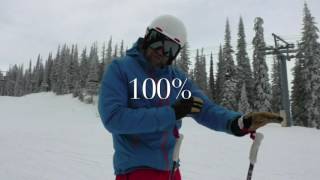
In this on‑slope instructional video Tom Gellie and Luc Neron demonstrate advanced parallel skiing techniques aimed at creating efficient, powerful turns. They emphasize the need for 100 % of the skier’s force to be transferred to the outside (downhill) ski throughout a turn, achieved by fully loading that ski while completely unloading the inside ski. The concept of camber is explained visually—when the ski is unloaded the light between the skis appears, and when pressure is applied the camber disappears. Luc shows how to release the camber of the inside ski on flat terrain to feel the correct weight shift, using the analogy of walking 100 % weight on each foot. They stress aligning the skis directly with the fall line at the end of a turn and switching edges promptly; a delayed, perpendicular position indicates a missed transition. An external cue—feeling light on the inside ski—guides the movement. The video concludes with encouragement to apply these cues on the mountain.
Chapters
Hey, so this is Tom Gellie and Luke Neron here in Sun Peaks, just having a great day, hanging out, skiing together, sharing some ideas. That's what it's about, to travel across the world and ski with some of the great skiers around here. So we're just going to put together a little video of just some tips from myself and tips from Luke, some things we're working on and see as important. I hope you guys enjoy it.
Thank you, guys.
Thank you.
So today I just working with, with Tom to share some idea about the advanced parallel ski. And then my concept on my mind, it's I want to be efficient turn to turn, to be powerful, like to linking the turn. But the thing is, if I want a better power, I want to establish a really good structure on my outside foot, and I want to make sure I have 100% power on one foot to the other.
Okay.
And that's my thinking. Yes, I have some concept on the flat terrain to feel what is the 100% power.
Yep.
And the thing is, it's like, you know, I want to make sure we have a perfect alignment And then I want to ski only one foot, and then the inside foot, it's a bit off the snow. Yep, with off camber. So guys, I want to make sure you have a good understanding about the camber. What is the camber? And then if you're able to see the light between my ski, and then this is the camber. But you know, when we had the pressure on the ski and then we don't have the light between the ski. And then I want to feel off camber, it's like this, this kind of happened on the ski.
Yep, unloading.
Okay, unloading. Exactly. When I'm releasing the camber, I'm just releasing this kind of pressure on the inside ski. Perfect. To be sure I finish 100% structure with my down hill foot.
Okay, perfect.
Oh, uh, you guys, you're probably able to see me on this kind of video shooting to, uh, to, you know, I'm releasing the camber of the inside ski, but on the inside ski. But the thing is, I need to releasing this kind of camber from the ski all the way through to the next turn. Okay, because if I'm doing a bit like, uh, less releasing. I'm not on 100% on my outside ski.
Yep.
And then I want to make sure I have a 100% structure of my outside ski.
Why, why is it you want 100% on the outside?
The thing is, when we, uh, it's like exactly the same when we walk. And then I want to make sure you guys, you have a good understanding, because when we walk, we don't walk like, uh only 50% on the foot to foot. We walk 100% foot to foot. So guys, I want to make sure you able to see what kind of movement I did, and then I exaggerate a bit on my run. Like, uh, with— you're able to see my inside ski lift. Yeah, a bit more of the snow. So with my experience with this concept, we need to be sure how we're releasing this fresh— this kind of concept to move foot to foot. And then I want to show you, the thing is it's really simple. When your ski arrives directly in the fall line You need to change for the next foot. And then how to do that? And then I just make sure my ski is finished directly parallel with the fall line.
Okay.
And then I want to switch for the next foot.
Okay.
Okay. And don't wait too much. If you finish like your ski perpendicular with the fall line The indication you're too late.
Okay. What a warmer than his head so cool. But that type I knew what to do when you have proved to be a real human being and a real hero.
So just use this concept for your external cue. Like, when I'm saying external cue, it's that you need to feel light on your inside ski, and then use this kind of a flat terrain to make sure you're able to apply correctly the, the, the correct movement. And then after that, just work with. And then, uh, so enjoy these tips, and then thank you to my tip.
Awesome, thanks, Luke.
Yeah, thank you.
So the only thing left to do now is put into your skiing and let it rip.