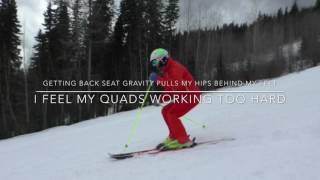
In this instructional segment Tom Gellie explains how skiers can use the hip joint as a low‑centered hinge, letting gravity pull the torso forward to stay balanced and improve turn dynamics. He describes the anatomical rationale, demonstrates a pole‑placement drill for hip‑awareness, discusses how individual body proportions affect stance, and outlines three sensory cues that indicate successful hip‑driven turning: stronger edge hold, easier ski return, and a clear hinge feel. He also stresses the importance of off‑snow (dry‑land) practice to develop hip‑hinge awareness. Interspersed is a brief, unrelated monologue from a second speaker about personal struggles with hypersensitivity, ADD, and medication, which does not pertain to the ski instruction.
Chapters
Alright, so something I thought I'd share with everyone is just this idea in your stance of using gravity to help, to help you stay forward, stay balanced, and bend at the right spot in skiing. The spot we're going to pick on today, or work on today, is just the hip joint. I'm looking at whether or not through the turn as I'm skiing, whether or not I can maintain a relaxed and effortless bend here, or if I'm bending against gravity and pulling myself into this position as opposed to letting myself fall into this position. That's good, but I have a question for you, Tom. If I'm using this, so what is, uh, what is my benefit? It's a good question, Luke, good question. So, uh, the benefits are, well, one, uh, the hip joint, uh, is, is a ball and socket joint. So where your femur comes into your pelvis, round, very flexible and movable. It's designed for a lot of movement. Okay, if we take just an inch or even centimeters above that hip joint, which is actually a good point. You should be able to feel it here. It's right at the level of where your pockets are, and it's a bony kind of protrusion. I'm not talking about bending at the hips here where you have your trousers. It's lower. It's at this point. So it's a ball and socket joint, much easier to move from. As opposed to bending at these bony points, which is bending my spine, which hasn't got as much articulation, tends to be one of the spots people end up with pain around the world. So let's try and keep that a little more stable and quiet and move from the hips. Luke's just going to ski alongside me filming, and I'm going to demonstrate the position from side on of letting the bend occur at my hip joint, which remember is quite low. It's not here, which is my back. It's quite low. So you should be looking for this angle. And as a feeling, I'm gonna feel that my hip flexors are relaxed. If I'm back and letting the hip bend, I'm gonna feel my hip flexors turn on, 'cause they're holding me, 'cause gravity is actually pulling my body down. As opposed to just letting it come forward. That's what you're going to be looking for. Ready?
Yeah. 'Cause of being where you are, right? I was a bright child, wide-eyed. My mind was open, highly motivated to succeed, quite devoted. But eventually I noticed every time I tried to focus down, my mind was kind of broken. So we saw the diagnosis: I had hypersensitivity, ADD, I'm fidgety. Basically, they want to medicate me till it fixes me, man. I don't really think this is the thing for me. I know I'm kind of shitty, but I'm just trying to live in peace. You want to make me to a zombie 'cause you're lazy and it's easier on you to say sorry. You're crazy, man. And if you don't take this, you're gonna fail exams.
Wait a year, your fate is So, a simple exercise to get some awareness of, for one, bending at the hip joints in this, in this forward plane, is just to put your ski pole or ski poles across that joint. Okay, so I should feel that the bony part of my pelvis is above the pole and that my femur is underneath and it's kind of going right across with my hip flexors are. So I'm going to put the poles there for awareness, and then I'm just going to ski and try and let gravity get my upper body in front of that bend rather than behind. So taking the feelings and the awareness we've gotten from the exercise of letting gravity bend us at the hip joints, I'm going to focus now in my freeskiing down here in a medium-short-medium radius turn of the middle and the end of the turn being where I really focus on keeping my torso in front enough so that gravity pulls it forward and creates a bend here. So we're just focusing on middle to end of the turn on both sides, feeling that sensation. So look for that from the bottom. I had a good discussion just on the chairlift up, just about different, different body shapes and lengths of different limbs. So him and I are not too far different in height, but yet We measured the length of our lower leg compared to each other, and Luke's lower leg is like that much longer than mine. And then his pelvis, the top of his pelvis, sits a good that far higher than mine. But yet our shoulders even out. So it just says my torso is quite long in comparison to my lower body, and Luke's legs are actually quite long, and his torso torso is shorter. So everyone is going to be different, and so that's why we all have different kind of pictures and stance. So some people may look like they're really flexed and low because for their limb lengths that puts them in a balanced position. Other people might look more upright. So take the information we give you, but of course remember that everyone's body is different. So yeah, all right. Putting that more into my free skiing, going a little bit quicker, the feelings I personally look for to know I'm kind of in the right spot and I'm getting a good result from using the hip joint and using gravity to help me stay balanced and forward, one is the ski reacts much more powerfully against the snow, the edges hold. Two, the ski comes back underneath me far more easily because being behind gravity pulling behind, the skis will shoot ahead, they won't come back under me and give me a nice transition. And then third is just an awareness of feeling this hinge point here, so yeah, and that comes from dryland stuff in the gym where I focus on in the mirror how that feels, because a lot of people out there kind of get a little bit lazy and end up bending a lot more through their spine, so they lose awareness of bending at this hip joint. So I personally know what that feels like, so you may need to spend some time off snow getting back in touch with this hinge point at your hips. So they're the 3 things I'm feeling for to know that I'm doing it right.
My mind was kind of bigger, so we saw the diagnosis. I had hypersensitivity, ADD, I'm fidgety. Basically, they want to medicate me till it fixes me, man. I didn't really think this is the thing for me. I know I'm kind of shitty, but I'm just trying to live in peace. You want to make me to a zombie because you're lazy and it's easier on you to say sorry. You're crazy, man. And if you don't take this, you ain't gonna fail exams. Wait a year, your fate is that of a vacant chair. But this ain't making sense. I gotta take a stand. They say I couldn't live without it. Well, I say I can, cause I never took those poison pills and I failed school bad with my