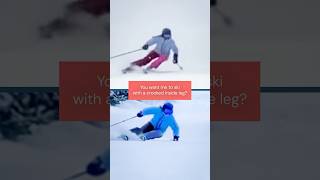
In this podcast excerpt, Tom Gellie and a skier discuss the challenges of skiing after a knee injury, focusing on the tendency for the inside leg to appear crooked during turns. The conversation highlights how a World‑Cup racer’s hip sits lower and more inside the turn than the knee, and how the skier’s wide stance and unstable hips contributed to a misaligned inside leg. The skier describes visualizing the femur and tibia from a bird’s‑eye view, realizing the leg’s crooked appearance, and learning to shift the hip inward rather than forcing the knee outward. Key biomechanical concepts such as the Q‑angle, hip positioning, stance width, and body “boxiness” are explored, leading to a breakthrough in awareness and improved turn stability.
Chapters
You want me to ski with a crooked inside leg? And he went, yes.
If we look at any good, like, you look at a World Cup ski racer, snapshot, bam, going around a gate. If their hip is on the snow, their hip is lower and further to the inside of the turn than the knee.
I blew my knee. I got the surgery done. My physios were always saying, make sure you're not going to let the knee roll into the middle.
Like the knee, in vertical, is collapsing inwards.
I was literally like looking at the videos just going, oh my God, what am I What is going on here? You could see my knee, you could see my inside knee. My stance had separated really far apart.
So wide feet, wider than my hips.
I'm a pretty narrow person. I looked really boxy from like the knees down and my hips were not stable. So I said to Tom, and I said, is it like you want me to ski with a crooked inside leg? And he went, yes. You want to, because from the bird's eye view, looking down at, you know, where you can see your femur and your tibia, it looks like it's crooked. Everything just sort of fell back into place and it was awesome. And, but I'd never had that awareness over that.
When you bend the leg and it's, uh, over here, you can see it looks crooked. The knee is still hinging straight, but because the more it bends, the Q angle from this point gives that cheeky bum cheek. Look inside turn.
Really focus less on moving this inside knee out of the way. This is my outside ski. I started instead trying to allow my hip to nudge inside the turn, past this leg here, past this knee point. And then what I mean by the crooked leg, when you can see my eyes, if I look down at my inside leg here, it looks crooked.
No, the tibias are pretty much parallel there. From your hip joints down to your ankle joints is not a straight line. It has this quadriceps angle. So you can actually still have parallel shins. But if you go up and you look at a skier at the thigh level, there's this V shape.