Skiers Hip Mobility Workout | Follow Along
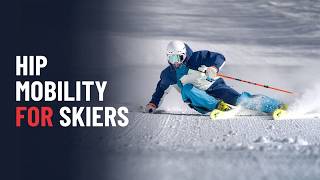
In this 5‑minute follow‑along video, Tom Gellie guides skiers through a hip‑focused mobility routine designed to improve lateral and rotational range of motion essential for on‑snow performance. The session requires no equipment and begins with a dynamic oval hip warm‑up, progresses through single‑leg abduction, adduction leg sweeps, cross‑body hip reaches, an in‑rigger style long‑leg/short‑leg drill, hamstring/low‑back extensions, a Foundation Training core press, wall‑supported hip shifts, a figure‑8 knee‑lead drill, low‑impact skier hops, and finishes with hip‑drop/hip‑shift exercises that emphasize glute‑medius activation and angulation awareness. Throughout, Tom offers cues on athletic stance, body alignment, breathing, and safe progression, emphasizing that the goal is to warm up and increase functional range rather than achieve gymnastics‑level flexibility. He ties each movement to specific skiing mechanics—edge angles, balance, and turn initiation—and encourages regular practice. The video concludes with a call to explore additional 5‑minute and 30‑minute workouts, carving lessons, and a free trial on the Big Picture Skiing website.
Chapters
Hey skiers, I have a simple hip mobility routine you can follow along and do before a day of skiing, or over the season to get your hips ready for skiing. And I've focused on the hips because I think this is one of the most important areas, and specifically lateral and rotational mobility. A lot of the time you're in the gym doing stuff very much straight on, skiing there's a lot of rotations, a lot of lateral stuff, so we're going to help open up your hips for that. Let's get started. So No gear required, so if you're watching, you can sit there and watch this, or you can take your shoes and socks off and get up and follow along with me. So first thing is just warm up your hips laterally. So put your hands here just for a little bit of added awareness of where we're trying to move, because our goal is to really mobilize these joints which are right in here. I want you to make sure you've got a little bit of flex in the way you stand. So standing upright, it's going to feel tighter and harder to move. As soon as you assume an athletic stance, it's going to get easier. I just want you to now warm up with a little bit of a kind of an oval shape. So you're going out, forwards, back, and across. Reverse the direction you're going, staying in a lower athletic position. Okay, now I'm going to get into single leg abduction or sideways movements, and notice my body stays still here. There's time in your skiing if you say catch air off a bump or you rebound out of a turn where you want to move your legs more than you move your body and center of mass. 12, other side, 1, 2, so as we're working here you can assume like a very similar ski position, so an athletic stance even simulating poles, and just see what range you've got before you need to kind of bend and change the angle of your upper body, and if you're only here that's fine, just work within your range, we don't need to push it, we just want to warm it up. Okay, now the adduction, leg sweeps this way, just a few to get us warmed up. Athletic stance. This one, it kind of feels like I'm kicking a soccer ball sideways, and I get the benefit of some hip flexor work and these adductors, inner thigh muscles. The side, I'm going to pretend I've got ski poles, feel the stable upper body and mobility in the legs. Okay, now we're going to get a little bit different. We're going to move the hips, keeping the feet still. You're just going to mirror me. Don't worry about right or left, mirror me. So you're going to step across, back behind this leg, and you're going to kind of sink down and see how far you can reach this free foot across without sort of falling over. And you should really feel that work the side of your hip muscles here. Really important to get them to open up and lengthen, otherwise you're going to have to borrow too much movement for your lateral balance from your spine instead of your hips. 2 more, 1, 2. Okay, the other side. So notice, as the more you reach across, the the more you have to kind of bend down, sorry, to reach further across. If I stay upright, it's as far as I get. If I bend, I can change the angles a lot more. I'm kind of aiming to get my leg like 90 degrees across, so you should be able to see that here as opposed to back. This gives me a bit of twisting rotation load up here as well. One more, okay, now in front of the body, so sink down, this should change it to feeling a little more on the front of this hip. So remember, just mirror me, even bring in our ski pole position, this would mimic sort of motions of the hips for creating edge angles later in the turn, where the feet are more planted and carving, the hips drop down and in for more angle. Other side, great for your balance too. So if you really want to challenge this, basically only touch the ground very lightly with your toes and see how far you can reach that foot. Can you beat where you were before? One more, We've worked this portion of our hips to loosen it up, and even if you try now, you should feel that's already smoother and easier to move. We're going to work the inner legs now. Assume a wide stance, mimic me, you're going to keep one leg long, one leg bent. This is like an in-rigger exercise, and I've got a video on YouTube about the in-rigger exercise where you practice it at slower speeds like this to mimic the motions of higher edge angle turns, but you get to do it at slower speeds on easier runs, so we're going to warm up those same muscles. So long leg, short leg, and to help load up these muscles a little more, we're just going to reach and touch the ground in front of us. So I could think like long leg, short leg, ski turn, It's very hard to get ski-specific exercises because skiing is sliding, it's dynamic, totally different, but we can definitely warm up our body and be far more ready for skiing. If you're not feeling this in here, a couple of things, allow your hips, hip to shove back and keep your back straighter as opposed to rounding, okay, that's one of the main things, and second is really grab the ground with both your feet. Other side. The width you choose is up to you, narrower if you haven't got as much mobility, a little wider if you've got more, but I really want to encourage you, this is not about trying to become a gymnast and be flexible and do the splits, it's just finding your range and warming up the muscles. So don't worry about pushing it, you don't want to cause an injury, you just want to wake everything up and feel it for the day. One more. This time we're going to mix it up, you know, this way, and you're actually going to reach back towards your extended leg. You don't want to ski this way, but this is awesome for your hamstrings, which helps your knees feel better, and your hips and lower back. Bending one leg, straightening another, and we're just touching, reaching towards this straight leg. As I do, the more I do that, I feel that in the back of my hamstring here. 1, 2, last one, 3. Cool! Important for hip mobility and freedom is also a good strong core, and strong core really relates to everything around here, the whole trunk region. Eric Goodman, founder of Foundation Training, we're going to do his classic exercise, the founder, awesome one, I love it. Follow along here, a little bit wider than hip width. I want you to shove your hips back, bend, bend your knees and hips, and have your knees behind your toes as much as you can. Then you're going to bring your arms out straight in front like this. This is the position I want to highlight. If you're not feeling this in your hamstrings or your lower back, you're doing it wrong, and you might be having the knees too far forward, so bring them right back. You might be standing upright and not feeling it, get really low, almost like you're trying to get rain to fall on your back as opposed to on your shoulders. Lift the thumbs up, really engage your back muscles, you should feel this really works all the back muscles here, it should feel like really hard work, it's good for them, a lot of the time you're down here in skiing you need strong back muscles as well as a strong core. Bend the knees a bit more, shove the hips back further, reach the hands further forward, like you're trying to send them in different directions. Let go, awesome. Now we're going to do a wall hip shift. So like we're working on here, we're going to add a little bit more of the side of the core in by leaning against something. So lean against the wall, the further away the harder. I'm going to stand on my pretend outside foot, and I'm going to try and move my hips down and across. This is Teddy, by the way. The thing you don't want to do is, it's not a side bend of your spine, it's not this. Put your hands on your pelvis and it's just below this line, a couple of inches below this line, that's the angle, the point you're trying to create an angle from right here. Again, we're not trying to go for maximum flexibility. Here's a straight line, fully inclined, a little bit angulated. Should feel some inner thigh muscle work, the foot work hard, and the side of your core. 2 more, 1, notice this leg is lifted up and shortened, 2, done, other side. So find, play around with the distance you need, I'm going to go a little wider this time to challenge myself a little further, Hand here, looking up, I'm trying to feel my hip joint is where the angle changes, not my spine. That means as I get across here, you can even hold it, you should feel your core engages to, to keep this all strong, and then you can make these subtle changes with your outside hip joint. 1, I've got 3 more, 2, hold, 3, hold, let go, awesome. Inside leg, create some angle. Now this one is different, we're not trying to go as close as we can to the wall, this makes me feel like I have to bend my spine. I'm going to feel like I shift across and drop down, so almost like a single leg squat, with a little shift. There's an outside longer leg and an inside shorter leg, and the more we move across, the more that inside leg should flex. Oh, there we go. So that should work the hip and those knee muscles, quads. So inside leg, feel the pivot point at your hip joint, like stick a finger there, feel that's where the majority of the motion is coming from. Sit here for a moment, you can even extend your outside leg, noticing that there's this big difference in leg lengths as opposed to being the same length in a turn. It's a shorter and longer leg, the more edge angle we create. There's also not just moving sideways, there's moving down. Just focus on a few more, across and down. Last one, hold it, come back up. Awesome! We're going to work on the front of the core now with just a classic gymnastics dish move. So you've got a couple of versions, if this is hard you can just lift your, lift the legs, keep your head down, You can also just lift the torso, just trying to feel a contraction here.
We're going to hold it, or you can do both.
Let's go.
I'm going to hold this for 30 seconds if we can, and if you can't hold for 30, just take one of the things down, even just one leg, and swap it.
Core is hard, but you just have to start somewhere.
Just start and you'll get better. Here's a more advanced version. All right, let's do another 10 seconds. Come on, it's worth it for all those great ski turns we're going to benefit from. Okay, 3, 2, 1, relax.
Take a little breather, maybe grab your knee. Okay, one more.
If you can really feel your ribs pulling down to your pelvis and your pelvis pulling towards your ribs and your belly button sucking in, you'll get a really good contraction. Remember, if it's really hard, just have a microsecond break. Go again. We'll put one leg down. All right, 5 seconds more. 3, 2, 1, nice job.
Okay, into some figure 8 movements. So just follow along, just mirror the leg I'm doing right here. Now the first thing I'm going to do is think about drawing a figure of 8 viewed from above, a bird's-eye view. So my toes are going to trace kind of behind me, out, across, behind me, out. There. Now I'm going to think about my knee joint tracing the figure of 8. So I'm going to tuck my foot under, knee joint leads the way, Back now to foot leads the way. When I use the foot, my knee joint kind of opens up. When I think about going back to the knee, follow me here, just the knee, I feel like I stay contracted. Times in a short turn, you're going to be low, this is going to happen without the extension. Okay, other leg, give that a second, balance, If balance on one leg is hard, just put a finger on the wall. We're going to go with foot first, that's right, tracing a big wide figure of 8. At this point, I don't want you to worry that your body is turning with your leg. I just want you to try and get the broadest range possible. Now to the knee. When I think about the knee joint, it really works my hips. I'm kind of thinking about turning only the femur. I'm keeping the lower leg and foot still and contracted. A couple more. Second round here, going back to this one, I want you to put your hands on your hips and just be aware of the range you have in external, internal, abduction, adduction, all these words. What's the range you've got in your hips before here you have to turn somewhere else. So I'm only going to use the range I've got. So awareness and control of just turning your legs and keeping this stable. Swap to the other side, hands on your hips, giving you some idea of keeping that still. See if you can explore that range. Be aware of the hand on the hip that's on the side, same side as the leg moving. See if you can notice that stays really still. And then now notice if we go for broader range, it moves. So one more just to contrast it, bigger range. There's a certain point where you need to let the whole body follow Okay, we don't need tons of separation in skiing. We need to be able to separate a little so we can stay more balanced and maneuver through terrain faster with the legs. It's very slow moving in the upper body, but even if the lower body leads the way, it's okay at times when you run out of range to let the rest of the body follow. You don't want to like force a joint really beyond its range with a lot of load on it. So finding our own range is the point of that one. Okay, we're gonna do some skier hops, get a little sort of dynamic here. So we're going to go side to side, and with this one, I want you to imagine you're staying under a ceiling. So when you hop, you're not trying to jump up and extend really long, trying to stay low and nimble. 15, 16, 17, 19, 20. Keep your hands and core engaged and still as well. Front to back, 20. 3, 4, 5, 6. Staying low, really staying on the balls of your feet. Don't let the heels touch the ground. Done. One more, 10 side to side. See if you can go a little further in your movement, so jumping wider. Really springy, staying in athletic stance. 2 more. Awesome. Okay. Almost done here with our hip focus mobility workout for skiing. Just to work here, I'm going to finish with a couple of hip drops. Okay, so find something elevated just slightly, ever so slightly. Keep your hips level, athletic stance, and see if you can bring one foot down to the ground, not by bending your knee, but by shifting into the side of your hip. Okay, so just do both. So drop the legs down by bending your knee and maybe straightening one. Okay, that's one way, works your quads. The other way, athletic stance, feet level, and you hip shift, sitting into the glute medius muscles. It's a really important position to get into skiing Notice you don't need— it doesn't create a ton of angulation, but this much here is what I really use in a lot of my turns. 2 more. Great. So we really should have worked out all around the side here today. Other side. Okay. So trying to bring the foot to the ground, the one that's in the air, through a hip shift, lateral change, as opposed to bending in the knee. This is not wrong, this is not just right, you just need to make sure you can differentiate the two. So hip shift to lower, creating this angulated position, knee bend. To lower. Okay, hip shift, knee bend, hip shift, knee bend. The change is either at the hip or more at the knee to result in the angle change in this foot getting lower, but the difference is one, no angulation is created, one, angulation is created. Awesome, alright, there's your hip mobility workout. Remember, use that before a ski day, use that during the season to stay mobile and strong. Keep doing at it, and I guarantee in a couple of weeks you will notice your hip range increase, and more importantly, your ski enjoyment really level up. One of my students from the Big Picture site did some workouts on there and said he usually warms up with a cup of coffee, but doing this little 5-minute routine I have on my website, he was like, way better, skiing was much easier, straight into better positions right from the get-go. I hope you enjoyed that workout, there are actually plenty more videos on strength and mobility covering everything from head to toe on the Big Picture Skiing website. I have 30-minute workouts as well as 5-minute workouts, so something there for everyone, just to get you started. That's the message here, just do something, your body and your skiing really, really thank you for it. So as well as that, there are tutorials, lessons on carving, short turns, intermediate, advanced moguls, everything I know and have learned about the body in skiing, I try and pass on to you through the Big Picture Skiing website. I look forward to you checking that out, there's a 7-day free trial, otherwise enjoy my videos on YouTube, please subscribe and follow along for more great content, and really have a great winter, look after your body, and maybe I'll see you out on the slopes someday. See ya!
More from Tom



Most skiers overlook how they use their poles. Try these five pointers next time you’re skiing.







