Skiers meet a new perspective on arch support and insoles - Adarian Barr and rethinking feet
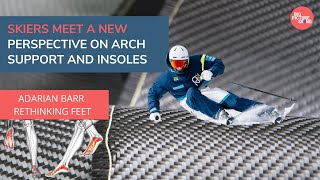
In this Big Picture Skiing podcast episode, host Tom Gellie interviews movement specialist Adarian (Aidarian) Barr about his carbon‑fiber insoles, foot biomechanics, and the broader principles that shape skiing performance. Barr explains why his insoles prioritize hardness over stiffness, how carbon fiber transmits pressure without spreading it, and how this creates a more responsive edge feel. The conversation expands to the anatomy of the foot—especially the arch and metatarsal region—arguing that traditional arch support often removes essential pressure and that a "flat" insole can still provide arch function by allowing the foot to flex naturally. Barr emphasizes the role of levers, rotation (pitch, yaw, roll), and the windlass mechanism in generating force, and he links these concepts to tibial alignment, pronation (which he calls "rolled‑in"), and the distinction between toe‑driven versus hip‑driven skiing. He also discusses the importance of balance, reflexes, and self‑exploration, encouraging skiers to be curious, test their movement, and use simple cues rather than complex formulas. The episode ends with mentions of Barr’s book Let Me Introduce You: Tales of Leverage 3‑Summit Movement, upcoming clinics, and where listeners can find his insoles and online resources.
Chapters
Hello and welcome to the latest episode of the Big Picture Skiing podcast. Today's episode features a guy named Aidarian Barr, and to be honest with you, I'm kind of struggling on how to introduce who this guy is, or really the, the big impact he has had on my life, my understanding of skiing, and the way I view movement and just tackling concepts in general. So, I mean, you could call Edarian an inventor, you could call him an athlete, you could call him a teacher, a mentor. He's many things, but I really enjoy the way Edarian makes me think about things in general. Now, today we narrow down the topic to footbeds, feet, how the body works and some of the concepts that Idarian teaches in his movement classes, in his new book that he recently wrote with Jen Pilati. Now, you'll find more about this in the episode, and I apologize at times for some dog barking. Idarian's dogs were really hungry, and at times they, you know, expressed that. But please look past that. The information is really fascinating, and if you are a curious person, a curious mind, you love you're skiing, you love movement, then I think you're going to learn some really important things in here. Edarian helped me really understand some important principles around, around pressure, compression, levers in the body, rotations, and, and gave me a sort of a sharper, keener eye with my analysis, my movement analysis of skiers and what is going on. I definitely credit some, uh, some of my latest sort of ideas and thinking to what Adairn has sort of challenged my thinking with and put forward sort of questions and not given me answers so I discover it for myself, and I'm truly grateful for that. Anyway, open your mind, delete things you knew about for the moment, put them aside, put your beliefs aside, and get ready to hear Adairn talk about carbon in soles, arches of the feet, levers, rotation, and much, much more. This is a fascinating episode. I hope you enjoy it and it opens the door to more questions as well as answers and leads you down a road of, as Adrien sort of puts it, curiosity. Be curious. So with that in mind, let's hear from Adrien Barr in today's Big Picture Skiing podcast. Hey Adrien, I can remember, uh, you Recommending carbon fiber insoles to me quite a few years ago, about 3 years ago. And I ordered a pair from you, they sent them over, and I got to try them first in New Zealand on some really firm snow. And I was skeptical. I wasn't sure what I was going to feel, if I was going to feel anything, because the carbon fiber insole was, was pretty much flat. It was, it was flexible.
Yeah.
But it had, but it had, uh, like a bump. Up sort of in under the forefoot area, in the middle of forefoot.
Yeah.
So I went out and I skied, and I tell you what, I could notice what, what I felt was different was I felt that I had more pressure under the ski edge, so I could direct pressure. I could feel more pressure and sensations coming through the ski and my foot to my body, and it felt easier to just edge my skis. Now, this— today I want to help people understand first about carbon fiber and the way you use this material. So do you want to just discuss maybe the properties of it? And because, because the ones you make are not stiff like a mountain bike shoe.
So the biggest thing, uh, that I had learned about— and I've invested carbon fiber for, man, at least 10, 10, 12 years now Started messing with, 'cause what happened is, I've been making insoles for, since '08, so I've been making insoles for like 15 years. And so, I didn't, you know, as you do things, you learn about more materials and things like that. But one of the first things I made was, I used a wire, 'cause the wire was flexible. You know, and so I was making wires, and then I tried to encase the wire in carbon fiber. And then I said, well, why do I need the wire if I got the carbon fiber? So then the wire— And I'm like, the carbon fiber is good enough, you know. But the whole thing about it was why I was doing that was because I wanted something hard underneath my foot that was really more responsive than the soft stuff underneath there. And the thing with the wire was the wire was thin, so you got a lot of pressure, so the feedback was really good. So, and then once we put the carbon fiber on, we couldn't feel the wires anymore because carbon fiber is hard. And so you couldn't feel the wire. You could feel them, but you couldn't feel them. And so we go, well, I don't need the wires anymore. And so what I started doing was I would make a wire mold and press into the carbon fiber. So I still have the rails and everything, because one of my original goals was I always thought about horseshoes, about why don't we do people's feet like we do horseshoes? Because you can get a horseshoe to make a horse do anything you want it to do— gallop a certain way, march a certain way. I'm thinking like, we should be doing the same thing. So that's when I had the wire, and I would trace the wire into the carbon fiber because it would hold. Once I take the wire away, it would hold up and stuff like that, and I still get the same effect without the wire anymore, you know. And so that was the first part. But the biggest thing was that, was like I said, carbon fiber is hard. And so, uh, a lot of times I'm going to jump in there—
hard, you got it for the hard property, not the stiffness property?
Yeah, you need to stack carbon fiber and carbon fiber. I mean, it's like you see somebody with a prosthetic leg, you know, that's probably like 10 layers of carbon fiber. You need that many layers of carbon fiber, you know, one layer of carbon fiber is not gonna be like that. One layer of carbon fiber is gonna be really flexible, but you need to stack 'em and stack 'em and stack 'em and stack 'em, that's what people are used to, or carbon fiber takes on the properties of something that it's a part of. So if I wrap, if I take a steel pipe and wrap carbon fiber around it, it's really gonna be hard, but it's reinforcing that steel pipe now. Or if I take a piece of cardboard and put it on that, the cardboard won't bend anymore. It just takes on whatever, you know. So I didn't, I don't attach the carbon fiber to anything, I leave it by itself. It's not attached to anything, it's by itself, so it maintains its own property, which means it's hard. And there's some words out there called modulus, which means how much it bends or breaks and all that kind of stuff, but that's not for here. But the biggest thing is, like I said, is people, two things, composite. So let's think about the word composite. And a composite is just that, where you're gonna combine some material. Now carbon fiber, Kevlar are fabrics, they start off as fabrics. And then they add a resin, it's like fiberglass, it's a fabric. And then they add a resin to it to reinforce the fabrics. So that's why they call it a composite, just add something to it. But really Kevlar is a fabric, carbon fiber is a fabric thread and things like that. So what ends up happening once you add the resin, like this here would be Kevlar. And as you know, if you can come for Kevlar up, it's not the same. It's soft, really soft, anything like that. But what does Kevlar do? It absorbs. That's why they make that bulletproof vest. You stack a couple of those things together, it's gonna— if you put a carbon fiber plate in front of you and take a bullet, it's gonna— it ain't gonna be fun, it ain't gonna be, you know. So, so that's the one thing. So, so like both of these, this is Kevlar, this is carbon fiber. Both are composites, but as you know, it's like I said, Kevlar, totally different thing, you know, it's just, it's soft, you know. So you take the, you take the carbon fiber and it becomes, it's hard, but it's still flexible. Not as flexible as this, because if I do this with carbon fiber, it'll break. It has a point to where it can bend so far before it breaks. The threads will actually break. And same thing, if you bend it back and forth, bend it back and forth, bend it back and forth, bend it back and forth, it's just like a thread string too. It's going to break at some point in time. That's just what's going to happen, you know. But what people are used to seeing carbon fiber for is, like you said, on bikes or high-end cars, things like that.
Yes.
And everything, you know, like BMW has— they have a carbon fiber factory, use so much of it. They have their own factory of carbon fiber. They don't have to buy it from anybody. They just making this stuff. But once again, you know, they make those parts because they want to make them light and rigid. That's a different story. I don't want to— I don't want to— I don't want the stiffness, I want the rigidness, I want the lightness, and I want it to be hard.
So now I'm gonna— now I'm gonna help people understand some context here. Uh, you are an athlete, you're an athlete, and so you were going down this road of insoles because you were trying to get more performance from the athletic things you did. You, you loved basketball, but you track and field stuff, and you coach that to a pretty darn high level. And, and let me get this right, how fast was your fastest 100 meters when I was young, back in my prime?
10.3.
Yeah, 10.3.
That was fast. Yeah, yeah, I was fast.
Yeah, you could, you could dunk a basketball.
Yeah, yeah, I, I could, I, I could dunk up until I was 40.
And how tall are you?
58 now, 5'10".
And yeah, okay, so there's some context on, on the kind of person you are. What you're searching for to get more out of your body. So, so you're looking— is that right? You came to carbon fiber and insoles again with the horseshoe thing because you're trying to get more out of your body, make your body work better. So why, why hardness? Why not softness? Why not support to do what you're trying to do?
Well, it's even like, you know, for me it's about fast responses. Fast things respond, the better I can be. That's like, I remember, um, when I used to ski. I used to ski. I wasn't good, but I could, you know, and everything. And then I learned to, you know, snowboard. I'm like, oh, you can go faster. And I could like— I'm like, this is— this is okay. This is it. Because skiing, I was always afraid like I would go over the edge or something like that. So I was— but when I got to snowboard, I'm like, oh, got it, you know. But it was always about speed, going faster. I want to go fast. I always want to go faster, you know. And even like I work on cars, things like that. I want to go faster, you know. I always want to— you have to go fast. That's all I care about is going faster, you know. And so the, the thing with, with softness is how the body works. The body works on pressure. A lot of times people think muscle, but it's really pressure that the body knows very well. It knows how— where your weight at based on where pressure is on the foot, where this is happening, where that's happening. The more pressure it feels, the more you can get, you know, which is the input, the better the output's going to be, or the more output you're going to get from it. But the thing about it is, you know, when you use cushion, cushion makes the surface area spread out too much. You lose pressure. Carbon fiber is hard. It doesn't make the— it doesn't— the pressure doesn't spread out. So that way, you get pressure and it stays hard. It's a fast response. You know, even like on one of the insoles that we actually— like one of the custom ones we make, we put these little, you know, we call pilings in it. And so we really sitting on pressure now. We really, you know, we really sitting on pressure. These areas we want to sit on, that's where the pressure is going to be at. The rest of the area won't have— we'll have very little pressure, and I want input from those areas and things like that, you know. And the thing about it, why this here, because once again, the carbon fiber is going to bite down into— it's going to— whatever, whatever soft material you got it, whether it's plastic, wherever it is, carbon fiber is going to bite down into it and eat it up and settle. And that's what you want, you know, even People talk about plastic. Plastic is pliable still. It's soft still. It melts still. It moves still. So your response is not fast enough because you're waiting for the, the carbon, the, the plastic to deform and then reform and going about your business. So, uh, with carbon fiber, it takes care of that problem. That's, that's for sure.
So on that, that's surprising to me, skiing in New Zealand on that snow with a layer of carbon fiber not directly under my foot, it was under a thin layer, like a little slim insole. I felt more pressure. Yet, mind-blowing, it took me a while to understand this, I thought my boot board and my hard plastic boot, which, you know, I feel is really hard— carbon fiber is like, how much harder is it than that? And then, and then how can we feel like— can, can the human body feel the difference between those hardnesses?
Well, I mean, that's like anything else. What people, you know, I have to mention my book real quick just because there's a section in the book about stress, strain, and deformation. And that's what people don't realize is that the stress, when we say stress, if you just say the word stress, that incorporates any type of force. You don't have to designate a vertical, horizontal, rotational, torsional. Stress is any type of force. And based on the stress, you can get a strain, which is trying to resist that force. That force. Based on the strain, you'll get deformity or movement, however you want to look at it. So, so when you get to plastic, and then the word elastic, it, you know, stretches out and compress. One thing about plastic is that it's going to what they call stretch out. It's going to move even, even steel, but just it does a different way. But it's going to stretch out, and that's what you feel. You feel the plastic stretching out. Under the stress that you just put it under. The strain is that it's going to give some, and so that becomes a thing. Well, carbon fiber, guess what? Doesn't give. And I think what people don't realize is how little movement you need. We're talking about the body can detect, you know, millimeters of movement. It detects it. I mean, that's like you get a grain of pebble underneath your— like a small grain of sand, you feel it. It doesn't If the dirt moves a little bit, you feel it. We're that sensitive to stuff. We have to be to stay upright, you know. Uh, and I think that's, that's, that's the other part, you know. Even, and this is, you know, one of the things that happens is, like I said, once you get on the carbon fiber, you know, let me, let me, I just, I won't even use the hardest one I got. Like I said, this here, you know, like, like if I use this here, like, like this here, this is, this is a couple layers of carbon fiber, and it, like I said, it has a whole different versus like this here, it's like one layer of carbon fiber. It has a hole, but it's still hard. So if I, if I like said, this thing here, see, that's gonna happen no matter what happens. You put it, it's, it's going to do these things here.
So then that was just so people listening that you had a boot board of a ski boot and, and you showed how it was plastic It sort of deforms.
Yeah, so now you put the carbon fiber on it, and even if it deforms, it doesn't matter because you're riding on the carbon fiber now. See, that's what you— so, so this here will move away from your foot. This here stays in contact with your foot. That's, that's the difference. So, and then as you press on it, like I said, the boot, the, the board, it could bend. But see what happens? The carbon fiber now says, okay, we got this. Without the carbon fiber it bends to— see, it becomes too soft again, and then you get all— you get the waviness of it. You don't want that. Carbon fiber says, ah, we got this now. If I put something even a little bit, you know, just a little bit hard on it, you know, all of a sudden this will just flex because the carbon fiber is now in control of it. It's in control, you know. So, so I think that's what, you know, when you say— when we talk about hardness It's just a matter of now all of a sudden the carbon fiber is controlling these, these flex points, uh, that the plastic has no control over because it just can't really take the stress. Strength too much for it and it's going to deform too much. Yeah, and like they don't have to move just a millimeter. If it moves a millimeter, you're gonna know it. You're gonna know.
So then that probably comes into, you know, that you're not making a supportive insole out of this. And so can you speak to like the arches of the feet? Yeah, so yeah, that area, because as we were talking about quickly before the show, that in the ski industry it is pretty well known that most people think you need a supportive footbed and you need one, and, and if you have one, you're going to ski with better performance and it's going to help the body work better.
Yeah, yeah.
So coming from that, that point of view, what, what's some thoughts you have?
Well, one of the things that, that, you know, underneath the arch of the foot is probably the most sensitive area in the body. It doesn't like anything underneath it, not, not anything underneath it. So even though this is flat, guess what's going to become? Arch support, because it's going to flex up into it. It's going to, it's going to, it's good. Even though this is flat, it's going to become arch support because you're going to flex up into that. System. It's funny how people say I got something, but no, that's sport.
So now if you take it similar to like, like if you stood on, uh, like soft spongy ground, right, it's going to form to what—
yeah, it's going to form. Okay. Yeah, yeah, yeah. And so even if you— so then you take that and then you say you take— and like I said, this is going to move. And then you take that and you put cushion on top of it. Well, the cushion is definitely in the arch now. And so basically at this point in time, you basically lift your foot off the ground. So you're not in full contact with the ground anymore to do things that you need to, because now you got pressure, you know, in one area really, you know, in this little circular areas where the pressure's at. And where I needed that, toes, where I needed, maybe need on the heels, where I may need it at on the fifth metatarsal, I don't have pressure anymore. Basically just height, basically just putting the jack underneath your foot and jacking it up off the ground, you know. So that becomes what, what's happening, you know, even when you have cushion. People try to make it so The more forming the insole is, the more you're really just jacking your foot up, you know, uh, and so you don't want that. You really want nothing underneath, you know, and I don't know if, you know, like say on this one here, even on these two, if you, you know, on the three that I pulled out, you know, I don't think people will notice this here, but, you know, we cleared out that area, you know, we're clearing out Yeah, he's showing an insole where he's basically—
where the arch would be, there's nothing.
Nothing. You don't want anything. Like I said, you only need a millimeter of movement, and so anything underneath there is going to interfere with the foot because it's a sensitive area. It's going to interfere with it, you know. And so then people will start doing funny things, like they will actually start to avoid it. They will actually start cupping their foot just to— uh-huh. And they'll— you start doing some things just to like, oh, that's not And why don't we need—
why don't we need arch support? Why, like, why do you think there's this whole, like, we gotta support the arch? Like, that's, that's a thing.
It's a thing, you know. Uh, you know, if you look at nature, two, two things in nature, you know, triangles are pretty strong and arches are pretty strong, but they work differently. They work differently. So if I get a triangle and this way I work, you know, stress-strain deformation coming at, you know, compression and tension and things like that. So if I get a triangle and I press down the top, the sides will go ahead and flex. They can go ahead and flex. And then so, but the bottom is going to stretch out. So the sides will compress, the bottom will lengthen, stretch out.
Yep.
So because of the flex. So see how that works with a triangle, you push down the top I get compression and I get extension, or whatever, tension's the best word for it, 'cause tension means it's gonna stretch out. So I get compression and tension, that is just how triangles work. With an arch, you don't want the bottom, the endpoints, to lengthen out, you don't want tension there. So when I get compression on an arch, I want the endpoints to come closer together. If the endpoints come closer together, arch holds shape. And so like people talk about flat-footed people versus, you know, somebody with a higher arch. The difference is this here. The load pushing out horizontally, the lower the arch, the greater the load is that push out. The higher the arch, the less the load pushes out. That's the difference between flat-footed people and— they have a greater load pushing out, so their windlass mechanism has to really work to make sure those endpoints don't go away from each other. Somebody with a high arch and windlass mechanism doesn't have to work as hard because the vertical or the horizontal thrust going out is not as heavy or not as strong as somebody with a high arch. It's just that simple, you know. So, so, and people, like I said, people don't understand like the windlass mechanism, how once your toe flexes, it doesn't matter whether I flex my toe up or where my heel lifts off the ground until windlass mechanism position. Once that happens, it's already pulling the heel. It doesn't pull, it doesn't pull the, the ball of the foot towards the heel, it pulls the heel towards the ball of the foot. It just made the endpoints closer. So because the endpoints are closer now, that arch is, it's stronger now, it's going to handle better compressive load now. So I think that's what people miss out on. They don't understand. Now I'm going to put some underneath. So, so think about this here. I may put some underneath me that's now interfering with that and may tighten it up too soon. So now, because all I gotta do is push up on it, it's gonna pull the heel. You push up on it, it's gonna pull the heel. So now I'm having the heel pulled in, but I don't need it. So now I have another problem. I'm getting something I don't— I'm getting something I don't want, you know, because pushing up is going to pull that in. I don't want that to be pulled in right now. I don't need it right now, you know. Like I said, if you're standing around not doing anything, you don't need an arch. But as soon as you move—
and we don't need necessarily— like, think about skiing, where I'm not rolling onto my big toe, like rolling through running or whatever, right? I don't necessarily need the windlass mechanism. The arches can still work without—
yeah, yeah, they still— yeah, because, you know, they work. Yes, they're gonna work. They work. They, they still going to work, you know. Uh, one of the things, because even this here, you know, let me, let me bring in my little gadgets and everything. I don't think I brought the rubber— yeah, I brought the rubber band. But one of the things that people forget too is this here. Part of the arch structure is the bone is already curved into an arch. That bone's never going to flatten out. Never, never is that bone going to flatten out. You have these series of joints here, you know. So I have this, I have this fifth metatarsal. Let me go to first metatarsal. I won't talk about— I'm just talking about the first one. I got the first metatarsal is already formed in this shape. It's not going to flatten out the bone unless it breaks, and that's— you don't want that to happen. And then I have this joint right here, and then I have this joint in front of it, then I have this, this toe with a joint, and, and so forth and so forth. So, so for the majority of the arch, it's already formed. It's never ever gonna— so when people talk about, you know, uh, a flat foot, it's not that it's flat. This bone may not be as highly structured, and so this bone may be a little bit lower, you know. And so it goes a bit lower, then the rest of it may be a little bit lower. And so now the end points, you know, like I said, because now all of a sudden the, the other connection is going to press out and stuff like that. So I need the windlass mechanism to help me out. But for the most part, you know, if you look at the structure of the foot— and that's the thing is, like, when people show an anatomical foot, they normally show about the structures, about the soft tissue, about the connecting tissue. They just show bones, and then they press the bones all over and make it look at that. No, that's what happened. Like, that you got, you got connecting tissue to hold all these things. No, it doesn't. And they say, we got 33 joints, you know, because you got 33 joints, you're supposed to be, you know— okay, let's look at this here. Take your fibula. It's a joint, right? It's connected to the tibia, right? Is anybody saying that thing's supposed to be flexible? You got 3 joints in your head. Anybody say no, it's supposed to be flexible? So see what I'm saying? It doesn't hold— just because you have a joint don't mean it's supposed to be flexible. It's a connection. It's just a connecting point, you know? And so, and so that's what people get into. We got these dysflex— no, no, no, no, because I got all these things that are tying it together. I got all these little You know, and then they say, you know, people say it's a spring, you know, and then you go, okay, let's call it a spring, let's just say it's a spring, let's go with that. Then I actually ask them, what's the spring rate? They go, what do you mean? I said, well, a spring has a spring rate, which means, you know, 100 pounds per inch, which means 100 pounds can compress an inch, another 100 pounds can compress another inch, another 100 pounds, it'd be 3 inches now, so 300 pounds, what are we working with? What are we working with? How much do I need to put on this before it compresses? And how much, you know, so you get into these things. But, but for the most part, really on a simple level, the arch supports you. That's it. It supports you, it supports your movement, supports body weight, anything about it. It can support you in many ways. The arch still needs to hold up when you're, when your heel's off the ground and you're rolling over towards it. That arch still is supporting you. When it's all— it, it, it can support you in all these ways that you want to support you. Just support the weight, that's, that's all, you know. But we don't make it much more than what it should have been in the first place. It's just—
what are your thoughts then on people that, you know, someone walks in and they— and their feet, you know, they would be classically termed by the podiatrist as pronated.
So I don't even use that word.
Yeah, I know you don't use that word, but you know that— that rolled in, people listening who understand, it's like, oh yeah, I have that foot, that's why I have a footbed that pushes me out of that position. Can you speak to that? And can— do those people need footbed, a supported footbed, or are there other things they can do? They just haven't realized the input they're putting in their foot is perhaps creating that.
Yeah, so, so for me, you know, one of the things people need to look at is, you know, uh, look at the— look at their bone structure. You know, look at your bone structure and, you know, is your tibia straight? Is it curved? Which way is it curving? Because the way it's set, it may push the foot out, it may push the foot in, it may, you know, and some people— and then, you know, one of the things I think they did a disservice to in the research when they started doing Q angles for women, you know, but they didn't look at the tibia to see how it's affecting the Q angles, see how it's maybe setting the hips in or setting the hips out. They didn't look at it, you know. And then, you know, the other part too is this here. People really have to think rotation. They really have to think everything's about rotation. People say that, but they don't really buy it, you know, because then they, then they do rotational exercises. Well, every exercise is rotational exercise if everything's rotational. You can't, you know, there's— but you really have to think that everything's rotational. And so when you start thinking that, you go, okay, let's, you know, which way— if, if my feet technically— and like I said, I don't call it pronating, but at that point in time, my feet have rolled in? Rolled in, yep. My feet have rolled in. What is my tibia doing? Is my tibia yawing or not yawing? So that's another rotational aspect of it, because people forget one thing about the ankle joint— it allows those two different rotations to happen. The foot wants to roll, the tibia wants to pitch or move back and forth, whatever people want to call it. The ankle allows those two things to happen without interfering with each other. That's what a joint does— it allows movement to happen without interfering with this other thing. And so if you get into that there, you know, and then you put on the ski boots, now you're in the ski boots, which is basically locked in what? Your ankle. Ankle's basically locked in. There's not much movement coming anymore. So at that point in time, what else is locked in? It's basically locked in your foot because, you know, it's basically done some things. So what people miss out on here, and this is going to, you know, this would be too much for people, but I'm saying anyways, that the toes are controlling the show. Because they can still do their thing. And that's what— that's part of what arch is for. Arch allows the toes to be very articulate in a sense, you know. And so, and because the— it's because the arch is on the ground while the toes can do all these other things. But then people say, I want to be on my toes. But once you get on your toes, you can't do anything anymore because there's too much pressure on them. They don't like pressure. Toes don't like pressure. Nobody— people push off the big toe, they don't do that. That's too much. It doesn't like pressure. They want to wiggle and move about.
And you're talking like toes, not not metatarsal heads.
No, yeah, toes.
Yeah, toes. Yes. Yeah, no. Yeah, stand on metatarsal heads. Yeah, yeah, that's, that's one end of the arch.
Yeah, yeah, yeah. So, uh, even, even, you know, and sometimes I think people need to ask more questions, you know, just like on the structures of foot. Some people have it, some people don't have it, but a lot of people do have it. But underneath the, the first metatarsal head is the sesamoid bone. It may be one or maybe two. Well, if you understand levers then if I had a 10-ton rock, if I put a little pebble underneath it, I can move that 10-ton rock now. Yeah, all these capabilities that people just don't look at. Like, what are these things doing here? You know, people say that's what it's making. Yes, but at the same time, it, it, you know, or, you know, think about this way here, that the big toe only has, uh, uh, 1, 2 pieces. The other toes have 3 pieces. So, so you have these 4 toes, or 4 toes, I'm sorry, the other 4 toes flex at a different rate. Than what the big toe does. But the sesamoid bones allows what? Them things to flex at the same rate. So you have these things going on in the structure of the foot that people just totally have just dismissed. And then you start like, no, y'all gotta go back and just look at the basic structure of the foot and say, hey, look at nature. Nature has arches. How many times in nature does an arch collapse? When it collapses, it fails. You know, it fails. But, but if it's underneath something, it's a strong structure, you know. So same thing, you know, levers in nature, you know, all these other things going on. But, but the biggest thing I think that people, you know, like I said, arch is there to support you, and then it also allows the toes to wiggle. And the toes wiggle, I can do a whole— I can do a whole lot of stuff once my toes can wiggle, you know.
And so maybe like a, a self-exploration type thing for, for people that have certain shaped feet, rolled in, rolled out. That's the thing. You, like, you could encourage them to look in the mirror, like, where is their tibia putting the load, right? Because probably, where is it? Yeah, because the foot is just going to respond to that input, right?
It is as simple as that, right? Right. Because the ground's level, the ground's level. So at this point in time, yeah, yeah, it's where—
so you've got Yeah, and I guess the, the one perspective is people try and push the— maybe the load in the tibia back through moving the arch of the foot, whereas if you just thought about what's above it, adjusted that, that'll come down through the foot, could come down a completely different way. Yeah, you're in control of how much it rolls in forward, but in pitch, your roll, all right, we are completely in control of that.
Right, right, yeah, because I got these, like I said, I got these fabulous joints, you know. Even when people talk about, uh, you know, so, so, so you go there and then you go up and you see what the hips are doing. But the basic thing is that, uh, people also want to be hip-driven when you should be toe-driven, you know. Toe-driven versus hip-driven, and that's still a rotational issue. And, and, but people have been, you know, distal, proximal— we got all these funny things in our head that people, you know— that people have told or something like that, you know. But the biggest thing is, yes, if the foot has rolled— I don't call it pronation, I call it rolled in— the foot has rolled in, check your tibia and see which way it's going, you know. See which way it's going, how it's putting pressure, you know. And then check your Q angles or where your hip's at, because that's going to play another part now. If my hips are wide and I got tibias that have turned, you know, all of a sudden, guess what? If they turn different, guess what? You know, so, but that's the first part. Yeah, look in the mirror and check your structure out. And then, you know, uh, uh, you know, and then, you know, once you see that, you go, okay, as simple as that. Which way do you need to rotate to get what I need? I don't need to fix this. Which way do I need to rotate to get what I need out of this? That you are who you are, there's nothing to fix. But if I understand me, then I go, okay, well maybe I just need to rotate my tibia as I ski. You know, maybe I need to rotate my toes, maybe I need to yaw my toes, maybe pitch my toes, maybe I just need to do that and everything's gonna work out just the way it should have worked out. Yeah, but that's the thing, you have to think rotation. If you think linear stuff or whatever, you're gonna miss the boat again. But it starts right there, you know, it's that simple. Just look in the mirror and take an assessment. Put your ski boots on. And then, like I said, once again, because ski boots are made straight, so if you got tibias that curve out, you're in ski boots, you already got problems. What's ski boots trying to do now? Push them in. So what's that going to do? That's going to roll your feet in. It's just, it's just—
yep, that was me for so— until I figured out that ski boots didn't adjust outwards enough for my legs, I had to do all sorts of crazy stuff. And, and it was— and skiing was more effort because I'm like, I don't want to be rolled in that much. And so I'd have this A-frame and like this, this is like— didn't feel strong. As soon as the boot got out of my way and I could just stand how my body— my parents' genetics shaped my life, shaped it— I could stand like that, like I'd practiced for however many years. I was good. I knew how to balance.
Right, right, right, right, right, right. Well, even it's here, you know, and, and it's something people think about too, you know. A lot of times people talk about motor learning You know, and you're going to get a lot of flak back, a lot of people, "You don't know what you're talking about." Yes, I do. A lot of times what people don't understand is we got one motor learning skill, balance. That's the only thing we got is balance. Everything else is easy. You learned how to grasp things when you were a baby. You learned how to flex your arm, extend your arm, all that, that's not motor learning. You already know how to do this stuff. But if I move my arm and it knocks me off balance, how do I maintain balance and move my arm? How do I maintain balance and move? That's, that's the motor skill. No matter what, if I get on the bike, what's the problem with a bike? Pedaling is easy. Balance is a problem. You can balance. What's the problem with surfing? Balance. Once you figure out how to balance, you can walk on it, do this, you can— but you got to figure out how to balance first. That's the skill, balance.
Yeah, I, I would say a lot of like people that know your stuff and a lot of the movement exercises, play that you have is so centered around balance and rotations. Yeah, to challenge your balance, right? What happens if I rotate this way, this way, this way? Pressure's here on my foot. Can I still maintain balance?
Or, or, you know, yeah, I mean, that's why people struggle to stand on one leg, because the rotation is knocking them off. They don't understand the rotation knocking your balance off. You see the foot wiggling trying to maintain what's going on. But what's really happening is the rotations that are happening are knocking you all over the place. You haven't figured out how to control them yet. Yeah, yeah.
And it's, you know what, just spend a bit of time doing it and like, that's how the body does it.
It's not that hard, is it? Yeah, yeah, yeah. You do it a little bit, you're gonna figure it out.
Yeah, yeah. There's not that sort of many special exercises. In fact, the more weird, the more weird you look and crazy, right, the probably the better.
Yeah, yeah, yeah. I mean, that's like the first time somebody gets on like roller skates. What happens? The wheels start coming and they try to do Once you balance, you can skate, but you gotta balance first. Yeah, yeah. Okay, leg extension, leg flexion, you already know. I mean, I mean, like I said, we only got so many movements— flex and extend. And those are rotational things too. I mean, it's still rotational things. We call them flexion extension, but it's the rotational thing. But we only got so many of them in us. It's not— but if you can't balance and, and, and rotate, yeah, you'll struggle.
Yeah, so what is the latest sort of iteration? What's the latest version of what you're doing with, uh, insoles?
Robots? No, I'm just messing. No, the latest version, the latest version is just, uh, making space. So, so, you know, you have the metatarsal heads, transverse arch, right behind that area. A lot of people have problems with that area, and so because that's a pressure area And so we made space for that area. So now that area has space. If you actually move around on top of it, uh, instead of, you know, people are riding on that area and we don't want to ride on that area. We want to make space for that area because that's, that's kind of where the gyroscope for the foot is, you know.
Yes, yes, yeah, that's an important part. I think that one of the things I loved about the insole was this gyroscope effect. Yeah, in the ski boot, because I think I was so used to being locked not, not able to kind of move my foot. I was stuck flat, balanced flat, it's fine there, but, but trying to get to the edges, uh, right, more difficult.
You know, that part, like, once again, just like the arch needs space, that part of foot needs space too, you know. And so you're trying to create space for those areas, and normally if you form a transverse arch, it creates space. But then once again, you put cushion up underneath, put stuff underneath there, space is gone. And then people— yeah, why their foot gets numb, why they got a neuroma, something like that. Well, because you're kind of squeezing on that area. It needs, it needs space. And once again, we're not talking about much space, we're talking about just a millimeter of room. It's all I need, it works.
Yeah, I must admit, you've told me once to take my boot board and the inside edge of the heel, just create a little bit of space there for my heel to like—
yeah, yeah, yeah, yeah, yeah, yeah. And I think that's what— that's why people understand how they're moving sometimes. That's the other thing too, is, is that You know, create space. If your foot's trying to— if, you know, same thing, think about this here. If your foot wants to roll in, create space so it can roll in. Don't take the space away because now it's still rolling in, it's just rolling against it. I mean, that's like I showed somebody on a slant board, uh, uh, one time, because they have the, you know, they have the slant boards to slant outwards. Yep. But the only problem is when you stand on those, guess what your foot's trying to do? You know, so, so instead of, instead of your foot trying to go this way, what does it do? It just rolls harder into the swing. So if you want those to work, you have to reverse them, you know, you have to flip them around and make a swing go inside, and then it works.
Yeah. Hey, now on levers, because I would say I credit you for helping me understand and think of everything in terms of levers, levers, however you want to pronounce it. Yeah, yeah, yeah, yeah, whatever. When did you first really dive into understanding this and, and really applying it and just seeing it everywhere?
Uh, you know, same thing, you know, it's been a man— it's been a long path for me because, you know, even, even like, you know, even, even like, you know, rotations and everything like that, you know, once I got into 11s, I got into rotations. But even like getting into feet, you know, I've been in the feet for a while, you know And it's just a path that you have to get rid of all the other stuff first before it really comes through. You have to get rid of so much stuff that's been stuffed in your head over the years about things that you go, oh no, you know, because to me, like, strength didn't make sense to me. Strength, when you talk about, you know, I have a limited supply of energy. I have a limited supply of energy. And so why am I trying to use that? I don't get that. Levers make it easier to move things around, which means I don't have to use as much energy. So it didn't make sense to get stronger. No, why don't I use what I have in the first place? You know, I mean, because levers are multiplying the effect. 1 pound becomes 10 pounds. Instead of trying to put out 10 pounds, no, just do the 1 pound, you get 10 pounds down here somewhere. But at the same time, what people don't understand about movement is this here. With levers, input's the output, and that's the beauty of levers. Inputs the output. And all that means is this here: if you want to create more, more something, then you have to put in— you have to create a heavy load upon yourself. It's not coming from any place else, it's coming from yourself. So in a sense, the body is designed to manipulate itself using these levers to put, you know, same thing, just like when people squat down, you know. I say somebody— when— and we, we talked about this other day, you know, I watch people on a force plate and they're standing straight up and the weight, you know, they balance it out to zero. And as soon as they squat down, the weight starts dropping down. Doesn't go up, it goes down. Why? Because the levers are unloading it. He's been unloaded by the levers. And, and then, you know, you go, oh, huh, that makes sense though. Levers can work both ways, bi-directional. They can make something heavier, they can make something lighter, you know. And so at that point in time, I was like, oh, that's kind of cool, you know. But then same thing, if I shift my weight forward, now I get the multiplication of a lever that zigzags now like a crowbar, you know. I get an effect now like, oh, this is how this works, you know. So to me, it was always about, you know, I didn't understand the strength thing. Even though I've lifted weights, been in, you know, like some of my athletes lifted weights, I didn't get it. But nobody never showed me how to use my levers throughout this process. They just said get stronger. Okay, I'm stronger now. I'm still not better than what I was before. You know, and so, you know, even when we talk about rotation, one way the body puts a great input on itself is to rotate, and then I'm going to counter-rotate against that. So by me rotating one way, that creates an input. Well, now the output is let me rotate against it, now I get more of something, you know. But to realize is that, you know, even— I mean, think about when you're trying to turn skis. You can turn skis with your feet, you can turn with your upper body, but what's happening? Some's turning one way, some turns the other way.. And so now the upper body can put a stronger emphasis on this turn because it feels that, oh, I feel the resistance, now I can get it. So, so, but that's what people understand. You are it. When they say put more something into it, it's you, and it's going to come to you through leverage, through greater resistance, via rotation. Yeah, simple stuff. You ain't got to go for that. Just, just understand where's the rotation coming from.
Yes, yes. I would say some, like, I I've personally— I've found when classic kind of biomechanics, like force diagrams, are applied to, say, like the body of a skier, they, they simplify it too much to, like, assume that the body is like a robot that doesn't—
would you agree?
Like, it's like it can't create more input, it's just this, like, thing, you know? But, but what you're saying, and definitely what I feel, is there are movements rotation, twisting, this, that, that creates more input that can go into the ski, go into like the surface you're working on, and get more out of it.
Right, right. And they never measure it. They never— because they don't— one of the things they don't do is they don't factor joints in. And that's, that's— yeah, I mean, think about this here, you know, people talk about like ground reaction force. It's always funny to me. Yeah, because I got— if I was, if I was a stick hitting the ground and the whole— I would move. But once I put a joint in there, the only thing moving is my foot. The rest of me isn't affected by this ground reaction force anymore. Yeah, it's the foot because I got a joint down here that's saying, okay, yeah, whatever. But if I want— if I want to use that, now all of a sudden as my foot gets pushed up, that's a rotational aspect of it. So what can I do now? I can rotate my tibia forward to counter that. Yeah, with something. But just to say No, I got joints I gotta work, I got limbs I gotta work with.
Yeah, and I think where it gets— maybe that gets harder because if you really try and do it the way they teach it, which is you have to do the math, you know, so you have to— like, that's where it just, it gets mind-blowing. But if you just leave that aside and just take the simple concept that you're explaining here, you can, you can roughly go, well, that's more or that's less. Yeah, yeah, yeah. Which is all you need to, it's like, kind of know, like, leave that other stuff for like building skyscrapers.
And yeah, yeah, leave it to the engineers, leave it to the scientists, leave it to the researchers. You leave all the math to them guys. Get on the slopes, have at it, you know, have that, you know, uh, uh, and same thing because I mean, think about this, you're going downhill at this thing here, right? So, so what does the body do? Does it lean back? No, it matches the terrain. So you, you going down So, so it changes once again. You're in a rotational, and what I tell people at that point in time is understand we can change the clock, you know. And so what that means is I can take a clock, you know, we look at the clock, this is 12 o'clock, right? Well, if you shift to your 12 o'clock, shift the clock too. Yeah, shift the clock. You can do that. We can just shift the clock. This is your new 12 o'clock. This is— it ain't over here no more. This is your new 12 o'clock. Now if you're flying a plane, 12 o'clock, 12 o'clock, 6 o'clock, 6 o'clock. Yeah, we're flying planes.
Yeah, yeah, you got to shift that clock so it is relative to the slope you're on at the time, right?
Right. Yeah, yeah. So yeah, and that's like, you know, I think that's the other part too about curiosity. That used to crack up, you know, just like this here, trees on the slope, right? Yeah, it goes up crazy. It doesn't— it doesn't— you know, the tree is not— yeah, you know, I'm riding the car through the mountain like, why is the tree straight up? I would think they would be hanging out, you know. Nope, straight up. Yeah, because the Earth clock doesn't change. But we as people, because we move, we can change our clock.
Yes, yes, yep. I remember learning a lot from you about reflexes, importance of those. Yeah. And also maybe why it's not intuitive. A lot of people, like, more input seems kind of crazy, like putting your body under more stress to get more out of it. A lot of people are probably moving skiing in a way to try and mitigate that, correct? So they're going in the wrong direction to get more out of it and actually for it to work better. Do you want to speak to reflexes, staying alive. Yeah, crash the plane.
Exactly. You know, I, you know, one thing is this here: we try to protect ourselves and we're poor at it. We're, we're— if you, if you're going for performance, you can't protect yourself. You got, you know, if, if, like I say, I'm, I want to go fast, you know. And so, matter of fact, you know why, you know why I stopped skiing? I was at Headline that weekend when Sonny Bono went off and I stopped after that. Oh right, okay. I was at Headline that weekend and I was like, yeah, I don't want to go that fast anymore. Okay, yeah, yeah. Even when I remember I learned how to, uh, I learned how to, um, uh, uh, speed skate, and they never taught me how to stop. They taught me how to turn, they taught me how to go fast. And so I would just run into the wall, which is okay. I'm just— I was just— when it's time to stop, I just run into the wall because that's— I don't— I don't— I want brakes. But in skiing, you need some brakes. You need some brakes, you know? Yeah, you do. So, but the whole thing about it, yeah, it becomes to let the senses take over and deal what you have to deal with, and so that the brain can protect you. Because the brain will see that you might be going a bit too fast for this turn We're either going to slow you down or we're going to make you turn this a little bit sharper. Or you might be doing this, so we're going to do this for you. We might be doing this, we're going to do this for you. But let the reflexes work for you, you know. If you find yourself off balance, like what's the first thing people do when they find themselves off balance? They try to fix it. What do they do? They fall on their butt. Yes. Instead of saying no, let me— there's like people stumble. Somebody goes into a stumble and then they try to solve it and then they fall. When the body's going to speed you up to fix this. Correct it for you if we let it. But we think we can fix these things and we can't, you know.
Yeah, because I remember this really helped me in terms of upping the level of performance and speed, say for short— shorter turns and getting to higher edge angles. Yeah, quickly was trying to, like you said, that crash the plane analogy. I'm trying to get in a position where my reflexes are forced to work, right? That's what you're talking about, right? A lot of people like kick in before the, before the reflexes can do the kicking in.
You know, fear drives people most of the time, but, but you already got to remember that, and you got to think about it. You're already doing— skiing is not safe. It's dangerous. You know, it's, it's dangerous. It, I mean, it's dangerous, you know, because it's just easy about all this other kind of stuff. But once again, the whole thing about it is if you let the system work for you, it's going to protect you way better than you ever could, you know. Uh, and like I said, we'll be back to that balance thing, because what's the body going to try and do? Make sure you stay upright, which is a balance issue. And so, and so at that point in time, yeah, but you got to put in the situations. Like, if you talk about joints, you know, where people don't push their joints into a position to be protected, you know. Uh, if you watch a shot putter, you know, people won't be able to see this, but if you watch a shot putter that shot put, 16-pound ball, is on these fingers pushing it back far enough. It pushes back far enough that now the hand can push through the shot put. But if you are worried about your fingers being popped out, dislocated, where are you going to put the shot put at? In your palm. In your palm, now you're going to jack your elbow up because your elbow— see the difference? Is your elbow is going to straighten out versus here, the whole system works now. And that's what people don't understand. But how did that happen? I had to put these joints in the situation for that sequence to happen. If I try to protect it, now I'm going to jack up my elbow because I was trying to protect me. And I think that's what people— you know, you gotta push things. But once again, and this is what we talk about, for instance, if, if I'm working the system correctly, like I'm working toes up, I can do a lot more extreme things than I'm working hip down, because then the system's not working as one. You know, if I twist my hips but my feet don't know I'm twisting my knees don't know I'm twisting, then the knees say, okay, well, you're doing something, I'm doing something, now we get a problem. But if the toes try to lead the path, then everybody knows, like, oh, we're all doing this now. Different story again. And I think that, that, that becomes the basis of it too, is sometimes, you know, people have to take a restructure of movement and just sit down and think, like, like, you know, am I skiing with my hips or am I skiing with my toes?. And those are two different, those are two different spectrums again. So, so if you're skiing with your hips, that's a, that's a whole different process. Again, if you're skiing with your toes, that's a different process, you know. But if you're skiing with your hips, guess what? You'll never go as fast somebody skiing with their toe. Never, never.
Just, you just can't push, you can't push to the extreme before you go out, nor deal with rougher, bumpier terrain. Yeah, right. Than the people that work from— yeah. So, and on that Would the shot put and the shot put thing be similar to just the foot end and the knee?
Like the elbow? Yeah, yeah, yeah.
Because same thing, like foot and toes.
And if, if I get through what— this, this is the difference about just, just even movement in general, about what controls what. And so if I'm on my fifth metatarsal, my legs will stay straight. If I'm on the fourth metatarsal, you're talking about, like I said, millimeter movement one way or the other, they're going to flex. Okay, cool. But I don't want to have to flex between these two, these two, these two, these two to do these things. But now if I get back to my arch, if I stand on my arch and let my toes direct me, guess what I can do now? I can also work my fourth and fifth. So I can, you know, you know, I was watching ski video the other day, and what I know is really good skiers, it depends how they turning. If they making really sharp turns, they flex, turn. If they making deep, wide turns, they turn, flex. But they can do both of those things at the same time. If you can't do both of those, you're never gonna be good at skiing, never, because you just can't get in the situation that you need to be in. I mean, like I said, you see these guys— I mean, when that guy is sitting on his— like, he's making a right turn and he's— his knee is to his chest and his heels to his butt, inside knee. Yep. You, you know, but if you try to do that with your hips, you're going to twist your knee. Yeah, yeah, because you can flexing and still get into that position. Now all of a sudden the pressure comes behind you, off you go.
I think I've, I've learned to be able to see this more easily now because I can feel it. I can— I know what it feels like to be using more the arches, toe-driven. And I can see it when, when people send me videos of their skiing, and I, and I like— I know down in there the foot, the arches is just not working. You can just see it's a dead zone and there's all this other kind of awkward movement. And you know, they like— you can see them avoiding more input, more pressure, because their body is probably like, we, we can't deal with this. And, and, and some of the time those people are like, yeah, I'm fatigued, I'm sore, I don't feel very athletic. Yeah, makes sense if you—
that, that end you're interacting with the ground with is just Yeah, pushing up on you, just trying to do some things, you know. Yeah, yeah, you know, I think like even one of the things I don't have— if I had them, I would do it— but you know, one of the things people can do to test it out is this here. Just squat down. If you're in your skis, you're in your ski boots, you know, how easy can you squat down? It should be— if you're doing— if you work your toes, you should be able to drop like a rock. If you're not working your toes, your butt— you may hinge, you may do a whole lot of things, but drop straight down. You know, and so, and once again, you know, if you got into problems, what's the best thing to do? Drop to your butt. Drop to your butt. Let things slow down, you know. But, but I think that becomes the thing, is that easy way to test if your toes are working, you should be able to drop straight down. They're not working, you're going all kinds of other things in order to try and get yourself to squat and drop down. Yeah.
Hey, Darren, you've been really generous with your time. Now I've read your book, which is pretty new. If people are interested in finding out more from you and understanding the rabbit hole you can go down with the stuff you talk about, which, which is good, it's not for everyone, but it is really— no, but that's, that's just life. Not everything's for everyone.
But can you mention what the book is called? Uh, the book is called Let Me Introduce You: Tales of, uh, Leverage 3-Summit Movement. But the thing about the book is It's looking at movement from a different perspective. And the best thing about this rabbit hole, you actually climb out of. You don't get, you know, you can't get so deep that you can't get out of it. But it covers those things about collisions and why collisions are important. It covers things like levers and rotation, arch of the foot. It's covering these topics in a different way, you know. And so, you know, even like I tell people, if I'm assessing somebody's movement, I'm assessing it based on rotation. That's the best, that's one of the best ways to assess movement. Am I rotating? Is this, like you said, just see which way things are rotating, which way I got it, you know. Which way I gotta rotate to make this work for me? So that's the cool thing about the book. Easy read, some exercises in the back to practice on some of these things. You know, one of the terms I use in the book, you know, is, you know, pitch, yaw, and roll, which is direction. A lot of people don't understand rotation needs a direction to it. So, you know, in the world, people talk about frontal plane, sagittal plane, and transverse plane, which is a viewpoint. It's not a direction. But pitch, yaw, and roll are actually a direction. Yaw to the right, yaw to the left, pitch to the da-da-da, pitch— it gives you which way this thing is moving.. And so that's a different perspective too, to actually know which way things are rotating versus viewing things in a sagittal plane, which doesn't say anything except you're just doing it from the side.
Yeah, yeah, yeah. No, I enjoyed it. It helped, it helps tie— because, you know, I've been talking with you for a long time, following you a long time, uh, it helps definitely tie some things together. I enjoyed it. The thing what I'd really like to do, unfortunately living on the other side of the world is harder, but is attend one of your clinics Yeah, people, people are sort of into like experiencing it and being there in person, which I think would be awesome. Are there some clinics, or how do people find out about— where's your— where's the website for, or the Instagram for finding out about that stuff?
Well, we have— well, one thing's, you know, like everybody, you know, upgrades come, you know. But, but if you can't attend in person, we have a couple of options. So the first option is 10 in person, always the best. The next option is to drop in on 'Cause we have a video chat you can drop in on if you want to attend that way, or you can view it while it's happening live, you just can't participate, or you can just watch the recording later on. So we have a couple options that you can deal with. If you can't attend, like I said, you can view it while it's happening, or you can drop in and actually ask questions and interact with us and things like that. And whichever one you do, it's the same price. It doesn't matter which one you do, it's the same price and everything. So, uh, but yeah, I got it, you know, I got a clinic coming up, you know, in July.
Where do they find that one?
Where do they find that? On what website? Biomechanics-movement-summit.com, uh, is where all, all my events are posted now. All my events are posted there, uh, um, and, and so including the in-person, including in-person, everything's— everything's posted there now, uh, because everything we're doing now is really based on the book. You don't have to read the book to understand, but it's really coming off the book, you know, even, even though we have another book, we have two more books coming out really soon. One is going to be running and one's going to be on the feet, on, on the foot. So, so, but it's all based off of this first book and everything like that.
So, uh, so we got more insoles, the insoles, finding the insoles, because I know some people will be interested in, in that. And you've changed it, I kind of like a bit more trimmed, trimmed to fit.
And you get several in the pack now. Yeah, so now we sell them, you know, they can trim them, you know, we still gonna recommend they get a wet trace out, but they don't have to send it to me anymore. You don't have to send it to me anymore. You're gonna get it and match it up. But the biggest thing is they come in a pack of 3 or packs of 5. And so, but outsole, we call it outsole 154, is, is, is what we call it, you know, because basically taking the household and flip it to the inside, that we just, it's just something we do.
And then we put the links in the, in the description so people can find it easily.
But, um, so those are two places. And then I'm like, you know, I'm on Instagram. I, I was on Moving Fast, but Moving Fast was, was too uncontrollable and the message wasn't clear anymore. And so now I have, uh, several different that each have a distinct message. So we're trying to clean it up, each of them has a, 'cause people, like I had almost 10,000 posts, 'cause I never delete a post, I put it up, and so I had almost 10,000 posts on different subjects, and you don't get everything every day on Instagram. So you may see me one day talking about insoles, or arch of the foot, then the next day you see me talking about rotation, then the next day you see me talking about levers, and you think like, this dude all over the place, no I'm not. Instagram's all over the place. I'm where I need to be, you know. So now we have a few of them, but, but the main one is called IX Brain, you know. IX Brain is the main one. Yeah, yeah, yeah. And so that's, that's the main one that I deal with now and stuff like that. Um, and that's just coming from a place of curiosity. Yeah, yeah. Like I said, why is the tree straight up when the thing's on the slope?
Curiosity. Yeah, yeah. No, that's, that's how I came across you— curiosity— and then discovered a whole lot more. And it's everything I must say has helped. And, and I— what I enjoy about your approach is you don't give me answers.
You give me clues. Yeah.
And I'm like, ah. And then, you know, like, one, I think I told you, like, 10:23 PM shower the other night. I was like, oh, far out, now I know what he talks about, like the calf twisting the heel. Yeah, yeah. And you said before you need to delete like some of the stuff you knew about Frye, because I was like, what is—
he's on crack, you can't—
it doesn't— like, it's, it's, it's like it raises the heel, like. But then, yeah, yeah, anyway, so I enjoy that because I enjoy thinking and thinking for myself and trying it out and coming to my own conclusions. So I appreciate that. That's the influence you've had on me.
And I think the learning experience is more powerful, I have to say, that way. Yeah. And that's what I always try to do. And I think if you think I'm talking riddles and clues in a crypt, but most of the things that we're talking about, it's in front of you. If you just look. And so that's all I'm asking people to do is be curious. Even on 9 Brains now, our main thing is to be curious and ask questions.
Be curious, ask questions.
And why we call it 9 Brains? Because it's octopus. Octopus has 9 brains. Very curious creature. It will sit there and watch you and watch you and watch you. You know, if you put a container that's closed, it will figure out how to get it. It's very curious. It's solving for itself. And that's what we got to do as people. Because like I said, I can talk to you one-on-one, but you go on the slope, I'm not on the slope with you. Good luck. You got to be able to think yourself through the situation. So then the reflex is like, oh, let me let my reflexes help me out in this situation because I don't want to I don't get them, you know, but I think that's, that's the thing that, like, not for everyone because I don't give direct— I may know the answer but I'm not gonna give it to you, just not gonna happen. Yeah, yeah. I think the learning is the more powerful of the situation, that you could, you know, give you some information like 1 and then we put 2 over here. You gotta figure out where the other one come from. We told you 1 and 2, you gotta figure out where, you know, did he subtract it for something? Did he add? What, what You gotta, you gotta figure that part out.
But, but yeah, totally. And, and like you said, it has made it so that when I go out skiing, I explore, be curious, you know, go one way, go, oh, not getting anywhere that way, come back. Go instead of, it's this, Tom, 2 2 4, just keep doing 2 2 instead of how can you get to 4, right, right, right, you know, given these principles. So, right, right, yeah, I appreciate—
yeah. Thanks, thanks for that. Yeah. Oh, okay. No, I was gonna say, I remember mogul skiing and how we was watching that and we was like, oh, a different beast here. You got— oh yeah, you know, and watching how some of the better ones, they were actually using the ski poles to help take some of that blow before they got into it. And other ones, they wasn't using the ski pole and they were just getting jammed up. It's like, oh, see them collisions, you gotta understand them. How does collision work?
You know, so, so yeah, but it's, it's, it's the, the power is in the learning. Yes. I think so many people now in moguls, what is the problem is they are definitely not using their toes. They are not using their arches. They're like just slamming flat-footed. Yeah. And you try and jump off anything flat-footed and see how that goes for you. Yeah, it is just not— yeah, but, but it's hard because people can't conceptualize that there's this action going on inside of this ski boot. It's just the environment, you know, like just freeze time, freeze the ski and the boot where it is, and now just adjust your body and foot in there to land on that exactly how you would out of ski boots.
Problem solved. Exactly. Yeah, yeah, yeah. However, whatever we've done outside, you should do inside. Yeah, it does become dead if you put something on it, you know. But, uh, and even like when people— like I said, people listen to this podcast, you know, and some people will, you know, go, what do you mean rotate the heel with the calf? You know, but, but once again, if you look at the structure of the leg, look at the structure of the gastroc, structure of the soleus, you'll figure it out. Like, oh, you know, I was talking to somebody today, we were talking about, uh, weightlifters. About how really good weightlifters, it's a gastrocnemius issue. It's not a quad issue. The quad is to help you decelerate the weight down. But to get it up, it's because it's a backwards rotation. And the calf is really strong at rotating the tibia backwards. It's not strong at lifting the heel off the ground. It's strong at pulling backwards. And when they pull, that's why you can jump high. If you got good calves, you can, but it's a backwards rotation. But if you like this, so if you look at that and you go, oh, Where's this tibia? Oh, where's the soleus? It attaches over here, it kind of attaches over here, and it's a pennate muscle, and it's at an angle. Oh, rotation. But you have to be willing to just look at it with a clear view and go, oh, this is what, you know, versus what somebody said because they read a book and cut a cadaver up.
Yeah, yep.
We're gonna leave it there. Thanks so much, Adarian. All right, thank you. Appreciate it, man.
More from Tom



Most skiers overlook how they use their poles. Try these five pointers next time you’re skiing.







