Skiers Should Listen To This Snowboarder - Ryan Knapton
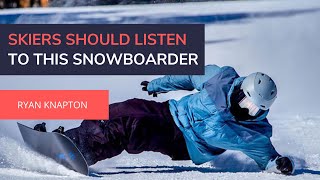
In this episode of the Big Picture Skiing Podcast, host Tom Gellie interviews snowboarder Ryan Knapton. Ryan recounts his early years learning to snowboard, the pivotal coaching that linked carving to tricks, and his shift from competing to obsessively mastering carving. He explains his technical approach to carving—using high edge angles, progressive radius changes, and a four‑line (toe‑side, heel‑side, switch‑toe, switch‑heel) framework—while describing the challenges of transition and boot‑out. Ryan details his equipment evolution, from early light boards to custom ultra‑wide, pure‑side‑cut snowboards built with Pete at Unity and later Donek, emphasizing the importance of board width, lift, and sidecut for achieving extreme edge angles without boot‑out. He draws parallels between snowboarding and other disciplines—his top‑20 world Rubik’s Cube ranking, foosball mastery, and visual‑spectrum analogies—to illustrate mindset, focus, and progressive learning. The conversation ends with practical advice for skiers: start on easy, groomed terrain, warm up through a “color‑spectrum” of edge angles (red to violet), respect the mountain by minimizing snow‑pushing, and use subtle cues (visual lines, body positioning) to improve carving. Throughout, Ryan’s enthusiasm for continual experimentation, equipment customization, and the joy of pure glide shines through.
Chapters
Today on the Big Picture Skiing Podcast, you're going to hear from snowboarder Ryan Napton. Yes, that's right, skiers, a snowboarder is on the show, and I want you to listen up. This guy has some seriously great takeaways and really understands how to master something. This is coming from the fact in the interview I found out at one stage Ryan was in the top 20 of people in the world for solving a Rubik's Cube. So overall, I'm a huge fan of the way Ryan thinks and approaches things. You'll hear a couple of stories that really stand out, like when people said, you can't do this, and he went, you've got no idea, pal. Like, I know exactly what I'm trying to do. You're held back with your beliefs and current sort of philosophies on things. And that part really resonates with me, and, and that's exactly my philosophy when I put videos on my Big Picture Skiing website. It's about looking at things from other angles, not exactly reinventing the wheel, but can things be done better? Are they viewed, explained, and, and shown in a way that makes sense, and are all possibilities explored? I mean, there's—
yeah, you've got to listen to this interview.
It is fascinating. It is honestly one of the most enjoyable podcasts I've done to date. And really, if you don't come away from this wanting to push the level of your skiing, have a better understanding of some ways to implement that and make progress, then I think you're missing something. You've got to come back and listen again. Now, just some context. I think it's really important when you hear from people that are really into a particular aspect, skill, or part of a sport, you're going to be hearing things that are very relevant to just that part. So, Ryan has become obsessive, and I mean in a good way, to master the carving on a snowboard. So, just like a ski racer, will become obsessive and masterful in one aspect of skiing, but perhaps some of those areas are not what you want to do, say for moguls or big mountain skiing. They pertain to just parts of that sport. So just remember, whenever you're hearing stuff from Ryan, it could be, you know, if it doesn't make sense, think about it in terms of, well, why is Ryan thinking this way? It's because he's trying to master carving. That's the thing he is loving and enjoying and interested in most. And I think that's just a good reminder for us all at all points when you, when you're hearing from somebody, just remember the perspective, the standpoint that that person is coming from. And so, their information, what they're trying to get across is really about that ultimate goal. And yeah, so, that aside, I really hope you enjoy this interview with Ryan Napton. It's literally one of my favourite conversations. I think you're going to learn a lot. So without further ado, let's get started.
All right, Ryan, now you are a snowboarder, but I've been following you on YouTube and Instagram for a while, and this is a skier's podcast. Um, I'm going to quickly say why I've wanted to chat to you. So in a nutshell, like we were just chatting offline before, I think in any sport, if you can find universal principles So, so we're both into turning particularly. You used to be into a lot more jumping. You still jump around a lot, but you love the feeling of carving. So turning, so turning sports like on a bike, a surfboard, skis, anything you're turning, there are universal concepts and principles that will help someone, uh, you know, improve. And I see that you look at those things, so I'm like, this guy gets it. And, um, so I've been wanting to chat with you, ask you some questions, and the goal here is for skiers to really learn from, from someone outside of their sport. Because I think stepping away from your own sport and having like a, you know, a broader view, bigger picture view of things, really can make a massive difference. So that's why, um, I'm going to throw it to you first. Can you give us some, some background? Because I don't even know that much about your background. What, like, when did you start snowboarding and then when did it start transitioning into you wanting to carve?
Sounds good. Um, it was, uh, I, I wanted to be, from the age of 10, I wanted to be a snowboarder. I saw the pictures in the skateboard magazines. I wanted to be a snowboarder. So I started, I was terrible for about 3 years. Summer of 1994, I, I got the framework of snowboarding. Tom Nordwall, the head coach at High Cascade Snowboarding at Camp— or Windell Snowboard Camp at that point, August 24th to 28th. What an amazing pivotal handful of days. He would not let us go to their park and pipe until after lunch. We had to work on our carving, and I remember him just we had to watch. He had to put us pulled over at Mount Hood on the public lane up against the where the racers are, and he had us watching the snowboarders, and he was relating their turns to the tricks. And, okay, and he was, okay, here's your takeoff, landing, takeoff, landing. And it's just the skiers and snowboarders, both of them doing those motions. And then he has Dave Dowd, legendary snowboarder, come by and he's like, hey Dave, will you do some of your grab carving? And Dave Dowd grabs his board mid-carve and just rips this turn. And then on the next turn, he grabs the other edge and rips the turn. And I'm 13 years old at that point, I think. And I'm like, oh my God, we're all nerds. These guys know what they're doing and none of us can achieve that. But just that framework before going to the park just made sense. And then you did the rotations, like he even did it with 360s. Here's your takeoff, here's your landing. So I understood those in my mind, and just to find those turns, that took work. And luckily I was able to do it at a young age, at 14, uh, 13, 14, 15.
Yeah, so that sounds like that was a pretty important bit of exposure Very— you were show— you were showing the link between, yeah, being out of master carving and, and then aerial maneuvers.
And I wanna say this, like, I remember being that young and being, like, I wanted one of those top pros as my coach. If that would— it wouldn't have worked if without him explaining snowboarding in that framework, we would not be chatting right now. That's how pivotal that idea is. Clockwise circle, counterclockwise circle, clockwise circle, counter attacking down the hill, essentially all at all times.
Crazy. So then how far did you take your snowboarding? Like after that, you, you got pretty good, competed, sponsored.
So I, I, I need to describe it like this because none of this would've happened without a mindset change. I was already a pretty committed dude when I was 10 years old. I ran the Twin Cities Marathon, 26.2 miles and whatever yardage. And I just remember the pain and like, oh my God, how do I keep my legs moving? But I wanted to finish it, so I finished it. And then I realized I didn't love running compared to gliding. So even after the marathon, I went home and was skateboarding. And then the next day, my body really paid for it. But, uh, It was a commitment of like, check this out, here's where the real change happened, the pivotal change in my own snowboarding. I was competing, I was not having success. I could feel my own progression happening, but I just was not winning contests. I did not even, I never qualified for nationals previously and I did not qualify for the 1994-95 nationals. When it was in Giants Ridge, Minnesota. So I knew my parents would've let me go to that one. Like, it was right in Minnesota. I, I couldn't qualify. My top results were like a 4th and some other jazz. And at 15 years old, I was literally the spring of that year after knowing that I didn't qualify. I was just disappointed. I'm like, well, I still love this snowboarding stuff.
I love it.
So, you know, instead of trying to compete, I'll just be the best snowboarder I can be. So I embraced that. And that spring I made so much transformational changes. And I'm seeing these guys in my head in Minnesota at Giants Ridge competing in nationals. So a bunch of my heroes, Chad Otterstrom, you won numerous things there. John Summers won the pipe, I think. And I'm just at Highland Hills in Minnesota. I had some ski, had some ski racing friends, and that's where they were training. So I got rides to these resorts like Buck Hill and Highland Hills, Afton Hills, Wild Mountain all the time through their parents. And so it was convenient. At least I had access to be able to go out there and keep on working on my craft. But at this point it's just be the best snowboarder I can be. So I gave up on competing, but sure enough, I just made all these gains really quick in one spring. And then the next year, my first day at Buck Hill, John Cow, rest in peace. He tells me I'm going to win nationals. He saw me doing these big switchback side 540s off this roller, and no one could keep a clean enough knot line to do it how I was doing it and making a certain landing just from the articulations of the hill. And he gave— that gave me so much confidence. A guy who I look up to, looked up, look up, looked up to, and still look up to, John Cow. Um, when he told me that, I was like, yeah, let's go. And so I was riding, I was able to ride Buck Hill's halfpipe almost every night. And just, I kept working on my craft, working on my craft, making it fun for me. And then I won nationals first year at it and I won the whole darn thing. The next year I got second behind the very talented Abe Teeter.
And, uh, yeah.
Amazing. Yeah. And then it, you know, it, let's fast forward. I, uh, I never really made it as a pro, as even junior world championships going into the finals of the junior world championships, 1997, I was 4 points ahead of everyone going into the finals. Back then it was a combined score thing and this girl gave me my first kiss right before my run finals and I literally forgot my run. Mid-run. So that doesn't work out, of course. And then I couldn't make it up. I tried my ass off to, to pull out everything extra I could do in the second run. But, you know, it's too late at that point. So but that was like taking steps back to now that I'm 44 years old, I am glad that that was probably the best thing that ever happened to me. Had I won that, had I had more success in that, all those people that I adored their snowboarding and I had their pictures on my walls as a kid and all this. And, you know, they— I'm competing against some of these guys, a lot of these guys, they don't— not many of them have inspiring snowboarding anymore within them. Too many of them, the jumps got so big after that era and a lot of them ended up broken and they're not snowboarding to where it's inspiring. And, you know, it's, it's a bummer because they were so good. They're so talented. They had so much skills and creativity. But when we break our bodies, you know, it's, it shuts the whole operation down of having fun. And that's where it needs to be, just going out and having fun. So I'm so glad that I'm just getting to enjoy snowboarding on these new, new and different levels. That like, this is, this is where my life's at now. Just go out and see how good I can feel, make snowboarding feel to me. And if something doesn't feel right, I just call up Sean Martin of Donek Snowboards. We chatted last night. I have a new snowboard from 10 days ago, and we chatted last night on day 9 of riding, and I already wanted new changes. And he sees it and gets it. And so the core thickness is changing, and then this board will be for a couple different purposes. And Wow. He literally will tell me, like, you're not breaking the bank by experimenting with what you want. So, yeah, and he gets it because he's a carver himself. He's an alpine snowboard carver and he's an engineer.
So, yeah, that's great. I'm gonna hold you there because that's a bit I want to get into, but I want to go back to, like, I love it when people get takeaways from chats like this. And so I would say, I want to ask you, like, the, the big part there that I think is important is you were aiming at just competing and, and winning. So there was that mindset, and then there was the change to you're just going to be as good as you can be and focus on everything that makes that possible. And if that's good enough, so be it.
Exactly. And the win— the winning, that was never a priority. Never a priority. Never a priority. I just wanted to do what I could do. Yeah.
So then do you like— because I would say most people probably listen to this are not going to be— they're not going to be in the boat even at all of thinking about competing. There'll be a small percentage that will, but I think that's really important if people don't get their mindset right of like how are they approaching the sport they're doing, then yeah, you're going to speed it up or slow it down. And I've been doing a lot of like reading into like flow state and, and all that sort of stuff.
Yeah.
And, and just, you know, how you have to be so curious and pushing like your limits by 4%. Doesn't have to be much, like, but you have to get tiny, tiny, tiny limits, but you have to be doing that and you have to be really, like, I guess, intrigued yourself as you are. I think there's just like a perfect case and example of, of it getting you, um, somewhere. And then, and then the second thing is too, like you said, you kind of— whether it wasn't your fault or not, but luckily fate stepped in and you didn't end up with broken ankles and then not really wanting to snowboard. I don't know, I don't know how that I don't know how you frame that. Maybe that's just like, I think there's always a positive to everything that happens.
You might, you know, at the time, yin and yang, yin and yang. Yeah, yeah. You got to take the good with the bad, the bad with the good, and yeah, try to figure out how to enjoy it.
And you got a kiss for a girl. You got a kiss from a girl. I mean, that's mad, you know.
How good is that? That's funny. Uh, when Kristen listens to this, she's gonna cringe. My girlfriend.
Yeah, okay. But hopefully the other girl is going to be like, hey, uh, Ryan, no problem, saved all those hospital visits.
And thank you, thank you.
Um, anyway, moving on. So you started talking about Donek snowboards, and I think you and I have very much on the same page here— equipment matters. And the type of snowboarding Ryan does is very much focused on, on carving now, and he does some very creative, cool spins and, and linking between turns kind of tricks and playing with that sort of stuff. But at the core of it, it's, it's how to lay that beautiful, smooth, high-powered arc. Equipment is so critical. When did you realize that? Because I think I watched an old video of yours, and I don't think you were on some kind of a— it was like the moonwalking one that you might— so when, when did that happen?
How did, like, how did you meet the Donik guy and Yeah, for the most extreme end of this, my range of snowboarding, my very first YouTube video is on what was at the time and probably still is the lightest board on the market. They don't make it anymore, but it was so light and flexy and flimsy. And but I, you know, I was given the board, I knew the owner, and it worked really good for what I was trying to do in that time frame for the buttering especially. It wasn't a twin, so the nose and tail were different. And of course, with riding halfpipe, I broke the tail of it. So on that, in that video, very first video, the tail is broken. So some of my options are in the wrong format of what I described with clockwise, counterclockwise, clockwise, counterclockwise. But in the carving stuff in that, you'll just see these low edge angle carves and they're just boring. Now I'm trying to hit just high edge angles nonstop and just party with them. And since those turn shapes have become so quick, I've had to increase radius, radius, radius, radius, radius over the years. And it, that's a long process, increasing radius and feeling comfortable with the four major chords for me are a toe side carve, a heel side carve, a switch toe side carve, and a switch heel side carve. So I need those four lines. And when I go up in radius, it's always a new— I have to work on finding the real comfortable levels with that new radius. Yeah, because with that comes— and then after that, when I go back to the tiny radiuses, it's so easy, and it's just like, ah, why is this turn ending so soon?
Yeah, yeah. I would say I found a similar kind of journey. I was doing a lot of carving on a slalom ski, so 13-meter radius, which is short for a ski, but then now I'm really enjoying like 17, 18 meters and, and going up from there. You just, uh, yeah. So how did you, like, what were there any— yeah, how did you get there? How did you get to that point?
Yeah, I get it. Back to the original part. Um, as soon as my body was knowing that I still love halfpipe, Tom, I still love halfpipe, but it's my second year ever on a snowboard in 34 years that I've not ridden halfpipe. Breckenridge doesn't have one anymore. I moved out here specifically for the halfpipe, and I'm really glad I did. I love it here, and some of my friends that I moved out here still with. But after I was done with the halfpipe and park, you know, or scaling that down and not trying more and more, then I was, uh, I still loved snowboarding, so I just kept Peak 7 had opened during that era, and all of a sudden there's these empty runs during the spring, and they have all this, all these rolls that I was able to play with. So I'd go out there first thing in the morning every morning and use that as my warm-up, just playing around with these little butters and turns with all these nice rolls on empty runs. And then eventually the sun would come around enough, light up both walls of the halfpipe, and then that's where I'd want to be at. And that helped, helped my halfpipe riding because and my physical body was really in tune with my edges, and it just made that even make more sense. But I'm always about reps, and I just— all those extra reps in different ways really helped in halfpipe riding. And literally, I was winning a pro— the last pro contest I won, or ever did, right there.
But yeah, where was that? Where was— when did you get a real dedicated carving board because you're like, you're pushing maybe the board you had and it's chattering or whatever.
Yeah, exactly. The chatter that— and it wasn't— it wouldn't even be the— it would be boot out because I wasn't riding too fast for the radius. It was boot out as you're dragging those heel cups, dragging the toes. And I got— I was like, man, I want— I'm, I'm literally already making YouTube videos. And I'm watching— I'm obsessive, Tom. I'm obsessive. I'm watching these guys, guys on Sward snowboards and every, every preseason and postseason at the time. I don't have a Basin Pass anymore, but I'd always see these guys on Donnick snowboards and these others with these on top of hard boots with these trench diggers. So 28mm of lift. Okay, this is what I've been, I've been bringing out 2 boards a day right now just for that extra clearance because as soon as the snow's so soft that I'm starting to boot out, then it's just like, well, do I just like be done with the day or do I play with the mountain in different ways? What if I can achieve those same edge angles without booting out? So that was the thought process back then. I'm on a Burton Custom at that point, Burton Custom Wide and Burton Custom X. Wide, and I'm just still booting out left and right. And yeah, it, uh, like, don't let anyone ever tell you what's possible. I want to share this story, Tom. Again, I probably would have— I'm not taking a path that has been forged, so I've been willing to trust myself because I've seen this aspect in Rubik's cubing. Like I said, I'm pretty obsessive. When I got into Rubik's cubing, I got really into it and I became one of the top 20 Rubik's Cube fastest solvers on the 3x3. Wow. And so I've competed in the world championships, US Nationals. Those are the two that I went to, and I could bring my time, my average time down below what was officially the world record. So that was about 18 seconds. And then I'm on— I'm at the World Championships and I'm a fly on the wall, Tom. I always want to hear what other people have to say. And I'm overhearing the event organizer and the top couple Rubik's cubers in the world at that time talk about what the fastest times that human being can possibly solve a Rubik's Cube. On average? And you want to know their answers at this time? And I saw through it. I saw through it already. But they're saying about 17 seconds, maybe 16 seconds. And here we are over 20 years later, Tom. And with the resurgence of information sharing through the internet, 5-year-old kids are crushing those times. Literally, some— wow, cubes are getting solved in 5 seconds, Tom. I know the, the methods I used to do it and they are just so far beyond it. And even the cubes have gotten better for speed solving. It's crazy. And then you see it on America's Got Talent, someone juggling and solving. I can't comprehend what they're doing. It is amazing. So I already had a deep instinct of don't let anyone tell you what you're capable of. So I knew I was booting out. I had already gone to the first wide board I wanted to try. I literally went to a local snowboard shop and I wanted to rent one just to try it. And I kid you not, the manager told me, what size boot are you on? And I say 8.5, or I was on 9 at that time. I've squeezed in since. I was on 9 boots and they tell me there's no way you need a wide board.. And I just knew you don't see what I'm capable of on a snowboard. Like, let's go. So I, I called, texted or called my friend Pete at Unity Snowboards. I did end up trying, trying a couple friends' wides board. I didn't ride one. And then, and then once I was like, yes, this is the direction I need to go after, uh, trying my friend Damien's Y159 Custom X. I was like, yes, this is the direction I need to go. I did not like the buttering aspects. The board was just, the nose and tail were too far away from me, it felt. But that width, I could absolutely notice it with what edge angles I could achieve. So that board, it was probably, it was still under 26 centimeters wide, Tom. So this isn't my current board. The current one's right there.. But, uh, this is 33.32.6 centimeters wide and the other one's 32.9 centimeters wide. That's such a big difference in 26. Yeah.
Yeah. Massive.
Yep.
And so then did you, you, you did, were you gonna go somewhere? Uh, so then how, like, how did you find the, the Donny guy?
Okay. Yeah. Okay. Oh, I can get lost in my own thoughts, brother. Um, So, so I started having Pete from Unity Snowboards make me boards after I was like, yes, this is the direction I could go. But there was not anything out there with a pure sidecut. They all had big old gimmicks of big wide parts around where the feet are. And I've already known the experiences of that. That's a topic you might want to ask me, but it's small.
I do. Okay, I'm going to— okay, what would I call that? Just because I want to come back to that.
Well, like the black— the black hole effect.
Black hole.
A black hole is what ends up— you end up on your face.
Okay, I'll ask you that later. So anyway, so you want—
you wanted a true side cut? Yeah, I wanted a pure side cut and I just wanted wider and I did not want the excess length. So Pete is, you know, he, he is not— he has a tradition. He had a bit— they aren't in business anymore, but they had a standard production snowboard stuff where you press out a bunch of boards over the summer and market them that previous, you know, get the riders on and market them and sell them, you know, the next winter. So, but so he had to custom cut out and custom make me boards. So he was charging me and what a great deal because I got to learn a lot. So the first, very first board specs I jumped up to were 27.5 centimeters wide, and instantly I had this freer glide. You know, I'm just not getting that friction. I didn't know enough about my own snowboarding and how much I could push that, so it was a couple weeks of riding it in the lame way versus all of a sudden, once I realized, like, trying to boot up, trying to dig my heels into the ground, trying to dig my toes into the ground, all of a sudden I was like, whoa, I can still boot out this so easily. So then I had to make me a second one with the 29.7, 29 centimeter waist width. And the very first run on that board, whenever I get a new board, I hold back, Tom. But the very first run on it, I was like, yes, this is what I'm searching for. Oh yeah, let's party. And then he wasn't really open to, you know, I had a concept in mind for a Beast Mode series of snowboards and he didn't see it. And even he, when he built me the first 27.5, he, you know, gave it to me and just like, holy cow, this is the widest thing I've ever built.
And, and was kind of probably doubtful.
He was super doubtful, Tom.
He, when he—
What year is this? He even tried to describe to me about the shape of a turn and why I shouldn't be booting out. And I just saw through it again. It was like, uh, and then, so I'm riding those boards and then eventually through emails, Sean Martin just sends me an email. Thank you, Sean, for this email. He says, hey, I would— I— yours, you— yours are the only videos that make sense out there. I would love to sponsor one of your videos. And I was already very aware of Donek Snowboards, and I was just like, they're, they're primarily alpine snowboard stuff, race stuff, in my, in my mind. And I was just like All right, Sean, you are custom building boards one at a time. I'm riding custom boards. This is exactly what I need. Like, if, if, if— can I try one of your boards? And if it works for me, I'd like to take this a lot further than just you sponsoring one of my videos. Amazing. Amazing. Dreams come— some dreams do come true. Like, that's all I can think of when my connection with finding Sean Martin in this world, or us find—
no, knowing each other. So to help me, help me here, at the time, from your knowledge, was that pretty much the widest— like, no one else was trying to do this? Is that— yeah, right? They're all— yeah, they're all just following what the designers are doing. No one's gone and said to the designers, hey, I can't do what I'm trying to do with this, I need it And what year was that?
Um, I, I don't even know the year, or roughly 2000, a bit after graduating college. So at that point especially, it's a real heavy focus on just how good can I make snowboarding feel for myself. So maybe, uh, I don't even know, mid-2000s. 2011, 2012. Yeah, I could go through my YouTube videos and find it.
No, not—
yeah, but not even— yeah, it's not like— yeah, I was just trying to— is it like early 2000s, but like 2010, '12, something like that?
And then, uh, along the line— along the lines of other companies now going wider. So at that time, there was not the widths, and if there was the width, there was the black hole effect. I've ridden boards with where they really go extra, extra wide. I've ridden the extreme ends of the versions of it where they go a standard sidecut radius, but under the feet, a big old bump, essentially tilt one of those on edge enough. Yeah. And all of a sudden it just gives out. You just— that middle of the board just loses contact with the snow and you're on your butt or you're on your face. I took one single run on the most extreme version of that and it was on the mellowest run ever, Tom. Like the bunny hill, essentially a long bunny hill at Breckenridge that I still love because it's steep enough. Once you got your speed, you can still jam it out. It's big and wide. Um, but it was the most miserable experience snowboarding that I had had in an extremely long time.
And so I realized what didn't work.
Yeah. Okay.
Okay. So then now onto like a bit away from equipment. I might come back to some questions there, but if, uh, if you're now being able to push the limits, you're not booting out, you're really getting some angles, what becomes apparent to you as like the biggest— I don't know, like the weakest link in your boarding? Is it the transition? Is it when you reach the high edge angles? Is it just after that? Where do you go to next? And like, do you reckon there's a pivotal moment in your carving technique where you worked at it and then carving just got way better after that?
Okay, um, once I got big on these bigger, wider boards, yeah. Tricky question. There's, there's too, just too many aspects that I don't know which order is the most important.
Um, okay, how about, how about the transition then? I'm going to hit you because you and I made a little video directed at skiers using your snowboarding as an example on the transition.
On the transition, my switch stance heel, from the toes to the heels, is still by far and away my hardest one. I'm out there this morning. What do I do every day? Every day I make sure I work on that transition and the thoughts for that. I know I just have to trust myself and to trust myself. It's very subconscious thoughts because I don't have the millions and millions and millions and millions of reps doing it on a, on a, on this large radius. Okay. On small radius, it's easy for me. On the large radius, I need to hit certain spots of my board bending.. And that's as early as possible. And the simplest thought for me is I just have to see that board tilting. I already have to see it tilted over there before I ever get there. And then I can go really subconscious internally and just use that and just then take an approach. And one of my favorite quotes from Mo Norman, take an alert attitude of indifference. And just judge how it felt, what the results were. But the big thing is, as long as I can visualize where that high edge angle is going to— how it's going to get there instantly, and it's got kind of— it has to go high edge angle to high edge angle. It can't be like low edge angle, boom, low edge angle one way and then bang.
It's got to like—
it has to be progressive.
Boom. I don't want progressive.
No, no, it's bam. Yes, bam. That's my little love tap on the top of the mountain. I want to give some energy back to the mountain. Little top. Everyone's so heavy at the bottom. And they just probably should have a little— might even have a little circle here for that. Yeah, this one works.
Like, does that— is that visible? Yep.
So we can see it. So the second one I had traced my beer can, literally traced my beer can. And it's circular. The first one, it's low edge angle. And then what happens? Everyone ends up with all these forces around 6, uh, 7 o'clock and 5 o'clock. They end up with all those forces there, and that just doesn't feel good to me when pure carving, you know. Um, yes. So I just want, I just want to hit the symmetrical circle. So if we're talking a perfect C1, you know, that's— and then to achieve that This is the sloppiest little diagram ever, but it's like I'm going up. If I want to achieve the circle, it's like I'm going up, but the board is actually just doing its own circle. And that's what— that's the— I don't have to think about what— how I'm doing that. I just need to know, hey, the board's going to do this, and then I can relax. And as soon as I hit that, it feels like set it and forget it. It's just like, boom, I'm on this new high edge angle. And since I'm on a large radius, I have a long time to just like to enjoy that. Exactly. Enjoy it. Disconnect my head, look around. You know, if I'm actually going down, I'm just reading the train and the traffic. It's very focused. I'm not looking off in the distance or anything, but I just want to hit those high edge angles, set it, forget it, and enjoy the view. Enjoy what I'm seeing. And enjoy thinking of where I want to hit those next lines. And so then you need to train on a really high level there. If there's a snowmobile track, oh, I'm changing certain trajectories of edge angles because I don't want my turns to be on that. If, uh, if I'm with my— if I'm snowboarding out there by myself, I'm not worried about any of my trenches. I can carve right through them. If I'm snowboarding out there with people who trench diggers, the guys who are slamming turns and digging, you know, 6 inches down into the snow. All of a sudden I have to worry about their tracks and that's something I'm working on. And that's why I have these. I haven't tried these, those power plate, the 28mm of lift with these for years and years now because at that point I was still on 27.5 wide. So it's the first time where I'm enjoying riding these super slushy conditions where it just sinks and still keeping the glide intact. So I'm using my normal board, my newest board on the first half of the day. But as soon as I'm starting to feel that boot out stuff happen, like starting to like, ooh, this is gonna be an issue, then I just swap my bindings over to the extra lift and then I can make all those lines happen efficiently and easily and trust the turns better. Uh, of course with rising above the board, freestyle-wise, it just, it feels like I'm standing above something else. So that aspect sucks. But otherwise, at least I can still go and, and ride this really soft snow where everyone else is just struggling. I'm seeing accidents nonstop because of the snow snake effect. You know, if you catch part of resistance of your ski boots, bindings, etc. People are just crashing. Even today, this morning, there's a guy who I help, I pick up his ski pole and deliver it 40 meters down the hill to him, like, and he's crashed. I watched the whole thing. He just got going too fast, didn't know what to do, and he eats it. And then I go and get on the chairlift and sure enough, the same guy, I didn't see how he crashed this time, but he's got both his poles up the mountain, 40 meters above him again, and his skis ejected. It's like, wait, why don't you just go and go slow? And find some control. Control. Slow is good. We like— yeah, we can just find control with slow, then we can start to ease into getting aggressive with our motions.
So then the, the transition thing and that push a bit up the mount, so trying to make that nice curve and, and avoid just building all the forces at the end, that's probably probably one of the hardest but most key things that you're going to be aiming for, as, uh, if you're after that perfect turn. Have you found a few, like, then talking about other people trying to do that, have you found any good cues or things that help others discover that?
Yeah, even this has even helped myself massively, Tom. I'm gonna bust out some graphics that I drew Perfect. I am, I am an artist with the edge of my snowboard, not with my calligraphy of my hands. All right, so here's the jam. I want you to think about a, a visible light spectrum range.
Should I do a screen share real quick for this?
Yeah, let me just, uh, make you host. All right, Tom, I'm back in action. Figured out how to do a screenshot. So here's the NASA Science Share, the science visible light spectrum. And if we're looking at that red line, the radius is so big with it, right? Visible light spectrum. And then it goes to tighter radius and tighter and tighter and tighter as you work through ROYGBIV— red, orange, yellow, green, blue, indigo, violet, whatever. So this is my theme. Just like it's small, big, large, large, large radius to tight radius. We're only on a fixed, we're on a single, we're not on a radius that really changes too much. There might be variable sidecut radiuses to our equipment. So the real change that we can hit, even if we're on, if we're on, if this, whatever our range is here, we can change the vibrational energies of it through edge angles. So for me, it corresponds directly from very low edge angle, that red visible light spectrum, and you're in balance with a heel side carve and then toe side with those edge angles. And it works its way up all to that, all the way to that purple and white light. And that's where it really, you know, hitting high edge angles. And then the board is at those high edge angles. It's storing, you know, a higher vibrational energy level. Yeah. And then it brings it back. We're low edge angle. You ain't getting that performance out of it. It's not going to happen. But you hit those like, you know, those green lines, the blue lines, the purple lines where it feels like you're almost pushing 90 degrees out on the mountain. Yes. And that's where it's like, yes. And does that happen every day? No, conditions don't warrant it every day. But when the conditions are firing and the body's firing, That's where, that's where, like, real snowboarding's at.
Have you used this, like, kind of visual with some other people? Like, hey, and so almost like, hey, you— so then you can almost speak in, hey, let's push into the green.
The only time I've ever shared it like that was, uh, during, um, uh, having a great Mexican restaurant dinner with, uh, Sean Martin, of course, from Donnick Snowboards, after one of the days at Nationals, and a Cassie Level 4 exam summoner, and she's incredible. She's a triathlete.
She's got her spirit. Yeah.
Gosh, yeah, I know, Melon. Yes, yes, yeah. And my goodness, she impressed the hell out of me how she can ride a snowboard. That was incredible. Like, so much power and adjustability and, yeah, just knowledge. Like, awesome. So, uh, so here's my drawn diagram. So, uh, here's my Donnick snowboard. It's— I purposely, I purposely kept the graphics all black on top they can do any artwork you want. And the people's art— my, my girlfriend, she has Chad Otterstrom's picture of Breckenridge with all these pink lights. And then these— and then one of our foosball friends did the artwork with this tree, adding trees and birds. And it's just beautiful artwork. So I've seen so many things with graphics alone that are amazing. I purposely kept all of my boards pure black just to show, just to show that graphics do not matter. They don't matter one bit in relation to your performance trying to come down a mountain. You know, the chairlift dropped you off. How do you want to approach this task? So here's the way that I think about it for the circles. The, those red lines are those low edge angles and red it might not even be a board that is visibly tilted off of the ground, but it is pressure on that edge and it's just the biggest circle. And I always warm up with some of those, just those reds, those orange, those yellows. I always warm up on those. And if I like today, I knew there was going to— there's these rolls on Peak 7 that I love buttering on. But am I willing to put tons of real work into— if conditions are firing, I can go right off the bat. But it's springtime conditions. I wanted to feel the takeoffs and landings because right now I can squish sometimes if they just groomed it right before, I can squish like that much into the snow and that sucks versus like 1 centimeter of depth. Yeah. So I'm willing to give myself the patience to test out the snow with real turns before I go into the full freestyle carving mode that I can do. And then throughout the day, it just gets more and more accurate until the snow conditions or traffic on the crowds fails me.
Hey, how important is using a hand or an elbow to do what you're doing? And do you have the goal of like one day You are like, literally it's your nose, maybe, but it's just the— like, talk to me about that. Because I'll tell you what, in skiing, sometimes there's people who like, you know, they kind of go, oh, you can't drag your hand, or you can't touch, you know. And, and I'm just like, man, for one, it feels so good, like, and then two, there's a functional reason behind it. Anyway, I'm interested to know, are you trying to like push, not using it? How high edge angle can you get, or do you not care? It's, it's essential, so use it.
Speak to that. For me, it is using it none at all, Tom. I am taking mellow physics for what I'm doing. Let me go into with the yin-yang aspect. I have friends that will carve on steeper terrain than me, and they— I, I know the sensations of that, of like, ooh, it's one more body part that is giving a sensory input to where I'm at. And they're not pushing their hands into the snow, but it's just there and touching it. And it's just part of, you know, it's a mind-body-soul experience.
Like a finger, a finger on the wall if you're bouncing on one foot.
Exactly. So they, they, it actually helps them. I'm not willing to put in, I'm pretty lazy as a snowboarder. I'm not willing to put in those, especially with a big meter radius board. I'm not willing to put in the work for those tight, tight turns down steep terrain. And there are better, uh, physics of boards for that type of stuff other than being on a twin, especially if it's soft snow. And yeah, these are things I'm working on. But, uh, for me, I'm— if, if I have one metric in snowboarding I'm the best glider. I'm just gliding on those circles. I'm gliding, gliding, and I just read the train and have a very in-depth sense of what's too fast and what's too slow. Most of the time I'd rather be on the edge of too slow, cuz I can just add extra energy into dropping my weight and pushing earlier. But too fast, you're just dealing with a lot of forces. I'm never in a race to get to the bottom. If I was, my turns wouldn't be what they are. Um, I don't know, did I ask you—
answer your question, or did I forget where we're going? So I guess I'm like, do you— are you trying to aim for, uh, like, could you achieve those angles where you're literally lying on the ground on a snowboard without anything but the edge?
No, that's my question. No, I, I can't be static, but that's— or, uh, I cannot be in that position and not feel something out there. So what— let me show you my jacket, Tom.
Yeah, this is, this is cool. And again, because remember, like, a lot of skiers listening here. Yeah, yeah. And I recently put out a video on, on using hand drags as a drill to get people comfortable, like, getting to that Understood.
Understood. Yeah. The, the weight should not be on the hand. The weight should not be on the arm. I use my arm cuz that's the last place I can get some of my bo— the rest of my body out of the way of the carve. So, and then if I'm using friction of a normal jacket material, it's too—
it catches.
It's abrasive. It catches.
Yeah. So just for the people that are that are listening, just because some people will listen, not view it, but Ryan's jacket arm all the way up to the elbow, is that duct tape or what's material?
This is a marine fabric vinyl. This is the slickest one I have. And that's very slippery. Yep. Very slippery. There's no friction at all. So if I just touch, like, I'm not doing, I'm not strong enough to do a plank, Tom. I'm not like, it's the arm is just there and then to soften it up just in case the elbow hits, I don't, I don't want like a pivot, a divot. I don't want my, you know, the divot should be the edge of the board, the edge of the skis. That's the arced sliver in the slope that is important. If you're dragging a trench through your elbow, oh God. So I wear, I wear elbow pads and these have actually saved me a couple of times in instances that I messed up and taken slams. But I've also taken falls where I've fallen on this and I just carve on through like, ooh, I touched it for a split second and my, yeah, the, the, it didn't disrupt my turn. I've literally messaged one of my race, a couple of my racing friends like, hey, I was like ripping these quick turns, boom, boom, boom. And I fell and I instinctively went right there, but I never lost a disruption, real disruption of what I could achieve next. So I was like, because you, you're able to glide on the, on the elbow, essentially. There was no, there was no friction there. So I was just like, you guys might want to do this for racing, just in case any, you know, of those weird things happen. Like, you could just get right back up and into the groove. Like, literally, if it was on a race course, I didn't lose time.
Like, so then for like the, maybe the snowboarders, this thing Is there— is there—
you're aiming for elbow, not hand? Yeah, correct. Yeah, for me, I have friends that are really proficient at using the hand. Some of them are very proficient at it, and they are using gloves with a similar material. And I've literally provided one of them with a pair of mittens that a Russian company builds or something, and it's the extreme carvers use those. Okay. Okay. For, for me, I didn't like the feel of the mittens and I didn't like the feel. I, I just like the feel of like high quality gloves and I, I, so, so I, I also can't have snow going up the sleeve. So I always been grabbing the base of the sleeve and then just using this one lever in complete parallel with, with a wrist, with the wrist up. Actually, the whole lever is utilized, and it has padding underneath it, so it's so gentle in the snow. But it's, it's more of like when I'm at that high of an edge angle, is just get the rest of the body out of the way.
Yeah, yeah. I must say it's kind of cool because when I was able to get higher edge angles and starting to put the hand and stuff on the snow, I've, I really focus now more on not the hand, but, but the forearm and elbow. And I just think, you know, it does a couple of things for me. One, if I'm thinking hand, I tend to maybe reach my body out of that alignment with the edge. So then I've just screwed it all up. I'm not now connected to the edge as much. The elbow, because it's close to my body, I feel like I'm more one whole thing. I say as a unit.
Yeah, yeah, exactly.
Yeah. And even like you think boxes, like, you know, you keep flexing in here. It's, it's stronger, right? But as soon as you go to open it, yeah, you, you start like core stability, all that gets looser. Yeah, yeah. So, so I like the, the parallel there, and, and I definitely am trying to put more similar to you here down, not, not just knuckle and hand when I get to—
if you ever want to fully utilize it, I'll, uh, build you a jacket and send it to you. Okay, cool. And you just wear some paintball elbow pads underneath. Yeah. And you could use that forearm in new ways that you never imagined. Um, that's it, I'm doing it, I'm doing it. That's cool. Check this out, Tom. So even this, this jacket, it's by West Beach. They offered me a pro, pro model jacket years ago, years and years ago, and I still might take them up on this, but I don't want everyone going out and thinking that's the ultimate version of snowboarding, because what I've seen is people who aren't carving just laying on the ground, and then they're they're using some weird trajectories out there that are putting themselves in massive danger. So I've held back on that. Like, it's a money-making opportunity for me, but unless they're utilizing it in the right way, there could be chaos.
It's bad, Tom. Yeah, yeah. Hey, so I'm gonna— I'm doing a bit of a summary here on the last, our last sort of 20 minutes or so of, of chatting here. I think a really important thing for people going towards like really awesome, perfect carving skis or snowboard, doesn't matter, your warm-up— and I love the, the light spectrum thing— like start in the red zone. Like, and, and like someone said to one of my students the other day, I was like, I looked at my tracks the other day and they were from the lift and they were dirty, so I went back and I cleaned them up. And I think like if people did that Well, I think there would be several things going on. I think the slopes would stay way better for longer. Yes, you know, like, because they're not grinding through stuff and churning it up. So people start there and like get so good at the red, then the orange, then the yellow, and, and then, you know, and then as you start pushing those boundaries, you're going to find, oh, dirty the line, dirty the edge. This is where I got to stay at the moment, you know, because that's that 4% I'm pushing into. I can't, you know, no point going beyond that because it's, it's just all a mess. You don't actually progress in that zone.
Yep.
Um, but yeah, that would be my summary of takeaways. To hell with people, because totally agree, people don't slow things down enough, go to easier terrain, and just like feel what the heck is going, going on, you know. They're missing all these sensations. Like you said, you feel there's this top part of the turn that you got to be like aware of and feeling. And so, so many people just miss.
Yep. In my mind, 40, 50%. When you, when you say this, what comes to my mind, I was young, 13, 14. I read in Wall Street Journal or something how many pounds of snow the average skier pushes and snowboarder pushes down the mountain. And yeah, like that's all I think about now. Like everyone just pushes snow down the mountain.. And it's like, wait, why, why did we go out there and beat it up? Let's give that thing some energy back. Such a simple thought. Let's just work with the mountain. Like, hey, I can finish this turn even up the hill a ways and snap some energy up towards the, the Mr. Mountain. It's just a big old smiley face up there. Yeah. You get to live a life and you just get to be on a mountain enjoying it.
Let's give it some energy back. Totally. And like, on that point of like, I don't know, preservation of the, of the slopes and everything, like several years ago I was on the Australian demo team instructors and we had a slope cordoned off so we could just do our training on it, and it stayed so good. You could still rip carving turns well into after lunchtime, you know, because, yeah, because of the way the skis were interacting with the snow. Was not—
wasn't pushing all that snow down as fast. Or you're talking dreams here, brother, because it doesn't happen every day. Yeah, yeah, yeah. I've been in those type of conditions and yes, they just— it just stays amazing. Like, yeah, convention— conventions. I went to a couple of hard boot Alpine events and it's everyone's little slivers.
The resorts just— it didn't get beat up. Yeah, yeah. Hey, on to— onto boots, because I'm a big like I, I'm a feet person, to be honest.
I love—
really enjoy understanding the mechanics of the feet and everything, and I think it's so important, especially both our sports. That's where everything comes through first. What have you done? Because we've talked about playing with board setup and stuff.
What do you like to do with your boots and, um, and that area of equipment? The interface is something I envision heavily, Tom. I'll literally sky's the limit with how we can think and meditate about skiing and snowboarding. So I literally imagine if there's some alien— let's not limit ourselves here, brother, I'm getting wild. Yeah, yeah. Alien civilization out there that has been snowboarding for 600,000 years, but they're in general humanoid form. Maybe they're more liquid, maybe they're more skeletal, I don't know. How, what if they've been snow skiing and snowboarding that long? What have they developed for the interface between their bodies to the snow of these radiuses that we're gliding on? And for me, everything needs to just go higher. So, and it needs to be more stiff. These snowboard boots I am on, the Ride Insano, it's got a hard plastic shell tongue and that at least gives me leverage that I can use my shins to drop, just drop those shins down and something's happening. Flexi boots. Oh, it's a difficult task at that point. Liners is really what I wanna dial in next. But the boots itself, I do need to use soccer shin guards. I add extra, extra padding. And I put, I put that in between that I'm using an extra heel hold harness. On these liners. There's not— it's not like zip fit stuff. And, you know, I wanna play with these liners, so I'm using an extra heel hold harness, and that at least locks me in enough. I always need to flex. And here's a big problem for snowboarders. Like, here's, here's me, day one of riding Sainos. They feel like a ski boot to me. They are just like so rigid that my workaround, I was not even doing the top boa, just leaving it loose. But then now, you know, 100 days in maybe on them, 60, I don't know, it broke a pair mid, mid-season. So maybe it stays 60. Um, but later they just, they just crumbled. Where you, where you as skiers, I don't think you have to deal with these technical problems of total crap equipment. For an interface to the thing. At least alpine snowboarders, they're in those hard shell ski-ish boots and the consistency is pretty similar, like whether it's day 1 to 100, like it's a gentler process of any break-in period. These things, day 1 to day 5 feels totally different, 5 to 40 feels way different, and then 40 to 60 in warm conditions when everything becomes more malleable, it's just like the boots are folding everywhere. So it's a— that part's a technical hurdle and skiers are going to deal with that. And that's why— that's why your podcast is so valuable, Tom, because I'm thinking about these type of levels because I love your skiing podcast, Tom. It's one of the two podcasts I listen to— Big Picture Skiing Podcast and Foosball Radio. And I love them. I love them equivalently. And I keep on learning so much from them.
So props on everything you're doing. Hey, so here I thought it's worth mentioning because, um, so where you're talking about the snowboard boot, like, it's great in the beginning, the, the forward flexion of the ankle. The equivalent in a ski boot, the, the problem you're dealing with— so imagine skiers, the sides of our boot that we tip laterally. Imagine after 30 days that started folding. So you go to roll on edge and your knee is just driving in. You described that perfectly. Thank Yeah, because, because I think there's a— there's an important point there, because with ski boots, our fore and aft range is kind of our balance area, and we want to, yes, manipulate pressure front and back on the ski, but the real jam is out there.
Yeah.
And I think some people overthink that it's all like— because they hear people talk about, oh, you got to get so far forward and bend the tip of the ski. But I, I would— I would— I'm going to ask you on this. I would say it's pretty sensitive. You're fore and aft a lot of the time. You're trying to stay feeling the tip and the tail and the center, right?
Like, okay, okay, right in the center. I gotta go back to this diagram then. Okay, got to. It's so important that I have a very singular focused thought. Todd Loffredo, if you ever— I'm a professional foosball player. I have learned a lot. Todd Loffredo taught me, or showed me I asked him to review my pull shot. He said it was two-stroke. He has the one-stroke. He's been the top player, one of the top players since the late '70s, and he's still at it. This is a guy with 100,000 hours of experience in professional foosball. So he saw it and told me. It didn't make sense to me for a long time, Tom, but there's cleaner lines of energy, and it's with the ball positioning and as you're going across the ball, going forward, and you can snap in one, one stroke rather than back, forward. Got it. Just go forward. So like, this is, this is why, like, extracurricular activities I've been involved with helped my snowboarding because I get to think about, like, absolutely one motion. Because I have 10,000 hours in, Tom. I even got second place at the pro doubles at world champ— at the world championships once. But these top masters that if anyone wants to take a deep dive into how obsessive and how amazing this sport is that I've dedicated this much time into, Foosballers, just Google it. Foosballers. Okay. It's a movie. It's a documentary featuring one of the world championships somewhat recently.
And these—
I've gone camping with some of these people. I know these people like on a really high level where we just chat and stuff. Garrett Schirkenbach, he's in there. We play foosball. I got my table right there. He comes over and we just jam, and he's just got a little tiny segment in it. But, uh, like, I like— the sport is crazy, and you have to dial in the thoughts of how you can execute instantly without, like, giving away your body mechanics.
So now tell me, how does that relate back to the—
yes, to my front, back, and yeah. So the dead middle molecule of my board, I'm on a— I'm centered on a twin. Mm-hmm. My stance angles are equivalent, 15, -15. Yeah. So the singular thought is bend the dead middle molecule of one edge towards where the other edge is, bend it away from me. That's the simplest thought I have. And as soon as I— when I'm gliding down a mountain all by myself, I can find it repeatedly. It's a struggle to find those thoughts when it's chaotic traffic and crap train and stuff. But when it's beautiful, that's the most singular thought I have. Bend that middle of the board away from me as soon as I transition. So my overlap of transitions, Tom, sometimes when I'm not going fast, it's like 3/4 of my board length overlapping where you can see my toe side and my heel side edge overlapping, where if I'm in a race, that doesn't happen.
Yeah, okay. Now tell me what happens you see with people who are not as— they're dirty with their tracks, you know, their pure carving, because this is, this is related to linking a pure carved arc from the heel onto the toe, or left to a right carve in a ski turn. Do you find— would you say that the people that often dirty the top of the turn they're, they're not bending that single middle center molecule, they're bending somewhere else, like either towards the tail of the tip, correct?
I, I just describe it as, for whatever reason, they're smearing the turn. And I don't— I can't get into each and every person's minds. And of course, skiers or racing aspects are different. But well, why smear the turn? There's friction. Everyone puts friction down the mountain. I don't want friction. I just want pure glide. So it's just they're not willing to trust their equipment in certain aspects for some people. Some people just want to smear it. Some people want to get down to the base of the resort. I don't know why you want to do that. Then you have to wait in a chairlift line. That part sucks. That's the worst part of the day, was just standing around in a big old herd of sheep. Like, I don't want to be there. I just want to enjoy all that glide. So to get that glide, you know, hang on to the previous turn. Maybe it's 1,1000. Maybe it's 1,1000 to 1000. If the snow's real fast and, and not too steep, maybe it's 1,1000 to 1000, 3,1000. Yeah, like those red lines. Today I was— emptiest runs I've had all year, and the conditions were great feedback snow, Tom, with just a squishy level of wet snow. It started, uh, misting this morning on the bottom and snowing on top, but those red and, you know, maybe orange and yellow ones, those lines that would normally seem boring to me, I was just using the whole width of the run and trust falling my center of mass into those turns. Yeah, enjoying it. Not knowing that no one else is out there. And each and every run, then say, say 8 runs later, I'm trying to achieve something similar and I spot one of my own little arced slivers in the run. I just try to connect with it and make it look like a skier's tracks, 2 tracks. So I'll pick the left side of it, and usually it ends up, and I'll just like Okay, what was my decision-making there? Okay, see a transition there. And I just try to match it up to where if you're on a chairlift, it's a confusing line, Tom. Yeah. Because it's like you're— someone's watching, a knowledgeable skier, which there ain't too many out there at Breckenridge. Like, it's a clown show now. They're used to— but, uh, if someone's who— a trained eye looking at a skier's lines like that, all of a sudden they'll get confused because I might cross my own path.
So, yeah, it's an interesting thought experiment. That's cool. That's very cool. That's very cool. Hey, I just, I'm thinking I want to keep talking like basically all day, but I have to go visit my, my mum and she's 4-hour drive away and pick up my son. Understood, brother.
Understood.
It's been a pleasure. Yeah. I'm trying to think what would I want to ask like right now finishing up. And so the thought that the thought I had is Okay, what do you think if you watch skiers in general, and maybe let's not say beginners, but people who are like trying to have a go, from your outside eye watching them and knowing the kind of turns we're trying to make here— so we're not talking about big mountain turns, we're carve turns— do you have one piece of advice that you would say, would, you know, you would say to those people?
100%, go to some mellower terrain. That is wide, that's a groomed consistent surface, and just hang on to your turns for a little longer than you expect. There's no, there's no ceremony at the bottom for getting there fast.
I love it. So true. And you know what I would add on to that? You're gonna find that's far easier and more enjoyable if you get off those fat skis.
The design— oh, the fat skis, they just jiggle around. They just jiggle.
Oh yeah, I never see anyone doing it right with those, you know, on-groomed runs for carving. Exactly, exactly. And you know, if you really want to maximize your time, like you maximize your season early season when it's just snow making snow and all the rocks are still exposed, everything, you can have possibly the best day of your life riding arcs, right? So if you get equipment that is not just your 99, 108 underfoot floppy thing that's meant for those rare days where it does snow a bunch. Get something else in your quiver that, that can do what you're talking about. And I think people will find like magic and joy. Yeah, yeah.
And like, and as you said, like, I think we both like to the point where you can't even— you can't wait to wake up and go play again. Yeah, and it's just play on a mountain, play with some physics.
Yep, it's my— it's definitely my form of, of meditation, of yoga, whatever you want to say. It's my way of getting into feeling every part of my body, feeling, you know, interactions with the snow, and it is just absolutely so much joy. Um, so that would be my advice on top of yours, which I think together is, yeah, And that's very cool.
And that's the best part— the sensations. The sensations. And when you can have a high level of expectations of what sensations will occur, that's the magic. Yeah.
And you know what? There's a—
it's not that consequential or dangerous. It's not physically hard, Tom. Today the gondola shut down a couple days ago. I now have to get off a bus and walk up 59 steps Oh my God. But those 59 steps walking up, I do it slow and rhythmically. And but it's the hardest part of my whole day physically, just walking up the steps to the where the snow is. Yeah, the rest is just pure glide and effortless on the body and it feels so good.
How can it not be addicting to where you just want to go hit the replay button? Totally, totally. All right, we need to do round 2. I'd love it. Yeah, and I've got some things that I want to share with you. I think equipment-wise, with the boots especially, I reckon would be some cool areas to, to delve into to get what you want. So yeah, I'd love to share that with you. But Ryan, thank you for your time. And like, yeah, as I said, I want to keep chatting. I'm sure people— I hope that people have really enjoyed this. Keep ripping it up. I don't know when you're gonna— you're probably gonna keep snowboarding until the season in Australia here starts.
So yeah, lucky bastard. Yeah, yep, I'm literally testing out product stuff, so I just can't wait. And I hope the snow conditions stay as well as they are. So because I, you know, I only feel this amazing on the snow at the— towards the end of the later parts of the season with the, you know, the sport-specific muscles just firing, where at the beginning of the season it's really hard to find that. So any first day people, like the first days of the year, hold back. Just find out the mellow sensations you want and maybe a couple things here and there.
But yeah, yeah, if you try to rip too hard all the time, that fails real quick. I'm sure you had friends this season got super keen on the big powder days and then this ACL or something, and then their season's done.
In the past, always happens.
In the past, it's been crazy, Tom. Yeah, yeah, just exactly. Take it easy, red lines, work up the spectrum. I love that.
That's my, that's, that's my next visual out there. Thanks. It just feels so good on days like that. You make the smart decisions for what you get, what's being offered. Yeah, thank you, my friend.
More from Tom



Most skiers overlook how they use their poles. Try these five pointers next time you’re skiing.







