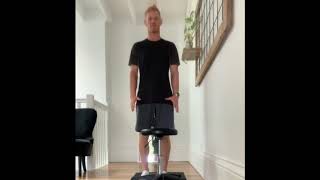
Tom Gellie breaks down how your tibia rotates during skiing and why it matters. He demonstrates safe versus risky rotation angles, explains which muscles control the movement, and shows why strength and mobility in these ranges prevent injury.
Chapters
People have a hard time understanding the role that rotation in the knee joint plays in skiing and actually many movement sports, to be honest. And so I'm going to try and just show a little bit of an example of how much movement there is in the knee and perhaps when you could use that. So, if I've got my left foot up on the stool here, I can keep my upper leg completely still and utilizing my subtalar joint mostly and my knee joint can create quite a considerable, considerable amount of rotation that is completely independent of anything else happening in the body. So when my lower leg is rotating out, the hamstrings on this lateral side are actually contracting and pulling, and the hamstrings on this medial side, inner side, are actually lengthening a little bit, and they swap in this internal rotation of the lower leg. Now, you should be able to see that there's quite a bit more external lateral rotation compared to internal rotation. People also think that as soon as the knee is out of the straight position, you are weaker. I'm just going to show you right now. I'm going to put my leg into a lateral position, and I'm now going to stand up. No pain on my knee, no strain, just a bit of a struggle because I'm on a stool. Internal rotation, Up I go. The foot that's still wants to untwist as I move that, because when you get into extension, that's when your knee will really lock and, and hold its kind of ideal position. But you have got some power and some strength when your knee is actually in this position. When it's sort of dangerous is if you were in, say, an externally rotated position, but you were pushing up with your knee on that angle, now I don't feel so great on the knee joint. But if my tibia is vertical, or the forces are coming up vertically through here, and I've got an external rotation, it's actually a massive workout for my vastus medialis quad muscle to help build it there. And, uh, and for the lateral one, if you've got your rotation this way, So, for skiing, you'd want to have the ability to isolate moving this joint. You'd also want to have the ability to, or you'd want to train strength in these ranges. And, because you're going to find that at certain points in the turn, you're going to need some mobility in the knee joint in rotation. Oh, I finally will say, so there's open chain rotation of the knee joint. Here is just showing how much closed chain I've got here. So see my tibial tuberosity, foot is still pointed at you, yet look where my thigh is. So, other way, you'll see I can't get quite as far as soon as I start going any further than, I don't know, maybe 15 degrees or something here. My foot wants to turn on the stool. So there it is, rotation in the knee joint. Don't be afraid of it. I would be more inclined to train strength, mobility, and awareness of using it. So there you go.