Stop Chasing Ski Tips — Do This Instead
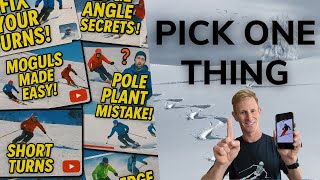
Tom Gellie explains why skiers stall: they chase too many tips instead of fixing one thing. Pick one concrete cue, film yourself immediately after each run, exaggerate the movement, and repeat until it sticks. His student improved stance and vision only when he stopped jumping between fixes and committed to single-focus deliberate practice.
Chapters
G'day, if you're trying to work on your skiing, I've got some advice that I think will help, and it's got to do with staying focused versus jumping around with what you're trying to work on in your own skiing. I see this common problem all the time, people don't stick with the one thing that they've been given to work on or that they've identified, they don't give it enough time, enough focus, and they don't stick with it. For example, I have an online academy where I take a select number of people and work with them throughout the winter, and they send in a video and I give them feedback on what to work on. And one student at the beginning of this season sent in some video of them carving short turns and moguls, and there was one common sort of theme I saw to do with their stance, and it was particularly how their stance changed in the transition end and and into a new turn. And what I saw was they were looking down, like making a kind of a rounded upper body position. It wasn't a strong athletic position. They weren't looking ahead, going to where they're going. And they were a good, you know, advanced skier. I said, this is something you need to change if you're going to be going faster, if you're going to be wanting to really improve and push your skiing. We're going to change this now. So this is the focus. Gave some ideas to him on what to think about, uh, different cues to try and see which one would work best. And so he took this information, went out, practiced for, for a day, got some video, sent it back in, um, and there was a little bit of improvement but not much. And what I noticed is he sent it in and his comments were, oh, but I see this problem, or I'm doing this wrong. He was just jumping straight onto a whole bunch of other stuff that he saw in his skiing, rather than the one thing I said I want you to go work on and send me back video once you've got it right. So, so there's that, this common problem. I see it all the time, even with members that are just using the video library, which is still super powerful. They might watch a video on one thing, but they think in like a day of practicing it, which maybe they spend, I don't know, 45 minutes in total really, working on it, not even that much. They think it's not fixed, it's not better. Of course it's not going to be that long, and they'll often not take video so they can't check whether what they're doing is changing, because it's really obvious. Often in video you'll see it, especially a stance change, hand change, uh, at a particular moment. You'll see if you're getting better or not, and people don't check it until later on, like, oh, the end of the day, I'd better check that video I was, uh, I'd had taken of my skiing. It's too late. Like, you want to check it right then and there. Just do a run, check it right then and there. Hmm, nope, still not different. I need to go back up, I need to exaggerate it more, I need to— oh, it's at a particular moment. I don't have to think about all the time, I have to think about this moment. So anyway, throughout the season, this guy started getting better. Took a lot of time. I had to keep going back, going, yes, I see these other things that we're talking about, but the one thing I asked you to focus on, you're still not doing it. Until finally he goes, "I spent a lot of time really focused on my stance, my vision at the particular point in the transition, and yes, I can really feel a difference. It does A, B, C. I feel more confident. I can move into the new turn more easily. It feels like I've got more time." All these things, it's like confirming, yes, this is a good thing to work on. I said, "Great, don't jump around the next thing. Just work on this." build lots of hours. By the end of the season, his main— he improved a lot, I should say, but he also really improved his process of training. That was the big thing, and he said that was one of his biggest takeaways. He'd often in the past go take— like, Tom's produced a new video on this, a new video on that, and another exciting idea, and he'd go and try it instead of knowing he hadn't quite got better at the first thing that, you know, he needed to fix. So This is a really common problem, so you might recognize in yourself whether you're working with a coach or you're just using videos, choose the one thing that you see that could make a difference and will make a difference. So a really important point when you're practicing, working on something new, you take video, you look at it right then and there. You do the run, you look at it right then and there. You don't wait till the end of the day, you don't show it to someone else first. First, you look at it yourself and see if you can identify whether the thing you're working on is changing. Simple as that. If it's not, go back, exaggerate it, do it more, maybe go slower so you've got more time to think about it, but do it then and now in that moment, because that's all a coach really is doing. If I'm there with you, hey, oh yeah, you tried, no, you didn't do it. Oh, there was one turn, like halfway down, did you feel that? Oh yeah, that felt a bit different. That's the one you're going to focus on, that's the feeling, so do that again. Video, you can use it in exactly the same way. Please do that, and please realize that you need to stick with one focus, not jump around, it's such a common problem, and you're going to see your skiing improve, just like one of my students did in the online academy, and just like I see selected people using the Big Picture Skiing video library do, Hey, I did this, I worked on it all weekend, I've worked on it for a couple of weeks straight and I really feel it's made a difference. Then you can look at where to go to next. Like for myself, this season I just had 2 focuses for mogul skiing, so when I was doing moguls, I just chose one, okay, I'm going to get reps in of where my posture is, where my head is down this run, get video, confirm, oh yeah, I can see that's changing better, great, I'm going to do that more and more and more and more. I haven't owned that yet. I need to do way more of that. And so that was this whole season, two things, the, the amount of hours I got in, and then coming into next winter, I'll assess it and see if I can move to the next thing that is the, the weakest link or what I really want to improve next. So I hope this has helped give you some training advice, pointed out a common problem I see all the time. And if you're a coach, just be careful. It's so easy to impart the knowledge we know with our students, like, oh, they paid time and money to, you know, be with me, I'd better give them more and more and more. That's not always helpful, you know, they've paid for you to help improve them, okay, which doesn't necessarily mean you give them all this knowledge. And so stick with the one thing and you'll get better results and they'll be appreciative of that fact. I hope you've enjoyed this video, and if you're having a break this, uh, this summer, if you're in the Northern Hemisphere, enjoy it. We're getting ready for winter in Australia. Well, it doesn't really look like it with the weather like this, but believe me, it's coming. Yeah, I'm looking forward to it. Hopefully we get some good snow. Fingers crossed. Thanks very much for watching, and just last but not least, a bit of a shameless plug for Skelly merchandise. You can buy hats, t-shirts, hoodies, help support a small company like myself. Yeah, all right, thanks for watching. See you next time.
More from Tom



Most skiers overlook how they use their poles. Try these five pointers next time you’re skiing.







