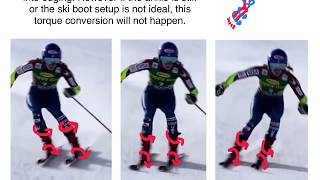
Tom Gellie explains how rotating your lower leg inward rolls your foot to shift pressure to the inside edge, the key to edging a ski. Without enough ankle mobility and boots that allow it, you can only move your foot forward and back, losing edge control.
Chapters
Okay, I'm going to do my best to try and show you how subtalar joint motion in the ankle which is dominantly a rotational and lateral movement joint, is likened to motion in the forearm, hand, and wrist. So in a post I made, I talked about the rotation of the lower leg inwards, so this these two bones rotating inwardly. If the motion is allowed to pass through the subtalar joint, that rotation converts at this joint because of the way it's put together. So here is the joint pulled apart. So there's the, the calcaneus part, top view of it, the talus. So, talar, sub meaning underneath, so this joint is what we're talking about. So, rotational motion here when you are standing on a ski converts into not twisting. This would be evidenced by no motion at the subtalar joint or actually supination not pronation of the subtalar joint. But when the ski is blocked on the ground and you can feel this motion, and your ski boots allow it, the rotation converts into rotation this way in the foot. And what's coupled with that is rotation inwards, almost is like the foot rotates out. Or if the foot's still, I can get subtalar joint motion by rotating the foot out and tipping it up. So you can get the same feeling if you put your hand on a firm piece of the ground, and when you rotate your forearm, which would be like the lower leg, when you rotate it in you will see my pressure gets pushed to this side of the palm of my hand. Everything's still in contact, but the center of pressure— more pressure is going down through this part, which would be like the inside arch of your outside foot. And rotation outwards is converted to pressure more on the outside here, which would be the outside edge. So inward rotation or medial rotation of the lower leg, if it's blocked at the ground here and you have movement at this section of your ankle, inverted commas, will convert to a rotation or a rolling over movement of the foot and ankle, which will help you get the skis on edge and start a an effect to use the ski design to turn. So you can get a feeling with your wrists of feeling how this rotation converts to a lateral pressure change, an alignment of the center of pressure being more to the edge you want to be on, the edge you want to be on to turn this way, and then you just need to convert it and feel that motion down below this point in the ankle. So it's not happening here, this only allows fore and aft movement. It's just underneath at this one I'm gapping, and this is where you need to have mobility in order to convert rotation through the whole foot into pressure aligned along the inside edge of your foot to pressure the outside ski, and then inside ski vice versa. So an outward rotation will align the bones stacking up more with the outer edge of the foot, which is where the outside edge is. Hope that makes sense.