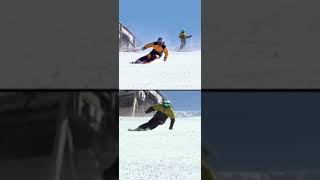
Tom Gellie breaks down how two elite skiers, Warren and Casey Bouius, produce different turn shapes from tiny biomechanical differences. Warren's straighter leg alignment and earlier extension create smooth, precise lines. Casey's steeper shin angle and delayed extension generate more dynamic, exciting turns.
Chapters
I want to use this awesome video here of two Canadian or ex-Canadian demo team members, really great skiers, Warren Jowett and Casey down the bottom here. And why I think it's really awesome is because it's exactly the same run. So there's Casey ready to drop in, this is him dropping in like literally seconds later after Warren. So it's a really cool comparison to look at the same run, same day, same conditions, them doing like a very similar turn shape. They've been on the same Canadian team together, so very similar ideals, but then looking at like what's, what's subtly going on different, you know, to my eye, to, to my eye. So I just want to point this out, share it, and, um, and hopefully some people find it interesting. And you know, it's just really ski nerdy stuff, but I think some people like that, me included. So the thing I want to point out that my eye is drawn to, some things. One is the anatomy. So the shape of Warren's leg versus Casey's leg. So, you know, a straighter leg alignment and more inward alignment. And when you draw some things like the femoral kind of angle, so from the hip socket down through the femur to the snow, and draw it across. Let me go here, down to the snow and across. Uh, we just see like a couple of different things here. So, so like Warren's edge angle is like quite consistent through the whole leg, whereas if we drew the edge angle of let's see, his like shin for Casey, you can see it's much steeper. So where the ski is being directed to the edge from, like from the big bone, the femoral bone, is just different between these two skiers. And that's just going to change what muscles are loading and what bones are aligning with the outside ski force. And at times I think this is kind of interesting with Warren's leg, because of how close this knee is, this knee is with the resultant force line, so that outside sort of ski straight up to the center of mass line. And then Casey's, you see like Casey's knee is always going to sit a little bit more inside that line, and as terrain bobbles and wobbles things, it won't go outside of that line as much, whereas At times you see Warren's knee kind of get pushed out, and his foot, if you're getting close here, kind of get pushed out flatter and supinating because of just the line of force and the torque, the knee being more this side of this resultant force line. So just something interesting there. And then I think what's really cool in all good skiers Regardless, is the transition having an element of float, glide, or float? Like, so from one turn into the next, so there's not a lot of ski-snow contact through here as you transition. Now the two skiers have a slightly different timing here. Warren has a really, like, has this like slightly earlier slight extension or pulsing the ski or pulsing his body like at this moment. Coming around at this moment, the turn is going to continue, but he kind of helps his mass rise a little bit earlier than the end of the turn. And what that does is he can now kind of draw his legs up, retract his legs up, because his center of mass has gone from here up a little bit, giving him float, so his legs can kind of pull up underneath, glide across the snow. Now Casey is just a little bit later, it's like he's coming up more like the mass and the hips are rising here, and so he ends up just like sending his body up and over a little bit further and coming down onto the new, onto the edges like with pressure a little bit later. You see Warren's already caught and gone, Casey is drawing out the turn, and I would draw his turn shape exaggerated more like this, whereas Warren's is more like this coming down the hill. Both very exaggerated, but you get the idea. And so then that changes when he comes out of this turn as well. You see he sort of extends, Warren in the yellow above, but not heaps. And this is beautiful, this just gets him his mass just up enough that makes his legs light. So you're jumping on a trampoline just a little bit so then you can pull and suck your legs up and under. And place them into the next turn. And so you see Casey is sort of almost coming out, and at this moment he sends it up, whereas Warren's just given a little bit of extension slightly earlier, which changes again the timing and how the body moves and when pressure can be applied again in the next turn. So Warren was sort of able to catch things a little bit earlier Casey waiting, waiting, waiting, now really driving in earlier. And that really comes out in the two different sort of styles of the skier. Like, you watch Casey, very exciting in a lot of his skiing, like really dynamic off-piste skier, lots of snow spraying, like really, really exciting to watch. Warren is like very precise and very smooth and accurate with all his, uh, his movements.. And so it's just quite interesting to look at the two and look at how they both use the same slope, similar turn, how their body shapes sort of look in different phases. So yeah, thanks guys for posting this great video and I hope it's okay that I did this sort of analysis on it. I find it really interesting. Again, just the shapes of the legs, the timing of the transition, how they utilize it, and then the resulting turn shape that comes from this.