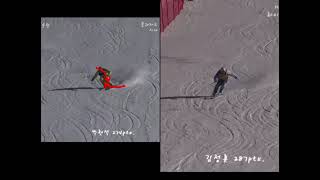
Tom Gellie compares two Korean skiers' transitions. The left skier compresses and pops, delaying ski engagement. The right skier resists compression, floats lighter, and achieves earlier contact with the snow for a smoother turn.
Chapters
Let's have a look at some subtle differences between two Korean skiers in a technical skiing competition. Let that play once more. So the guy on the right scored much higher points, you can see at 287 versus 274 on the left. And I just wanted to point out some things that, you know, my eye is drawn to in the way these two transition. Okay, so we sort of look at this moment in the turn, I would say the edge angle they both have is relatively similar. So they've got the same amount of, uh, sort of ski bend, I guess you could say, through the ski being at this edge angle. It's, it's not very different. Even their posture is kind of similar. Like, this guy has got more level upper body, his is more inclined, so there's a difference there. But I think one of the major things that happens is as the turn is completing, this part is happening, they do different things. So the guy on the left lets his upper body like keep coming down, down, down as he's kind of retracting his legs. Okay, so, and I'm saying it in that order, so they're both kind of coming together, which to me means he gets squashed and wedged between between the snow and his body, and that pops him up too much in this next part of the turn. You'll see here he can't get the ski to engage with the snow early, whereas this guy has already managed to make that happen. And the result is, see, now he's finished that turn already, he's already into the new turn, done another one. This guy's barely gotten into it. So why is he getting this kind of popped out sensation? And here it is again. This side's probably even better to look at with this guy in terms of what he's doing at the end here. So you can kind of see his upper body mass is kind of like coming down, coming down as his leg is coming back in towards him. His leg's coming back in, his upper body's coming down, like kind of compressing like a spring, which is going to— whoop— spring back out. Almost like compresses through his body and then throws throws his arm up. Now the guy has a very low transition on the right but does things very different. So as the pressure builds at this moment and the skis are coming back across, where this guy lets his body come into his feet, this guy kind of resists and stays strong here and waits for a deflection. So waits for his mass to be moved in this direction a little bit, as well as a tiny bit of deflection upwards because you want to become weightless or floating in the transition, which is what he's doing here. He's flexed and low, but there's no, no weight on his joints, on his skis or anything at this moment. So the timing of like the pressure is this guy resists, gets a tiny bit of up but not too much, uses the rest of the energy to let his legs come up through into his body, kind of like if you were jumping over a bench and you only jumped, you know, say this high and the bench was, you know, as high as this arrow, you have to kind of suck your legs up to get over it. This guy, however, comes down and compresses so much, like he's still compressed here, whereas this guy is on the right would be floating. It's compressed, and once you're down and compressed, you're going to come back up again. So then that's why he cannot get as early engagement with the snow, even though the two them in the transition look like they have pretty similar heights in terms of flexion. Okay, so anyway, that's my take. There it is, my take on what I see between these two really good skiers. A difference in the way they transition, difference in the timing. And yeah, I hope this is of interest to you and maybe helps you think about what you're doing to perform a low transition. And the reason you're performing a low slow transition is to get your center of mass to cross over your skis in a more direct line, and so you can keep kind of flowing down the hill more directly.