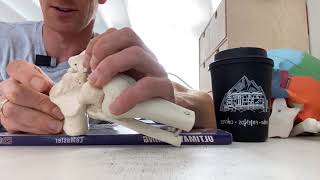
Tom Gellie uses a model foot to explain how the heel bone sits off-center from the tibia, causing natural pronation. He applies Gary Ward's three-legged picnic table analogy to show why the foot needs support, and how shifting weight toward the back-outside of the heel improves turn initiation and edge pressure in skiing.
Chapters
So I'd like to share a few things about the human foot and how that relates to skiing using this model foot that I've got here. Very well-used model foot, I should say. I study this thing a lot, and, and it really gives some great insight, especially when you look at it from, from different angles. So the first thing I want to point out when looking at the foot is notice where the tibia bone is, which is the load-bearing bone from when your knee joint comes down. Most of the weight comes down through this, this bone. Now if you have a look at, uh, this space here, notice all the support of the heel bone is, is off-center. It's sitting on this side of the tibia bone. So what does that mean? Well, when weight comes down from above, you'll see the foot is designed to go into pronation. So the muscles and ligaments hold the foot in this sort of arched shape, and when more and more load is added the arch wants to tend to drop in this direction. Just like a great analogy would be the foot being like a three-legged picnic table. So one leg being here, one leg being here, one leg being here, and there being a missing leg at this point. So this viewpoint again from this angle, you're looking down on top of the picnic table, there's a missing support under here Often orthotics and custom footbeds are made to try and support in under this area because of the tendency of our foot to want to go that way because it's designed to go that way. A couple of other interesting things when you look at the heel bone itself and the surface of it that the talus sits on top of and the tibia is pushing down on top of. When the weight is more back, you'll see that the load-bearing surface wouldn't have as much torque or effect on making the heel bone sort of fall over when it's back here. But more forward on the heel bone, you'll see there's another load-bearing surface here that the talus sits on, and you'll see this definitely sits sits like off-axis of where the heel bone would sit, and so load a little bit forward on that part of the foot, load up here, makes the foot want to go in this direction. So what is some possible usable information from this? Well, in terms of skiing and movement, the more you're aware of what your feet are doing and where the weight is in your feet, then you can start to manipulate and take advantage of these effects. So placing your weight a little bit more back and over the outside of the heel will stop the foot from pronating, okay, whereas as the weight moves more forward and inside towards this point, right, then the foot is going to want to roll over, and so for skiing, weight is going to move to that inside edge of where the ski would be here and help direct pressure to that point that we want to hold. And another point, if balancing the weight through this part of the heel bone, this rear part right through here, stops the heel from rolling over and collapsing, then perhaps part of what's going on with your feet, if you're someone that collapses all the time, is that you're just living around this part of your, your foot. You're not really weight-bearing much through that back outward part of your heel bone. And if you just worked on some exercises and some awareness and mobility to get the weight back out there, then you could change the shape of the arches of your feet. And this is totally trainable with movement and with awareness because The reason this foot kind of collapses very easily is because it's got no muscles, no ligaments and tendons like I do, that I'm in control of, that I can manipulate and control. So as a summary, I think it's really interesting studying the shape of the joints in our whole body. Gary Ward from Anatomy in Motion has really helped me to understand the foot a lot better. And it was his analogy that, that I'm using, the three-legged table one, that you can think of the foot like, and you can use this to help you balance the three-legged table so it's not always falling over, but also manipulate that table to move it in the direction you want it to move, which we all know is going to help us initiate a turn and apply pressure to the edge of the ski to help get those skis to start carving and working for us a little better. So I hope you enjoyed that video and it was some, there was some helpful information in there.