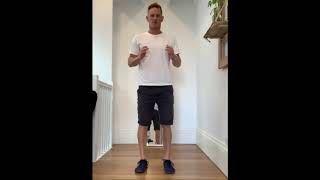
In this instructional video, Tom Gellie expands on his earlier discussion of isolated quadriceps use in skiing by presenting two dry‑land exercises designed to train that specific movement. He first explains the biomechanical difference between extending the knee with the quadriceps alone versus using hip extension and the glutes, emphasizing how quad‑only extension moves the skier’s centre of mass forward, creating tension through the calves, Achilles and the soles of the feet, which loads the forebody of the ski. He demonstrates a wall‑based knee‑extension drill that isolates the quadriceps and produces this forward mass shift. Next, he describes an isometric side‑quad hold—holding the outside leg extended while maintaining hip mobility—to develop turn‑initiation strength. Throughout, Gellie stresses the importance of awareness and a ski‑specific mindset, contrasting these targeted quad exercises with generic squats that involve multiple muscle groups but do not replicate the forward‑mass‑movement needed in skiing. The video’s goal is to give skiers clear cues and exercises to train isolated quad activation for better ski control.
Chapters
This video is designed to go with the previous video on isolated quadriceps use in skiing, and I had a few people ask what would be some exercises that they could do dryland to train this movement. So I'm going to try and get that across in this video. So, what I was talking about previously was getting people aware of using their quadriceps, which extend the knee or take it from being bent to being straighter, as opposed to using hip extension and the glutes, hamstrings to extend the knee via the hip extending first. So hopefully you can get your head around that. So, if I use my quads only, I could actually extend my knee without extending my hip that much. So here is an example. So this would be the first exercise you could try with something, a wall in front of you, to feel extension from the knee not being coupled with hip extension. So that would be the first thing. Why that would perhaps be useful in a ski turn comes down to this. When I use the knee extension alone, the result is my mass only moves forward. And if I do it to the point where I don't fall over, so right here, what I start feeling is an increase in tension through my calf and my Achilles and under the soles of my feet. So I've created some leverage through moving my center of mass forward through the ankle joint, which would help me load up or apply more pressure towards the forebody, the front half of the ski. Now if I do say something different, so my extension comes from quads, knee, and glutes, I end up coming up, but I don't have the same sensation of feeling tension through my calves and under my foot because my centre of mass is essentially still over. If I keep the flexion from the previous turn and now extend, The result is now this isometric tension created through the back half of my legs from my center of mass being pitched forward. So there would be one, hopefully, explanation and a simple way of training the quadriceps for skiing. So the outcome would be tension through the calves and the ankle joint. You should feel your center of mass be moved forward, not just stayed central and moved up through hip extension as well. So that would be one, and then the second thing I would say you could work on, because that would be more a turn initiation type movement, would be an isometric contraction of the quads. With your leg out to the side, which would give you the feeling of being able to hold resistance or hold this leg long, the outside leg long, while still being able to mobilize it. So extension, mobility in the hip joint. Extension, mobility in the hip joint. So there would be two simple ways. It really comes down to actually you being aware of what you're doing and thinking about what is it I want to achieve with, with the training. Because when you do squats, you're going to be training the quadriceps, the glutes, the hamstrings, a whole bunch of stuff. But a squat, as opposed to in skiing, is just meant to take weight from down low and push it up higher. Where in skiing, we're not really trying to do that. There's more an importance on moving mass forward and back to find a really sweet spot along the ski to make it work. So there's the maybe the mindset you need to, to think about to help get your head around this. So all the quadriceps exercises you can do are great, but then when you use it in isolation, the goal is to help move some mass. Hope that helps. Thanks.