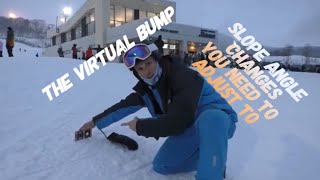
Two presenters use an iPhone angle meter to show how slope angle shifts during a ski turn, rising from near 0° at the apex to about 23° in the dip. A skier's body must stay perpendicular to the slope to stay balanced, requiring constant adjustment as the terrain steepens and flattens through the turn.
Yep, okay, so this is a little angle meter device on my iPhone, right?
So when you tilt it, it shows the degree of whatever thing you're measuring. So we're going to measure the slope.
Over here, this little slope is 16 degrees. Okay, so when your skis are down the fall line on this slope, to be in balance, your body needs needs to be— oh, there we go, 17 here— perpendicular to this angle. Okay, now watch this. If I back up, here's my ski, back up, back up, back up to the top of the turn. Can you see on there? You zoom in on that, or look there, it's zero. Same slope, I'm just facing across the hill. So if I'm a skier and I start a turn, the top of the turn now is 4, 5, 6, 7, 8, 9, 10, 11, 12, 13, 14, 17, 16, 15, 14, 13, 11, 10, 9, 8, 7, 6, 5, 4, 3, 2, 0. So the slope changes, gets steeper, steeper, steeper, steepest there, 23 in that dip. Coming back across the fall line, you finish 90 degrees across the head of the fall line, it's 0. So you need to accommodate for this change when you are skiing. If you don't go so much down the fall line, if you just like here, so say at 9, goes to 16 or 20 there, back to 14, back up to 20, 12, 11, right?
So if you're more down the fall line, you experience this change in angle less, but if you go all the way across, there's a big change. Steeper at the start, steepest in the middle of the turn, and then it gets gradually flatter. And if you're all the way across, goes to zero. So that is why that phenomenon is called the virtual bump.