Tom Gellie Training Session 1 for Whistler Blackcomb Ski School
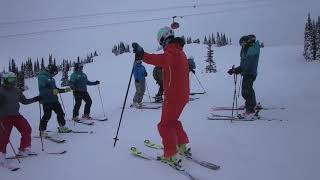
Tom Gellie teaches turn initiation through foot contact, introducing the foot tripod: heel, big toe, and pinky toe as three pressure points that stabilize your position. He has skiers loosen their boots and feel pressure changes after the fall line, comparing this sensory approach to conventional pronation-based turns.
Chapters
And they said, can you talk about the turn initiation, what happens at the start of the turn? Because I know the CSIA is important for that, trying to get a good— which is great— a good sort of clear, concise story as to what is happening in the body at the start of the turn. I'm just going to get you guys to just try and experience some feelings through the feet, what happens as a result of that, and then leave it up to you as to what you do with that information. So I'm not telling you what's right or what's wrong, I'm just going to give you what happens and the result, and then you can choose if you want that result or outcome on the snow or not, and maybe understand when you get a certain outcome why that's happening. Okay, so we're going We're going to start from the feet. We're going to start with our boots undone. And for this one, just undo the top 2 buckles on your booster strap. Just leave the bottom one done up. Oh my God, I feel better already. Right. Who fits your boots? I'm going to be talking, for those who didn't come to the talk last night, about these 3 points of contact, or the tripod on the foot. So this is a drawing of my left foot. The contact is the heel, or the pinky toe, or the big toe. Okay, so I haven't really included the toes. It's not to say I'm not saying that you don't use your toes, but the strength comes from these 3 points. Okay, and you join them together, you get a triangle, a tripod shape, which is a very stable structure. Now, base of support as a concept helps us. If it's— the bigger the base of support, the more stable the structure on top is going to be. That makes sense to everyone? The smaller and narrower it is, the more tippy. Yeah. Second, in a structure, the higher the center of mass, the easier it is to topple. The lower it is, the more stable. So there's kind of two things straight away you can think about that'll make something more stable. So with our feet, the bigger surface area we've got contact in the snow, the more secure it is. Okay. So let's see. The bigger surface area you have under the foot, then the more stability you have. Okay, so yes, if you include the toes a little bit, you'll get a bigger surface area, more stability. You're standing, say, on the fourth metatarsal, not the fifth one, and now I join the tripod up. You've taken away this section here. And you could probably say in my drawing that's probably 15% less surface area in contact, so it's already a less stable base of support to stand on than the first one. So if you can find maybe when in the turn you really need that stability, because not all the time do we need it, okay, it's going to be a detriment. When we maybe need that, we want this whole tripod. So we're going to go for a ski down to the right of the chairlift here. I want you guys to just be aware of these 3 points under both feet. And I'm going to give you a point in the turn that I really want you to try and sense whether you stand on these 3 points. So if I'm coming around and finishing a turn to the right, This is down the hill. Just after the fall line in this zone here, I want you guys to start sensing what your inside foot is doing on the snow. So it doesn't mean I don't want you to stand on it, I just want you to feel where are those contact points, are you standing on all of them, does it feel the same when you go the other way. So 3 points after the fall line, so through the completion, feel for it, sense it, and then you'll know, stand on it, start the next turn. But that's how early we're going to start to feel it, and you're going to give me some feedback. Let's do a good, uh, warm-up first. Okay, so, uh, quick clarification. When you So when you go and try this again, you're just getting feedback, so I don't want you to try and do anything. If you try and, oh, I need to roll the ski on edge, I need to twist my leg, you're going to interfere with what is going to happen when you're standing at the top of the hill and you're just going down, no thinking. You're not going to get that information coming into your brain, so shut all that stuff off that I need to I need to turn my legs, I need to do this. Just feel what your body does for balance and stability at that point in the turn. Where is the pressure? Where is it not? And I should say, it's not just pressure. Where is the contact points? Because there's always going to be more pressure because the edge pushing up from the snow on the pinky toe heel side. So, that's a given. But do you feel, is there a sense that you actually have your big toe or The ball, the big toe, even just contacting. Is it lifted off? Is it pushed a little bit down? That's what I want you guys to try and feel. Don't try and do anything technically-wise. Just gather feedback and then let it go. So what that foot, that inside foot, is preparing to do through the completion of the turn is, you could think about it gathering information from the snow about where your center of mass is. You know, more pressure on the pinky toe side, maybe you're actually a little bit inside. Too much on the big toe, maybe you're already exiting that turn too soon. But it's gathering information information and preparing to tense muscles, to relax them. Anyone feel more relaxed with that second task? Yeah, good. Relaxed, you've got access to more movement, right? Straight away. So the foot is gathering information. If it can feel more surface area, the 200,000+ receptors on the soles of your feet can tell your brain without you having to think, where am I? It's gone, oh, Tom's center of mass is just a little bit back. Maybe let's get him a little bit further forward so he feels more over the whole foot. Sensed it, bam, next turn, he's on it already. Yep. So we're gonna try now just switching to the complete opposite. I want you guys to try and initiate a turn Not by sensing what the inside foot's doing, but by doing what most of us are taught at the start. Would you agree you roll the ankle over, you make a pronation type movement? Yep. So compare how that feels and how much information you can gather versus what we just did. So we'll do that till the speed. —so it's economical. Cool. So I would just call this first kind of run as like gathering information, right? That's what we're trying to do here. I'm not telling you what is right or wrong. So this next section down here, what I'd like you to try is if we take this concept of stability is increased with a larger I need some support. Biggest surface area is my right foot now. Heel, ball of the big toe, ball of the pinky. If I feel that I'm standing on my heel, but even just a little forward, like Guy's saying he feels, uh, he's finding that point kind of just in front of the heel bone here. Okay, so if he's feeling, say, here, is that right? Slightly more forwards, yeah. So even more forwards. Okay, so if Guy's reference point for sensing where his foot that's going to take his center of mass is, if it's here, now we redraw his tripod. And the thing, the thing is, as soon as you come forward here, you don't get to go out to this point. You now go straight forward to probably here. Yeah. So now I'd probably say that's 50% smaller than what the potential could be. Yeah. So back, you know, half to the fall line, there's no harm in sensing. You don't— I'm not saying put pressure there. Sense here, sense here, sense there. Your body, your brain will take an aggregate of all those points and probably put you right bang in the middle because that's where the most stable point is. So I want you guys to now try and think, am I really feeling the ball of the big toe right here, or is it here? And the pinky toe, am I right there, or am I a little bit inside? And the heel, am I feeling the most back, very back corner of the heel, or am I a little bit forward? And just see what feedback you get from feeling a bigger, bigger, bigger surface area. Does that make sense? So people ask, what do you do at the start of your turn? Is it an active pronation kind of movement? Well, for a basic parallel and sort of warming up, it sort of happens a little bit automatically. And part of the reason is, if you're balanced, the way that the heel of the foot is shaped, the structure of the bone, is the heel is off-center. You could think of it almost like a 3-legged picnic table where this leg is missing. Okay, so there's kind of the most back part of the heel you'll be able to feel is somewhere over my right foot back here. Okay, wait. So if you stand on a picnic table, if it's it's got no— people aren't standing on it, it'll hold up. 3 legs there, right? With this one, back one here missing. But as soon as someone stands in the middle of it, what does it want to do? And does the table have any muscles that kind of forcefully do that? Gravity kind of does it. So as long as you start back here, feeling all these points unstable first, all you need to do is start putting your center of mass there and it's going to start wanting to topple for you. Now if you take a guy, for example, who's standing here already, then when, when he goes to stand on it, the table's already tipped, it's already fallen over, and so he's probably tensing other muscles to probably maybe even try and hold it from falling too early. Another way, another way to think about it. So we need another whole run now of you guys just feeling more of what's going on on both sides, and then we can move on. Let's go.
More from Tom



Most skiers overlook how they use their poles. Try these five pointers next time you’re skiing.







