Tom Gellie Training Session 2 for Whistler Blackcomb Ski School
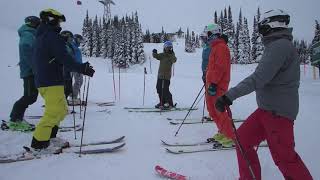
Tom Gellie teaches ski instructors how to control turns by adjusting joint angles, foot pressure, and pelvis position. He breaks down three ways to change joint angles and explains how big-toe versus pinky-toe pressure affects edge feedback and stability. The session uses live drills to show how subtle movements in the hips, knees, and feet can shift the skier's center of mass and improve turn control.
Chapters
Gathering information. Yeah, and so sometimes what—
to gather information, you need time, right?
It's like, make a decision now, you can be a bit shocked. But if it's like a bit of time to gather the information then you can make some adjustments in that last bit, especially because this foot, this inside foot, is not really—
it's not structurally as important to support as the heel support is coming back in the snow.
So it's got a bit of freedom to place itself in a different spot to be ready. Because I think about it earlier, which is why I got to this position. Right, great. So, uh, kind of perfect. It's working out perfectly. Your feedback about feeling this weird big toe extension that gives you lots of pressure on the ball of your foot and you're actually getting issues outside of skiing because there's so much pressure there. Brings up this idea that there is always 3 ways to change a joint angle. Okay, so if I take my poles to demonstrate my knee joint, okay, my knee starts out straight and the end result is I want it to be bent, I can either move the femur down without moving the tibia or the lower leg. Okay, that's one. Two, I could move the tibia up without moving the femur. Both end up with a 90-degree bend at the ankle that the knee has bent in the two different ways. What would be the third way I could end up with a 90-degree angle here?
Both of them 45 degrees.
Or any combination. Yeah, any combination. They both So what if, we don't know yet, but what if MC in her quest to get pressure on the ski tip, pressure at the front of the ski and the ball of her foot, she's actively pushing there. So she's, we take the, this is now an ankle, foot, lower leg, and MC is pushing like that, lifting the big toe to get pressure there instead of up here. If she moves this part of the body, there's going to be mass moving forward to that point. Alright, two ways to look at it. And those people that said they didn't feel pink toe contact through the end of the turn, and they're like, why would I want to press that? It's going to make the ski go flat. I don't want them to go flat. Well, then I say to you, well, what about if that lack of fingertoe contact is your body telling you that you're too far inside and maybe you need to move the rest of your body that's totally free and mobile, whereas your foot's not really. It's stuck on the edge on the snow there going, help me out, bring some weight here. What if it just was saying, get some of your mass so So you could feel a little bit of contact, a little bit of feedback through that finish. So down here, same focus point, second half of the turn, outside foot, feel the 3 points. But I want you to try and start, just start from maybe your pelvis, arrange your pelvis, move it towards it. Maybe tip it sideways a little bit until you start feeling maybe a little bit more feedback from that thing. And if this doesn't do anything, doesn't help you, maybe try the knees, maybe try somewhere else. Try somewhere first to see if you can change that feedback loop. Does that make sense?
Yeah.
Try and put pressure against that pinky toe part of the foot through the end of the turn. Would have your Wouldn't your first intuitive move be to press there with your foot?
Intuition, yeah. Yes, yes.
Because you think everything else is doing the right thing. So it's not that that's wrong, but just realize that you're using one of three ways to change that pressure point. Okay, there's a whole 66% of other possible combinations to change that. So, I'm not saying that that's wrong. I'm just saying that there are many other ways to do it. And it's probably in the other ways, the ways that you don't think about, that you're gonna get the change you're after. Because that's different. If you do the way you've usually been doing it, then you wouldn't have that problem in the first place. Does that make sense?
Yeah.
Because if it worked, it would've been fixed. You wouldn't be feeling that sensation. Okay.
So, yep, I'm gonna say, I don't know, like, in ways that I found that I've achieved on this side, my good side, um, better contact here with the pinky toe, because I've allowed, I've allowed them to be square at the top, square at the start of the turn. Yeah, yeah, with my hip.
Okay, if that makes sense.
Now you could please tell me if I'm messing up.
So here at this point in the turn, if I'm— we'll say we're sort of almost finishing the turn. To feel a bit more pinky toe contact there, you're squarer.
Oh, sorry, no, I'm talking about the start of the next—
ah, the next—
ah, right, yeah, yeah, yeah, yeah, yeah, no, just the second part. Does anyone feel that they could get more feedback from that part of their foot by adjusting their body towards that point? Yes. And how did it feel?
Better?
Better? Okay, why? Why did it feel better? Was it more stable?
More balanced? I find that I kind of too much walking on my feet.
Okay.
Just like, basically, like, it's more like a bar.
You're bending your hips too much before you land.
That was so different.
Oh, really?
Yeah, that was so different. And then I feel, okay, I need more coordination. More like an up bump, like a big jump.
Initially when we were talking about it, to me it thought like if I pushed on the foot, I could possibly put more pressure there, which would be a drop in speed. But if I take the hip and move it around there and I keep the knees equal, then it's not going to change the edge angle, it's not going to give me better support. Exactly. So once I kind of got to that point, then I was like, yeah, this is a good idea.
The foot, just keep thinking the foot is giving you feedback all the time. There are definitely movements in the foot that are beneficial. But a lot of the time it's telling you that something else up the chain is not working right. But since we talked about these 3 different ways, instead of moving the body towards the foot to change that pressure, why don't you guys try an isolated movement. Don't move the rest of your body, but try and move your downhill foot in a rotational twist. So twist it more across the heel to the end. Okay, and see if that— it does, it does, it's there. Yeah, yeah, it does.
I can't lift my big toe, and if I do it a little bit more, I can't move my big toe and I feel more of my pinky.
Uh-huh. Okay.
The way the foot turns, it's going to be that way. Yes.
It goes plops like that, right?
When you twist it, it goes like that.
Yeah. The motion is linked. So there's a lateral movement with rotation that happens together. Yep. So you're going to get a different result from moving this because you can keep the edge angle the same and move the mass. But if you— through the end, I mean, most We need to be kind of at some point getting off that edge. So we could also use a bit of motion in the foot to try and help with that. And what I want you to try and do is just move the foot. Just move the foot. Don't move anything else. Don't move the leg. Don't move the hips. Just move the foot through the end. See what happens. Let's talk about that. So if you weren't at the talk last night, I was just saying that there are movements of the body that end up stiffening the foot, making it more rigid, and there are movements that end up making the foot more loose and mobile. Now at the end of a turn, middle to the end of the turn where most forces are coming at you, and if you want those forces to act upon your centre of mass and push you across across, a stiff foot is a very useful structure because it's going to resist. It's not going to absorb some of that energy. It's not going to let your body collapse against it as much. It's going to resist it, and then you're going to get this pushing in the direction of where you're going. So there is some use in, of a movement of twisting the foot inwards. Because that is a movement of stiffening the foot.
But in reality it's quite a little one, isn't it?
It's very little. It's not like a big one. No, no, no, because really when your ski's like this against the snow, what actually happens, it's not really the ski pushes against the snow, I get resistance and so my foot ends up doing this. So it makes it stiffen. Ah, right. Yeah, cool. That's a good result, right?
Yeah, but do we want that?
Do that—
do you want to be—
yeah, I just get away from things like too— it just depends what you want at that point.
As soon as you feel weak, you have to stop.
Yeah, yeah. Or as soon as that openness is turning into you going back. Here perhaps, which is then going to take you away from being balanced over that foot again at the start of the turn. But sometimes you'll find there's improvements to be made within working on the things that you think are wrong. So many of my biggest improvements have come from doing something that I believe shouldn't happen in skiing. So just take that away. There's nothing there's nothing that is wrong. Like Otto said, skiing is an open, skilled sport. Many ways to do it. If you can cover all the different ways of moving, you're going to be a far more versatile skier. I mean, you've seen amazing skiers out there, right, that are rotating their body, doing all sorts of things. So there's an effect that'll have on the snow that'll give them a certain outcome. It might be detrimental in other areas, but can really actually help in, in others. So be open to that.
More from Tom



Most skiers overlook how they use their poles. Try these five pointers next time you’re skiing.







