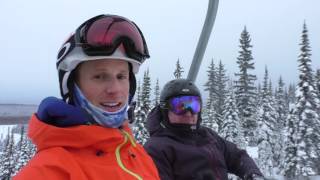
Dave's skiing improved dramatically after learning to use his skeletal structure instead of muscular effort for turns, which sharpened his edge angles and turn initiation. Tom points out that boot fit and foot balance are the next piece, since refined movement only works if your equipment supports it.
Chapters
Alright, here on my last day of skiing in Sun Peaks. It's been an amazing trip. Just riding the chairlift with Dave, a good friend of mine. We've shared some ideas, some of my thoughts on skiing and what's happening, and I just wanted Dave to maybe give some feedback on what he's felt change.
I think primarily the first thing we've been working on is being structurally aligned and to be able to, rather than using muscle, using the structure of the body and the skeletal structure has really made a huge difference in the top part of the turn for me. So to be able to initiate the turn, to get higher edge angles, and to be able to feel longer in the top part of the turn. So the initiation is completely changed for me.
Nice. And would you say the way would say I helped you achieve that was simple or complicated?
No, I would say it was extremely simple. You've talked to a man that's probably spent thousands of dollars on lessons, and some real epiphanies have happened over the last week. And a simplification again of body structure, how it works, what it's meant to do.
And when it's meant to do it.
And when it's meant to do it. And also understanding that the body actually doesn't do anything wrong. It's trying to counterbalance you at the end end of the day for what you're, what you're trying to achieve. So we've just really refined that movement, and I've found, as I said before, that the initiation through the turn and, and the whole turn in general, because the top's been much, much more improved, has been— efficiencies in skiing has been, quite frankly, feels quite amazing. Nice.
And next step, because we've got to this point of things are moving well, but, uh, equipment, we found there's a hole in the system there that's not allowing your body to move as easily as you felt it. Or there's a difference side to side, so the next step is to look at boots, isn't it? And that's what you're going to—
Yeah, that process in itself has been very interesting. Having ski instruction at the end of the day, you don't necessarily get to understand the refinement of what goes on in the feet. Tom has certainly cleared up a lot more about balancing on the foot first and foremost, and then secondly, what the boots need to do to be able to align you to be able to make these efficient movements trying to work towards. So that's been again one of those epiphanies. Nice.
Yep, so you've got to have the movement right, the timing right, and then the equipment has got to allow you to do all those things. And if one component is missing, it's going to be just not as easy, more difficult, and you're going to have to invent some interesting strategies, which is what we see on the hill with a lot of people, arms, body limbs in different positions, just, just to keep themselves in balance. And it's not wrong, It's just they're doing the best they can for what strategies and what equipment they're on for that time. So thanks for your time, Dave.
Thanks, Tom. It's been awesome.
Yeah, yeah, yeah. Look forward to skiing again and see you guys out there, hopefully on the hill someday. Tom Gellie out.