Two tips for mogul skiing
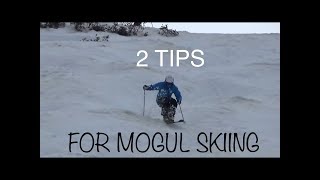
Tom Gellie teaches two mogul techniques: coordinate your pelvis, rib cage, and head so your spine stays long and strong as you absorb bumps, then drive your knees forward and hips ahead of your feet on the way up to stay centered and powerful instead of getting pushed back.
Chapters
G'day there, my name is Tom Gellie and I run a business called Functional Body and I basically work on people's alignment, movement, to try and help them increase performance and get out of pain. And I came from a background of ski instructing for 19 winters, and I'm now married, so I had to find a different career. And I'm still very passionate about skiing, so I wanted to just put out another video that perhaps would help people with their mogul skiing, of all things. So there's two concepts I wanted to get across today that should help with the moguls, and one of which is to do with more your spine and upper body, and coordinating movements of your pelvis, rib cage, and head. 3 large bony segments that coordinate with your spine and getting you to feel how they can perhaps move in a slightly more efficient way. So that's one. And the second is how you can perhaps change the way you think about moving forward and rebalancing yourself after you've absorbed a mogul and you're going down the backside, because that's probably when most people tend to get caught in the backseat, left behind their feet. So I'm going to just put out a different way that you can perhaps think and train for that movement pattern. So first of all, in mogul skiing, you need a lot of range of movement in your hips, which sort of equates, I guess, to real life functional movements to a squat movement, just like this. Okay, so first of all, this is a great video, hopefully, if you're someone that struggles with a squat to begin with. Okay, so when you go through a squat, your knees and hips particularly move through a really large range of motion. Okay, they both have a lot of range, particularly in this plane of motion. So, as you absorb a mogul, your hips go through flexing, okay. You want to get really in tune with a couple of different bony landmarks in your body to help make this exercise feel more effective and be more accurate. So the first of which is your pubic bone. So, from your belly button, if you follow down, prodding into the soft tissue until you find the hard, kind of prominent part of your pelvis, right here, that's your pubic bone, okay? That's one point you're gonna need to just be aware of and know. Second point is gonna be the top of your sternum, so up around the top of your chest here, okay? The third point is gonna be the top of your head. Now, you'll notice the top of my head I'm referring to is right sort of in line with my ears. It's not actually in front over where my forehead is, okay? So it's back here you want to be aware of. So, before we get into the absorption squatting movement, we need to start getting a sense of coordinating these 3 segments, pelvis, rib cage, and head together. So that when we squat, we're in a better position. So, first we'll start by just rolling your pelvis forward, which would feel like your pubic bone rolls down and kind of underneath your body a little bit in this direction. So just start with that movement, and then take your awareness up to your sternum. See if you can start timing your sternum rising up and away at the same rate as your pubic bone drops down and underneath. Okay? So you can let it rise, maybe come all the way back so they're closer together, so you feel the complete opposite. So you get a better sense of moving through a greater range of motion here. And ideally, I should be feeling a bit of length and stretch happening in my abdominals., as opposed to in my back. If you feel it in your back, that means you're used to extending in this movement by compressing your vertebrae instead of lifting up and lengthening and putting the load into the abdominal muscles. Okay, so one, one thing to be aware of. This— the next part I want you to be aware of is, as your pubic bone draws down, your rib cage rises. Let the back of your skull come up and back. Almost as though a piece of string was attached from here through my sternum, and when I pull this up, it helps to lift the rib cage. So again, these 3 segments are all coordinated really well together. When I end up in this fully extended position, Here, with my head up and back, you should see my body looks really long and tall. My shoulder blades fall back. So I feel in a really strong position, okay. Next step is to try and time this into a squat, or basically when, in skiing, when the mogul hits you, the moment in which you start to absorb, okay. So, mogul's approaching. I start letting my ankles flex as the bump pushes into me, my pubic bone drop down and forward, rib cage rise, head up and back. That allows me to go into a deeper position with length in my upper body, okay. So there's a couple of really good benefits by going to this, uh, synchronized position of the spine, one of which is if you get all these parts moving together, you end up with your head in a really strong position, and then if a bump hits, you're not going to end up compressing the back of your neck, okay? Because you're going to be strong, abs are on because they're stretched out here, okay? As opposed to if you come in, your pubic bone doesn't move down, which essentially means you're not flexing your hip, you're actually extending your hip as you go down to the mogul, you load the lower back muscles for one. Your rib cage wants to drop, okay, it's just a natural thing. If you try and go the other way, your body just restricts you. So if you go in here with the pubic bone rolling up, rib cage will drop, and to keep your eyes up, your head will tilt this way. So you're coming into a mogul ready for your neck to be compressed, right? So as the impact hits, you're collapsing under this way, your neck is going to get thrown back this way, your chest is going to collapse down onto your thighs. So if you get a collapsing feeling, perhaps this could be something you could work on. Timing your rib cage, pelvis, and head together. And as you can hear, I've already had a breath from being in that position. It's just Not as efficient. So there's one benefit. Second benefit, if your pubic bone rolls down and forward, your sit bones move back and away. Your sit bones are where your hamstrings attach, so as you move down into this absorbed position, my hamstrings, you should be able to feel them, they should be tight and loaded eccentrically. Okay, the great thing about that is, as I make my, uh, pole plant and I move over the back of the bump, My hamstrings are loaded, ready to explode to extend me forward. As opposed to coming to the bump with my pelvis rolling this way, sit bone is moving towards the back of my knee, rounded back. My hamstrings here aren't under so much tension. My quads are, definitely, massively, but my hamstrings aren't taking much of the load, so they're going to be a lot more delayed and harder to engaged to extend me up and forward. Second, my glutes are also not loaded because as my pelvis rolls under, my glutes shorten, so they've got not much range after here to actually extend and help me get up and forward again. So, second benefit, loads your hamstrings to get you extending over the backside of the bum. So, once you've got a sense for feeling the timing of the 3 segments, head, rib cage, pelvis, you can start working on the second concept, which is just after the absorption as you start to extend. Now, most people, I would say, get the timing wrong and initiate the movement with the pelvis moving up or extending straight away through their feet. So something like this as you go over the mogul. So, if we want a smooth ride down the mountain and our center of mass following a straight trajectory down the hill, that's going to be too slow. The center of mass would look like a wave going up and down instead of a straight line. So, a different way you can approach the extension phase is after you've got your position right here, Rather than standing up, let your knees topple forward and your hips get in front of your feet. So that brings your centre of mass in front of your base of support. My, my centre of mass hasn't risen, it has just gone from being behind my feet here to now in front. And it's exactly— this is still an extension of the hip, it just hasn't involved an extension of my knees at the same time. So slightly different timing. So as the bump drops away from you, you would start to drive your knees forward and over the bump, getting your hips in front of your feet. Now obviously it's a bit different, uh, out of ski boots because I can flex my toes to help me get forward, but the principle, if you take that away, is still the same. Okay, trying to get your hips in front of your feet. Before you start extending. So it would be after this point that I could start to let my hamstrings engage. Mobile's back here, and I'd be well in front of my feet. Obviously too far here, but that is the thought process. So you could practice first getting this spinal movement synchronized, all these 3 segments working. Second, you could start working on a movement pattern of being comfortable in a low squat. Even if you go down here, not worrying about form, but just worrying about feeling your center of mass move in front of your feet from a low position. You can start even playing with, from here, letting your knees roll. So now you're getting edge and your ski is directed down the side of the mogul, back up again, roll, back the other way. And if you really wanted to get techy, you could, uh, take a look at my pronation video and feel that this foot pronates a little bit. So it's a relaxing feeling that drops my knee slightly in, allows me to open my hips up and drive down the back of the moguls. So two, uh, new concepts hopefully for you that you can work on. Please feel free to send me any feedback or questions. You can check out my website, www.functionalbody.com.au, for some more information about what I do, perhaps even to come and book a session. I would love to see you, and yeah, jealous of everyone who's about to go out, practice this, and apply it to skiing because it's 27 degrees outside in Sydney right now, so I don't have so much chance. I can just imagine it. Okay, thanks guys.
More from Tom



Most skiers overlook how they use their poles. Try these five pointers next time you’re skiing.







