When To Move Up In Performance With Your Ski Boots And Supportive Vs Minimal Footbeds
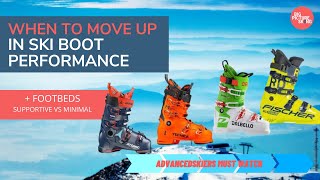
Brent Armsbury, a boot fitter, explains why plug race boots demand high skill and precise technique to work. Narrow lasts, aggressive forward lean, and minimal footbeds give direct edge control but feel unforgiving without carving ability. Most skiers should exploit their current boots before upgrading.
Chapters
Hello skiers, welcome back to another episode of the Big Picture Skiing podcast. Today you're going to hear from Brent Armsbury again, and Brent's back on the show because he is a wealth of knowledge. We're talking ski boots and specifically plug boots or race boots— very stiff, very narrow— and we're going to look at who these boots are really designed for and is it something you should be looking at or completely sort of steering away from at the moment. So I've recently moved into a plug boot, but I've skied for most of my career, most of my life, not in a plug boot. So I guess there's some, some context we want to get across here because he's had some situations where people have gone down that road and it hasn't helped their skiing, it's actually hindered it. So hopefully you'll have some more information on sort of what higher-end type of ski boot might be better for you. So that's one area we discuss. We also get into footbeds, supportive versus non-supportive in your ski boot. And so this is interesting because Brent went out and at the end of the season actually skied in a pair of race boots that had a very minimal, if barely at all supportive, footbed inside of it. And he talks about his experience, what he felt, and sort of gives some understanding as to why some people might like that experience why others might not. So I think this is a great chance to get some understanding and context from two people, myself and Brent, on the topic of supportive footbeds versus less supportive ones and what benefits you get from both sides of the coin here, the, the type of footbed you choose to ultimately put in your ski boot. Now I think it's really important to have this conversation with a boot fitter like Brent, because if people know me, I ski with a minimal— it's a flat footbed, I don't have any support in there, I've been doing it for a long time. And I guess if you want to understand where I'm coming from, my approach to skiing, who tends to like my kind of coaching, if you're really into technical skiing, getting better, you're an instructor, you're sort of like skiing is your thing, you put all your energy in it, you love getting better, it's not just something you go around and you, you go to lunch with people with, it's, it's like you're real passionate, you, you're a deep diver into the sport, That's where I'm coming from when I sort of talk about things in terms of ski equipment and the way I set things up. So if this is interesting to you, you can check out a lot more of my content, of my philosophy, the way I teach things, the way I set my boots up, my skis up, on bigpictureskiing.com, as well as an iOS and Android app. So that will also give some understanding as to where I'm coming from, because it's definitely not for everyone, the footbed, having a minimal one, there are quite a few steps you've got to go through to get your boots set up right, as Brent will kind of touch on in this episode, in order to make that minimal footbed, that dynamic setup for your foot that's going to be working a whole lot more, perhaps a little bit harder inside the boot than a supportive one. But there are reasons behind it that I truly enjoy, that you really feel if you go down this road. So to really get that a lot more, you really need to probably understand where I'm coming from, and you'll find out a lot more of that on the Big Picture Skiing website. Okay, enough on that. Let's get stuck in today's episode with Brent Armsbury from Park City Ski Boot.
So Brent, there is a spectrum of performance within ski boots, and today we're gonna, we're gonna look at that. I'm going to start right at the top with race lug boots, so narrow, very thick hard plastic designed to sort of perform on really hard snow and go really fast. Do you want to start with talking about like the design in these boots and, and who they're really for and who they're not for?
Yeah, for sure. Um, plug boots have, have over the years gotten this sort of mystique of being the absolute top performance boot product you could get. And of course, every World Cup racer uses a plug boot, right? And the name of a plug boot, the nickname, why it was called a plug boot is because the inner, the inner shape is the smallest one they would do, meaning it's the smallest plug inside the outer casing of the of the injectable shell. And so you ended up with this really thick shell wall, right? Really thick, no space inside. And then technician would go in and like, um, you're hitting here, you're hitting there, and you would just grind out the shape of your foot and off you go the races. But the plug boot evolved from there. They, over the years, they figured out, well, we can make these boots do better on these harder conditions, on these harder, firmer water-injected surfaces by changing the angles of these boots. These boots were no longer just sort of copies, thick shell wall copies of, of boots that everybody could get on the market. They started changing the forward lean, they changed the ramp, they changed the outward cant of the boot, They changed the height of the cuff. They changed also where your foot was positioning inside them a little bit, either inboard or outboard, or whether you were abducted or adducted. So the race departments were always like, what is it that makes our racers go faster? Bottom line, that's all they did. It's no different than like a Formula 1 race car, right? I mean, the early Formula 1 cars were just like lightweight bodies with big, big engines, and but not much different in terms of the tires and everything you could get stock. Now look at an F1 race car. It's all carbon fiber. It's a, it's a, it's a computerized controlled hyper-built motor to produce maximum horsepower for short periods of time. It's nothing like a car you would use to go get groceries with, right? It's absolutely a completely different machine. And that's where plug boots have gone. These boots have become fine-tuned for maximum edge angles on hard snow at full throttle, right? And so they really don't— they look like their freeride, you know, cousins, but they don't perform like their freeride cousins because they're, they're built and angled differently. And so if you don't have a strong skill set, if you're not carving simultaneously making trenches in the snow, these boots on your feet are going to make you feel very, very different. If anything, even maybe out of balance at first because they're putting so much energy into the turn, they're putting so much more input into your ski than you're used to, that you're not quite sure, you know, what to do with all that. And so there's a— there's definitely a skill set you need to have to kind of qualify to use these boots.
So I would say, I mean, along that, you've like, uh, performance on the snow-wise, we're talking about how you want to be pretty comfortable on a blue, decent blue run to be railing those turns clean, two clean edges, outside ski, inside ski, from top to bottom, linking turns, and comfortable going with a bit of speed. Like, these things, like, you've got, you've got to be okay going with, with speed because they're just going to punish all the little errors you make at slower speeds with their precision fit and, and stiffness of plastic.
Absolutely. Um, There is a bit of a misunderstanding with these boots is that because they fit narrower, then why don't people with just narrow feet buy them? I mean, that's like a 1 1 2. Oh, I have super narrow, low-volume feet, and the only thing that seems to fit the description of my feet is this low-volume, narrow-fitting race boot, plug boot. So I just get a pair of buck boots, right? I fit— I've solved my fit problem. But there's a problem, right? There's a paradox here. You're not in a boot that's actually helping you balance better until you have this capacity in your skiing, the ability to rail edge to edge. And even then you may not find this boot to be the most comfortable device to use in a wide range of conditions. A plug boot, full World Cup race boot is not the preferred choice to go powder skiing in. No. It's gonna put weight— I mean, you can't really— it doesn't want to promote a good scarf, right? A good smearing effect.
So—
And kind of, and even when, you know, when your ankle flexes, your boot's going to shove the tip down. So you may be hitting some bumpy terrain, you— your ankle doesn't just flex as an absorber, it flexes and shoves the tip down, and then the tail's gonna— it's just gonna not have, have as much give there.
Correct. And, and because a plug boot has a higher back, right, it's higher, it has more forward lean. So if you make the fatal mistake of leaning back in one of these boots the punishment is immediate. I mean, the tips will absolutely squirt out, the whole ski will squirt out from underneath you and leave you completely out of balance. You have to be forward on the boot all the time. So there's no forgiveness, there's zero forgiveness in your skiing for these. So yeah, on a nice smooth surface with linked carving turns, you can master these boots, but you have to have a baseline in your skill set. And so if you have these low volume feet that you say, well, 1 1 2, I should just get a narrow fitting boot, and you don't have the skill set to work with this level of boot, it's not going to work out in the end. You're not going to feel balanced. You're not going to run a flat ski. You're not going to feel like there's any sort of forgiveness for any errors in your technique. You, you could potentially go backwards in your ski technique because you're going to find yourself trying to overcompensate for what this boot is trying to do.
Yep.
And I guess we're having this conversation because you've seen people come in with this problem that they don't have the skill set that we just mentioned, but they're in a full-on race plug boot trying to ski around doing more medium-level performance and even instructing low-level stuff. And they're wondering why they're having such a hard time. So I think you've got to be— I guess I'll give a story. Like, I only went to a proper 150 plug boot this season, and I've skied all my life prior to that without having a plug boot and done fine. And the only reason I went there was, uh, because I said to myself, if I'm going to ski in New Zealand, I'm going to ski in Australia on harder snow go faster and really push it, and there's going to be more energy, more forces on me, I feel like I need a little bit more than what I've got, and I'm ready for that. But I was having a great time. I could ski all that sort of stuff and still be okay and fine, and, uh, but I could feel that there was like a little bit of performance missing there, so I was ready for that. But if you don't really get to the point where you've maxed out your current boots like, as you said, wrung out every single last bit of performance, I don't think it's really necessary to, to move up. You'll, you'll kind of miss all the learning you get from really getting the juice out of, you know, what currently boots you're skiing in, right?
And it's not something— sometimes even moving up, it's you're trading, right? So in a plug boot, yeah, you're moving up, but you have to trade. You have to give something up. To get that move up. And that is you're giving up sort of a slackness, a buffer, um, some— the ability to kind of back off when you want to. Um, these boots want you, and they, they inspire you to ski at full gas, right? Full throttle. I have a pair of Blood Boots. I I've gone out and skied on them. How much do I ski on them? Very little. And because it's kind of like when I had a motorcycle with 160 horsepower on a lightweight frame, it was really fun to ring the throttle and go 150 miles an hour on the freeway, but it wasn't really good for me. And that's the same thing with my skiing, like taking a pair of plug boots out and skiing on them, I'm not going to ski on them in conditions where it's bumpy, lumpy, uh, sketchy early season stuff. I'm going to make sure it's really nicely groomed, it's early in the morning, there's nobody out there, and I can just put full gas, full throttle, and I can ski them for 3 or 4 laps. My heart rate's really up, up there. I've— I'm completely focused on every turn, what my feet are doing. I'm on the right ski, right? I'm on a racing carving type ski, and I'm giving it 100%. 100+ percent for 4 runs, and then I'm done, right? That, that's, that's it. That's all I can put out there for that. And I'll then I'll just go back, switch my boots to a good old freeride boot, and I can have fun and blow around the mountain for the rest of the day. Because I understand that that boot, that's what it wants. That's what I have to deliver to make it work. If I'm gonna compromise and say, ah, this plug boot, it's going to be great for the rest of the day, I'm going to go ski a bunch of bumps and powder and boot off, it's not going to be good. I'm going to work way too hard. I'm going to have to put too much focus, too much energy all the time. And, and there's some things I won't be able to do with the boot. I can't really always just schmear. I can't just, um, relax, okay, and be a little lazy, okay? And sometimes in skiing it's fun to be a little lazy. You get to be goofy, right? You can totally— you can do things to just kind of back off and catch your breath for a run or two and be a little lazy, and then go at it again. A plug boot by design doesn't want you to go there. Yeah, the forward lean, the angles, the high backs, the thick plastic is just sending all this information to you all the time, and that's what it's supposed to do. But we don't always want to ski that way, so you have to be careful in making a choice for these type of boots and saying, oh, I'm ready, I want to be an all-star skier, so I'm going to get this 'World Cup plug boot,' and I'll get it fit and dial it in. Um, be careful, right? Like, be careful with that choice. It may not be— very unlikely it will be a good daily driver.
And I think you're— the other mistake, the other mistake you're mentioning people made in going to a plug boot was just the narrowness factor, because they are narrower than a lot of the other narrow boots out there. And so maybe you just want to comment on on that.
Yeah, I mean, I've had clients come to me and say, hey, I have super narrow, low volume feet, and I read that these boots will fit narrow, low volume feet. And they, they buy into that, and they get in these boots, and then all of a sudden things are not working out. They don't feel like they're riding flat. They don't feel like they're balanced. Um, we've had clients go out and go, oh, it's got to be the canting. So they go get them canted differently, and then somebody says this way and somebody says that way, and then they kind of take it out. Like, there's, there's all these iterations of things that they keep throwing at this boot and spending more money and more money and more money to try to figure this boot out, but they don't have the baseline skill set to ski them. And so the boot fit okay, It was narrow enough, but because these boots were set up for a certain skill set, they never find they can feel comfortable and balanced in the boots. And they spent like thousands of dollars because they thought a narrower fitting boot was going to solve their problem with their fit. But the, the way the boots are, these boots are are set up out of the box, what they're designated for doesn't match for them. And it turns out to be a really a backwards situation when they thought they were going forward, instead they were actually going backwards.
Yeah, you know what, it's probably worth mentioning, I don't think we've maybe talked about it or deliberately here, but so, you know, you go in the shop and you go, you find out or you look online that the Fischer Podium GT is 96mm wide in the forefoot. So it's a 96mm last. But some people know this, but others may not— the sizing or that last changes per size down and up. So can you just speak to that? So people might realize that they have a small foot and actually a 96mm last, and they have a 92mm foot, maybe they will fit.
I'll let you speak to this, uh, sizing difference. Correct. And that's where these numbers things get a little confusing. So almost every manufacturer, when they rate their boots, let's say you say, oh, it's a 96mm last, but that's at 26.5. Almost every manufacturer for their freeride unisex boots use 26.5 as what they call the reference last. So when they say, oh, it's a 96mm lasted boot, Well, that's at 26.5. At 25.5, almost every manufacturer drops down about 2 millimeters. So it's a 20, it's, it's a 94 at 25.5. It's a 92 at 24.5. Okay. And at 23, it's a 90. Okay. And it becomes an 88 at 22. So like you're saying, well, you know, I've got, you know, like a 94mm foot, right? And I'm a 23.5. Wait a minute, that's a 90. So you're actually in a boot that's actually narrower than your foot, right? So you re— a lot of people do not need to go as narrow as a 92, 93mm boot. These boots were designed to be downsized, and they were designed to be punched and stretched and ground to make you fit. I mean, there's, there's a lot of World Cup racers with 102mm feet, okay, at width, and they're in a 92 lasted boot because there's a technician who worked all that out, and they're used to being compressed like that. If your feet are not being used to being compressed at that level All right, then you don't need an extremely narrow boot. Okay, you can— if you want a snugger fit in the ankle, get yourself a really good zip fit liner. Lots of choices in the, in the different range, or you can go to a foam injection, or you go to Intuition. But like, for performance, you know, zip fit is like one of the greatest things out there, right? You can snug up the fit without having to go to a narrower boot. You get all the performance without having to get all the pain. All right. That's right. Yeah. So like the 96 lasted boot is kind of like that end range for the, the consumer high performance boot. And you just put in a better liner and a booster strap and you kind of dial it in with all your goodies. You don't need to go to a plug boot until you're really ready for the tradeoff that you're going to make going to a plug boot. You got to know what's right. Get up. You gotta give up something to get something. It's not gonna be this, you know, I get everything and give up nothing.
Okay. Yep. Yep. Now, Brent, we've talked before, and if people follow me, they'll know I'm sort of an advocate of not having much, if anything, under my, my foot other than a flatter insole. And this is compared to like a custom molded one. And I just want to, I guess, clarify some stuff here. We had a good discussion offline before, but let's see if we can bring it back. Some of the points that I think we both agree on in terms of it's not a good or a bad thing, there are just things that you get when you have, uh, an insole that is shaped to the, to the bottom of your foot, or even changes the way it naturally sits on, on the ground. And there things that happen and certain environments, boot setups where perhaps a, a flatter insole has different outcomes. So, so that's kind of the topic. And, um, I was interested, you went out and you tried basically pretty much a flat insole, a little bit of something under the arch to just feel it. But can you talk of that story first before we then go into like when a, when an insole is a, is a really good helpful thing at your stage of skiing, and when perhaps even taking that away bit why that—
what that might give you. Yeah, so this, this whole thing, I mean, it really comes from— there's always, when you hit these high-level, elite level of skiing skill sets, you inevitably hit this question like, do I need footbeds at this point? I mean, I've had footbeds, I grew up with footbeds, I had footbeds, molded footbeds, but now I'm like downsized in this really high-performance boot. There's not a lot of room in there. I feel pretty good with my feet just on the bottom of the boot. Do I need these? And I think the best way to explain it is that as the boot gets closer and closer to your foot, right, as you progress into a snugger and snugger fit— because that's this natural evolution, right? You start off with a boot You bought it at, you know, like the parking lot sale 20 years ago. It was too big, it was too wide. You know, somebody said get a pair of footbeds, it was magically much better. And that was— yeah, it was great. That was me. I went through that. Okay, footbeds were magic, it made everything ski better. And then you went, oh, the liner's packed out. And then you got properly measured and you got down to a smaller boot. Snugger fitting boot, and then you like skied that for a few years and went, what if we go even a little snugger, right? And you just— everything gets closer and closer, but that footbed starts to fade in its overall importance because that boot is now becoming the support to your foot. So, and, and I've played with it myself. I went out end of the season I got— I brought my old race boots out. I had a foam injection liner in there and I had footbeds in there, and I checked my feet in these things and I was like, I don't feel like I'm on the bottom of this boot, right? Fit me 6 years ago, 5 years ago, and actually fit. I mean, they felt like they fit, but I was thinking in my head going, I want my feet— I want my feet on the— really on the bottom, like the bottom bottom. So I took the footbeds out and just put a stock insole in there. And I was like, boom, my foot went in there. And then they hit the bottom and they kind of got to spread out. And I felt really natural. It just felt really like the light bulb went on my— like, ah, right, my feet are here. A little bit of an arch cookie on the right because I have a taller arch and there was a little bit of a gap. So I just got a little scaphoid pad, a little foam cushion, and glued it on and cut it off with some scissors and chucked it in there. And went out and skied on it. And I went back and forth, actually. I had— I put my footbeds back in there, went and skied on it, and then I took the footbeds out and just put my pseudo footbeds in there, the flat ones with a little tiny foam cushion, and skied it again. And there was definitely a difference. And the difference was I felt more precise. I felt more like I could really make the ski work through the turn progressively. I could feel like I get the ski out a little farther. I really felt more connected with the ski without the added footbed. Now, would I do that for my powder boots and my powder setup? No. Do I have footbeds in my touring? Absolutely. I'm walking, I'm climbing, I'm doing all these other maneuvers. I don't fit the boot quite as tight or snug. I'm not downsized in those boots. And so My custom footbeds are like, yeah, yeah, absolutely, positively. But in these race boots, I'm downsized, I'm tight, I already got a foam injection liner in there, so I am snug as a bug. Um, without the added resistance underneath my foot, I got a different feel, a much different— and in the— a different feel. The feel was for me, for performance, was better. Okay, did my feet feel great? Did my feet feel like, ah, how would a refreshing 2.5 hours— no, I definitely feel like the muscles in my feet were working because that's what I wanted them to do. I wanted my feet to work inside the boots and make that nice entry and exit, and I feel like everything is going on. So I had to trade something. If I had my footbeds in there, I could probably ski lazier. I could have skied more, a little bit more chill, but I don't think I could get the skis on higher edge angles. I don't think I could have had quite the same feeling. I don't think I could have made the ski carve the way I was without the resistance underneath my feet.
So I gave something up to get something. Yeah, like we were saying, so there's not— it's not like a good or a bad thing, it's just what— yeah, the environment that your foot is working within, it's going to respond and work differently depending what's under. That's all it is. It's just that that boot is an environment that your foot is working, has to work within. And so the, the shape of it, the type of material even under there Like, I think there would be— you'd probably even have a massive difference if you had a custom insole that had a certain type of foam across the top versus a custom insole that was really thin and had a layer of carbon. You would have been able to speak to, like, a different feeling.
And, yeah, and, you know, yeah, in hindsight, at this point, let's say I quit my day job and I just go out and I race train. I just want to be a master ski racer and I just want to race train. You know what, I'd put a footbed back in there, but I'd probably make it out of carbon fiber. I'd make a special carbon fiber insole. I probably wouldn't put anything over the top of that dang thing and no cushion. I just— I'd be hard on the deck with the contour of my foot in its most conservative form in that race boot. And that's what that would have taught me. Like, I get this really natural feel. I'm on the bottom of the boot. I got minimal material between me and the bottom of that boot, and I can get but I'm getting a lot of information, and yet I have just enough little bit of support for my type of anatomy and biomechanics that I'm getting just enough to allow me to race train all day. Okay. Yep.
So do you want to speak to, like, because then it brought up, it's like, okay, but people listening, and you know, there's definitely, you know, people have had some really great experiences where they've maybe they've skied for 5 years and then they get taken into a shop and they get custom insoles. They come out and skiing is much easier. Hallelujah!
It is more enjoyable.
It's easy to do all this sort of stuff. Do you want to maybe speak to one of the things that, like, a footbed can help with if you're, yeah, in that realm and you're maybe not the most athletic person that's really, you know, agile on their feet? Yeah.
What is that footbed kind of helping to give that good experience that people talk about? Well, the things I noticed right away with the footbed, and I, I test a lot of boots, especially at the end of the season, new products come out. And so manufacturers, they provide boots to test. And so, okay, I get a pair of test boots. Now they're almost always 26.5 because that's their reference size and that's what their first production is. So for the tests, they usually don't have a range of sizes. So like, well, maybe have a 27.5, maybe have a 26.5. If you're lucky, they might have made a 25.5, but it's almost always 26.5, 27. So I get a pair of 26.5s, and that's a little big on me, right? So it's just a little bit on the big side. So I throw a good pair of custom footbeds in there, and the thing I noticed right away with the custom footbed is that the passive resistance through the arch and stuff gives you a lot of tactile feel, right? You feel everything underneath your foot. And so when you're just kind of rolling from edge to edge, 0 to up to maybe 30 degrees, you feel good. Like, the passive resistance of the footbed gives you a lot of comfort and control immediately. It's just very easy to make things happen. It's when you push past 30 degrees, when you're trying to get everything to topple, that the footbed starts to shift what you're feeling. And for many skiers, right, we don't go past 30 degrees. I mean, powder, great. I am not laying out. I don't want my inside hand on the snow. That's retarded, right? I am popping and floating, and I'm kind of you know, smearing and having a really good time, I'm not using big edge angles. So it's great, but at a certain point in terms of the fit, if, if I were to take those same full custom footbeds with the support that they offer me in a boot that's a little bit bigger or a boot that's a little more relaxed in the fit and put them in a downsized very snug fitting race type boot, even if I trim them just right, the way they're going to fit and feel, what they're going to deliver at all phases of the turn is going to be very, very different. And they— it could be different to the point of negative. So there's nothing wrong with the full custom footbed within most of the range of having fun and skiing and enjoying ourselves. But when we're pushing the envelope, we're looking to push for bigger edge angles, and we're looking to push what we need to do to get our feet to ski, right? We're skiing with our feet. We got to think a little more outside the box.
Yeah, because I think I liked what you said, you know, for like an intermediate person, that footbed is helping kind of contain their balance a little bit, because I mean, skiing is all about balance. And, you know, steeper runs, you're challenged in terms of, whoa, leaned too far or back or whatever. That footbed kind of reins you into a certain zone that, that you don't breach as much. So that, that experience possibly that people are having that's enjoyable is like suddenly someone is helping— this, this device in their ski boot, it's helping them keep within a nice balanced range so they can I've got time to react. It's not like too late before they, before they lose it. Um, yeah, and I was saying to you, you know, working with, with people that I work with training their bodies in the off-season for ski season, many of these people I find, you know, we, we work on their feet, we work on their balance and knees, and it's terrible. Like, they're not even moving, it's just in their living room on the, on the hardwood floor. And I get them to try and do these balance maneuvers using the side and the front and the edge, and then one foot or not, and they're terrible. And so of course, if you give them a footbed and say, right, just try and stay balanced doing it, it's going to be easier. But then, like you said, it's going to keep you within a smaller zone. You're going to have that balance and control, but you're outsourcing that kind of containment of balance to a device instead of learning to have the agility and the reactions, the balance reflexes, muscle activation to do it, you'll do it yourself. So yeah, why a lot of people like, don't rip your footbeds out, like, after hearing something like this, because you're probably going to have to go through some training. Like, even you, you did it all season. Sure, your feet are obviously like, just like anything, you do lots of squats, you can eventually get more and more weight on your back, but you can't just go, great, squatting heavy is going to make me stronger, I'm going to put 250 pounds on. You've got to start small and, and build your way up.
And there's, and there's the progression with the boot as well. You can't just, you know, say, oh, I'm taking the footbeds out of my boot and it's going to work. Like, you do have to downsize. You have to go to a much snugger fit. That's, i.e., the plug boot. That's the whole concept of it, was plug boots actually run a little bit bigger than their average, than their, their, the, than their rated size. They're actually longer inside, so you can downsize. And so another people, the people understand with plug boots is that you have to downsize with these. You can't just go, oh, I'm a 26.5, therefore I'm a 26.5 plug boot. No, you're probably a 25.5, you just don't know it yet. And so get there when you downsize, that boot's closer underneath all the points where a footbed would be working. So the boot becomes the footbed. Yep. And so you have to make these legitimate moves and progressions to understand why that footbed isn't really central anymore. It's now faded into the background, and the boot and the fit and the angles on that boot now become central. Yeah. Okay. Yeah, it inverts the picture that we've been taught, right? Yeah. Gotta have a footbed. Got— I mean, you know, okay, now it's inverted. Gotta have the boot closer to the foot, and the footbed now becomes sort of like this fine-tuning device, if at all. Right. If, you know, many racers don't use the footbed because they don't— that they're on the bottom of the boot, they're getting all the information they need.
They don't want another layer of material in there that they have to filter that information away.
Yeah, yeah, yeah, yeah, totally. It's, it's just, it shifts that picture. Yeah.
So I hope that I hope this has helped— this conversation has helped people maybe understand, and that's just listeners, other boot fitters, you know, people that have listened to conversations you and I have had, Brent, around this topic, and maybe given a little bit more context as to, yeah, reasons why we choose certain things in our boot setup. But, but also for those people on their own journey a little bit more information again on, you know, what you're getting into. And, you know, don't get ahead of yourself, you know, until you've really wrung out like everything in, in your current sort of setup before moving up. And realize there's just trade-offs. Things, things change. It's not better, not worse, just certain aspects, attributes get stronger, others, others get less. So if you think about that you weigh it up and that's what you— where you want to be going, sure, like, go into it. But, uh, yeah, any final words from you on, on this discussion?
Anything you've got in your gear, right, like your current boot setup and your footbeds, and as long as you're fore and aft balanced, right, you, you feel balanced on your ski and you're on a good 14, 16, 18 meter radius, radius sort of carving type ski, you can wring the crap out of that stuff. I mean, you can go out and rail, okay? You don't have to have a World Cup ski. You don't have to have the hottest ship and the one that the ratings are 5-star and all that. You can take your current setup and tune it and dial it in and rip. And learn how to rip on it. And when you've completely wrung every little performance out of what you got and you go, oh, I want more, now you're ready. Yeah. Okay. Now you're ready to move up to the next piece of gear and appreciate it. Your gear is not going to ski for you. It's what you put in, right? Yeah. And so jumping around like, oh, I'm going to buy this ski, I'm going to buy this boot, I'm going to buy this, it's rated like this and this and this is going to make me a better skier. I hate to tell you, folks, it ain't. It's, it's the time on the hill putting muscular effort and skills into what you got that teaches you how to go to the next level.
Yep, that makes me think of that lady you sent some footage and you said, do you think this person, what they're doing here is down to their boot setup or their, or their sort of technical skill level? I was like, that is all skill, what she's doing. And so what they were doing there, that was just probably better off loosening the boots, going out and doing just drills and learning to, to balance. And yeah, yeah, I totally agree. I think a lot of people go down the boot equipment path when they haven't, like you said, really pushed, rung, you know, everything out. It really pushed how much they can, yeah, challenge their balance and technique.
So it's great. But I've gotten gear, I've gotten gear, you know, I've gotten boots. I was like, oh, I got the pro model and I went out and skied on it and went, this thing's too much for me. And what I did is I went and got the 2 flexes softer and it skied better. So like sometimes we have to check our egos, right? Totally. I'd rather have a boot that I can wring the crap out of it as opposed to one that like, I can't, I can't make it happen. Oh, it's, it's pretty, it's yellow, it's shiny, it's the one that's on the magazine cover, but I ski like crap in it. Yeah, yeah, it ain't awesome.
That's all I'm saying. That's great. Well, thanks very much, Brent, for your time, and I hope this is really informative and, and helps people Enjoy more days skiing.
More from Tom



Most skiers overlook how they use their poles. Try these five pointers next time you’re skiing.







