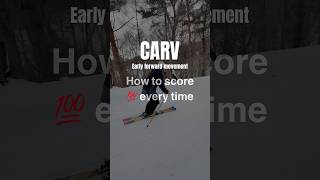
In this instructional video, Tom Gellie and skier Floris demonstrate Carv’s monitor mode for the “early forward movement” metric. Floris shows how to achieve perfect 100‑point scores by performing rapid foot‑forward‑and‑back (dolphin turn) movements. Tom explains that Carv’s accelerometers, embedded in the boots, only detect this foot motion—not upper‑body shifts—so the metric reflects the dolphin turn rather than overall turn dynamics. He clarifies why long, patient turns typically yield lower early‑forward scores (38‑60%) because the foot movement is less rushed, whereas short, aggressive turns produce higher scores. The video emphasizes the coaching value of training dynamic foot movements to improve balance and mogul skiing, warning viewers not to mistake the metric for overall turn quality.
So I've got Carve monitor mode on for early forward movement. I'm going to show you how to get 100 every time. 100, 100, 100, 100, 98. It's just making a dolphin turn movement. So I'll get a bit more speed.
This is a dolphin turn, in case you didn't know, where the feet move forward and back in a jump very quickly.
172, 100, 100, 165, 100.
So at this point in time, Carv is using accelerometers to measure a foot forward and back motion at a certain point in the turn. And yes, pulling the feet back is a very effective way to get early forward movement in a turn. However, I think a lot of people don't realize this and are trying to move their upper body. And so the accelerometers in the Carv 2 units just don't sense that. And so you don't see an early forward movement change. You don't see much of an early forward movement change, or not nearly as much as in a short turn when you carve a long turn. This run here, I averaged between 38% and 60% for early forward movement, because remember, Carv is using accelerometers on the boots to measure the feet moving back and forth. And in a long turn, we don't often need to be as rushed. It's more patient and gradual with those movements. So that's why there's going to be lower metric scores in these type of turns. Overall though, I think it's very important to work on the skill of moving the feet dynamically back and forward. It's a really great way to adjust your balance from feet, not so much just the upper body. Here's my friend Floris practicing with monitor mode so you can see that he can also score 100 practicing this movement.
What now? It's tiring, but it's not measuring early forward movement, it's measuring your feet going forward and back. If you want to work on early forward movement, it's not necessarily moving forward in a turn Great movement for your short turns. It's pretty much measuring the dolphin turn, the dolphin turn in your skiing.
So my suggestion here would be to learn to do a dolphin turn, learn to move your feet back and forth just as carve measures early forward movement. This will help your mogul skiing. Your upper body will be able to stay far more quiet as your feet do a lot more of the work. In this rough chopped up snow, for example, my feet moving forward and back give me a much more balanced position. But remember, longer radius turns or slower rhythm or even lower performance turns don't require you to make such a drastic movement, so you shouldn't be looking for Carv to give you high scores in the early forward movement metric. So go ahead, work on it, use Carv's monitor mode to help track it. You don't have to have it, but it definitely does help to get real-time feedback. I hope this has helped explain another Carv metric and it's helped you to improve your skiing.