Your Ski Poles Are Too Long! A Deep Dive In Pole Planting and Technique
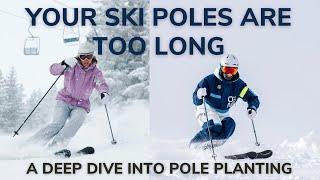
Tom Gellie and pole specialist Paul Lorenz explain why most skiers use poles that are too long and how proper pole length improves timing and edge transitions. Paul's extendable poles cost around AU$129, and he shares drills like inside-pole dragging to help skiers feel the difference pole placement makes.
Chapters
Ski poles are not really a talked about topic, but today you're going to learn a whole lot more about the importance of getting the right length of ski pole to help with your style and technique in your own skiing. You will quickly learn that you probably have too long of a ski pole, and the reason behind it comes back to the way we introduce beginners to ski poles in the rental shop, the way it's measured right there, and it's great for the beginner. However, as you advance on and become a better skier, and start skiing more dynamically, skiing bumps, that sort of stuff, you're going to require a shorter pole in order to have a better position when you go through the transition. In this episode of the Big Picture Skiing Podcast, you're going to meet Paul Lorenz, a really good friend of mine, an excellent skier. He's got a ton of information and has spent a lot of time thinking about pole planning, arm position, and all of that that goes into creating a really great turn. And if you've seen him make a turn on skis, you would know this guy knows what he is talking about. Just before we get started on this fantastic episode, a shout out to my own company, Big Picture Skiing. If you're interested in elevating your technique, learning about all sorts of stuff, whether it's carving, moguls, your equipment, I try and cover it all with a video library that is as extensive as it comes on the internet. Okay, I think you're going to love this episode with Paul. There's a ton of information, so let's get into the episode right now. Hey Paul, I think that ski poles not really discussed that much. Even upper body, arms, pole planning, it's not really discussed in people's skiing. Can you let us know your thoughts on, is it important? And if it is, what's it going to help with?
Well, I think it's an interesting question because, uh, like all equipment, it does play a part and have a big impact. But, um, I think that if you are going and spending $600 on a lesson or private lesson and then you only work on pole plan or you only talk about equipment, that's a problem. So like I said, it does have its place, but I think it's more in that sort of intermediate to advanced zone where the equipment starts to have more of an impact. I think until you're parallel skiing and you're making a pole plan and you're using it for a purpose, it doesn't really have a whole lot of an impact. But once you get to that point, then it does start to have an impact. And I think when you then look at the really, you know, more advanced and higher levels, that, that sort of 1% that improves everything will make a big difference, and your poles are a big part of that as well.
So yeah, so what is the— what role do ski poles in a pole plant play in your opinion?
Well, um, the, the pole plant, I think everyone knows or talks about the pole plant as having to do with timing, and that's a big part of it. And I think at first glance, um, a lot of skiers use it simply for timing. But I think the bigger part, and what I find in my time training and time skiing, is that it helps with edge change in more than just the timing. And I say that— this is going to get a bit detailed, and it might be hard to explain without showing you, um, but for anyone to transition from one turn to the next, if you're thinking about your skis are pointing across the hill, to transition and have both skis change edges at the same time, your center of mass, or let's just say the hips, need to be at least above the skis. So across the hill, downhill, need to be above the skis or more so actually down the hill of the skis. And that's the part that most people struggle with, even advanced skiers. So that's why you'll see they'll often do a stem, which is a snowplow, because that's a sort of a fake way of getting your center of mass or hips down the hill of what's going to become your outside ski while you've still got a training wheel. So that point where you're down the hill of your skis at the top of every turn is a very vulnerable position. And while you you know, when you're skiing at speed, you might not have weight or balance on the pole. It does give you a third point of reference, and that's something that, you know, I find that third point of reference gives me so much spatial awareness as to how far I've moved in or what angle I've crossed over at. And when I ski without poles, yes, I can do it, but the autonomy of that transition is not there like it is with poles. So there are other benefits as well when it comes to, you know, absorbing pressure and that sort of thing. But if you're doing that well with your legs, really that first point that I mentioned about sort of spatial awareness and allowing you to transition, that's the key.
Yeah, wouldn't you say like a great sort of experience to sense what you're talking about is do a couple of runs, especially on a steeper slope, without your poles and just feel like where, where do you feel comfortable in that transition? It's, it's way easier with poles.
100%, absolutely. And another thing, if you're, you know, not comfortable going on steeper terrain, you could go the other way where you go on very flat terrain and go too slowly and see if you can try to keep your skis parallel. And I mean truly parallel, even when the edge changes. And even again, most advanced skiers, it's something I'd warm up with because it's a hard thing to do because the window of, you know, that transition of being over your skis or into the turn is so small, that small, that slow speed, and on the flat that it's very hard to get right. And again, if you do with poles, even whether it's a pole plan or dragging your poles, you'll be far more successful. So that's a, that's a really good sort of technical, very slow-moving thing you can do to warm up. And it'll tell you if you, if you have somebody videoing you, you'll see a snowplow most of the time. It's because that transition, uh, you know, isn't right, and the pole plan will help you with it.
Now I remember So speaking— so we've talked about poles and that there's not just a timing thing, but it's also— maybe put it in the— in like, it helps with commitment to that critical position in the transition, especially as turns get on steeper terrain or you're going slower. So if it helps there— I remember back in Threadbo when I first sort of met you and we started skiing together, you skied a lot with adjustable poles. And I sort of learned from you and, and Riley that, that shorter was, was more useful in the kind of skiing we were chasing— high performance dynamic skiing. So how did you come across shortening your poles? And then, yeah, going, you know, why did you keep choosing adjustable poles as your pole of choice?
Well, I think there's sort of two parts to that question, but the adjustable pole is simply for flexibility of being able to experiment and change the length, and it sort of makes sense. The second part to that is that I think that the length of pole or the height you're going to be at during the transition will be very different depending on your ability, depending on the edge angle and speed you're skiing, and also the terrain that you're skiing as well. So in the same way that there's no one ski that fits every turn, I think your pole length— there's no one size that fits every turn. And it's interesting because I think there's probably, you know, when I went through my— or started my career and went through my training, there wasn't a whole lot of information about this. So it's sort of this unknown, just go by what's always been done in the past sort of situation. And the only way that people have really fitted poles has been for beginners in the rental shop. That, and when you look at racing or, you know, cross-country skiing, there's a lot of emphasis on pole length because it has a lot to do with skating and your length of push. But for downhill, outside of skating out of the start gate, there hasn't been a whole lot of discussion or experiments going on there. So I sort of thought, okay, well, let's have a look at this and play around with it a little bit. And I guess it also was sparked a little bit by the fact that I found myself repeatedly saying to instructors and people that I was skiing with that they're skiing with a pole that's too long. And you could see, you could see that in the effect it had on the upper body, in its stability, and the vibration back through the arm. Um, it reduced the fluidity. And I actually found when I was on a longer pole that I started to get, um, quite sore joints through my wrist and thumb and shoulder if I got in the bumps. Very much so. So I thought, okay, there's something to this, I've got to look at it a little bit. And I mean, the extendable whole thing was just so that I could experiment without cutting down, you know.
Yeah, absolutely. So that— yeah, that's how you found your more ideal length. But on that, was there someone that you realized was skiing on much shorter poles than what when you started out were being trained as to what it should be?
No, not necessarily. Um, you know, obviously speaking with Riley a lot, and he was sort of going through the same sort of transition, and speaking with yourself, and, um, not so much. I mean, you saw freestylers using it, but they don't really use poles. It was more a trendy thing. But from a technical point of view, no, I didn't, didn't really see too many other people. Um, yeah, so I just thought I'd play around with it like we all do and experiment.
And what did you find What's— so, so you've said sort of there's different lengths almost for different types of turns. What do you like? What are the different lengths? And maybe let's start— how tall are you and, and what's your kind of like average— what do you ski with?
Yeah, so, uh, there's two parts to that as well. So I'll start. I'm about 178 centimeters tall, and when I started ski instructing, I was on a 120 centimeter pole. And now I would say as an average, if you had to use across everything just without changing, I'd be about 110. But that changes again. If I'm in the moguls, I'll go down to 105. You know, if I'm skiing with intermediate or lower intermediates, I'll be more like 115 or 120. So I will change. So now the question, how or why does it change? I'll start with the performance of the skiing, which has the biggest effect, and the, I guess, the edge angle that you have through the turn. That will determine how tall you are in the transition. So we're going to go into detail here, so again, might be lost in communicating, but the more edge angle you have, inherently the further your center of mass inclines or moves into the turn. And the, the more you move in, you don't just move in, but you also move down. So if you look at a lot of trending photos on Instagram, the hips are very close to the snow. Now, in the transition, then, if I need to go from that far in and down on one side to that far and down on the other side and I need to do it quickly, the more direct— the more directly I travel across the skis, the quicker that will happen. Now, I'm not saying that my hip's going to stay this high off the snow and drag across the tails of my skis on the way across. There will be an up motion, but the less of an extension up, the quicker I'll go across. So if you look at a high edge angle, the transition height will be more compact as I take a more direct path across my skis. So at that point, if I'm flex through the ankle, knees, and hips to be in that compact transition as the edges change, then naturally I'm not going to be too tall. So if I'm on a 120 pole or 125 centimeter pole, uh, you'll see in a lot of videos, like if you watch yourself and you're transitioning like this, your pole plan will be up above your head even. And I was noticing that a lot. And not only that, um, it was having a huge impact, uh, on dragging the shoulder back, and I was getting a lot of pain as well. You know, I'm sorry, I'm going on a tangent here, but when you look at a pole plan, if you want it to have the least impact while still getting the benefits of what we talked about before, you want to be planting but then pushing through the pole so that it doesn't affect past your lower arm or forearm. But as soon as it becomes too high and you can't push forward, something else has got to give. So at the higher performance, I was finding this was happening a lot and a lot of pain, so that's when I started to play around Extendable makes a difference because I could, you know, I don't have to commit to cutting down the pole length, you know. So I just, I played around with it there, you know. The same thing goes, like we're talking about a compact transition there. If I was skiing with a beginner or an intermediate or doing demos as an instructor, then the edge angle that I'm going to have through the turn is not going to be great. So my hips and center of mass will still be quite above the skis as opposed to being inside. And so then I'm really not moving or I'm not moving down and in as far, so when I transition I'll still be quite tall. So then if I have this 110 pole and I go to pole plant, there's no snow there, so then, you know, that extra 5 or 10 centimeters helps. So I think it depends there on your, not just your skiing performance, but also your ability. And then if we talk about terrain, you know, I mean, we're really— you need to be looking at where, what height you're going to be in relation to your skis when you're transitioning, so edge changing. So terrain, an example of that might be like if you're mogul skiing, you know, once you've absorbed the mogul, at the point where you're then most absorbed, that's when the edge change happens. So again, that's when I'm planting the pole. And if I'm in my most compact position, and you'll see this, you know, a lot in mogul skiers, they're pole planting up here somewhere. And that's why mogul skiers will ski with like a, some of them were down in the 90s even. We're talking like, you know, men skiing with 95cm poles. And they've gone a little bit longer now to like 100 and 105, but they're still a lot shorter than what we ski around on the piste with. So, so that sort of explains your performance, that explains your, um, terrain ability as well.
Yeah, yeah. Okay, so you, you've now gone out and sort of like developed your own pole because there's like— if we go a little deeper into things, there's also preference on, on swing weight. Yes, construction, that kind of stuff. And I know when we were like, uh, skiing together quite a bit in Thredbo, I remember these Castley poles that you really liked. Yeah, I remember those. Yeah, yeah, you're so annoyed. Yes, so light, but there's something about that at that time you, you really, uh, appreciate it. So maybe do you want to, do you want to talk on the, on the weight and the feel there and what things you personally— it doesn't have to be for others, but share what you feel with swing weight, that sort of stuff.
Well, that's an interesting conversation, and I think it's one that will change depending on what you're trying to focus on in your skiing. And it's interesting you mentioned those Castaway poles because they were the lightest pole I've ever skied with. And I was going through a phase in my skiing there where I was playing around a lot with, um, you know, the rhythm, like the cadence of the turn, and trying to get a very fast rhythm. And to do that, it is in a short turn, and to do that, having a light pole that I could like power forward, as in like muscle forward quickly was great and for moguls and that sort of thing. So that felt good there. It was a full carbon pole. I actually find that now having a little bit of weight, particularly at the end of the pole— and I'm not talking heavy, I'm just talking natural weight of the material— creates a pendulum or a swing that feels quite fluid. And when you're not— like, I find that the pole swing aside from looking, feeling nice, it actually serves a huge aesthetic purpose. So you can look at somebody that's skiing even just at an intermediate level, and if their pole swing is muscled or powered, it can give a very contrived look. But if you have somebody that's pole swings forward at the same rate or progression as they are through the turn, it looks very fluid. So a big part of skiing for me, particularly as a demonstrator or as a technical competitor, has been about the look. So having a little bit of weight. So there is that pendulum or swinging effect I kind of like now, and that can go too heavy as well where it becomes too much. And also where the weight is down the pole affects that too. Now I know there'll be people listening to this, and I've spoken to instructors that are like, you know, that sounds like a gimmick and you're just saying that and all the rest of that. And look, that's probably, you know, I would say I would have said the same as well, but I did start a pole company and, you know, part of starting any product is to really investigate every part of it and make it as good as it can be. So, um, you know, I got a little bit more focused on that when I went into that. So yes, it might be a bit of a, um, you know, some people might say it's a bit of a wank to talk about that, but you know, why not? If you're going to create a product, make it good, I would say.
So, um, yeah, and we're sort of speaking to this level of, you know, you and I, we got so— and we still are like so deep into like the technicalities of skiing And then, and you start realizing these things like do have an impact, that, that swing weight, what you like to feel. And 100%, like, I, I think that how it feels to swing through can either make it feel very natural and almost that once the swing starts you can almost relax your, your wrist and arm and the momentum takes over and helps with it, whereas too light you almost, it's, you feel like you're really tense to like, you've got to hold the tension to, to do it.
I think that like the most attractive looking anything. So let's— we don't have to talk about skiing, but we can focus on skiing because that's what this is about. But the most— the highest performance and efficient look of anything is when things look natural and you tap into external forces for these things to happen. The less muscle you can use, the better, you know. And so what you just talked about, that swing rate, if, if the pole moves through at the rate that it should, then— and you can time off that, that's quite a fluid movement, and it doesn't look like you're then controlling or pushing or pulling or slowing or whatever. So that's where, you know, having something that's too light, uh, I think can be a bit of a problem too. But it depends on what you're trying to do. If you're in the moguls and a lot of competitive mogul skiers, they want light because they need it really quick, you know. Yes, I'm not doing that, so I don't need that. And actually, the first iteration of the, um, the poles that we created had a low, uh, a 3K carbon upper and lower section, and they're too light. Um, so I actually, actually took a step back from what a lot of pole companies did, which was trying to create the lightest pole possible. And went with an aluminum lower section, which not only gave rigidity and created a robust lower section for being hit with skis or whatever, but it also gave that weight at the end of the pole. And I guess the other thing is where the weight's distributed as well. Like, if you've got a heavy handle and upper section and a light lower section, it doesn't have a swing rate either. Or if the weight's in the middle of the pole, same thing. So you kind of want light upper section and the weight more balanced lower down the pole is what I found. And again, some people probably just need this rolling their eyes, but that's, that's what I found.
Yeah, no, no, totally. This is, this is— we're getting into kind of the nerdy end of the spectrum. It's just like, you know, same sort of thing, you interview anyone about a sport that, you know, they're right at the sort of pointy end of it, you find these little nuanced things. Hey, so I wanted to ask you, Paulie, maybe tricky on a podcast But is there like a simple thing you find you keep saying with people, maybe not with pole planting, but even just hand and pole position? Because I find when I watch skiing, probably the thing that stands out almost most when someone doesn't look great is how they hold and use their arms and poles.
What do you, what do you think of that? Yeah, absolutely. I think, um, again, it speaks so much to the aesthetic side or the picture of the skiing. And, um, it— yeah, it's— there's a sort of two parts to it. Again, I keep saying that, but there's like that— there's— if the pole plan is happening in a way that affects their ability to, uh, you know, balance on the ski properly and edge it properly, and you can see it affects performance, there's a real problem there and it needs to be addressed. But then also— and that's— that happens maybe half the time when we're talking about pole planning specifically. And the other half of the time I would say, well, you just said there, it doesn't actually affect the performance at all, they just look not so great. Yeah, yeah. But then that's a part of it too. I mean, like, I— like, we both surf a lot, and you know, you want to be out there looking good. And if you don't look good, you kind of want to know how you can change it. And sometimes the whole plant can change, change the look of it to make it look better, you know.
Do you find on that, like, you want to change it, you want to look like— people might be going, yeah, I have just seen some video and I did like notice these arms kind of everywhere, or my arms dropping here and my poles are hanging way behind me, my baskets are way behind me. Yeah. Is there something simple you reckon, without going too, too detailed, on where you kind of like to keep your hands, or you tell people is a good home position?
Yeah, because I think that again, speaking to the efficiency and a natural look— natural and, uh, lacking tension is what I'm going for. And the catch-22 here is that your lower back and all through your back is your core, and that spreads to your arms. So I've always struggled the faster I go and the more high performance I get, the more everything tenses and the elbows rise and everything looks very contrived. And it's, it's interesting. I might move back here so you can see this. I don't know if you can see that there. Yep. Um, but relaxed without tension means that everything hangs in a sort of a natural way. And for me, that means there's a little bit of a, um, you know, it's kind of like if you were going to slip and you put your arms out to catch yourself. Your elbows are outside your rib cage, your hands are slightly outside your elbows. There's no aggressive angles where there's tension created. So for me, I don't know if you can see that there, but I'm like, that sort of shows there's a big gap here, like almost like a 45-degree tent with both shoulders. Yeah, yeah. And then usually something that helps me, again, I mean, this is me as a personal cue. I don't know if you can see this here., but your radius and ulna here sort of lines up down through your thumb as well.
Yes.
So when you pole plant, everything can move, uh, in one plane here.
Yes. Now what would be that? What would be the— what would be not so good in that plane? So we're looking straight at Paul's forearm. Okay, so I don't know, broken arm. Yeah, so like his wrist is being like bent backwards like someone's beating him in an arm wrestle.
That's not a good position. Often people talk about like a blocking pole plant, and anyone that cocks their wrist that way is going to have issues. It also brings the elbow in there. You know, same, same thing. If you've got a high elbow this way, you'll see that would have to be— I can't swing the pole forward here. I have to move the forearm to do it now. Yeah. So for me, like, I want to show, um, lack of tension or a natural position. So for me, like, that's quite loose there, but like, my hand can be in the same place and that looks tense now. Yeah, that looks flimsy now. Yeah, so that's just relaxed, right?
Yeah, yeah. This is just for the listeners, like You could try this. I'm just going to say, just little list is like, have your arms like, you know, drop down 45 degrees, uh, upper arms out, wrists sort of, uh, holding a magic pole. And then try like having your elbows up at your like shoulder height, and then drop them down and bring your elbows in like you got chicken wings, and have your, have your forearm like your hands out to the side. Yeah. And just feel like you look stupid too. Yeah. And then you're just trying to find this point right in the middle and also where you can kind of then line that, like, the, the hand and the forearm up in a nice way.
I like that. Yeah, so like, if you have a look here, we talked about that, this sort of line here. I mean, this is anecdotal again, it's not going to be exact. Like, I'm not looking at that with the measuring tape, whatever. You can see that that is also now parallel with the pole. I don't know if I'm far enough back, but yeah, yeah. So when now you use the wrist to swing the arm forward or the pole forward, you can see that the pole is swinging along that same radius and ulnar line there. And I can do this without too much movement of the arm or anything like that.
Yeah, yeah, sorry, just— oh, you're doing it.
Sorry, I was gonna say, as soon as you go cocks, then the movement of the pole is not in any forward direction.
And same this way, you know what I mean? Yeah, it's not in line with the radius and the ulna, the forearm.
Yeah, yeah. Um, but you know, again, this is all sort of my take on it. I'm— people will tell you all different things. And I mean, you look at a mogul skier and they'll train to be exactly like this and pull straight and forward. So there's sort of a very minimal, um, movement there.
So yeah, and I think that, you know, just on the aesthetic side of skiing, you and I, we don't, we don't race. And there's— there is definitely this in technical skiing. There is, uh, there's enjoyment in pursuing almost like a dancer would, looking good. And like you said, looking natural, looking graceful, efficient. And, you know, I guess this is explaining why we both kind of go down this line of being particular about wrist angles and like anything you want to mention on on that point, like the difference between, you know, because people always use racers almost as the example of like, oh, but racers do this.
Well, racers, racers also need a pole plant. And if you like, I did my coaching levels in Canada through the CSCF, and I've done a lot of coaching through my career, and particularly in slalom, it's a massive part of a cross block is the pole plant. So again, efficiency of pole plant there is super important too. And I think You know, when you talk about aesthetics, for me, aesthetically pleasing is efficient skiing or efficient movements. And so that's not too dissimilar to racing. Like, yes, a racer is trying to get around, you know, down a corridor as efficiently as possible with the least amount of unnecessary movements on the most direct line possible. So this all speaks to that as well. And if you look at a really good racer when they're freeskiing or even when they're cross-blocking in slalom, they will also have a very similar pole plant. You don't see them doing any of the ski instructor— you know, I use the word ski instructor as if it's a derogatory term here, I don't mean it that way, but you do definitely see trends in pole plants with different people from different countries, different organizations, whatever. You know, you don't see these sort of trends in arm position in racers because they're really moving the most efficiently. And again, that speaks a lot to that position that I just showed you there. You don't, yeah, you don't see those sort of trending looks. It's interesting though, because if you do go— I'll jump back the other way now and go to the trends. You know, that's something that while it may not affect the picture so— sorry, the performance so much, it does affect the look in a big way. So like, if you were to ski down with exactly the same body position with your arms out in front like this, that would have looked very much like the Asian countries, Japan or Korea, for a little while back then. You know, if you had the high elbows, that would look like Austria, you know, back in the '90s and 2000s. I mean, when we were on the demo team the first time, the APSI national team, we spoke to some Austrians that talked about a brace that they would wear that held their, their upper arm and their lower arms. They all looked the same, you know, they very much went through that stylistic, like, stiff robotic look. So, but, um, but yeah, so back to racing, you don't really see that so much in racing. I actually see that sort of natural look and efficient look, which is what I'm trying to do in all my skiing, whether— yeah. Whether it's for a look or whatever. I just think that that's the most efficient, right?
Yeah, nice. Hey, so on to like, how difficult was it to start like a company that creates polls?
Well, I want to start by saying I know we're doing a poll, a poll podcast, so we're talking about polls and all that. And I'll say, if you're listening, I hope there's a lot of people listening, but if you're listening, this is not about selling Play and I don't— I'm not caring too much about the sales here. I do hope at some point you get an extendable pole. Whether that's a Play pole or not, I don't really care, but the extendable part's important. And the reason why I started Play was because, uh, when I went through that phase that we talked about and changing my length, not just to find the right length but also to have the ability to change for the task or the performance, um, at that time there was no extendable poles on the market., in Australia other than— I won't go into brands, but there was one that was about $280 or $300 at the time. Um, besides that, you could get a touring pole, which were very heavy and clunky. And the reality was everyone, particularly ski instructors, you know, and they're, you know, when you're working and you're on, you know, uh, the minimal pay and that sort of thing, um, spending $300 on a pole is out of the question. So for me, it was not about starting a business, it was about creating an option for people so that they had an extendable pole that was affordable that they could then go and buy. And if they liked it, they could use it. And then if they wanted to go and spend $300, they could, or, or not, whatever, you know, because cutting your pole down is just a, you know, you cut it down, it's too much and you can't uncut it, right? So this extendable option needed to be. So I thought, okay, well, again, didn't— maybe I didn't go into this in a smart way thinking about a business, but I wanted to make it an option available. Because I was saying it that often, you need a shorter pole. So then I spent about 6 to 12 months dealing with a whole range of manufacturers around the world, um, and, and having samples sent, and probably had about 20 different samples. I eventually arrived on a manufacturer, um, that had a lot of integrity in what they did, and they dealt with some other major companies as well, um, and they were very good at being able to adapt small things, um, you know, about the pole and sort of work with me and exactly what I wanted. So that's where we set up everything about the pole. So like I said, the materials like I mentioned before, the different threads for the basket, because I still wanted to be an interchangeable basket. I definitely wanted to go with a twist lock system over the snap lock. Yes, that had— that has a lot to do with the swing rate, which again, most people like, it doesn't make any difference, but the snap lock is definitely heavier. And when you have a heaviness in the middle of the pole, it does affect your swing rate. So that's why I wanted to go, um, twist lock. And then the grip, I just wanted something that was simple and minimal and not over the top. So, um, it's interesting because at that time the industry did move away from the twist lock mechanism because they are, um, and, you know, again, this is not about selling poles for me, but I wanted a twist lock, but they were notorious for, uh, slipping or having problems with locking. And so actually, in our first iteration of the pole, we did have, uh, we sort of, uh, redesigned the twist lock system, which I now think is probably the best twist lock system on the market, and it's tested to 70 kilos, so I can pretty much put my weight on it and it won't slide. But I guess the difficulty with Twist Lock is it does work on friction, and you know, if you're at different temperatures, if you tighten it up inside and then you go out into the cold, it can, you know, obviously things can expand and contract. So there's that sort of element to it. So it may not be as, what's the word, as sure thing as the Snap Lock, but I think from a performance point of view and the weight side of things and just the streamlineness of the pole, I wanted to stick with, with the Twist Lock. And again, I set this up purely like this business, purely selfishly on what I wanted. This wasn't so much about selling, is what I want to ski with. And so that, yeah, I'm really happy with where it's at now. We've got different colorways. The next step will be to offer that sort of Snap Lock option if people want that. But yeah, so that, that's why it started and It took a bit of time to find the right manufacturer and the right products of exactly what I wanted. And now I've got that relationship with these manufacturers and yeah, that's what, that's where we're at. And the other thing was I wanted to come in very much under the market, so under the market price so that people— so it was a no-brainer, you know, when I said to somebody, hey, you need shorter poles, it was like there wasn't a huge financial impact on them going and getting some. So, you know, we came in at $129 Aussie in the first year. And again, the competitor was $280, so that was less than half price. Wow. Yeah, so again, it wasn't— maybe it wasn't about making money or a business or anything like that. It was really purely on making something that works for, for skiers. And obviously, like any business, then you need to look at how you can make that work. And, um, yeah, and it's—
yeah, that's sort of the purpose. I can imagine it must have been like quite an interesting process learning about materials. You know, you use carbon fiber in there, different things like that. Redesigning the, the twist lock system. Like, that part must be an enjoyable part as well.
Yeah, it was cool to learn about it all, and, you know, cool and frustrating at times as well, because often the best thing isn't the best thing, if you know what I mean. Um, or there's materials that's very lightweight but it's not so strong, or, you know, I mean, everyone seems to froth carbon, but carbon is very, um, structurally weak in certain ways, you know, like It's very— it's like a straw, you know, like if you press on a straw, it's very strong this way, but if you flick it, it snaps. So carbon snaps very easily. I mean, you can go about reinforcing it and all this sort of thing, but so, you know, like we— I wanted to keep it as light at the tops. The top's like a 3K carbon, which is a very thin carbon, but then, you know, so very strong this way, but weaker, you know, if you, if you hit it this way.
Yeah, yeah, it was interesting to sort of play around with all this for sure. Yeah. And then can you just, for maybe anyone that's listening, or if they decide to get a Pole, because I think that's an important thing you mentioned about the temperature and adjustment. So maybe just like a recommendation on when, when the— with the twist— yeah, you know what I'm getting at.
Yeah, with the Twist Lock system of any brand, and even a Snap Lock, if you tighten it up inside, uh, where it's warm, or if you do it in summer and then go on a ski trip, when you go out into the cold, obviously, uh, all the materials will shrink slightly. But it's slightly enough that it can lose the resistance. So like with my Twist Lock, and this is with any brand, you know, I used to be with a major, major pole company, um, and you know, I had to tighten— you have to tighten it every day. So like if you go out skiing, just quick tighten when you get on the lift the first time, you're gonna be holding it in your hand anyway, that's it, they'll be fine for the day, you know. But if you tighten it once in the lodge before you go out skiing, and this is the same with the Snap Lock, and then you go out skiing, it may— if you go and lean on it with all your weight, and it may start to slide, you know. There are other, I guess, situations where, you know, if it's raining, which doesn't really happen anywhere but in Australia, it seems like, you know, where if you get a lot of moisture up there, then the more you change it, the more likely it is that it might have an issue there. So it needs to dry out properly. But, you know, I mean, it sounds a bit like it's a— these are all, all negatives. I think these are more ways that you can manage, you know, make sure it doesn't slip. But I still stand by the twist lock. Like, I I prefer it. I think it looks more like a technical pole than a touring pole, and the swing rate's right, you know.
Yeah, I mean, I, I've used a couple of the generations of your poles, and yeah, I just, I just absolutely— I mean, a couple things I love when I go traveling with it, I don't think any, any poles get as short when you compact them down as yours.
Yeah, so a lot of the other poles— I'll just grab— sorry, this sounds like such a play plug No, but I honestly—
yeah, I think— I mean, I'm gonna say, and to everyone, I've known Paul for a long time, we're good mates, and he doesn't like talking about, you know, this sort of stuff. But for me, as an outsider, a friend who's created this, this product, which I think is a great product, I want to give you the platform to talk about it. So, so don't worry, you've already given tons of value on what people should be doing with their own stuff, so So like, I appreciate it.
And this speaks to Tom's point, and it was an interesting one when I went about where the twist lock would go. You'll see a lot of companies will have the twist lock system up here somewhere, so you can imagine then— yeah, so it's up, it's this part here, that, and the lower section then retracts into that. So if that's where the twist lock is, it can only retract that far. We kept the twist lock system uh, right in the middle. So it means that the lower section can retract completely into the upper section. So that means that it will collapse to very small, so that will fit in your suitcase even. A lot of snowboarders like this because they can go in their backpack very easily. Yes, you don't need multiple different locking systems like you see on a lot of touring poles.
Yeah, yeah, so yeah, that's a, that's a really handy feature. And I must say too, like, back to the main thing, the adjustable pole thing, like you said this is all— this is about a topic that's not really spoken about much. Poles, pole planning, um, position, that sort of stuff has an impact. It's not as much, as you said, as like, you know, get your feet in the right place and all that other stuff, but that definitely has an impact, right? Yeah. But I know that, that playing with pole length myself, I've found my own— like, I like 113 centimeters. Yeah, this is like, I just, you know, and then you can choose that with that pole. And then if there's a powder day, change it because it's maybe feeling like you, you know, you're reaching too much or whatever. Yeah. Or you're skiing bumps, you can, you can drop it further. Having that versatility is, is so cool because it definitely has an impact on, you know, if you're the type of skier that you're trying to get better, you know, you know, you're trying to improve your skiing, you're going to come across pole length is going to play a factor.
I also think that just from a like an experience, experimental point of view, uh, you know, when you start to switch on to the differences that the pole lengths make, it really has an impact on your, on this, on your senses when you're skiing and the sensitivity you have to what you're doing. And like, if I get on a— if I often will give somebody my poles so they can change to whatever length they need, and, and I just get blown away at how different it is when I get a particularly a longer pole. It's always too long. I find I'm like on a 125, 130 and I'm skiing down the hill and, um, you know, I, I hit the pole on the snow as I'm bringing it forward. So then I'm like, well, geez, I really have to change the way I move the pole forward now. I can't bring it forward like we talked about before. I now have to actually tip my wrist so the pole's sticking out the side. Yeah, so I'm running a boat so I don't hit the top of the snow, you know. And, um, and also just that weight, you know, it's really— it's interesting. And then the same thing goes the other way when I get on a pole that's too short, I go to pole planting and I'm expecting the, the, the stability of the snow when I plant the pole, but it takes a fraction longer to get there because the pole's too short. I'm like, oh geez, I'm way off there, you know. And yeah, so it's really interesting to bring that sensitivity to what you're doing. And whether you're an advanced skier or an intermediate skier, even maybe, you know, getting into that parallel sort of zone, you will 100% feel the difference in the different lengths of poles and the weight if you're pole planting. You know, whether it has an effect at the point you're at in your skiing or not, it will definitely be like the day you spend playing around with it will be a day that you'll come off the slopes and be like, geez, that was very different every run. And you'll actually start to switch on to making some sort of change that you have control over, really, that you can change instantly.
So yeah, and it's funny timing. I think I was telling you, one of my online students just messaged after I said you need to work on your, um, position and your poles because he had his long poles, and when he skis by the camera, his baskets are way back by his tails and his timing's off and just looks, just looks awkward. I was like, just work on your hand position. And I didn't actually talk about pole length. Sent back a message saying, man, I kept like catching and like jarring my hand and everything when I got this— like, felt better in this position, my stance felt better. But so then he's like, watch this video I had on pole length Uh, yeah, and he's like, oh, shivers. I think he'd done the old, like, in the rental shop, upside down, standing upright. He's like, so should I measure it like more in an athletic stance, you know, like flexed?
And I was like, well, that's it. That's an interesting one because we sort of touched on this at the start about how it's measured. And people stand in a rental shop with their ski— with their, um, shoes on, not skis on, or anything, just standing there, poles upright under the basket. And, you know, look, if you're in a snowplow and, you know, there's, there's no sort of change in height, then that makes total sense. And also, for a beginner, they need to get around, and that length of pole is a good thing. But then, then they don't revisit that pole length once they progress on from beginner, and that, that's really the issue there. I'll tell you another thing which is quite interesting, and I've done some clinics on this as well, and I think it adds to the whole experience of skiing with or without poles. And people really focus on the benefits of the pole planting hand. So at the end of the turn, the downhill hand where you place the pole in the snow, and everyone thinks it's all about that, and it is. But I don't know if you've ever looked at video or photos of yourself and what you do with your inside pole through the turn, because I'm a strong advocate of dragging the inside pole on the snow. Same, same.
Yeah.
Yes. And again, it comes down to that spatial awareness, that third point of contact or reference point while you're moving. And you'll actually— like, I look at some of the photos and I actually see the inside pole is starting to move a little. Yeah, yeah. So, you know, that point of reference or that spatial awareness that it gives is so important. And I mean, there's a bunch of different tests you can do even just standing at home to show you how important even something that has no weight on it can give you in spatial awareness to sort of prove that. But I find that actually when I'm skiing without poles, it's not the pole planning side that I miss as much as it is the inside hand guide. Geez, how far inside the turn am I right now, you know?
And it's not there. Um, yeah, yeah, yeah, totally, totally would agree. That, like, that proprioception, that feeling. Yes. And I think, like, humans don't even need to think about it as much as, like, we all— once we start driving our cars, we, we know when we park, even though we can't see where the front, right, and left corner are. We get a sense of it, and you can almost feel— you start to be able to feel the tires. And like, this stuff, the things we are in contact with, like, become an extension.
Yeah, exactly. Feel and sense. That's what people don't realize. And they think— and, and I can also almost hear listeners sort of rolling their eyes to that as well, because like, oh, you know, you're not balancing on it, you're not putting weight on it, and all the rest of that. But, um, subconsciously, we get so much data about where we are in relation to the slope from that. You know, and when I went through the, like I said, the coaching courses that I did in Canada, particularly at the Level 2 where we started to introduce slalom, you know, that third point of reference for the pole plant was more on the outside pole. The pole plant was so critical for slalom cross block, but that's what sort of made me think, well, surely the one that's being dragged in the snow would also provide that data as well. And like, I mean, you can try this even like, I mean, maybe less effectively in shoes at home, but if you're standing on a slope and you just lift up one foot and shut your eyes and see how long you can balance on one foot just standing still on a slope. And then with— it doesn't matter which hand, but just get a finger out like that if you're in a glove and just rest your pole on top so that the other end's in the snow and the handle's on your finger so that you're not holding it, it's just on your finger. So there's just enough data through the pole for your brain to know where you are. Shut your eyes and do it again. I guarantee you it'll be easier. And, you know, and that— I guess that's sort of, um, practical proof that you might justify why that pole drag can give you so much assistance, you know.
So yeah, so maybe that— you know what, I'm going to 100% back you up on that as something to go out and play with, because that would be another thing I see a lot of, probably around that intermediate to advanced level. Even people, they may be— they have even been told at one stage by a trainer or something, hey, you're dragging your inside pole too much, don't. So they deliberately try and get it away from the snow, and they get really messed up with their balance. Yeah. So like, the, the experiment would be, you know, it's not like you lean on it. No, like, like what you just mentioned there, just drag it so you feel where you are through the turn on that inside. Yeah, absolutely.
Um, I think that's a, you know, a term that I have heard over the last 20 years in skiing. Striking has been a, you know, about being a pole dragger, you know, and I'm, yeah, I just, I, I'm like proud to be one.
Yeah, yeah, yeah.
So, so, so, yeah, I think it's interesting at this point as well to talk about how, how you might actually hold the pole, because one of the things that I see a lot, um, yeah, I see this a lot. I won't go into any more detail on that, but I see it a lot about people that don't hold their pole firmly, where if you can see from side on, they'll swing their pole through and I'll actually let the pole go so that I'll grab the hole. I'm just going to show you this because it's better to see. But so that, that's holding the pole, so I'll swing it through and they'll let the pole go like they're sort of javelining the bottom out, and when it hits the ground, they'll then catch it again.
Yes, you know, it's like, like a pole flick where you let the, the only, you're only gripping with your, your forefinger and your thumb at the end. That's it. And so your pinky finger lets go. So do you want to speak to— because I'm big on this too. I hate that.
Yeah, well, strong word, but you know, I'm not here to say if it works for you and it's working and it has no effect, fantastic. But you know, like I, um, we talked about that, the whole data, you know, spatial awareness thing. Um, the, the less of a connection that I have with my pole, the more that transmission of, of, uh, information or data or spatial awareness, uh, is affected. So, you know, if I'm— if my pole's swinging around out of my hand, I'm not getting that information back. But further on from that, as I start to get into more difficult terrain or I start to have more performance, then there are elements of stability that the pole also gives me. So, you know, if I'm looking at a mogul and I hit a bump and I don't get it right with the amount my legs bend in relation to how big the bump is,, then I use my strength in my arm on the pole to stop myself from collapsing, you know. And again, if I'm throwing my pole forward with two fingers, that integrity of that— of the connection between my arm and pole isn't there, you know. I do get that in short turns when my timing's off, particularly the start of the season, you know. I will find that I've edged too much too late in the turn, so I get a lot of kickback back up the hill., and I— and that pole will help provide stability there. Yeah. Um, you know, and, and if I'm doing it right, which I— you know, that should never happen, but if I'm doing it right, it's not there as much. But the thing is, it might need to be there. So if I'm holding my pole by two fingers, I'm not getting the benefits of the pole, really.
So I would also speak— you know, the thing I really noticed in that it helps too is, remember, one of your first sort of things you commented on is when the pole plant is used, what it's used for. It's that, that moment where you're actually trying to kind of get perpendicular to the slope in the transition, which is— yeah, you're on a steep run, you're falling at that moment. Yeah, pole plant gives you a bit of stability. So if you flick it out, you don't really move your body to find that because you're almost like throwing just the pole.
Yeah, too, into that, into that. Absolutely. And, and you're also, you're not in control of where that point of the pole will land. I mean you can do it with a bit of accuracy, but not the same way as me holding the pole and saying, I want it there. Like, I'm very precise with where the pole tip ends up, and, and that sort of release and, and fling, it'll end up wherever it ends up. And, you know, like, I get that. I've spoken to people about this. I'm never one to, you know, I'm not one that really talks much about skiing in the locker room or outside of these sort of spaces because it's kind of like politics or religion. You get into big arguments. And, you know, but I'm very interested to ask people that do these sorts of things why, and you know, I think it's important if you do do it, and that's okay and it works for you, that you have a reason why you do it, you know. And so I have heard some justification for it, and I agree with it, some of the things that I've heard. But, you know, it's— everything works for the person the right way, and I, I prefer not to do it that way.
I'm not saying that that's wrong to do it that way, but that's just my preference. So yeah, yeah, yeah, I agree, I agree. Hey Paulie, so I think we've like got into heaps. I think there's a lot of great information for people that maybe haven't really heard much on this topic. Um, if people are interested in an extendable pole, I'm going to give you the chance to, to give a plug. Like, where can they go to check out Play Poles and find out more?
Okay, okay, now we can do the plug part. So yeah, um, that— if you go to playnosports.com, um, we're going to work with Big Picture Skiing and offer a 20% discount to Big Picture Skiing members, and that also includes free shipping. So jump on the website playsnowsports.com. If you want to go straight to the shop, it's playsnowsports.com/shop. If you just go to playsnowsports.com, you'll see the shop there. Um, 20% off plus free shipping off all of those poles there, and we'll get those out to you if you're a Big Picture Skiing active member.
Otherwise, it's still a great— it's still a great bargain even if you're not. Like, you know, as you said, for an adjustable pole. Paulie, thank you so much for your time.
Thanks very much for having me on, Tom.
It was good to froth about pole planting.
I know, always, always. Yeah. And again, I just, I want to say again, I just want to reiterate, and I said this at the start, that, you know, I've also seen instructors out there that spend 6 hours working on arm position and pole plant. If you're a listener and you go and spend a full day private lesson rate and you only talk about arm position, or pole planting, there's a problem there. You know, that definitely will have an impact, but you want to hope that your instructor is giving you some movement feedback as well, or some cues and, you know, exercises to work on how you move to get a better performance, unless your pole is really affecting your picture, which I haven't seen that yet where I've spent 6 hours on this.
So yeah, just want to put that out there. Yeah, yeah, nice tip. Yeah, don't go blaming like everything on, oh, I've just had long poles and that's why my skiing is not great.
I'd love to say that Play Snow Sports poles will give you make you an expert, but you got to do that yourself. Absolutely.
Yeah, you got to put in the work.
Thanks so much, Paulie. All right, thanks, mate. Appreciate it. Thank you.
More from Tom



Most skiers overlook how they use their poles. Try these five pointers next time you’re skiing.







