Your spine and skiing with Professor Stuart McGill
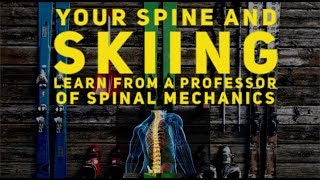
In this interview, host Tom Gellie talks with Professor Stuart McGill, a world‑leading spine biomechanics researcher and clinician, about the causes of back injuries in skiers and how to prevent and treat them. McGill outlines his three‑pronged career— in‑vivo laboratory work linking specific tissue stresses to pain, a clinical practice treating high‑performance athletes and severely disabled patients, and a research program that bridges the two. He describes the primary injury patterns seen in downhill skiing, including disc delamination and labral fractures caused by repeated high‑load flexion, and explains how nerve‑root irritation produces sciatic‑type symptoms. The conversation moves to neurogenic inhibition, where chronic back pain suppresses gluteal activation and forces the hamstrings to dominate, altering hip mechanics and increasing injury risk. McGill then details the concept of mechanostimulation: muscle adaptation requires short‑term loading followed by rest, bone remodeling needs several days of recovery, and motor‑engrams (neural patterns) are reinforced by repeated, purposeful movement. He stresses the necessity of clear training goals, appropriate coaching, and the transfer of gym work to sport, citing studies that show coached athletes retain performance gains while reducing injury markers. Practical tools are demonstrated, such as the belt‑squat (which loads the hips without spinal shear) and the ProFitter device for breathing‑controlled core stiffening. McGill also promotes his “McGill Big 3” core exercises, self‑assessment protocols from his book Back Mechanic, and a progression to Ultimate Back Fitness for performance‑oriented athletes. He shares case studies of athletes (e.g., powerlifter Brian Carroll) who returned from serious disc injuries and even surpassed prior performance, while acknowledging that not every case is recoverable. Finally, McGill describes his own aging regimen— daily core work, regular mobility, limited strength sessions, varied recreational activities, and periodic rest— illustrating how he maintains health and activity into his 60s. The interview concludes with resources for listeners (BackFitPro website, books, upcoming training summit).
Chapters
It's great to have you on the show chatting with me this morning, or it's evening for you, afternoon in Canada, Stuart. I'm a great follower and fan of yours and really appreciate all the research and understanding you've brought to the physical therapy world on mechanisms of back pain. Now, a lot of my listeners won't have heard of you before. Some will have. So can you give them some context of who you are, where you came from, and why you got into understanding spinal mechanics? To the level of being one of the best in the world.
Good morning or good evening. First of all, Tom, I will say that my father first emigrated to Australia in 1946. So I could very well have been born Australian. But I said to him, why did you ever leave? And he said, I just got fed up of beautiful women and beautiful sunny weather every day. So he came to Canada to Four Seasons. But nonetheless, I was a professor of spine biomechanics at the University of Waterloo for 30 years. And during that time, I ran two different laboratories. One was an in vivo laboratory where we took real spines and created the injuries and created a one-to-one match between various sorts of physical loads and repetitions and durations, et cetera, and very specific types of tissue damage. And then we would bring them full circle through to real people in the second lab, which was an in vivo lab where we would take real people and use various forms of instrumentation to measure the stress stress shared among the tissues of their back. And then we were able to link very specific types of tissue stress with pain. The third element was we ran a clinic and we would specialize in very difficult backs, not the easy ones, but the two ends of the spectrum, very disabled people, but also high performance athletes. And when you think about it, they're very similar. In that you're dancing on a knife edge. There's not a big margin of safety. Obviously, if the person is very fragile, they do the slightest little thing and trigger massive back pain or leg pain. They have to stay within that very narrow envelope until we address the triggers. And the great athletes as well, they push their bodies right to the biological envelope. And of course, if they make a mistake and cross it, they get injured. But for the average person, it's, it's interesting what has gone on in the last 20 years. We now have people who will sit at a computer for 8, even 10 hours a day when you count TV time and that sort of thing. And then they go to the gym and train. Or they'll hit the slopes on the weekend and really have fun pushing that envelope. And interestingly enough, the adaptations that are occurring to their body due to their chronic work exposure, which is passive sitting, is setting themselves up for certain types of stress concentrations when they go to the gym for an hour. It's almost a perfect storm. But, uh, anyway, And that's what we spent 30 years doing. And now, you're actually in the headquarters of BackFitPro, which is a clinic in my home, and I still see mostly athletes here.
Yeah, and what sort of, can you give an idea to the listeners of the level of athletes that you have sort of dealt with in the past, in all realms?
Yeah, around the world, hundreds of Olympians. I've consulted with many countries and programs, many national sport programs, the professional sports around the world, the American sports. I've consulted with Australian rugby, for example. I've done a little bit of work at your AIS. Yes, in Canberra. Yeah. Uh, what else now? Uh, then there are the sports that are neither Olympic nor professional, things like powerlifting. Uh, some of the top record holders in the world didn't have an easy pathway there. Uh, I, I've seen quite a number of them, a lot of fighters, the MMA people, uh, which is a sport that's really come along in the last 10 years. So I have seen, I would say, pretty much the spectrum of athletic competition in here because I'm just the back pain guy, but have specialized in taking the painful back and restoring performance.
Yes. Yeah. And so with If we go on to skiing, more looking at skiing, what mechanisms then, because this is your area of expertise, what mechanisms of back injury are skiers more likely at risk for?
Yeah, well, there's a cluster of injury pattern around every sport, and when you've been around it for a while, you realize and are able to pick out the patterns or clusters. Downhill steers broadly fall into two categories. One that has been instigated by a crash. So heavy ballistic trauma, we see spine fractures occasionally to the neural arch, but more commonly in the front of the vertebra, what we would call a labral fracture. For example, I've had to very high-level cup downhill skiers with that kind of a fracture, which is really a very ballistic flexion type of injury. And sometimes that will go along with the disc herniation or disc bulge, for example. But I'll— well, why don't we just show that right now? Yeah, you can just bring the camera in a little bit closer. Closer, you can see right down in the middle of the vertebra is a gel if it's healthy. And then when the spine gets exposed to compression, you can see the disc squeezes just a tiny little bit, which pressurizes the nucleus inside. Well, that's fine. That's quite a healthy thing to do. But if you repeatedly flex under high load, eventually the collagen fibers— you see, this is not a ball and socket joint, falls into the category of an adaptable fabric. And if I wanted to work the fibers loose in a fabric like my shirt, I would create stress-strain reversals back and forth, and the fibers would slowly— at least not the fibers, but the ground substance between the fibers would get a bit loose. And allow delamination. Well, the key here is that you're containing a pressure within the nucleus, a very, very high pressure. And if the person was to keep flexing the spine over and over again, probably through poor training, you can see that little red mark, which is a delamination pattern in the back of the collagen.
Yeah.
Watch what happens when I pressurize the nuclear gel And squeeze. Oh, did you see the gel come out?
Yes.
And that's a lateral nerve root. Now if it goes down the sciatic nerve, the people will experience numb feet or toes or hamstring muscles. If it's in the femoral root, which is this one, they would get pain down the front of the thigh or around in the anterior hip. Speaking, that is a pattern. There are many other pathways to create the disc bulge, by the way, but that is one. But then things become a bit problematic because the nerves— do you see how they floss up and down through the spine with various hip movements and leg movements and neck movements and whatnot? So that's why some people with a disc bulge, uh, that bulge will friction the nerve root. So when they do this, that might cause their low back pain. They might extend the leg or try and tie their shoe and they get a sciatic symptom. Um, that's usually associated with discogenic disorders. So that can occur from a crash.
Yes.
Most likely that occurs in the gym. They sit all day.
Yes.
Sitting isn't a problem.
Yes.
They go to the gym and create that delamination and then sit all day. All of a sudden they made sitting painful. You see, it was a behavior and probably disrespecting that cumulative trauma pattern in the weight room. So they were perhaps doing power cleans or deadlifts or some exercise like that without sufficient discipline, and they allowed or created some delamination to occur. And then, as I said, sitting for a long period of time, you know, they might say, well, after 20 minutes my toes go numb. Well, had they not created that delamination, they would be much more resilient. So that's one pattern, and the lesson there is everyone has a finite biological capacity. Now, you can have poor posture and poor movement and train and get strong, no question you will, but what you're building is more miles on your body when you don't need to, and sooner or later that accumulation will reach the tipping point now, so it becomes painful and obviously disabling in some people. So that's a start. In terms of skiing, probably the weekend warrior skier thinks they will be a better skier by doing more deadlifts and squats and that kind of thing because they recognize the sport demands that kind of hip strength, leg strength, and athleticism, and having to tune stiffness to ride the moguls. And if they want to be competitive, of course they have to tune the suspension in their lower body to accelerate out of a curve and all the rest of it. Well, what happens when you get back pain, at least in quite a number of people, there's a phenomenon called neurogenic inhibition. And we were— this is well known in the knee, for example, people with chronic knee pain, not all, but some tend to get inhibition of the VMO muscle. And then so some therapists will measure this recognize it and do targeted exercises for that. But we were the first to measure neurogenic inhibition of the gluteal muscles. So this was proposed by a Czechoslovakian neurologist named Vladimir Janda. And he said, well, with chronic back pain, you tend to use the gluteals less, they're inhibited, therefore the hamstring muscles take over. Well, what's the problem with that? The problem is severalfold. First of all, when you become gluteal deficient and hamstring dominant, as a sequelae to pain, the hamstrings, their line of action, if you extend with the hamstring, tends to push the femoral neck into the anterior part of the hip joint. So as you start to do a deep squat, they will feel a hip impingement sooner in the descent. Whereas when you become gluteal dominant, the line of action pulls the femoral head off the anterior labrum of the hip so they can squat a little bit deeper. So if I was doing a goblet squat, for example, side to side training, carving turns around the gates down the ski slope, the more gluteal dominant I could become, the less the knee load which is a very good thing. Yeah. And you're also sparing the anterior labrum of the hip joint. So these are subtle mechanics and of course a person's personal anatomy when it comes to their hip joints, et cetera, matters. So the deeper the hip socket, the more important the phenomenon that I just described is. So those are several thoughts. Another violation is when we train, we don't become fit while we're training. And a lot of people don't realize that. So they think training harder and more often is better. But what the training does is it stimulates adaptation. The adaptation takes place when you rest., and you fuel the system when you eat. So this, that would be another common training flaw.
Could you give it, like, say how that would look? So say you went to the gym and then the next day, how would you break that kind of rule? Could you like put that in a bit of a story?
Say over a, yeah. Absolutely. Boy, I could give a whole week. Yeah, stimulation. But let me draw a contrast now because of the popularity of bodybuilding techniques in the gym. So if you go to the normal gym, you'll see most people doing bodybuilding exercises, not exercises for true strength or motor patterning or or things like that. It is bodybuilding. Well, when you, when you analyze the goal of the bodybuilder, it is to hypertrophy muscle. So what they do is they train one day, which tears down the microstructural level of the muscle. It tears down the fibers so that the next day is the rest day. You rebuild those muscle fibers and through various systems, the muscle grows because that's what they want. They want a hypertrophy muscle. But let's look at someone like a powerlifter, for example, who must adapt to bone. If you don't have strong vertebra, you know, I've got some athletes who pick up over 1,100 pounds, if you can get your brain around that, or close to 500 kilos. Yeah. Squat 500 which is like having a car on top. And the stress on the bones, there's microfracturing that we've measured that occurs just underneath the end plate of the vertebra. Well, is that a good thing or a bad thing? Let's get back to the discussion of mechanical stimulation. It's a good thing if you're a powerlifter who trains a heavy squat squat day or a heavy deadlift day and then takes 5 days off. And the great ones, that's how they train. So if you're going to squat 1,000, you can't train like a bodybuilder. That's the problem when people try and adapt connective tissue and bone and whatnot with a bodybuilding regimen. So the whole programming now has to change. So there's an example I can talk about bone callusing mechanisms and that kind of thing if you like, but generally it's a much longer turnover rate than hypertrophy in muscle.
I guess if, if, yeah, the moral then for, say, our, our sort of keen skiers out there, even our athlete skiers in the gym, how would you sort of look at that in terms of they need to to look at the goal of like adding some load to create this mechanostimulation and then respecting like what's the kind of timeframe? Is it like 2 days, 3 days? Like, like what would you— Yeah, yeah.
It all depends because I need to know their age. I need to know their training goals and that kind of thing. For example, if I say to an athlete, well, what's your training goal? What are you trying to achieve in the weight room? And you'd be amazed at how many of them cannot answer that. So they're not training to create specific adaptations. So, um, A, they never get really robust injury resilience, nor do they achieve their high performance. So, uh, to use an example, I'll just describe bone callusing, for example, which is what we would have to do with a back-injured powerlifter, for example, who had an end plate fracture and subsequent broad-based disc bulge or something like that. When you bend the bone, this surface, the tension surface, uh, would be on this side and the compression surface would go on this side. Well, it's the property of a piezoelectric crystal to build a charge where it's stressed. So if you take two pieces of quartz rock and sharply rub them together like that, when it's dark, you'll see flashes of lightning go through the rock. That's the building up and the liberation of a charge as the crystal bends and then restores back to neutral, unloaded position. Your bone is a piezoelectric metal, believe it or not, with crystalline structure. So when you bend the bone, it builds a charge in the location of the highest stress. Well, this now stimulates what's called Wolff's Law. The bone remodels itself based on the chronic stress. So a skier bending certain bones, the classic one would be at the top of the ski boot, for example, you're creating bending stresses and you're actually building bone. Around those regions. But here's the rub: the piezoelectric charge sucks in free ions of calcium and magnesium that are in the plasma in the blood, and there's a chemical bond now as they add these building blocks of bone. But if they then train 2 days later, those chemical bonds haven't scaffolded yet. They're still weak. So they stress the bone again and they break off what they just bonded. Over the 5-day cycle, those new ions and new bone material scaffold right in and now they're built. So now if you train 5 days later, once again, you keep the bone, you scaffold it, and you add even more. So this is how we rebuild damaged bone in athletes. Well, me being a spine guy.
Yes.
Yes. But, you know, if we were building back muscle, now we have a different kind of athlete or a different injury history, then of course, it's a much more frequent cycle. Now, for building motor patterns, which is called the engram. So, you know, as an athlete and a coach, when you're trying to coach a new movement skill, interestingly enough, you're recording that through repetition in the brain. And the more load that you use, the stronger the representation in the brain of that movement. That occurs while you're training. So I've just given you 3 different forms of mechanostimulation. One is immediate. Yes. One takes a couple of days, muscle. Yes. Takes 5 days, which is bone. So you see, you've got to know your stuff a little bit. Yes. To know how to address specific deficiencies. But it all comes back to that question.
Like, what are they trying to achieve? Know your goals.
Yes, yes, yes. If I can just go on and finish off your question, because it's a good question about skiers. I'm going to talk about what happens to a joint when it gets a bit damaged. So I'm going to show L5-S1, L4-L5, and L3-L4 spinal discs. Everyone's familiar with this lower part of the lumbar spine. This joint here has been damaged a bit with a little bit of a disc bulge and an end plate fracture. But now watch what happens. It loses its stiffness. So when I bend the spine, do you notice that the normal joint hardly moves?
Yes.
Normal joint hardly moves. But look at the motions that are taking place around the joint that has lost its stiffness. So you can imagine an ACL deficient skier, you do a drawer test. And they have much more shear instability in their knee. Yeah. So that's what spine instability looks like. Well, there's several issues with that, but one is this, and it's not talked about very often. When the body detects an unstable joint, it will not send full signal, full neural drive, or full nerve impulse, or full strength, whatever wording you want to use. It puts an inhibitor on. So if the spine detects that— sorry, if the brain detects that instability, not only is that instability triggering pain, that's one pathway to pain, but a second one is it's now inhibiting strength. So the athlete could make up for that instability by appropriate muscle bracing strategies. That might be an abdominal strategy, it might be a thoracic compression strategy, it might be a breath-holding strategy, whatever it happens to be to try and add sufficient stiffness to that joint, and then all of a sudden now the brain will send full neural drive and restore, uh, athleticism.
But, um, you know, talking about squats and, uh, yeah, say we're back in the gym with this person, the, you know, they're trying to do some training to get ready for their upcoming season or stay fit. Can you talk us through, you know, transference? So whether the squats with a, with a plate on their back, or if there's other ways you could look at training leg power?
Yeah, I can Can I just divert this, Tom? And I hope folks appreciate this. My daughter has to go very shortly. She's just going to move the camera around. Yes. If I can just introduce the belt squat. Yes. Then we'll come back and discuss transference. So let's stay with the question. It's a good one. And I'll just talk a little bit about alternatives to squats.
Perfect. Yeah, that's, I think, what I was asking.
Yeah. Unplug the earphones here. Yes. So we're just going to travel through the BackFitPro HQ here and out to our different machine section. Excellent. Back doing squats and developing the horsepower I need to be a great skier, I cannot get into a full skier's tuck. Big bar on my back, it's not possible. I would, something in my back is going to break. What we use is the belt squat. Now this one we call, well it's not we call it, it's manufactured by a squat max and knee. And the reason that we use this here is a lot of belt squat machines have a cable from the belt over pulley in front to a weight system, but to get into the skier's tuck and to virtually get into anything, you have to squat your hips back. Well, that produces a shear load through the cable, so the great design feature of the Squat Max is the weight you'll see hangs straight down, so I can then take this— I can descend now right into a skier's tuck and I can squat out, squat back and up, and then there's no shear load. That load stays right down through Yeah, fantastic. And we use this for a lot of back-injured athletes who work very hard to develop the athleticism in their back, but when it's compromised, we don't want them to lose their hips and knees, so we can preserve that and unload the back. It's a fabulous training tool.
Um, before we lose your daughter, is there anything else out there you wanted to maybe show that would be ski—
yeah, applicable? So we were talking about some of the neural programming for, uh, skiers. So then if that's part of the training goal and When I was talking a few minutes ago about what is the goal for the athlete, it helps us to organize the training cycles as well. So we might go into a bone callusing training cycle for a few months. Yeah. And then out of that, we will then start to add some of the neural programming and that kind of thing. So it's a very well thought out progressive program, but we'll just tilt the camera down a little bit. There we go. Familiar with the ProFitter. So I'm just going to start it off now, and I'm going from side to side, and I'm not the world's best skier, so forgive my technique.
That's great.
Now I'm going to pressurize so I can control my breathing. I'm, I'm controlling my hips, my knees. I'm not getting too out of alignment, so to speak, which would cause stress risers, which is okay to do, but you're putting a lot more mileage on your body than you need to. So there I can start to tune the stability mobility through the linkage to re-groove that in the skier's brain. In any case, we'll just let Sarah go here.
Perfect. Thank you, Sarah.
Much, sweetie. Okay, bye now. Okay, there's a little personal break, but we'll get back to— you were asking about transference?
Yes. Yeah, sort of, I guess LinkedIn, if you want to tie off what you've just shown there, I think it may be I, I certainly see some skiers not really linking what they're doing in the gym to actually what's going to help them out on the slopes. Even the, like, the engram movement pattern training you talked of, um, the sort of— yeah, I guess they miss that link.
Yes, it's a very important one, and as you know we try and create an evidence foundation for all of our opinions. And quite a number of years ago, I couldn't find any studies that would document the transference. A lot of people would, would claim transference from the weight training room to whether it be the rugby pitch or whatever. But it was, it was very hard evidence to find. So we did several studies. One study was done with the Pensacola Fire Department, actually, and we spent 2 years with them. What we did, we had them do different exercise types. So one would be they just fitness trained, they were shown how to do more reps and that kind of thing, and they got strong and, and whatnot. However, when we measured them going back on the fire ground, doing things like, um, uh, using a ram to knock down a door, that's what firefighters do, or to chop a hole in a burning building, or to advance a spraying fire hose with the water reaction, all very, very physical tasks. They had more movement flaws after that kind of training. The second group were coached by EXOS coaches. And I don't know if you know the organization EXOS, but they're very, very highly trained trainers. So they will explain frontal knee plane deviations, for example. So if you're pushing a sled, some people will let the knee collapse into a valgus collapse. Well, we know that's a marker for ACL injury risk, for example. Um, so they would do some correctives and then coach the movement. Uh, we might look at certain kinds of spine deviations, for example, under high loads, which we know are related to certain types of disabling back injuries. Nonetheless, they were very well coached, that second group of firefighters, when they went back out onto the fire ground and retested. Now, we didn't coach any fire ground movements. All we did was coach and describe in the training room. They went back out onto the fire ground and retained all that they had learned with much fewer injury markers. So that was the first study that I know of that showed and documented the of good coaching. So the bottom line is, you know, you and your contribution to your athletes is really important. Good coaching really, really matters. We documented that, but we did other studies over the years. For example, we would take groups, and I'm thinking of one group, a group of hockey players, who hockey players typically have stiff hips. So we started out with a training study study where we did 3-dimensional hip stretching, then another group did just core stabilization, and another group did core stabilization plus 3-dimensional hip stretching. Yeah. See what was better. Yeah. Interestingly enough, all of those techniques worked. Wow. Slightly more than others, but, you know, a good 3-dimensional stretcher, and if you lock down the core— yes— and put more motion into the distal joints, you will achieve more motion. But yeah, once again, before those trials, we measured those hockey players doing sport moves, you know, running, walking, getting out of a chair, and all this sort of stuff. Yep. And then after the stretching trials, we measured them in their normal daily movement patterns. Again, even the ones that pushed their hips. Now, now here's the critical question. Do you think getting all of the new mobility, and by the way, we increased their hip mobility from the 5th percentile to the 75th percentile. Magnificent. So the physios who did that, it was run by Jan Morside, who was a physio who did her PhD with me. She took them from the 5th to the 75th percentile, but then she remeasured their daily movements. Do you think they changed? Yes. Yeah, they did not. Really? No. So people sometimes, you know, think of this. I would forget my eyeglasses and I'd watch my kids play in various sports teams, or I'd be working with a 14 and I didn't have my glasses on and I couldn't see the names or numbers or facial features of a player, but you know who the player is by the way they move. Yeah, correct. Yes, correct. Someone walking off in the distance, you can't see them, but you know who it is by their gait pattern. Yeah, that pattern is wired in there. And so, you know, people think, oh, I'll do this and I'll reduce the risk of injury. No siree, Bob. Complicated than that. So that's where the coaching comes in. You can change the physical fitness variables, but they don't transfer until you actually coach them. So there's two fairly powerful studies.
That's a bit— that's fantastic.
Yeah, in proving that it is the coaching skill that transfers Furs and changes, uh, really you're changing athletic behavior. Yeah, changing it to reduce known injury mechanisms and enhance performance.
Yes, yes. So there's got to be these, all these components. Yes, get the body being able to hold stiffness, move at the hip joints, move at these, these joints, but, but then you've got to have someone show you technically how that transfers through to whatever activity, whatever day-to-day thing they're perhaps putting themselves at risk at, that you've got it. Yeah, that's the critical part.
The, the coaching, um, styles and cues. Generally speaking, coaches treat athletes like 5-year-olds. The great coaches give them a lot of responsibility, but they also explain what it is they want. And oh, the stories I could tell you. But you know, there's a— just as an example, there's a recognized as one of the best MMA fighters in the world. And I was with them and I don't have good skills. I'm not trying to say I do, but I have very moderate ones that I like to have a little roll with these guys. And we're training a bit together, and I said, okay, try and get an arm bar. And I thought, there's no way he's going to get an arm bar. And I had my arm braced, and he had it in 3 seconds. Okay, what did you do? And he said, well, the first thing I did is he said, I dug your liver reflex, and I brought my elbow in, externally rotated my arm because he was gonna you know, yeah, yeah, gave him my arm and said, I let you exhale, and he snapped his hip under and, and got me. The point in all of that is, um, this is very sport culturally, culturally within a sport. So in MMA, as an example, the great ones will give you a medical textbook description of why they're doing something, why they're taking an angle. They're working on a nerve or a vulnerability in the body. Absolutely brilliant at it. And that's the culture of their training. And then they drill and repeat them 1,000 times slowly, and then they speed it up and speed it up. And then, you know, they get sparring partners to give them different pictures and patterns. But the, um, brilliance that they have is absolutely fabulous. And then you go to another person in the NBA basketball and you say, well, how do you dunk a basketball? And they just say, well, you know, I don't know, I woke up in the 10th grade and could dunk a basketball. You have to break it down with them. Yeah. If you can do it with that style of coaching, which is very different, you can get to the answer. But they don't. Think that way sometimes. So yeah, anyway, it's, it's a lot of fun.
Yeah, great. So then on to, I guess, my question to you. When we've chatted about this off, off the, um, recording before, but skier comes to you and you mention something about— you ask them, they, they must know their goals, and if they can't explain it, and you said something about what the coach, maybe that's not the right coach, and do you want to speak to that part at all? Because I think that links to what we're talking about.
Yeah, it's a great question. Obviously, why they come to me is because they have a back issue. So they're not coming to me because I'm the world's expert in their sport. So obviously, I know a little bit about a number of sports, but there are some sports where I don't know that much about. So the first thing I do is I sit down with the athlete and the coach, or there might be a team of coaches, you know, there might be a strength coach, a technique coach, a mental training coach, etc., etc. We sit down and I say, what What are the variables an athlete needs to be the best in the world at this? Write it down. Now, do you know that some have a difficult time answering that question? And that's when I say, if they can't answer the question, if the athlete doesn't know what they need, they need a new coach. So we then sit down and say, okay, well, I don't know, maybe they want to be a powerlifter and a deadlifter, take one example. Well, they need good hand grip because if they don't have good hand grip, they'll be going into over and under far too soon and compromising their back with asymmetry when if they could get a double overhook, you know, they would equally distribute stress and pull back and that kind of thing. So they need that, they need tight hamstrings. Tighter hamstring is a stronger hamstring for a deadlifter. Is it what you want to be a gymnast? No, it isn't. But that particular sport, you want tight hamstrings. Um, you need big stiff feet. You've got to be able to dig the toes and the heels and make the foot as absolutely big as possible would be another one. Um, gluteal drive, all of these things. So those are some examples. And then I'd say, okay, those are the things that a person needs to be the very best. Then I go measure them in the athlete, and if they can say they need— we'll prioritize 8 athleticisms. Say they have 6 of them. So now I say, well, there's no point in training those 6. Let's train the things that matter. And by the way, you have a back that is underperforming, and here's what my expertise is bringing to the table. You're going to do We're going to add C, D, and E. Yes. And then that becomes the program. And I then say, okay, what is— what's the very best tool to train what you need and you don't have? Is it a squat? And then they'll say, oh yeah, it's a squat. I'll say, wait a second, you're telling me the only tool you have in your toolbox is What about a belt squat? How about this? Let's go outside and push a car back and forth in the parking lot. That will make you a better athlete. It will unload your spine. And we've just increased our, our tolerable training capacity. And they'll say, oh, well, you know, they hadn't thought of that. So again, I'm starting to wonder, do they really have the right coaching staff?
Yeah. Yes.
Yes. Involved there because A, they don't even know what they're training, and B, they don't have the, uh, breadth of training tools to achieve all of those kinds of things.
So, uh, now do you think we could then steer this into the skier and your thoughts on, uh, because I had a question for you about if, if you watch even the high-level athletes skiing, you know, Mach 10 down a racecourse over bumps, sharp, you know, forces around on icy snow, their spines never are neutral the whole time. They deviate, they rotate, they laterally flex, they flex, they extend. So if a skier has that going on in their spine, what considerations are there? And then also, do you want to maybe speak to what you might see in the best skiers, perhaps, in their spines?
Right. Well, again, you're asking fabulous questions. Generally speaking, and a rule of thumb, is the higher the level of the athlete, the less the spinal deviations. Now, we could take tennis. As an example, the great ones use their hips and shoulders. The second best use their spines. We could say that about, uh, well, I did publish a study in powerlifters, for example, those who lift closer to the world record have more hip load and power generation and less spine load and power generation. In other words, it's hip-centric. And, you know, you go through different sports, a good hip trumps everything.
It means all the other joints.
Yeah. So now let's, from that foundation, let's take that concept on and apply it to skiing. And I would say the top skiers have less spine deviation.
Yeah, the guy, the world number one, he's amazingly not flexed. Not laterally flexed, not rotated. He's this Austrian short, very rigid spine.
Well, it has to do with what we call energy leaks, for example. So I'll give you an example of an energy leak in the shoulder. If I had a great big bench press muscle, my pec major, say I could bench press a couple hundred kilos, the pec muscle crosses the ball and socket joint. So distal to the ball and socket joint, it flexes my arm and allows me to push. However, the proximal side, look what it does. It bends my rib cage towards the joint. It collapses. So do you see on one side it's what we want and on the other side it's an energy leak. Yes. Don't do anything. So if all you have is the, is the muscle crossing the joint, You've just leaked all the energy away. So if I can proximally stiffen my core, 100% of that muscle activity is now directed distally. So now let's go to the ski example. Every time I create hip extensor power, those cross the hip joint, connect the leg, the femur, but also to the spine. So if that muscle is bending my spine, spine lost the ability to direct more power to bend the femur. It's the femur that drives and tunes the skis. Yes. So it's a pure energy thing. So not only does it go along with higher performance, it also goes along with injury resilience. So we can all take a spine and bend it around, no problem. However, putting on more miles So what I would do then to measure is that athlete resilient to getting heavily deviated, because some skiers just have this, you could call it an undisciplined style, but it's a style that's worked for them. I would put them in a standing posture and put a bar across their backs, just say an unloaded Olympic bar, so 20-kilo bar. Yeah. Pelvic tilt back and forth. Just move your spine, stay upright, but move your spine. Do you know that in 10 repetitions, some of them will say, whoops, there's my back pain. Yeah, yeah, just found the mechanism. So I can do that with several other tests as well and prove to them very quickly that they are now putting a lot of miles on their back or whatever joint is compromised with, with undue stress. And that it's then a matter of working with the technique coach to clean up that pattern, make it more hip-centric. My job will be to build their hips and back. Their job will be to create the engrams of a little bit more spine-conserving ski style, which, damn it, gives them more problems. Yeah, this is the sweet spot that, that, you know, there's a few guys who do my job, and I think they would be a little bit better if they, not only while they were dealing with the orthopedic issues, but if they just knew a bit more about the sport and went through this formal process. What do you need to be the best? Yes. And let's train. If they went to that level, they— I think it would propel them with their success just a little bit more.
Yeah, fantastic.
I think there was one analogy, uh, you gave, uh, with rock and rope to do with the, the spine and the Yeah, the spine is a flexible rod, so no engineer would take a flexible rod and ask it to bear compressive load. So the analogy there is you cannot push rope, you can push a stone, and the great athletes create hammers and stones. So in a skier, a skier punching out of a mogul, for example, the hammer is the hip and the stone be a stiffened floor. So if the hammer hits a rope and the spine collapses, they just lost speed, and B, they just created a stress riser that your spine will take a few but not too many.
Yeah, yeah, that's a great analogy, I think. And you even mentioned something about the frogs being able to jump, and, or is that, that's more to do with the breathing?
Into issues of breathing. Uh-huh. This cylinder around the spine, if you pressurize the cylinder, you can make it stiffer and more load-bearing. Or in terms of performance, power developed in the hips going through a rigid cylinder can express out the shoulders without an energy leak. So if you want to jump really with the greatest result, don't— well, you'll find that you have to hold your breath. It's, you know, Venus Williams grunt when she serves the tennis ball. Yeah. As it locks down her core, it's called active expiration. It stiffens the intercostals. And it forms a mechanical composite. Oh, the lectures I could give on a piece of wood. Yes. What's a good Australian wood? Oh, what's that?
Huon pine. Huon pine.
Yeah, I remember that wood from Aussie. If you take a Huon pine board, you would measure its strength and stiffness stiffness. But if you then cut that board into thin layers or veneers and you took one layer and then a layer of glue and then you'd run the cross ply on the next layer, in other words, you'd form plywood. Yeah. You added more wood. Yes. Then measure the— so the weight doesn't change. Yes. Now measure its strength and stiffness and you'll find out it's much stronger and it's much stiffer. So we call that super strength and super stiffness. The body forms composites. The oblique muscles, we have the fascia, external oblique, internal oblique, transverse, and fascia between, anchored with—
like the plywood—
form a mechanical composite. So just like I said, this is an adaptable fabric. This is biological material science. This forms now a mechanical composite. And, uh, when you form the barrel, you know, try and, uh, suck in air and squat heavy at the same time. You can't do it. Try and sprint while you're laughing. You can't do it. You have to get a serious game face, lock down the air. And as you know, the great sprinters, they take two little sips of the air, maybe Some don't breathe at all because of the energy losses in their core while they're sprinting the 100 meters. Some will have a little sip at 60 meters. That's it. Or you might take an Olympic lifter. So they're doing a clean and jerk. They've done the clean, boom, and then you'll see them, they're weighing the bar, feeling the elasticity, and they might sip the air. But if they let air out, Yeah, yes, yeah, that much load. Yeah, so getting back to your frog jumping example, yeah, it's well known before a frog jumps it fills its lungs with air, closes its glottis, and fires the, uh, the hammer. Yeah, their magnificent leg structure, and hits a stone which is the pressurized core. Yeah, so, you know, our blow out all your air and then get hit. Yeah, see how you enjoy that. Yeah, yeah, you get stiff, you take in air and you close your claws.
Yeah, yeah.
So it's enhancing and increasing your resilience.
Yeah. And then I guess in the sport of skiing and say taking different types of skiing— mogul skiing, downhill racing, slalom, short turn— the the different variances, that there's got to be moments or timing where you, you are needing the stiffness, and then you're needing some suppleness to allow some fluidity and change of positioning before you need to, to stiffen again. So there's— that would be a difference, say, to the weightlifting room, where it's like as as you're with the, the weight is on you and you're lifting it, you do not change the stiffness really at all. But skiing, you're sort of on, off, on, off, on, off for a bit.
Would that be correct? Absolutely. It's a variable suspension system, so you're tuning the suspension all the time. How do you tune suspension? Well, when a muscle contracts, it does two things mechanically. It creates a force. Everyone realizes that. But the second thing it does, it creates stiffness. So try and punch someone really hard using a lot of muscle. You can't do it. I can't move. Yeah. You pulse and then you boom, you let it go. So what we measure in the great athletes are the pulsing and the tuning. So now let's consider a neurological tuning exercise like a foot ricochet. Remember that nervous kid in high school who would sit beside you and drum his foot on the floor like this? What they were doing was tuning the stiffness to create a resonance in the ankle. So if there's no muscle activity and if they popped their foot into the ground, it wouldn't store any elastic energy. And if they over stiffen it, it's like hitting a piece of steel. It doesn't bend either. But when you make it compliant, just the right amount of elasticity, and you do that by muscle tuning, maybe it's 30% of neural drive. I don't know. Now you store and recover elastic energy and I get a beautiful little bounce. Well, that's what the great runners use and it's what the great skiers use. In the full suspension system of the ankle, the knee, and the hip. But if there's another soft spring sitting on top of that, A, they're creating tremendous stress risers, and B, they're leaking far too much energy through the wonky core. The knees and hips are made to be tuned, and that's the magic. So a stiffening exercise would be skipping. For example. So you jump rope and then you do doubles. Yes. All kinds of things. Or you might just go down onto the belt squat machine into the tub. Now this, by the way, is very taxing of the body, both neurally and mechanically. So this is all very low volume exposure training.
Yes. Yeah.
Okay. You know, it might be something to do in some of the final phases preparing for the season. I wouldn't be doing that too soon.
I, you know, got it. Yeah, that's— yep. Okay.
Get all the base strength done first.
So that probably leads us maybe to some wrap-up questions. A lot of my listeners, there's some people on the professional end, others just love skiing, and if they're dealing with some back pain problems in skiing, or even if they're wanting to be proactive, hopefully after this talk, realizing there's some proactive stuff, what can you recommend? I mean, I, I've read the book Back Mechanic. I thought it was fantastic. It was gifted to me, and it's, uh, that's what led me to, to seeking you out. Do you want to talk to, talk to those people and give them some advice?
Yes, I would love to. Thank you. For the people who have back pain that is inhibiting the joy in life, I wrote a book for the lay public. I have a copy here called Back Mechanic. It is available in a Australia, by the way. So if you go to our website, backfitbow.com, you can order this through the American— sorry, the Australian distributor based in Sydney. Yes. Or you can order it right on Amazon. And usually friends in Aussie, I know people get together and they buy a few copies and ship them that way. But we do have an Australian distributor. Nonetheless, I wrote that the lay public with back pain. So it guides you through a self-assessment. There's no such thing as just nonspecific back pain. Could you imagine if someone said, oh, I have nonspecific head pain? It doesn't exist. There's a reason why you have it. You need to figure it out and treat it appropriately. So back pain is exactly the same and it guides the people believe it or not, better than an assessment than they would receive from their physician. Mm-hmm. Because they'd only get 2 or 3 minutes and then probably a pill because the physician doesn't know what to do with them. So it guides them through 9 tests to get an idea of what's causing their back pain. And then the first job is to eliminate the cause. So it might be because they're sitting at a computer for 8 hours a day. And then they go and do 30 burpees at the gym at night or whatever. I— yeah, yeah, but they're creating their own misery. So we show them how to stop the cause once we've identified it, and then it's a matter of— we were talking about transference— performing what we call spine hygiene throughout the, throughout the day according to whatever your pain trigger is. Then we respect the laws of the linkage. You can't argue against the laws. You can't even— if you didn't have core stability, you couldn't even walk. If you've ever seen a child who has a neurologically deficient quadratus lumborum, for example, their whole pelvis falls to that one side as they walk. So you need a certain tone or stiffness just to be able to walk. Well, if you're skiing, you know, the requirements suddenly went up. Yeah. If you push someone on a rugby pitch, of course. So we then build the linkage in a way that respects their particular category of back pain. So we're known for what's called the McGill Big 3. 3 exercises, for example, and where they came from was we measured how much stability was created, what was the load on the spine, etc., and we kept coming back to those 3 exercises. So a form of the bird dog, a form of the side plank, a form of a modified curl-up or a front plank restorative or the pot are all variants to create both mechanical and neurological proximal stability. And then depending on other factors, you might need a little bit of ball and socket mobility, both of the shoulders and the hips, but you want to do that in a way that doesn't create more soreness. You want to do it in a way that that is creating more resilience. Yeah. So that's the first book. And then, uh, that's designed to get people out of pain. If they want to transition to performance training, they, they enjoy life and maybe they just want to go for a bushwalk or maybe they want to ski. Uh, we would then transition them to my next book, which is called Ultimate Back Fitness and Performance. So that was written for the weekend warrior coaches and athletes. If they're a strength athlete, I wrote the book called Gift of Injury with Brian Carroll, and his story was he had 2 world squat records and he had a terrible fracture, crushed fracture in his sacrum and 5th lumbar vertebra. But after 3 years, we show the MRs of what mechanostimulation did to rebuild his spine, and he came back and said set 2 more records after that. He squatted well over 1,100 pounds, 1,100 and a half hundred pounds. So there's a few stories like that. And then if you're an absolute geek or a medic that really wants to get into the medical side of things with all the references, then I wrote Low Back Disorders for the medical community.
Yeah, yeah.
But that's the full suite of evidence and self-help guides. So I can tell you a story about this. Yeah, there was an agent that shopped it around to the publishing houses, and the publishing houses said, you've got to have a title, Cure Your Back Pain in 5 Easy Steps. I said, that's a lie, it's not possible, I'm not going to do it. And in fact, it's 17 chapters, but it's a sequential stepwise way through, and I'm afraid it's non-negotiable to go through the various steps of knowing the cause of your pain. Yes. Rid of the cause and then building the foundation for pain-free. Yes. Yeah, this is quite a metabolism, this thing of our body. Yes. Create pain-free optimal function is something that I think maybe our grandfathers knew a little bit just from good old-fashioned force sense. Yes. And unfortunately, our technical lives have compromised a lot of that.
Yeah, change. Yeah, there was, um, one last question I have. A friend has— he's a very— he's an amazing skier, very talented, creates a lot of loads in skiing. But I can't remember how long ago, 9, 10 years ago, had a bulging disc found and some pretty serious lower back pain. And his question was, after something like that, do, do you see athletes come back to the level of performance they were before the injury?
Well, I can say in Brian Carroll's case, who I just described in the Gift of Injury, who came back even better. I can think of an Olympic weightlifter who set 3 world records, and he did not set those records until after he herniated his disc. And he says, I never set a world record until I went through disc herniation, and I learned the discipline of training well. Never again am I going to train when I'm tired or use poor form. Yes. Because it just takes— the stress risers on the tissues are just too much. So, you know, to build a race car that wins one year, then you start afresh and you build another car and you win the next year. How many hundreds of thousands of car mechanics are there in the world?
Yeah, lots.
Yeah. How many can build a race car and then another one and then another one that wins through their careers? My point in that analogy is to tune an athlete is a real expertise. You need to know the science, but you also need to know the art. You've got to be able to read people. You've got to know their psychology, their anatomy, their physiology, their mechanics, and put all that together. But if you can, I can give an awful lot of case studies where athletes have come back to be better than ever. Now, can you do that in everybody? The answer is no, absolutely not. Sure. There are some things that simply can't be fixed. Mm-hmm.
So— Great answer. That's the reality of it.
Yeah. I know myself, I've had injuries and, you know, you reach a peak athleticism and sometimes the mileage just builds up. But, you know, you see some of the master athletes and they just win on their guile and their experience. You know, it's—
Yeah, yeah, there's— Yeah, like you mentioned, the art sort of, yeah, side of things. So what do you do these days to keep yourself doing the things you love to do?
Oh, well, what a great question. I was feeling really old about 5 years ago. I've had a lot of trauma myself in my body and I needed hip replacement. I finally got it about 5 years ago, but it failed. I had terrible bone pain walking upstairs and whatnot. Would you believe last summer I had stem cell therapy, but I was on crutches for a little while and I got off all supplements like glucosamine and chondroitin and vitamin D and that sort of thing. And then I also started some Tesla coil therapy. Do you know what that is? No. Coil looks like a big MRI machine and you go in and a DC current oscillates around the coil to change magnetic flux. So if you had a magnet, north pole, south pole, flip back and forth over and over again. Tico. Anyway, so I did those 4 interventions all starting on the same week. Once I got off practice, it's about a A month later, I started walking upstairs and I noticed, you know, all my bone pain was gone and it just went. And I was back cross-country skiing, I'm riding a bike again, I'm doing a little jiu-jitsu with my friends in the gym, I'm having an absolute ball and I feel like I'm 50 once again, which is, you know, about 15 years ago now. But anyway, so as a young fella, Of course I did strength training. I really enjoyed being strong and fairly quick and that kind of thing. But now my training is to forget about the strength, just keep a little mobility and keep all the pain out of my body. So I'm going to say here's the general plan now. Yeah, in my 60s. I strength train a couple of times a week. I do, I do, I do my core work every day.
You do that every day? Yep. Yeah, every day.
Yeah. And I do a little bit of hip mobility, uh, every day. Um, and I do a little bit of thoracic spine mobility every day. I'm tending to get a little bit more kyphotic as I get older. So anyway, 2 days a week I do a little bit of strength training. 2 days a week I spend a little bit more effort on mobility. 2 days a week I try and do something completely different. I might go for a bike ride, I might go for a cross-country ski, a swim, depending on what season season we're in here, but I really enjoy being outside, and it's seasonal as well. I might really have a heavy day of splitting firewood. Yeah, I'll make sure— I used to just do it till it was done. Yes, I always take a day off in between. Right, you get smart too late, too soon. So there, there's 6 2 days to strength train. I do my core every day. Yes. 2 days for focus mobility.
Yeah.
2 days to focus on something else. And the last day, the 7th day, that's, that's really— I try and just rest. Rest. Let all the adaptations take place. And Tom, I'm feeling like a million bucks. I feel fabulous. That's great. Also, you know, I can go anywhere around the world and I have such wonderful friends, you know, I think of, do you know Pavel Tsatsouline, the chairman of Strong First? Yes, the kettlebell. He's a good friend, we have so much fun together. My, the UFC fellows, the, you know, well, I don't want to get into naming them because, but all of my friends in powerlifting and, oh, tennis, It's just wonderful. I can go anywhere in the world and go and train and have a little bit of fun with it.
Yeah, that's fantastic.
I'll be in Tawasi in February, actually. Yeah. We're coming to put on a 4-day summit of training courses.
Yes, fantastic.
I'll see a couple of your athletes then.
Yeah. Hopefully I'll see you there. I'd really like to take the training.
Yeah, well, we'll have a beer. Yeah, we will. What would be a good Aussie beer?
Victoria Bier? Well, actually, it's probably happening in Canada as well, the explosion in craft beer. So actually, there's so many good beers out there now. You probably— Life is good. Exactly, exactly.
Fantastic. I'm looking forward to it because I can honestly say I've never met an Australian that I didn't really like. You got a fabulous country and fabulous people.
Well, I'll say that about Canada. I've spent almost 10 winters, 11 almost actually, skiing over in British Columbia. And so I've— my Canadian mum and some families over there that really look after me. And I could say the same about your country. I think it's a great—
Yeah, we're both blessed, that's for sure.
Definitely. Fantastic. Well, I'm really glad we got to chat, Stuart.
And myself included, I hope that's helpful for your listeners.
Yeah, I think it will be. It was really nice to wrap up with what you do and then your views on how you're just— how a reflection on how you're living your life now really happily and fulfilling. And that's, that's a great sort of message to send out there.
So I think this was worth it. It's a much better show. Sarah was able to film some of that other stuff.
Yeah, fantastic. All right, well, thanks very much, Stuart. People can head to BackFitPro, exactly how it sounds, backfitpro.com. To find out more of the products, any more information. You've got videos on there, I know. There's a whole wealth of information. So I'd encourage people to go check it out if they're looking for some more resources in that area. But thanks again, Stuart. We'll look forward to catching up in the next year.
You bet. Thanks. Stay well.
More from Tom



Most skiers overlook how they use their poles. Try these five pointers next time you’re skiing.







