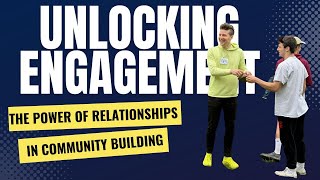
In this introductory lecture, Tom Krieglstein uses a dance‑floor metaphor to explain how personal relationships drive engagement. He argues that the number and strength of relationships, not mass‑media flyers, determine whether people move from the edge (indifference) to the center (active participation). He presents the Engagement Pyramid, highlighting the hardest transition: moving a person from a neutral "meh" state to an engaged "hmm" state. To illustrate incremental progress, he introduces the X+1 model, likening it to video‑game level‑ups where each small win (level 1 → level 2) builds confidence, whereas jumping too far demotivates. Krieglstein demonstrates a brief physical exercise (cross‑arm activity) to embody the shift from meh to hmm, and previews the concept of a "blender event"—a targeted activity designed to pull indifferent individuals toward engagement. He concludes by assigning a quiz and prompting viewers to continue to the next lesson.
Chapters
By show of hands, how many of you out there have ever been dragged from the edge of a dance floor to the center before? Okay, keep your hand in the air. If the person who dragged you is someone you knew or you knew well, it looks like almost everyone's hand is still up. So here's my question. Why is it that someone you know or you know well can literally walk up to you on the edge of the dance floor, go, you're coming with me, and physically grab you by the arm, you yank you towards the center, drop you in the middle, and tell you to dance, and you don't punch them at some point along that process. Why are they able to do that? Think about it for a moment, and if you say things like, well, we have a connection, I know that they came to this dance to have fun, meet people and dance, and they're not getting it from the edge. That's true. Or you say, I know them and I know they want to dance, but they just need the push. That's true. And it all surrounds around this one topic, which is you. You have a relationship with them, you have a connection. You've built up a connection with them, and you know that they don't want to be on the edge, that they came to stand, to have fun, meet people and dance. And so you go up to them like, uh, you're coming with me, and you take them and you physically move them to your event in the middle of the dance floor, and then by the end of it, they're having fun, meeting people and dancing. Now, take that same concept with your flyer on campus, and you again, run around campus to someone. You're like, hey, you shouldn't come to this event. We got this main thing going on. How well do you know that person? You don't even know if they're a student on campus. They could just be touring through campus as a potential student, but you just saw a warm body, and you're hoping that they show up to your event the same way your best friend would engage with you on a dance floor. So what I'm saying is that maybe it doesn't matter how many flyers, posters, Facebook snaps, whatever you send out. What matters most to engaging people on a dance floor are the number of relationships. Then what's going to matter most within your club, your organization, your campus as a whole are the number and strength of those relationships. On the engagement pyramid, the hardest step is to get someone to go from meh to hmm. Because once they go, they'll see your flyer and they'll actually show up. But if we never get them to go, they're going to stay disengaged at our campus for the entire time they're there and never even see the flyers for the events that we're hosting or give you a chance to build a relationship or connection with them. Can everyone out there quickly take your arms, cross it across your body just like this. If you have someone next to you, can you just look at them and make sure they have their arms crossed? All right, now repeat after me. It goes like this. It goes me to. All right, all together. Ready? One, two, go me to. Great. Now switch the way your arms are crossed. Whoa, whoa, whoa, whoa, Tom. Too early for this. All right, same thing, but opposite hand. Ready? One, two, go me to. Hmm. The hardest step on the engagement pyramid is to get someone to go from meh to. Hmm. From a neutral to a 1. In the world of dance floor theory, we call this X plus one math anxiety. I see it in your eyes. Video games do an amazing job of X +1. Think about it for a moment. You know, you're playing a video game and you start at level one and you have a sport and you have to fight the rabid squirrel. And the rabid squirrel comes at you and you're like. And you defeat that rabid squirrel. So the video game goes, congratulations, it's time to move on to level two. Yeah. So you get to level two, but your spoon gets upgraded to a spork. But now you're not fighting a squirrel. Now you have a monkey coming at you. And so the monkey comes charging, like, and you defeat the monkey and the video game graduates you to level three. And then eventually you get to level four, five, six, and you're fighting levels. You have the golden sword and you're fighting the dragon. Video games do an amazing job of X +1. What a video game will never do is they'll never start you at level one with a spoon. You defeat the squirrel, you get upgraded to a spork, but then jump you all the way to level 10 where you have to fight the golden dragon with the spork. They'll never do that because that's X 10. That's demotivating. And so on. The engagement pyramid, X represents what level are they at, and plus one represents the next level. So if they're neutral, we want to get them to be a one. If they're a one or two or two or three or three or four or four or five. But we never want to try and get someone who's a neutral, who's never participated in any event at all. To actually show up at our event, Start with a one, get them to be a two. From meh to and then from to. What's in it for me? Keep following this process, and you'll eventually get that person to move closer and closer to the center of the dance floor. So now we have X +1, and we know that the hardest step is to get someone to go from meh to. Hmm. So how do you do that? How do you get their attention? Well, the good news is, in dance floor theory, we have a tool. It's called a blender event. And in the next lesson, I'm going to introduce you to what a blender event is, and I'm going to show you some examples of different blender events. But before we do that, you got some work in your notebook, and I believe there's a quiz waiting for you that you have to complete to continue on. But before you do any of that, make sure you hit that. Complete and continue, and I'll see you in the next video.