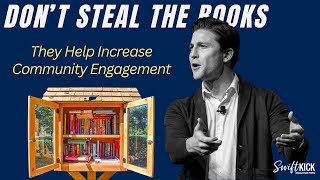
In this talk Tom Krieglstein explains his “dance‑floor theory” of community engagement, focusing on how low‑effort, high‑visibility activities—called “blender events”—can move disengaged members (the “neutrals”) from a state of indifference ("meh") to curiosity ("hmm"), spark new connections, and strengthen social bonds. He illustrates the concept with a free little library he observed in a neighborhood, outlining three core benefits: pattern‑interrupt attention, a novel way for members to interact beyond traditional gatherings, and the creation of ongoing relationships as people discuss books. He contrasts this success with a failed magazine‑exchange box he set up in a Chicago apartment building, where management removed the box, highlighting common resistance from leaders who view such initiatives as clutter or unnecessary. Krieglstein argues that neglecting these simple, low‑effort activities forfeits the opportunity to build resilient social networks that can mitigate future conflicts and improve overall engagement. He concludes by urging leaders to adopt blender events like free libraries to foster a culture of connection and belonging.
Chapters
In dance floor theory, we talk about the idea, the strategy that is needed to get the least engaged people. We call them neutrals, to get them to be more engaged, more connected within your team, your organization. Some of those strategies are us physically doing things with them. Other of those strategies are changing the environment in some way that gets them to go from meh to hmm. I was recently walking around my community and I walked past this house that had what looked like birdhouse in their front yard. It was on a pole, but it was larger than birdhouse. And as I got closer, I noticed on the side said free little library. And then inside there was a. It was a glass door. And inside the glass door was a bunch of books. And then there was a little sign that said, add one, take one. I was like, I love it. I love it. Not that I'm in need of a book, but I love seeing that this type of activity, this type of blender event, which is what we call it in dance floor theory, is existing in this community here. I looked it up online. There are tons of these free little libraries all over the country. It's kind of a thing that people do, and you can host one on your front lawn as well. It really has three major benefits for your community and your members. The first one is it gets people to go from meh to hmm, which is one of the major goals within engagement on our engagement pyramid that we talk about within day Dance floor theory is that the first step is you have to get their attention. You have to get them to go from meh to hmm. Otherwise nothing else you do is going to matter because they're not even paying attention. So I walk past this library and I go from meh to hmm just by seeing it. The second thing is it creates this way to engage with each other beyond what we traditionally do as engagement. Meaning we're not having an event, we're not sitting around the water cooler talking, we're not having lunch together. But now the community is connecting this new way through this little library where we're giving a book and taking a book. I get to see like, oh, look, that's interesting. Someone in my community has read that book. I love that book. And they put it back in there. And third, it helps to build the bonds because several times I now have walked past it and I see two neighbors out there talking about the books in the little library, and they're building connections. One was adding some books, one was taking some books. These type of activities in dancehoor theory, we call them blender events. The two main goals of Blender event are to get people to go from met, which is called a pattern interrupt. And then also to build the connection, to build the connection with the people, us to them, and also them to each other within our community. Because the first rule of dance floor theory says that on a dance floor, the more friends you have in a dance, the more fun that dance is going to be and the longer it's going to last. But if we don't get them to pay attention, nothing else we do is going to work. You know, I tried this once at my apartment way back when in Chicago. I had all these extra magazines that I had ordered and were kind of sitting around. I was like, do I throw them out? But they're kind of useful magazines because the content's still good. So I decided down in our main lobby to put up a little box and I put all of the magazines in there. I said, give a mag, take a mag. And so you could give a magazine and take a mag, thinking maybe other people would put their magazines in there. And we have this, like, exchange going on. I put it down there, brought all like 40 of those extra magazines I had built up in my apartment, put them all there in that box. I came back the next day and the box was gone. And then there was a note from the management that said, please do not put anything into the hallway. And I was like, ah, some people just don't want to build community. Some people resist it, thinking that that's the right thing to do. But the reality is by not allowing that box to be there, which I assume they're thinking like decluttering and not having messes there. I get their point of view on that. However, by not having it there, they're missing out an amazing opportunity for within the building to build the connections with each other. Social connections. And I bet had we built stronger social connections with each other next time there was friction between two members in the building, I bet we wouldn't call management. We would probably just talk to each other because we know each other. The value of building these social connections within our community are massive. And yet, unfortunately, too many leaders miss out and ignore it or forget about it or fight against it like they did with my free library. So maybe you could set up a free library in your community and that could get your people to go from meh to. To increase that engagement, to create that culture of connection so that all your people feel more welcome, feel more connected, feel more engaged. My name's Tom. I'm here to help you, to engage your.